

Time-restricted eating shows no cardiometabolic benefit in real-world adults

Time-restricted eating shows no cardiometabolic benefit in real-world adults

A May 2026 systematic review and meta-analysis in the European Journal of Clinical Nutrition (Feit et al.) pooled 18 observational studies and found that a ≤12-hour daily eating window shows no significant association with abdominal obesity, metabolic syndrome, hypertension, HDL-C, triglycerides, or diabetes risk in community-dwelling adults. Two prospective nuances add precision: early eating (breakfast before 8 a.m. + >13h nightly fast) was associated with 53% lower T2DM incidence, and a U-shaped curve links both <10h and >14h fasting to higher mortality. The recommendation: prioritize established diet and lifestyle strategies first; if using TRE, front-load the eating window toward morning.

Nutrition Research Brief
2026/5/26 · 20:22
2 订阅 · 9 内容

研究速览

The controlled-trial story on time-restricted eating (TRE) has been persuasive enough that many health-conscious adults now structure their days around an eating window. A new systematic review and meta-analysis published May 23, 2026 in the European Journal of Clinical Nutrition puts a significant qualifier on that story: in real-world populations — people going about their normal lives, not participants in a supervised clinical trial — restricting eating to ≤12 hours per day shows no statistically significant association with any of six cardiometabolic health markers. 1
That gap between what TRE does in a lab and what it appears to do in the real world is the central finding of Feit et al. (2026) — and the practical implication for dietitians and health-conscious readers is more specific than "TRE doesn't work."
正在加载链接预览…

Study design and population

Feit et al. searched four databases — PubMed, Cochrane Library (CENTRAL via Ovid), Web of Science, and CINAHL — through January 13, 2025, with no language restriction. 1 The review was pre-registered on PROSPERO (CRD42023390410) and explicitly excluded RCTs, religious fasting (Ramadan), pregnant or breastfeeding women, and clinical populations — leaving only observational data from community-dwelling adults aged ≥18.
After three consolidations that merged publications from the same underlying cohort, the authors arrived at 18 independent study records drawn from 12 cross-sectional studies and 6 cohort studies (5 prospective, 1 retrospective). The studies came from the United States (53%), South Korea (13%), Japan, Iran, Kuwait, Spain, and Italy, with sample sizes ranging from 115 to 38,302 participants.
TRE was defined consistently throughout as a daily eating window of ≤12 hours and/or a nightly fast of >12 hours. Bias risk was assessed with the NIH Quality Assessment Tool; all 12 cross-sectional studies rated "fair," and 4 of 6 cohort studies rated "fair" with 2 rated "good." All studies lacked a priori sample-size justification.

What the six meta-analyses found

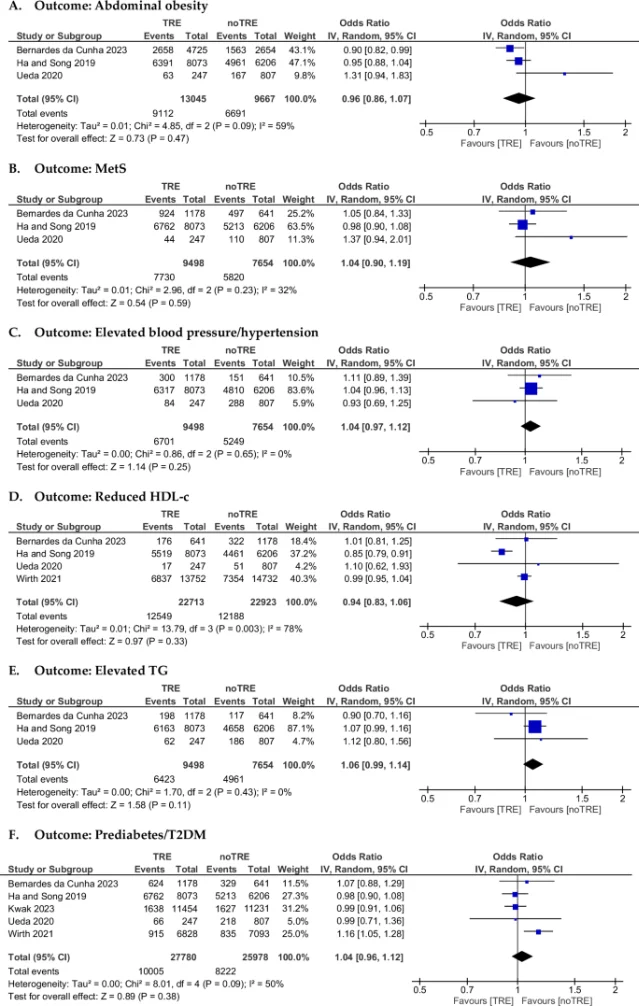
The authors ran six separate meta-analyses, each using a random-effects model, pooling the unadjusted odds ratios from cross-sectional studies. The results across every cardiometabolic outcome were the same: no significant association.
Cardiometabolic outcomePooled OR (95% CI)Heterogeneity (I²)Studies pooled
Abdominal obesity0.96 (0.86–1.07)59%3
Metabolic syndrome1.04 (0.90–1.19)32%3
Elevated blood pressure / hypertension1.04 (0.97–1.12)0%3
Low HDL-C0.94 (0.83–1.06)78%4
Elevated triglycerides1.06 (0.99–1.14)0%3
Prediabetes / T2DM1.04 (0.96–1.12)50%5
Every pooled OR sits within a narrow band around 1.0. No trend toward benefit or harm is visible. As Feit et al. put it: "To date, cross-sectional data have not consistently demonstrated associations between TRE and cardiometabolic health in community-dwelling adults." 1
Forest plots for all six meta-analyses (A–F), random-effects model — all pooled ORs cross the null line at OR=1
Figure 3: Six forest plots (A–F) — abdominal obesity, metabolic syndrome, hypertension, low HDL-C, elevated triglycerides, prediabetes/T2DM — all pooled effects cross OR=1 1

Two prospective signals worth tracking

Because there were too few cohort studies per outcome to meta-analyze (≤2 studies for each endpoint), Feit et al. reported prospective findings narratively rather than as pooled estimates. Two of these deserve attention.
The early-eating signal. Palomar-Cros et al. (2023) followed 103,312 participants in the NutriNet-Santé cohort for a median 7.3 years and found that participants who fasted >13 hours nightly and ate breakfast before 8:00 a.m. had a 53% lower incidence of T2DM: HR = 0.47 (95% CI: 0.27–0.82). 1 The protective effect did not appear for long overnight fasting alone — the early meal timing was required. In the same cohort (n = 103,389, median 7.2-year follow-up), a longer nightly fast was weakly associated with lower cerebrovascular disease risk: HR = 0.93 (95% CI: 0.87–0.99, p = 0.02), though there was no significant relationship with coronary heart disease or total CVD.
The U-shaped mortality curve. Cheng et al. (2024) found that nightly fasting duration follows a U-shaped relationship with both CVD and all-cause mortality. Compared with the reference window of 10–14 hours, fasting ≤10 hours was associated with CVD mortality HR = 1.30 (95% CI: 1.08–1.55) and all-cause mortality HR = 1.23 (1.08–1.39). Fasting ≥14 hours showed similar elevations: CVD mortality HR = 1.37 (1.12–1.67) and all-cause mortality HR = 1.36 (1.19–1.54). 1
Feit et al. interpret these two findings together: "future research on TRE should consider not only eating/fasting duration, but also chrononutritional factors, such as timing and alignment with circadian rhythms." 1 The implication is that when you eat within your window may matter more than how long the window is.
正在加载链接预览…

Why RCT benefits don't appear in observational data

The contrast with controlled trial evidence is real. In supervised RCTs with selected populations, TRE has produced improvements in weight, insulin sensitivity, and some cardiometabolic markers. Yet across 18 observational studies covering diverse real-world populations, those benefits simply don't emerge. Feit et al. identify four probable reasons. 1
First, measurement error is likely severe. Most observational studies used only one or two 24-hour dietary recalls — a snapshot that may fail to capture habitual fasting patterns and introduces misclassification of exposure. As the authors note, recall-based misclassification "could weaken the associations found in RCTs." 1
Second, adherence and intentionality are uncontrolled. In an RCT, participants know they are following a protocol and are monitored. In observational data, someone with a 12-hour eating window may be doing so intentionally for health reasons, accidentally because of work schedules, or because they skip breakfast due to illness — three very different biological contexts collapsed into one exposure category.
Third, residual confounding from unmeasured variables — sleep quality, chronic stress, shift-work schedules — may dilute or obscure any TRE effect.
Fourth, the meta-analyses were constrained to unadjusted ORs because included studies used different reference exposure groups and incompatible covariate adjustment sets, making it impossible to pool adjusted estimates. This makes the pooled figures sensitive to population-level confounding.
A 2026 Cochrane review (Garegnani et al.) reached a broadly consistent conclusion from the RCT side: across 22 randomized trials, intermittent fasting produced "little to no difference in weight loss, quality of life, or adverse events compared to standard dietary advice." 2 The two bodies of evidence — RCTs and observational — point in the same direction: TRE's incremental benefit over standard dietary advice is, at best, modest and inconsistent.

Limitations

Several caveats apply before translating this review into practice.
Observational design, no causal inference. All 18 included studies are cross-sectional or cohort; the cross-sectional majority cannot establish temporality and are susceptible to reverse causation (people with metabolic disease may already be restricting eating hours in response to symptoms). The prospective cohort findings are more informative but still not equivalent to RCT evidence.
Unadjusted ORs throughout. The choice to use unadjusted estimates — though methodologically forced by study heterogeneity — means the meta-analyses do not control for important confounders (age, sex, BMI, physical activity, smoking, diet quality). Age was the most consistently adjusted variable across included studies (100%), but energy intake was only adjusted in 67% of studies.
Few prospective studies, no pooled estimates. With ≤2 cohort studies per outcome, the review cannot offer pooled longitudinal estimates. The U-shaped mortality curve and early-eating T2DM signal come from individual cohort analyses, not meta-analyzed effect sizes — they are directional signals, not confirmed dose-response relationships.
Heterogeneous TRE definitions. The fasting cutoff varied across studies from 8 hours to 16 hours. A study that defines TRE as "eating window ≤8 hours" is measuring a different exposure than one using "≤12 hours." Pooling these introduces conceptual noise.
Study quality. All cross-sectional studies rated "fair" (not "good") on the NIH tool, and no study provided a power calculation. Publication bias was assessed but could not be reliably estimated given the small number of studies per outcome.
No media or independent expert commentary available. As of May 26, 2026, no media coverage or independent expert reactions have been published on this paper. The findings reported here reflect the authors' own analysis; post-publication peer review has not accumulated.
正在加载链接预览…

The recommendation

The practical takeaway from Feit et al. is not "TRE is useless" but something more precise: in an unmonitored, real-world context, simply constraining your eating to a ≤12-hour daily window does not reliably deliver the metabolic benefits seen in supervised trials.
For health-conscious adults and dietitians, the evidence now supports this hierarchy:
  1. Prioritize established cardiometabolic risk reduction first. Feit et al. are explicit that until stronger real-world evidence emerges, "the priority should remain on established CMD prevention strategies" — specifically those in the ACC/AHA 2019 and ESC 2021 guidelines: not smoking, limiting alcohol, maintaining a balanced diet, regular physical activity, reducing sedentary time, managing stress, and maintaining a healthy weight. 1 These have population-level evidence that TRE currently cannot match.
  2. If adding TRE, front-load the eating window. The one prospective signal with a meaningful effect size — the NutriNet-Santé finding that breakfast before 8:00 a.m. combined with >13 hours of nightly fasting was associated with a 53% lower T2DM incidence — suggests that when the eating window falls matters more than its duration. A TRE approach anchored to circadian rhythms (earlier first meal, earlier last meal) has more biological plausibility and at least one large prospective cohort supporting it.
  3. Avoid extreme fasting durations. The U-shaped mortality data from Cheng et al. (2024) — higher CVD and all-cause mortality at both ≤10h and ≥14h nightly fasting, relative to a 10–14h reference — suggests that very short or very long fasting windows may carry their own risks. A nightly fast in the 12–14h range (e.g., finishing dinner by 7:00 p.m. and eating breakfast by 7:00–8:00 a.m.) falls in the apparently safer zone.
  4. Set realistic expectations for standalone TRE. The 2026 Cochrane review's conclusion — that intermittent fasting shows little added benefit over standard dietary advice alone — means that TRE without accompanying dietary quality improvements is unlikely to move metabolic markers. If a patient or client has tried TRE without measurable benefit, this evidence supports moving the clinical conversation back to diet composition and energy balance rather than fine-tuning the eating window.
Cover image: AI-generated illustration.

围绕这条内容继续补充观点或上下文。

  • 登录后可发表评论。