
One IBM: how Lou Gerstner stopped the breakup that would have ended a giant

One IBM: how Lou Gerstner stopped the breakup that would have ended a giant

In April 1993, Lou Gerstner arrived at a dying IBM and did the one thing no one expected: he stopped the breakup. With the board poised to split the company into 13 independent 'Baby Blues,' Gerstner spent 25 days listening to customers, then publicly reversed course at the annual meeting. This case traces the hiring negotiation, the counter-negotiation that saved the company, and the $8B-loss-to-$8B-profit turnaround — with four reusable frameworks on listening before deciding, cultural leverage, the information asymmetry of first 90 days, and structural vs. behavioral change.

On January 19, 1993, IBM filed results that made the financial press stop and check the number twice. The company reported a $4.96 billion loss for 1992 — the largest annual corporate loss in U.S. history at that time 1. Seven days later, CEO John Akers announced his retirement under board pressure. The same month, a plan was already in motion to dismantle the company into 13 to 14 independent units — the so-called "Baby Blues," named deliberately after the Baby Bells AT&T had been split into a decade earlier.
By the time 1993 closed, IBM would report a $8.1 billion loss 2, breaking its own record. The stock had fallen from a 1987 high of $176 to roughly $12 per share — a 93% collapse 1. Mainframe revenue, once the core of the business, had dropped from $13 billion in 1990 to a projected under $7 billion in 1993 3. Gross margins had fallen from 55% to 40%, while operating expenses ran at 42% of sales versus an industry average of 31% 4.
Larry Ellison, then Oracle's chief executive, put it bluntly: "IBM? We don't even think about those guys anymore. They're not dead, but they're irrelevant." 5 The Economist wondered whether a company of IBM's size "can ever react quickly enough to compete." 4 Wall Street's consensus: break it up.
This is the case about what happened when the board's breakup plan ran into a new CEO who believed the thesis was wrong.

The negotiating landscape

Before tracing the sequence of decisions, it helps to map each party's starting position. The asymmetry below explains why the board was surprised by what their new hire did on day one.
IBM board / Jim BurkeLouis GerstnerShareholders & Wall StreetEnterprise customers
Core objectiveHire a proven change leader to execute orderly breakup; preserve shareholder valueDiagnose IBM's actual problem before committing to any course; survive the first 90 daysRecover capital lost since 1987; restore dividend; see a credible strategyGet a supplier that could integrate hardware, software, and services across incompatible systems
LeverageUltimate authority — sole employer; could fire Gerstner; had public support for breakup thesisOutsider status gave political freedom; had no IBM career to protect; could listen to customers without being managed by fiefdomsMarket pricing power; could punish IBM stock at any earnings callRepresented IBM's only source of revenue; Ford and Boeing made explicit their dependency on IBM 3
BATNAProceed with Akers' Baby Blues plan under a caretaker CEOWalk away from a job he initially didn't want 3Sell IBM stock and redeploy capital elsewhereManage thousands of vendor relationships independently — expensive, complex, unwanted
Hidden preferenceBoard chair Jim Burke wanted a "superior business strategist" — tech background explicitly not required 6Preferred operating over consulting; had spent 11 years at American Express as a major IBM customer — understood what IBM could be as an integratorPrice recovery over strategic eleganceWanted one unified IBM — not eight competing piece-part vendors

The board's dilemma: hiring someone to do a job he refused to do

Jim Burke (former chief executive of Johnson & Johnson, widely considered IBM's strongest outside director) 6 chaired the search committee. His stated criteria: the new leader must be "a proven, effective leader — one who is skilled at generating and managing change." Not an engineer. Not a computer scientist. Someone who could manage complexity at scale 3.
On December 14, 1992 — before any public announcement of Akers' departure — Burke appeared at Gerstner's Fifth Avenue apartment at 10 PM and asked whether he'd consider the IBM job. Gerstner, then chief executive of RJR Nabisco, told him he wasn't qualified and wasn't interested 3. Burke persisted for two months.
In February 1993, after a weekend of reflection in Florida, Gerstner reconsidered. His friend Vernon Jordan told him: "IBM is the job you have been in training for since you left Harvard Business School. Go for it!" 3
On March 26, 1993, IBM named Gerstner chairman and CEO — breaking a 79-year tradition of promoting from within 6. He started on April 1. His compensation package — $2 million base salary, $1.5 million performance bonus, a $5 million one-time payment to compensate for lost RJR Nabisco income, and 500,000 stock options — totaled up to $8.5 million in year one 7. His RJR Nabisco total compensation in 1992 had been $3.06 million 7. The options would be worthless unless IBM's stock recovered.
The board's apparent intent, per multiple contemporaneous accounts, was clear: Gerstner had been hired to manage the breakup, not reverse it 8.
On his first morning, Gerstner rode to IBM's headquarters with his neighbor — Thomas Watson Jr., the former IBM chairman who had built the company into a global institution. Watson's message was unambiguous: "Lou, I am mad as hell about what they have done to my company! Those people don't know what the hell they are doing. I want you to tear the place up and move quickly. We took bold action in my day. I'm not going to tell you what to do, but I will tell you that it better be bold." 8
Watson's version of "bold" probably meant executing the breakup faster. What Gerstner heard was something different.

The counter-negotiation: reversing the plan in 25 days

Gerstner gave himself roughly 30 days before he had to say anything publicly 4. He used that time not to study IBM's internal documents but to listen to the people the internal documents claimed to represent: customers.
On April 21, 1993 — five days before IBM's annual shareholder meeting — he convened his top 24 managers and issued four priorities: right-size the company, find strategic direction, repair employee morale, and "bear-hug" customers 4. Operation Bear Hug required each of IBM's 50 senior executives to visit at least five large and small customers within 90 days and submit written reports directly to Gerstner, which he read every night at home 4. By October 1993, Gerstner had personally spoken with thousands of customers and 20,000 employees 4.
He also convened IBM's top 200 enterprise customers in Chantilly, Virginia, and asked them directly what they needed. Their answer was not "smaller, faster IBM business units." Their answer was a single integrated supplier — one company that could advise on architecture, deploy whatever technology worked best (including competitors' products), and provide services across a hybrid infrastructure. Boeing Chairman Frank Shrontz told Gerstner that America's largest exporter could not build airplanes without IBM computers. Ford Chairman Harold Poling said "we are so dependent on IBM that your success is almost as important as our own." 3
On May 19, 1993, Gerstner told those same customers: "One of the most important things I can say to you is there is now a customer running IBM." 4
Then came April 26, 1993 — IBM's annual meeting in Tampa, before 2,300 shareholders. Gerstner stepped up and publicly reversed the plan: IBM would not be broken into the Baby Blues. The investment bankers who had been arranging the dismemberment were dismissed 9.
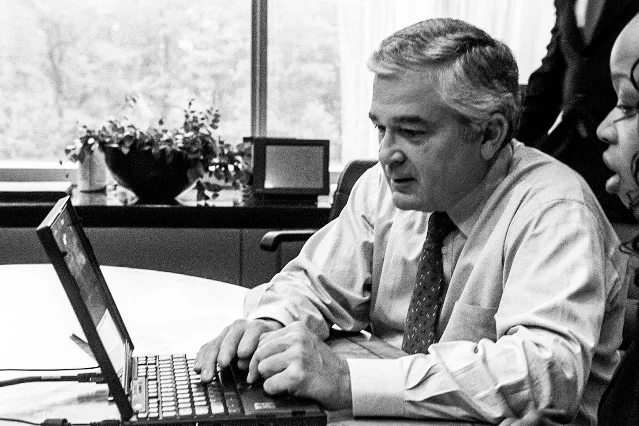
Lou Gerstner at his desk during the IBM turnaround era
Lou Gerstner at IBM, ca. 1993–1994 10
His reasoning was simple but required an outsider to articulate it. The breakup logic assumed each unit would be "stronger" if freed from IBM's overhead. The customer evidence showed the opposite: customers didn't want to manage integration themselves across thousands of vendors. IBM's unique value — its breadth of products, services, and global reach — was precisely what the breakup plan would have destroyed. Gerstner later called the decision "not just at IBM, but in my entire business career" his most important — and paradoxically said it was "one of the easiest" because the customer logic was clear 11:
"There wasn't going to be an IBM; there was going to be six or eight IBMs — effectively no IBM." 11
The negotiation asymmetry that had looked firmly in the board's favor — they hired him, they could fire him, they had a plan in motion — had been inverted by customer testimony. Gerstner had converted the board's own constituencies into evidence against the board's strategy.

Stabilizing the patient: the "no vision" firestorm

On July 27, 1993, at a press conference in New York's St. Regis Hotel, Gerstner announced IBM's second-quarter results: an $8.04 billion quarterly loss, including an $8.9 billion restructuring charge ($6 billion for workforce reduction, $2.9 billion for capacity and facilities) 2. He announced 35,000 additional layoffs on top of the 45,000 already made under Akers in 1992, and set a $7 billion cost-cutting target 4. IBM's dividend was cut by half.
When a reporter asked about his vision for IBM, Gerstner gave the answer that dominated the next month's headlines: "The last thing IBM needs right now is a vision." 3 Most coverage ran only that sentence. The media's interpretation: IBM's new CEO had no plan.
The actual quote, stripped of its middle, was blunt tactical instruction: "What IBM needs right now is a series of very tough-minded, market-driven, highly effective strategies in each of its businesses — strategies that deliver performance in the marketplace and shareholder value." 4 When pressed further at a mid-August employee town hall, Gerstner told an executive who demanded a vision statement: "Our mission is to be the most successful information-technology company in the world. O.K., you want a vision statement. Fine, we got it, now go back to work." 4
Meanwhile, CFO Jerry York had uncovered a structural problem the vision debate obscured: while IBM's personnel costs had dropped $3 billion since 1990, other expenses had jumped $7 billion 3. Nine task forces were launched to find $1.75 billion in overhead savings. Excluding the $8.9 billion restructuring charge, IBM's full-year 1993 operating loss was just $40 million — the core business was near breakeven 12. The bleeding was already stopping.
In August 1993 — four months into the job and at the depth of the public crisis — Gerstner spent $772,250 of his own money to buy 17,500 IBM shares 4. No announcement preceded it. The purchase was disclosed in a regulatory filing.

The strategic pivot: from hardware to integrator

Gerstner's strategic diagnosis matched the customer evidence. IBM had built its business around proprietary architectures that locked customers in. The world had moved to open standards, distributed computing, and a proliferation of vendors — none of which IBM controlled. The answer was not to reassert proprietary control. It was to become the company that made sense of the chaos for customers.
IBM would pivot from a hardware company selling proprietary systems to a services and solutions integrator — deploying competitors' products when they were better, wrapping everything in services, and charging for expertise rather than iron 5.
OS/2, IBM's operating system designed to challenge Microsoft Windows, was discontinued. By the end of 1994, IBM had ceased new OS/2 development entirely — a decision Gerstner called a "resounding defeat" that had been "draining tens of millions of dollars, absorbing huge chunks of senior management's time, and making a mockery of our image." 13 An insider CEO, he argued, would have lacked the emotional detachment to kill it.
In June 1995, IBM acquired Lotus Development Corporation for $2.2 billion 5 — securing Notes, the dominant enterprise collaboration platform, and signaling that software and services, not hardware, would anchor IBM's future revenues. IBM also bet early on the internet and "e-business," correctly anticipating that the shift from PCs to network computing would favor large-scale integration capabilities. By 1998, IBM's e-business strategy was generating over 25% of its $82 billion annual revenue 14.
Services revenue tells the story most cleanly: it grew from $7.4 billion in 1992 to over $30 billion by 2001 5, eventually surpassing hardware as IBM's largest revenue source.

Dismantling the fiefdoms: culture as negotiation

The organizational problem Gerstner found inside IBM was, in negotiation terms, a multi-party coordination failure. Every division was its own state. Units competed with each other, hoarded information, and "spent countless hours debating and managing transfer pricing terms between IBM units instead of facilitating a seamless transfer of products to customers." 15
正在加载链接预览…
One division head in Europe was intercepting Gerstner's internal emails, deciding which were "appropriate" to forward to his team. Gerstner summoned him to Armonk to clarify that those employees did not belong to the Europe division — they belonged to IBM 3.
The fix was structural. Compensation for the top 100–200 executives was shifted from division-level results to total corporate performance — removing the financial incentive for fiefdom behavior 3. Gerstner introduced Personal Business Commitments (PBCs): every employee made three measurable commitments annually, tied directly to variable pay. He distilled the culture target to three words — Win, Execute, Team: win in the marketplace, execute with speed, and act as one IBM 14.
The IBM white-shirt-and-tie dress code, discontinued in 1995, got more press coverage than anything else Gerstner did on culture. He was clear it was the least significant change 3. The significant change was the performance system — what the company measured, what it rewarded, and what it was now willing to fire people for.

Scorecard: $8 billion loss to $8 billion profit

IBM reported its first profitable year since 1990 in 1994: $3 billion net income on $64 billion in revenue — a profit swing of $11 billion compared with 1993, per IBM's own annual report 16. Headcount fell from a peak of 406,000 (1985) to approximately 220,000 by the mid-1990s 12 — a reduction of 186,000 positions across the Akers and Gerstner eras.
By the time Gerstner stepped down as CEO in March 2002 and retired as chairman at year-end 5:
  • IBM's market capitalization had risen from $29 billion (1993) to approximately $168 billion (2002) 5
  • The share price had recovered from roughly $13 to roughly $80 (split-adjusted) — approximately sixfold 5
  • Annual income had swung from an $8 billion loss to an $8 billion profit 5
  • The S&P 500 gained 154% over the same period — IBM outperformed it substantially 5
His successor, Sam Palmisano — a 31-year IBM veteran who had built the services division — extended the arc through 2012: revenue grew from $81.2 billion to $99.9 billion; gross margin from 36.6% to 46.1%; diluted EPS from $2.43 to $11.52 17.
Two caveats worth noting: critics at Wharton and Fortune have pointed out that IBM's revenues were partly inflated by a pension-plan accounting change, and the stock price recovery was amplified by an aggressive buyback program. Neither of these is discussed in Gerstner's memoir 5 15. The operational turnaround was real; the full financial picture is more complicated.

Frameworks you can use

正在加载链接预览…

"Execution over vision" — strategy is a floor, not a ceiling

Gerstner's most misquoted statement was also his most deliberately chosen. He arrived to find IBM stocked with "file drawers full of vision statements" — the company had accurately predicted nearly every major technology shift yet was paralyzed and unable to act on any of them 18.
His three pillars of effective execution: world-class processes tuned to the industry's key success factors; strategic clarity that reaches every employee; and a culture that does not tolerate mediocrity 18. His operational rule: "People do what you inspect, not what you expect." 18 And his corollary: "No credit can be given for predicting rain — only for building arks." 18
The application in deal-making and organizational change: when facing a restructuring, merger integration, or regulatory negotiation, the party that translates strategy into executable sequences faster than the other side gains a tempo advantage that compounds quickly.

"Culture is the game" — compensation design as negotiation instrument

In Chapter 20 of his memoir, Gerstner wrote: "I came to see, in my time at IBM, that culture isn't just one aspect of the game; it is the game." 14 The mechanism he used was not a speech — it was the compensation system. Shifting executive pay from division performance to total corporate performance was, in negotiation terms, realigning the incentive structure of every counterpart he dealt with inside IBM.
The practical framework: identify what the existing incentive structure rewards (fiefdom building, transfer-price manipulation, internal politics) and what it punishes (collaboration, information sharing). Then change what gets measured and what gets paid — the behavioral shift follows. "High-performance companies are led and managed by principles, not process." 14

The integration gambit — size as leverage

The conventional wisdom in 1993 was that large, diversified companies were structurally disadvantaged against focused competitors. The Baby Blues logic followed from this premise: smaller units would be nimbler.
Gerstner's counter-argument, developed in Chapter 26 of the memoir: "It isn't a question of whether elephants can prevail over ants. It's a question of whether a particular elephant can dance. If it can, the ants must leave the dance floor." 18 Scale enables larger investments, greater risk tolerance, and longer patience for payoff — none of which small units can match.
The operational test is integration versus fragmentation, not centralization versus decentralization. Shared activities fall into three categories: those that leverage scale economics (procurement, data processing, HR), those tied to marketplace linkages (common customer databases, shared CRM), and — hardest — shared approaches to winning in the market that require profit-center managers to subordinate unit goals for the collective. That last category is where the cultural work happens 18.
For any deal-maker facing a "break it up vs. keep it together" board debate, the Gerstner test is simple: can you produce direct customer evidence about which structure serves them better? If yes, use it. Boards reason from market-theory assumptions; customers reason from operational experience. The latter tends to win.

Proactive punctuated change — the Tushman/O'Reilly/Harreld framework

IBM's 1993 turnaround fits a specific cell in the academic typology of organizational change developed by Tushman, O'Reilly, and Harreld (Harvard Business School, 2013): reactive punctuated change — a dramatic, discontinuous transformation triggered by a crisis 17.
The Tushman typology arranges change on two axes: proactive/reactive and incremental/punctuated. IBM 1993 under Gerstner was reactive and punctuated — the crisis created the urgency that made discontinuous change possible. IBM 1999–2008 under Palmisano was proactive and punctuated — the harder form, because there was no burning platform to mobilize action. Palmisano achieved it through 40 Strategic Leadership Forums (SLF off-sites, 5,000+ senior executives), and 180 Emerging Business Opportunities (EBOs) — corporate-level exploratory initiatives. By 2008, those EBOs contributed 24% of IBM's total revenue 17.
The cautionary arc: after Palmisano, Ginni Rometty's tenure (2012–2020) saw revenue decline 28% (roughly $30 billion), net income fall 41%, and market capitalization drop over $95 billion — a 44% decline — while IBM underperformed the S&P 500 by an estimated 18,762 basis points 19. Analyst Charles Fitzgerald attributed the failure partly to the structural causes Palmisano's financial engineering had set in motion: "Palmisano hollowed IBM out and turned it into a financial engineering company as opposed to an engineering engineering company." 19 Strategic renewal capability is not permanent. It erodes when the mechanisms that produced it — leadership forums, protected innovation budgets, ambidextrous organizational design — lose executive sponsorship 17.

What to remember

  • The board's thesis was wrong, and the evidence to prove it was already available. IBM's enterprise customers — the only people who actually had to live with the consequences of fragmentation — consistently said they needed one integrated supplier. Gerstner found this out in weeks by going to see them. The breakup plan had been built from market theory; the counter-case was built from operating reality. When facing a board-level strategic assumption, the fastest way to test it is through the constituencies the board claims to represent.
  • Outsider status is leverage in a counter-negotiation. Gerstner's most valuable negotiating asset was the absence of IBM career history. He had no division to protect, no predecessor's decisions to defend, no internal coalition to repay. This made his "no vision" stance — counterintuitive and politically exposed as it was — executable. A 30-year IBM insider would have been under too much internal pressure to hold it for six months.
  • Compensation redesign is the fastest lever for coalition realignment. Gerstner didn't talk IBM's executives into collaborating across divisional lines. He changed what they got paid for. Shifting 100–200 executive compensation packages from unit performance to corporate performance converted former fiefdom-defenders into stakeholders in the integrated whole. The behavioral change followed within months.
  • Reactive turnarounds create a window; they do not keep it open. Gerstner's reactive punctuated change worked because the crisis was visible and acute. The harder test — sustaining proactive renewal when there is no burning platform — is what separated the Gerstner era (1993–2002) and the early Palmisano era (2002–2012) from the Rometty decade. Building the mechanisms for continuous renewal before the next crisis is the management problem the IBM case leaves unresolved.

Cover image: AI-generated editorial illustration (IBM ONE architecture concept, 2026)

围绕这条内容继续补充观点或上下文。

  • 登录后可发表评论。