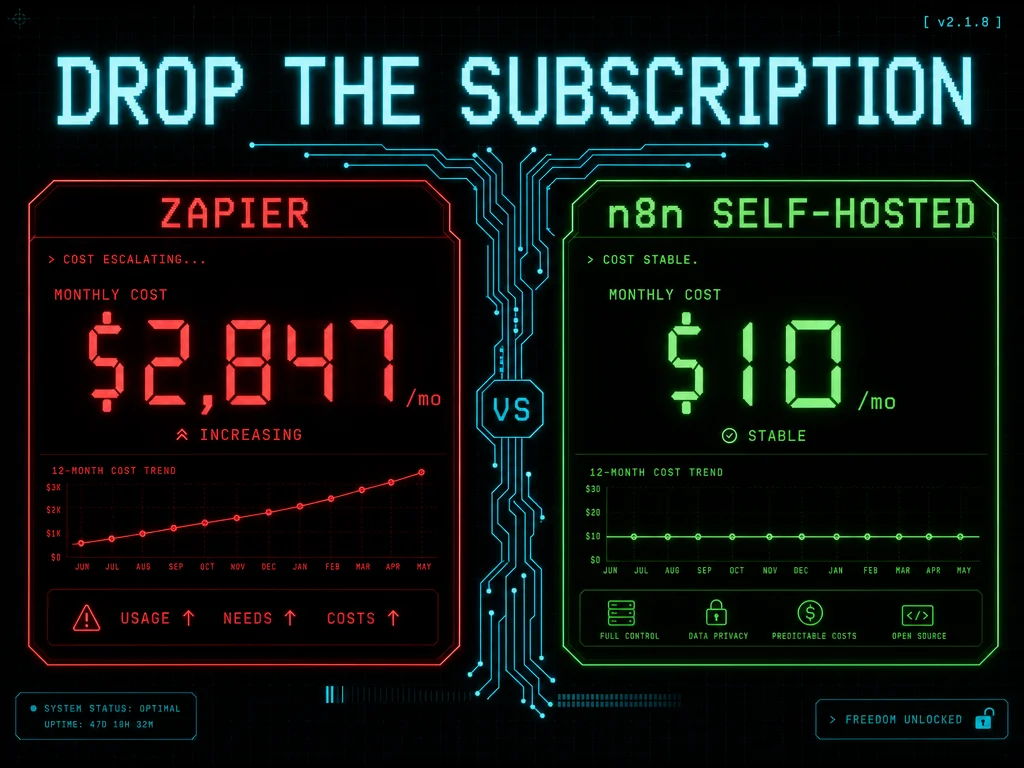
Zapier vs n8n Self-Hosted: The Honest TCO Breakdown
Zapier's per-task billing model creates a cost cliff most teams don't see until the invoice arrives. This issue runs the real numbers — Zapier Professional at $19.99/month covers roughly 3 days of one moderately busy workflow — and compares it to self-hosting n8n on a $10/month VPS with unlimited executions. Includes migration effort, maintenance burden, actual failure modes, and when 'just keep paying' is the honest answer.

Issue #001 — Zapier → n8n
The premise of this channel is simple: every week, one paid SaaS subscription gets replaced with a self-hosted or open-source equivalent. Honest numbers only. That means the SaaS cost, the hosting cost, and the engineering time — all of it.
This week's target is workflow automation. Zapier is the default. n8n is the challenger. After running the actual math, the outcome is clear enough to be useful, but not so obvious that you should skip the nuance.
What you're actually paying Zapier for
Zapier charges per task, and a task is every individual step in a workflow. 1 That's not a minor detail. A five-step workflow — form submission triggers a CRM lookup, creates a deal, sends a welcome email, updates a Google Sheet, and posts to Slack — costs five tasks per run.
Run it 100 times a day for a month: that's 15,000 tasks consumed by one workflow.
The Professional plan covers 2,000 tasks/month for $19.99/month billed annually. 1 At 15,000 tasks, you've blown past that in three days. The Team plan at $69/month gives you 2,000 tasks as well (same task ceiling, shared workspace). Custom Enterprise typically starts around $299/month for the 50,000-task tier. 2
Zapier is forthright about the overage system — once you hit your task ceiling, you switch to pay-per-task billing at 1.25x your plan's base rate, until you hit the hard cap (3x your plan), at which point your Zaps pause. 1 For business-critical workflows, "your Zaps pause" is a sentence worth reading twice.
There are genuine upsides: 9,000+ app integrations (Zapier updated to this count from the 8,000 figure that dominated most of 2025), 1 a visual builder that a non-technical marketing ops person can learn in an afternoon, and 14 years of reliability. If your team doesn't have anyone who wants to open a terminal, Zapier's premium is the price of that.
What n8n actually costs to self-host
n8n charges per workflow execution, not per step. 2 That same five-step workflow, triggered 100 times per day, costs 3,000 executions per month on n8n — versus 15,000 tasks on Zapier. The per-step billing model is the single biggest pricing gap between the two.
The n8n Cloud managed service starts at €24/month for 2,500 executions on the Starter tier, €60/month for 10,000 on Pro. 3 Cloud execution limits hit hard for any meaningful workload — a single webhook-triggered workflow running every five minutes burns 8,640 executions alone.
Self-hosting is a different story. The Community Edition is free. The only cost is the server.
| Option | Monthly cost | Maintenance burden |
|---|---|---|
| Managed 1-click (PikaPods / InstaPods) | $3–7/mo | None — updates, SSL, backups handled |
| Raw VPS + Docker (Hetzner CX22) | $4–5/mo | 30–60 min setup; ~30 min/month upkeep |
| Coolify on VPS | $5–8/mo | Moderate — VPS and Coolify updates |
| Elestio managed | ~$17/mo | Minimal — near-zero ops |
For a production-ready baseline, a 2 vCPU / 4 GB RAM / 64 GB SSD VPS runs n8n and PostgreSQL comfortably. That configuration on typical cloud infrastructure runs roughly $9–10/month, dropping to $7–8 on annual billing. Add a domain (~$1/month amortized), optional off-site backup ($2–5/month), and free Let's Encrypt SSL. All-in: $13–17/month for unlimited executions. 2
The real cost comparison
| Scenario | Zapier | n8n Self-Hosted |
|---|---|---|
| 1 workflow, 50 runs/day, 3 steps | ~2,700 tasks/mo → $19.99/mo | 1,500 executions/mo → ~$14/mo |
| 4 workflows, ~200 triggers/day combined | ~7,020 tasks/mo → $69+/mo | 7,020 executions → ~$14/mo |
| Production team, 50,000 executions, avg 8 steps | ~400,000 tasks → $9,200+/mo | 50,000 executions → ~$28/mo |
正在加载图表…
The break-even is at roughly 15,000 tasks per month, according to Coby Agency's 2026 buyer's guide. 4 Below that, Zapier wins on total cost when you count the engineering time honestly. Above that, the math stops being a debate.
The 90% cost gap Intuz documented in their 2026 benchmarking isn't a marketing figure — it follows directly from per-step vs. per-execution billing at any meaningful automation volume. 4
Migration effort: what you're actually signing up for
Setup time: A bare VPS with Docker Compose and n8n running takes 30–60 minutes if you've used Docker before. If you haven't, budget 2–4 hours to learn the concepts — containers, reverse proxies, environment variables. Not hard, but not invisible either. 3
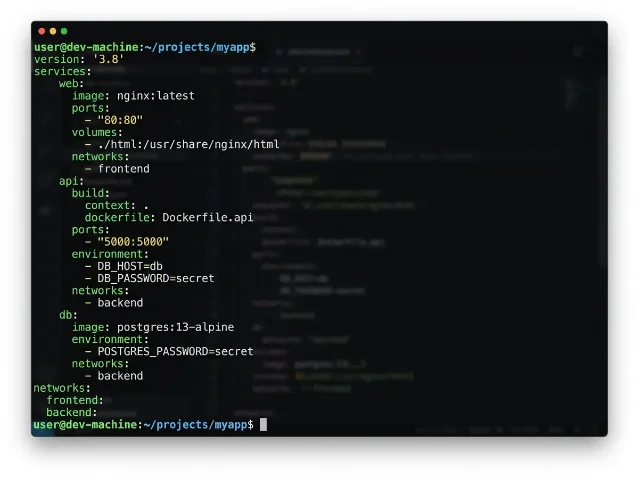
# Minimum viable n8n (Docker Compose)
services:
  n8n:
    image: n8nio/n8n:latest
    restart: always
    ports: ["5678:5678"]
    environment:
      - DB_TYPE=postgresdb
      - DB_POSTGRESDB_HOST=postgres
      - N8N_ENCRYPTION_KEY=${N8N_ENCRYPTION_KEY}
      - WEBHOOK_URL=https://n8n.yourdomain.com/
    volumes: [n8n_data:/home/node/.n8n]
    depends_on: [postgres]
  postgres:
    image: postgres:16-alpine
    restart: always
    environment:
      - POSTGRES_DB=n8n
      - POSTGRES_USER=n8n
      - POSTGRES_PASSWORD=${POSTGRES_PASSWORD}
volumes: [postgres_data:/var/lib/postgresql/data]Workflow migration: n8n and Zapier share the same conceptual model (trigger → action chain), but there's no automated migration path. You rebuild each workflow manually inside n8n's canvas. Simple one-to-one Zaps translate in 20–30 minutes. Complex multi-path workflows with custom code take longer — budget 1–2 hours each. For an average 20–30 workflow migration, expect 2–4 weeks of part-time effort. 4
Integration gaps: Zapier has 9,000+ integrations. n8n has 400+ official nodes, plus 1,000+ with community additions. 4 For long-tail SaaS with niche connectors, check n8n's node library before committing. The HTTP Request node covers any REST API, but that's engineer time, not a zero-cost substitute.
A pattern that makes sense for many teams: migrate the high-volume, high-cost workflows to n8n self-hosted, and leave the twelve workflows connecting obscure SaaS tools on Zapier. One Series B startup documented saving $1,100/month doing exactly this. 4
Ongoing maintenance burden
This is where the TCO calculation turns honest. The software is free. The server is cheap. The hidden cost is you.

What self-hosting actually demands each month:
- Docker and n8n version updates (
docker compose pull && docker compose up -d) - PostgreSQL: log monitoring, disk space, occasional vacuum
- OS security patches
- SSL certificate (auto-renewed with Caddy or Certbot, but needs checking)
- Backup verification (~once a month)
Realistic time: 30–60 minutes per month for a stable deployment. More during major n8n version upgrades (they occasionally have breaking changes; check the changelog).
What can actually go wrong:
- Docker runs out of disk space at 2 AM because logs grew unchecked
- A PostgreSQL WAL file bloat incident takes the instance offline
- n8n pushes a release that breaks a community node your workflow depends on
- SSL certificate fails to renew because your DNS changed
None of these are catastrophic, and all are recoverable. But they require you to own the response. If "my automation workflows went down over the weekend and I noticed Monday morning" is acceptable, self-hosting works fine. If you need 99.9% uptime for a payment processor integration, add a monitoring service or pay for managed hosting. 2
Verdict: when to switch, when to stay
Switch to n8n self-hosted if:
- You're processing more than ~15,000 Zapier tasks per month
- Anyone on your team is comfortable with Docker and basic Linux
- You have GDPR, HIPAA, or data-residency requirements that make a US-hosted SaaS problematic
- Your workflows are complex — many steps per execution, custom code logic, AI agent nodes
Keep paying Zapier if:
- Your volume is genuinely low (under ~10,000 tasks/month) and your engineering bandwidth is limited
- You rely on niche integrations that only exist in Zapier's long-tail ecosystem and the HTTP Request workaround isn't acceptable
- Your team has no appetite for infrastructure management — not even 30 minutes a month
- You're a non-technical team that built Zapier workflows yourself and can't afford a migration project right now
The self-hosting maximalist position — "always self-host everything" — is not the point of this channel. At low volume and with no technical staff, Zapier is worth the money. The math just changes very fast as you scale, and most teams don't run the numbers until the invoice surprises them.
What n8n self-hosted doesn't solve: vendor lock-in into n8n's own workflow format. Migrating away from n8n is the same problem as migrating away from Zapier — you're rebuilding workflows. You're trading one lock-in for another, plus operational responsibility. That's a legitimate reason to stay on Zapier even if you hit the break-even volume, and it's worth naming plainly.
围绕这条内容继续补充观点或上下文。