
1/3

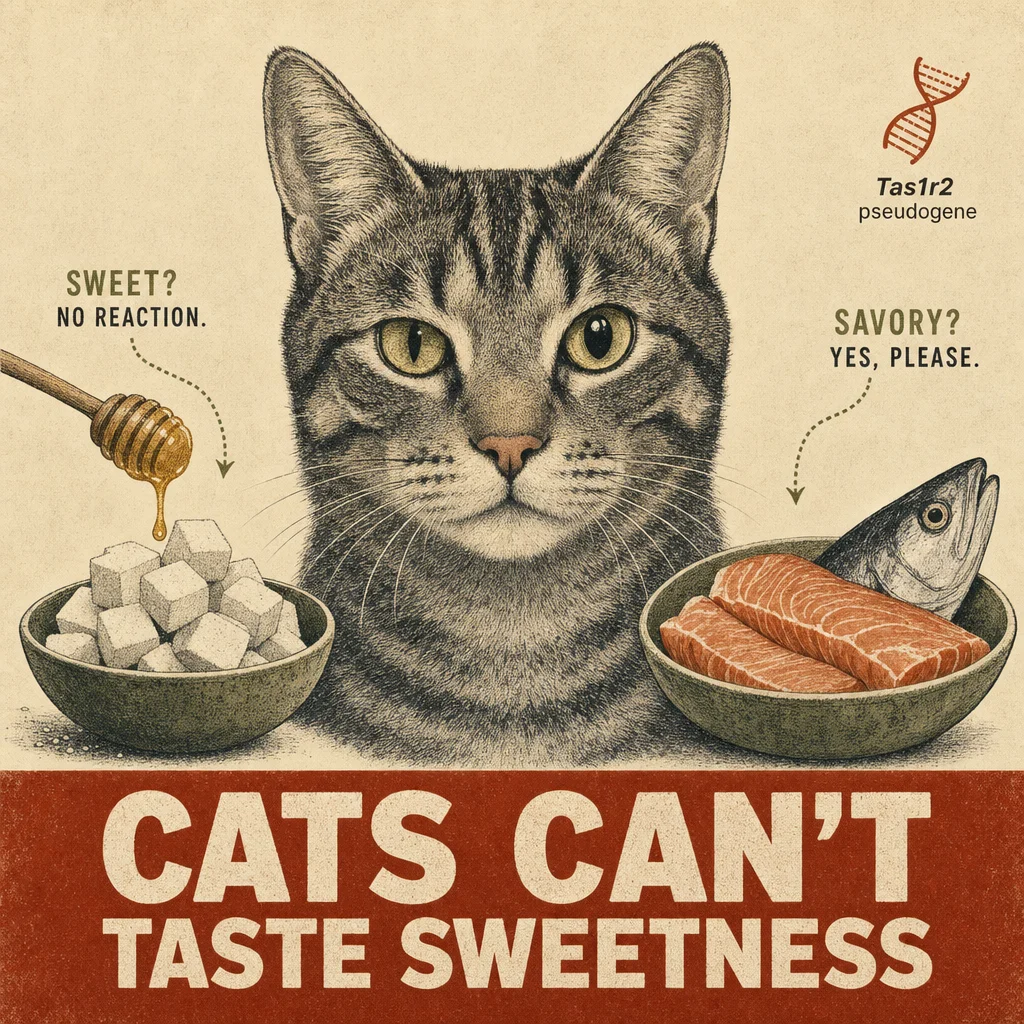
Cats can't taste sweetness — and the gene is broken in every cat alive

Every domestic cat, tiger, and cheetah carries the same 247-base-pair deletion in the Tas1r2 gene — making sweet taste physically impossible for all felines. Here's the molecular reason why your cat doesn't care about dessert.

2026/5/23 · 7:11

图集

Your cat has never once tasted the sweetness of the treat you just offered. Not because she's picky — she's physically incapable of it. A gene that other mammals use to detect sugar has been broken in cats for millions of years.

The receptor that never forms

Sweet taste in mammals works through a receptor made of two proteins: T1R2 and T1R3, each produced by a separate gene (Tas1r2 and Tas1r3). For the receptor to function, both proteins have to pair up. 1
In cats, Tas1r2 carries a 247-base-pair deletion in exon 3. That deletion shifts the reading frame, triggers a premature stop codon, and produces no usable protein at all — making it a pseudogene. Without T1R2, the receptor can't form. The sugar molecule has nowhere to bind. No signal reaches the brain.
The other half of the gene pair, Tas1r3, still works fine — which is why cats can taste amino acids and respond to the savory flavor of meat. It's a very targeted gap: one modality, completely absent.

Not just your cat

Researchers at the Monell Chemical Senses Center in Philadelphia found the same 247-bp deletion in tigers and cheetahs, and confirmed it across six unrelated domestic cats. The mutation is shared across the entire Felidae family.
"They don't taste sweet the way we do." — Dr. Joseph Brand, Monell Chemical Senses Center 2
The deletion almost certainly predates the divergence of these species, making it an ancient evolutionary event — not a recent accident. Dogs, by contrast, have a fully functional T1R2 and actively seek out sweet flavors. The difference arose after Feliformia and Caniformia split.

What this means for your cat's diet

Cats evolved as strict obligate carnivores. Nature never needed them to detect ripe fruit or sweet carbohydrates — their calories came from protein and fat in prey. Losing the sweet receptor carried no evolutionary cost.
What they can detect extremely well: specific amino acids, the nucleotide ATP (a signal of fresh meat), and bitterness (a warning against toxins). Their taste system is tuned precisely for hunting protein, not browsing a dessert menu.
There's a practical angle here. Modern dry cat food typically contains around 20% carbohydrates — well above what a cat's biology expects. Since cats can't taste sweetness, they get no palatability signal from those carbs at all. The food needs to deliver its appeal through aroma, texture, and protein flavor alone.
正在加载链接预览…

So — has your cat ever seemed weirdly interested in something sweet? Ice cream, yogurt, cake? Drop the story in the comments. Given that they can't taste the sugar, it's almost certainly the fat or protein pulling them in, not the sweetness.
Daily Cat Fun Facts — one surprising cat truth, every day.

评论