The king who carved his laws in stone: the 3,750-year journey of the Code of Hammurabi
Carved from a single block of black basalt around 1753 BCE, the Code of Hammurabi (Louvre Sb 8) is the longest surviving law text of the ancient Near East — and one of the most traveled. This article traces its full provenance: from Hammurabi's Babylonian empire to an Elamite king's war-trophy heap at Susa, through three millennia buried under rubble, to Gustave Jéquier's 1901–02 excavation and the Louvre's Room 227, where the stele has stood without a glass case since 1904.

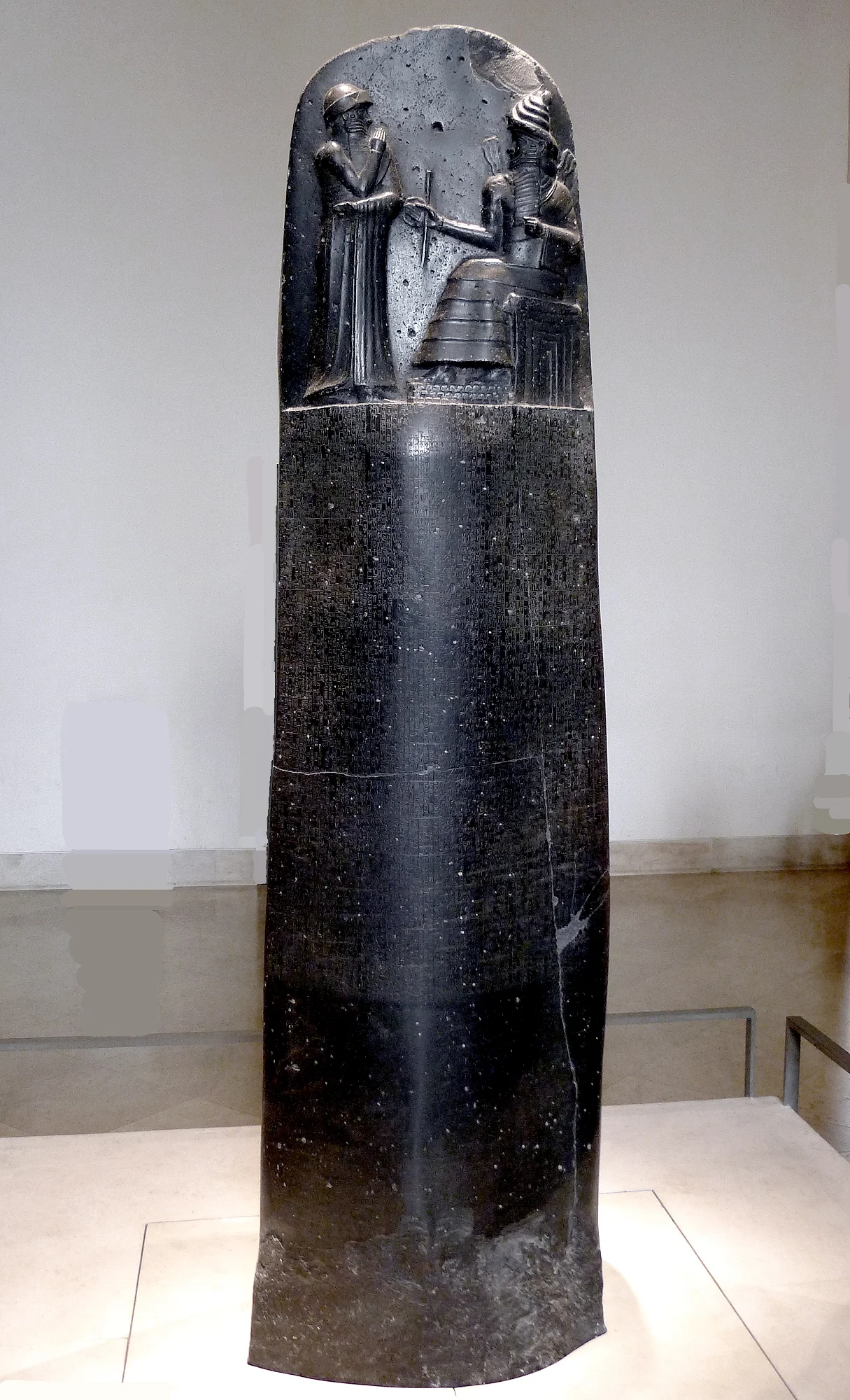
Walk into Room 227 of the Louvre's Richelieu wing — the room the museum simply calls the Salle du code d'Hammurabi — and you find it standing in the open, without a glass case, occupying its own small halo of floor space. 1 The stele is 2.25 meters tall, the height of a tall man standing on another man's shoulders, and it is made from a single block of polished black basalt whose surface, after nearly four thousand years, still holds a faint gleam. 1 The shape is tapered, slightly narrower at the base than at the top — what scholars call a finger-shaped stele — and the effect, standing close, is less like looking at a document and more like standing before a monolith that is looking back at you.
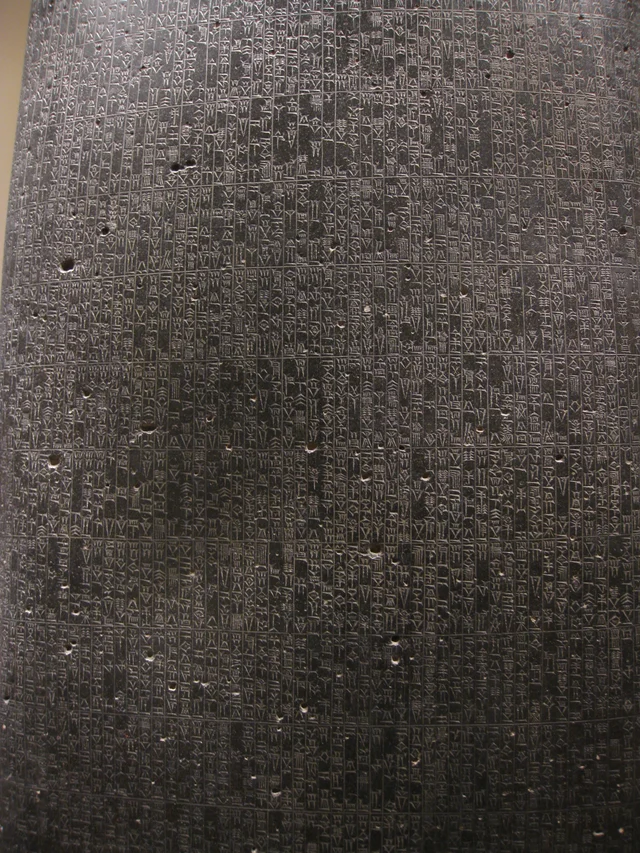
The top third of the stone is carved. Two figures occupy a shallow relief scene roughly 65 centimeters high and 60 centimeters wide. 2 Below that, covering every remaining surface in tight columns that wrap all the way around the stone, are approximately 4,130 lines of cuneiform script in the Old Babylonian dialect of Akkadian. 1 2 The text has been dated to roughly 1753 BCE — a date nearly a thousand years before Homer, fifteen hundred years before Rome's Twelve Tables, almost two thousand years before Hammurabi's laws were echoed, however faintly, in the Hebrew Bible. 3
The stone is accession number Sb 8. It weighs approximately four tons. 4 It has been to at least two cities, survived a military sacking, been erased in places by a conqueror who never finished his inscription, spent three thousand years buried under rubble, and ended up in France. The story of how it got there is, in its own way, as intricate as the laws carved on its surface.
A king who called himself a shepherd
To understand the stele, it helps to understand the man who commissioned it. Hammurabi (r. c. 1792–1750 BCE) was the sixth king of the Amorite First Dynasty of Babylon — a dynasty that, when he inherited it from his father Sin-Muballit, controlled a relatively minor city-state in central Mesopotamia. 2 5 Over the following four decades, through a combination of military conquest, calculated diplomacy, and at least one episode of strategic betrayal, Hammurabi transformed that city-state into the dominant power of the ancient Near East, extending his empire from the Persian Gulf through the Tigris-Euphrates valley into parts of what is now northern Iraq and Syria. 2 3
He was careful, throughout, about how he presented himself. Royal inscriptions consistently describe him as a shepherd to his people — a paternal ruler who restored temples, dug irrigation canals, and above all upheld justice. The stele's prologue, which runs to some three hundred lines of poetic Akkadian, frames the laws that follow not as Hammurabi's own legislation but as a divine commission: the gods Anu and Enlil had called him, he says, specifically to make justice shine in the land, 「to prevent the strong from oppressing the weak.」 2 The phrase in Akkadian — dannum enšam ana lā ḫabālim — appears near the opening of the prologue and sets the moral register for everything that follows.
The Code was compiled near the end of Hammurabi's reign, when his empire was established and his legacy was something to be planned for. 5 The epilogue adds another five hundred lines of warnings: any future ruler who erases or ignores the laws will be cursed by fourteen named deities, in language that grows progressively more detailed and more terrible for the last 281 lines. 2 The curses were also, presumably, aimed at the Elamites. They didn't work.
The god who handed over the rod and ring
The carved scene at the top of the stele is the key to understanding everything below it.
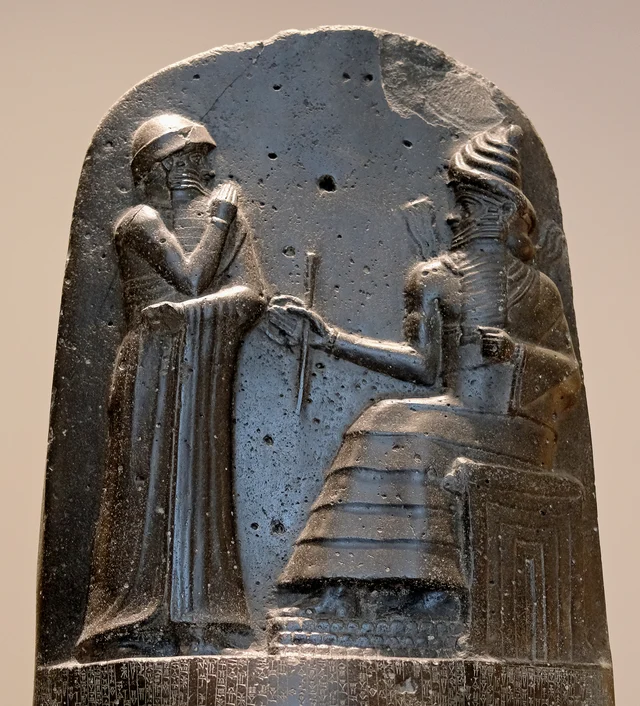
The seated figure on the right is Shamash, the Babylonian sun god and the deity most closely associated with justice. 2 Three iconographic markers identify him without any ambiguity: the horned crown of divinity that rises from his head; flames that sprout from his shoulders, his solar attribute; and a footrest that symbolizes the mountains over which the sun rises each morning. 6 Shamash extends his hand toward Hammurabi, presenting what the Louvre catalog records as cercle et bâton — the rod and coiled rope, traditional Mesopotamian symbols of divine authority, measurement, and the right to build temples. 1
The standing figure on the left — Hammurabi — wears a long robe with his right shoulder bare, a high-bordered cap, and holds his right hand raised to his lips in a gesture of reverence. 2 He is smaller than Shamash, as convention demanded: in Mesopotamian visual art, scale communicated status, not physical reality. The composition establishes, in a single image, the theological argument that the entire text below it makes in three hundred lines of poetry: Hammurabi's laws are not his own invention. They come from the god of justice himself.
What exactly the scene depicts has generated scholarly debate. Martha Roth of the University of Chicago lists at least three competing interpretations: that Hammurabi is offering the laws to the god; that he is accepting the emblems of sovereignty; or — what Roth considers most probable — that the rod and ring are the measuring instruments of temple-building, symbols of Hammurabi's sacred duty to maintain and construct the gods' houses. 2 Dominique Charpin of the Collège de France has proposed that Hammurabi may even be imitating Shamash's pose — an act of ritual identification with the god of justice himself. 2 When Father Jean-Vincent Scheil published the first edition of the stele's text in 1902, he got the scene backwards entirely, identifying the seated figure as Hammurabi and the standing figure as Shamash, and describing the sun god as dictating the laws to the king. 7 It took other scholars to correct him.
One further detail: some scholars have proposed that the relief — particularly the beards of both figures — was reworked during the Elamite period at Susa, centuries after the stele left Babylon. 2 If so, a conqueror's hand touched even the most sacred part of the monument.
What 282 laws actually say — and what they don't
Below the relief scene, the cuneiform inscription originally covered 51 columns of text. 1 Seven of those columns — each containing more than eighty lines — were polished smooth in antiquity. 2 The erasure is conspicuous: a wide, blank band runs around the lower midsection of the stele where carved text should be. What survives has been divided by modern editors into 282 provisions, though the original text contains no such numbering — that division is a nineteenth-century editorial convention. 2 3
The laws are written in casuistic form — "if... then" conditional sentences — and they cover criminal law, family law, property law, commercial transactions, and slavery. 6 The most famous is Law 196, the lex talionis provision: 「If an awīlum should blind the eye of another awīlum, they shall blind his eye.」 2 The Louvre's interpretive page is careful to note that this is far from a call for private vengeance: it stipulates that punishment must be proportional to the harm suffered, and that the state — not the victim — administers the penalty. 6 The distinction matters. The principle is already recognizable in modern criminal law theory.
The Code also distinguishes three social classes, with penalties calibrated accordingly. The awīlum (free person, member of the elite), the muškēnum (commoner or dependent free person), and the wardum (slave) faced different scales of punishment and compensation for the same offense. 2 4 A physician who cured a severe wound charged ten silver shekels if his patient was an awīlum, five if a muškēnum, two if a slave — and faced the same sliding scale of punishment for malpractice, up to having his hands cut off for killing a wealthy patient. 4 The Code also contains what may be the earliest recorded version of a presumption of innocence: an accuser who cannot produce evidence of his charge faces the penalty that would have been applied to the accused. 3
What the Code does not cover is as significant as what it does. Despite its reputation as comprehensive legislation, it says almost nothing about shepherds — a vital sector of Babylonian agriculture. 2 Marc Van De Mieroop of Columbia University has noted this gap as evidence that the stele was never intended as a complete legal code. 2 Martha Roth, who has studied more than a thousand Old Babylonian legal documents, has stated that she knows of only one case among them that might be said to turn on a point of Hammurabi's law. 2 The dominant view among Assyriologists today — advanced by Roth, Van De Mieroop, Jean Bottéro, and others — is that the stele is better understood as a work of jurisprudence: an abstract demonstration of how judgments ought to be reasoned, sharing its serial logic with Mesopotamian omen lists and scholarly treatises, rather than a body of enforceable legislation. 2 6
It was, in other words, a monument to the idea of just rule — which is why it was carved on a public stele rather than filed in an archive.
Susa: the sacking that preserved it
The stele stood in a Babylonian temple for roughly five hundred years — long enough to become a touchstone of Mesopotamian scribal culture. Over fifty manuscript copies of the laws have been found at other sites across Mesopotamia, evidence that the text was studied and reproduced as part of the scribal training curriculum for more than a millennium after Hammurabi's death. 2
Where, exactly, the stele originally stood is uncertain. The prologue's reference to the king's later years, and Martha Roth's analysis of the text, suggest that it was erected in Sippar, the northern Babylonian city where Hammurabi is known to have spent the final years of his reign. 2 Encyclopaedia Britannica, drawing on other sources, places it in Babylon proper, in the temple of the city-god Marduk (the Esagila). 3 The two accounts cannot both be right, and the archaeological record has not settled the question.
What is certain is what happened to it around 1150 BCE. The Elamite king Shutruk-Nahhunte (r. c. 1185–1160 BCE) launched a military campaign into Mesopotamia, sacking Sippar and carrying back to his capital at Susa — modern Shush, in southwestern Iran — an enormous haul of Babylonian prestige objects. 2 5 The stele went with him, along with the cult statue of the god Marduk — a deliberate trophy-taking whose political message was hard to miss. Hammurabi had promised in his prologue that the gods would curse anyone who defaced the stele. Shutruk-Nahhunte, it seems, was not impressed.
At Susa, the Elamites polished seven columns of the law text smooth — the blank band still visible on the stone today. 2 Scheil's hypothesis in 1902 was that Shutruk-Nahhunte ordered the erasure to make room for his own victory inscription. 7 The inscription was never added. The empty columns may represent a project abandoned mid-campaign, or a change of mind, or simply a monument that lost its usefulness once the Elamite king had demonstrated that he could deface it at all.
After that, the stele disappears from the record. It was buried — whether intentionally, as part of a ritual deposit, or accidentally, through the gradual accumulation of rubble and soil over the Susa acropolis — and it remained buried for approximately three thousand years.
Jacques de Morgan's winter in the field
The French had been digging at Susa since 1884, when the archaeologist Marcel Dieulafoy led the first formal excavation. By 1897, the Délégation archéologique française en Perse was operating under Jacques de Morgan, a geologist and engineer who had previously directed excavations in Egypt and Georgia and who brought to Susa an organizational scale the site had not seen before. 2
In the winter of 1901 to 1902, an expedition member named Gustave Jéquier — trained originally as an Egyptologist under Édouard Naville in Geneva — was working on the tell of the Susa acropolis when his team turned up three large fragments of a black stone stele. 7 2 The fragments were heavy, polished, and covered on one face with a dense cuneiform inscription. The other face, at the top, held a carved scene of two figures.
De Morgan understood immediately that the team had found something significant. The fragments were transported to the newly established French archaeological depot at Tehran, and from there, under the partage (division of finds) system governing French excavations in Persia, the stele was transferred to France. 2
The inscription was handed to Father Jean-Vincent Scheil, a Dominican priest and trained Assyriologist who was part of the expedition. Working at extraordinary speed, Scheil transcribed, translated, and published the entire text in 1902 as the fourth volume of the Mémoires de la Délégation en Perse — the editio princeps of what he called 「a moral and political masterpiece.」 2 The publication caused an immediate sensation in European scholarly circles. The biblical parallels — between Hammurabi's laws and passages in Exodus — were seized upon by journalists and theologians alike, and the stele became, almost overnight, one of the most discussed archaeological objects in the world.
It went on permanent display at the Louvre in 1904, where it has remained ever since. 2
Two stelae from the same rubble
The Code of Hammurabi was not the only major monument Shutruk-Nahhunte carried to Susa. Among the other trophies from his Mesopotamian campaign was the Victory Stele of Naram-Sin (c. 2254–2218 BCE), a pink limestone monument from the Akkadian Empire, 200 centimeters tall, recording the king's triumph over the mountain people of Zagros. 2 Both stelae were found by de Morgan's expedition on the same Susa acropolis, separated by roughly fifteen hundred years of history. Both are now in the Louvre.
The contrast between the two is instructive. The Naram-Sin stele is primarily pictorial: it shows the king, wearing a divine horned helmet and scaling a mountain over the bodies of his defeated enemies, using diagonal composition and dynamic movement to project power and superhuman energy. The Hammurabi stele does something different. It subordinates the image to text — the relief at the top, for all its theological weight, is physically small compared to the massive block of cuneiform below it. The monument's real argument is made in language, not pictures.
Where Naram-Sin presents himself as a god, Hammurabi presents himself as a recipient of divine authority. It is a different posture, reflecting a different moment in Mesopotamian political theology — one in which the king's legitimacy rests not on his own divinity but on his relationship with the gods who entrusted him with justice. 2
The lawgiver in marble, on two continents
The stele's afterlife extends well past the Louvre's galleries.
The Hammurabi text has never entirely left the legal imagination of later civilizations. Connections between the Code's provisions and passages in Exodus and Deuteronomy were noted by biblical scholars as early as the nineteenth century and debated in the decades following Scheil's 1902 publication. 6 Scholars continue to debate the nature and extent of any direct influence, and the Louvre's curatorial statement describes the stele as 「a landmark monument in the history of law, and an invaluable window onto ancient Near Eastern society.」 6
That assessment has had consequences in stone. Hammurabi appears as one of 23 marble relief portraits of historical lawgivers installed above the gallery doors of the U.S. House of Representatives chamber in Washington, D.C., placed there between 1949 and 1950 by the Architect of the Capitol. 8
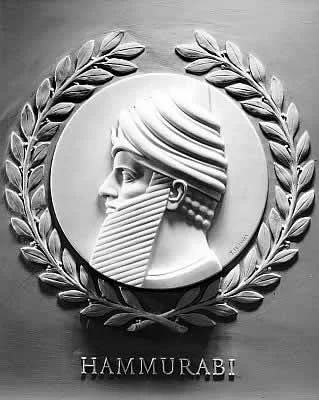
He also appears on the south wall of the U.S. Supreme Court courtroom, as one of 18 historical lawgivers in the marble frieze alongside Moses, Solon, Justinian, and others. 9 Replicas of the stele stand at the United Nations headquarters in New York and at the University of Chicago's Institute for the Study of Ancient Cultures, among other institutions. 2
The same image that appeared on the Susa acropolis — a king receiving authority from a god of justice — turns out to be one of the most durable ideas in the iconographic vocabulary of Western law.
What the blank columns say
The seven erased columns are the stele's strangest feature — and in some ways its most telling.
The erasure was careful work. Whoever did it took the time to polish the stone smooth, removing not just the ink or paint that might cover the incised signs but the signs themselves, cutting back into the basalt surface. 2 The blank space was apparently prepared for a new inscription — Shutruk-Nahhunte's own victory text — that was never carved. Several other Mesopotamian objects that Shutruk-Nahhunte looted do carry his inscriptions, so the capability existed. On the Hammurabi stele, it stopped at the preparation stage.
Some scholars read the unfinished erasure as evidence of an interrupted campaign or an unexpected death. Others see it as a statement in itself: the Elamite king demonstrating that he could deface the most famous legal monument in Mesopotamia, without needing to replace it with his own name. The blank columns, in this reading, are the inscription.
Additional manuscript copies of the text found at other sites across Mesopotamia have allowed scholars to reconstruct most of what the erased columns contained. 2 The missing laws are largely recoverable. What cannot be recovered is the exact reason the Elamite project stopped — a gap that sits at the center of the stele's history the way the blank columns sit at the center of the stone.
The stele without a case
The Louvre made a deliberate choice not to enclose the stele in a glass case. It stands in Room 227 hors vitrine — literally, outside the showcase — which means visitors can walk around it, look up at the relief from directly below, and get close enough to the cuneiform columns to trace the individual wedge-shaped impressions with their eyes, though the museum's implied social contract asks that hands stay back. 1
This was almost certainly the way the stele was intended to be encountered in its original setting. Set up in a temple court or public space in Sippar or Babylon, it would have been accessible — to those who could read Akkadian, which was not the majority of Hammurabi's subjects, but also to those who could not, for whom the image at the top said enough. A king, a god, a transfer of authority. Justice is not my invention, the image says. It comes from higher than me.
Whether or not Hammurabi's laws were ever systematically enforced — and the scholarly consensus suggests they were not, at least not in any direct legislative sense — the stele accomplished its primary purpose: it existed as public testimony to the king's just character, an argument in stone that outlasted him by three and a half millennia. It survived its maker, its empire, the civilization that produced it, the civilization that stole it, and the three thousand years when nobody knew where it was. It is still making the argument today, in a room in Paris named after it.
Cover image: Full front view of the Code of Hammurabi stele (Sb 8), Musée du Louvre. Photo by Rama, Wikimedia Commons (CC BY-SA 3.0 FR).
参考来源
- 1Code de Hammurabi — Louvre collections catalog
- 2Code of Hammurabi — Wikipedia
- 3Code of Hammurabi — Encyclopaedia Britannica
- 4Code of Hammurabi: Laws and Facts — History.com
- 5Code of Hammurabi — World History Encyclopedia
- 6The Code of Hammurabi — Musée du Louvre interpretive page
- 7The Code of Hammurabi, Discovered in Khuzestan, Iran — historyofinformation.com
- 8Relief Portrait Plaques of Lawgivers — Architect of the Capitol
- 9Courtroom Friezes: South and North Walls — Supreme Court of the United States
围绕这条内容继续补充观点或上下文。