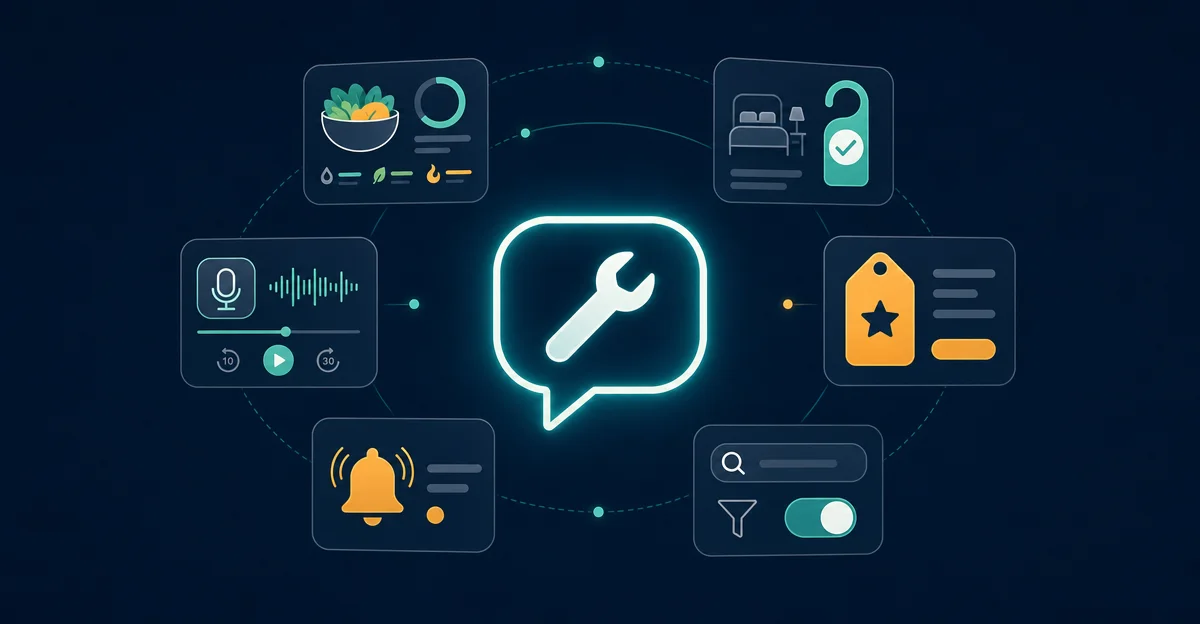
8 Product Gaps Builders Should Know About This Week (June 4, 2026)
Eight unmet-need signals from public X/Twitter posts in the past 24–48 hours: a source-quality filter for AI search, a single-user PaaS for vibe-coded apps, an AI agent job-completion notifier, agent-readable pricing pages, a messaging layer for agents, a Flighty-style hotel tracker, a DoorDash-integrated macro counter, and a bookmarks-to-podcast pipeline. Each entry includes a verbatim quote, source permalink, competitive gap analysis, and an indie-builder feasibility rating.

Collected from public X/Twitter posts and HN threads in the past 24–48 hours. Eight gripes, all with a specific missing product at the centre.
1. AI search with no "exclude social media garbage" toggle
"I really wish there was a way to exclude 'random online comment' from them. It's messed me up numerous times."
@KenLaCorte (68k followers, journalist and YouTube creator) 1 sent this directly to Perplexity after a serious research thread was derailed by Reddit-sourced noise.
The ask: a source-quality filter that lets you exclude low-signal domains (Reddit, Quora, generic social commentary) while keeping everything else. Perplexity's API does have a domain filter 2, but it requires developers to configure it — there is no consumer-facing toggle in the app UI. The gap is a one-click "no social media commentary" mode, not an enterprise API parameter. With Reddit now suing Perplexity for scraping 3, the relationship between AI search and social platforms is only getting thornier.
Competitive gap: Perplexity offers a Focus dropdown (Web, Academic, Writing, etc.) but no source-quality exclusion. Exa, Tavily, and You.com have similar omissions at the consumer layer.
Feasibility: High. The underlying capability exists in Perplexity's API. A browser extension or wrapper product could implement this today, with zero ML required.
2. A PaaS built for single-user vibe-coded apps
"Someone should build the PaaS for vibe-coded personal productivity apps. Deployment model looks entirely different. Since these apps have an audience of one you do auth at the network layer (not app layer) and only need the app to be up when the user wants to do something."
@aidandcunniffe (exited founder, building git-ai) 4 articulates the infrastructure mismatch precisely. Standard deployment platforms (Vercel, Railway, Render) are built for multi-user production workloads. Single-person productivity tools that nobody else will ever touch are a different thing: they need instant spin-up, zero auth overhead, extremely cheap idle cost, and probably a simple "wake on request" model.
Competitive gap: Nothing on the market today targets this persona — indie tools like Val.town or Observable come close for notebook-style code, but not for deployed personal apps with persistent state. Existing PaaS assume you want a public-facing product.
正在加载内容卡片…
Feasibility: Medium. The deployment primitives exist (containerised lambdas, tunnels, personal auth via mTLS or IP allowlist), but packaging them into a "one command, personal-only" experience requires product work. Likely a developer tool with a narrow niche — but that niche is growing fast as vibe-coding becomes mainstream.
3. A notification when your AI coding agent finishes
"Someone should build an alarm clock so Codex can wake me up in the middle of the night when it's done running"
@sima_alexx (Yale CS/Econ alum, building in fintech) 5 is running long async Codex jobs and has no good way to know when they complete — so she's staying up waiting.
The gap is surprisingly awkward to fill: Codex, Claude Code and similar agent runners don't emit a completion webhook by default. MCP notification servers exist for Discord and Slack 6, but they require manual setup. There is no native "text me when done" in any major AI coding product.
Competitive gap: Vercel and Netlify have deployment notifications. GitHub Actions has event hooks. AI coding agents have essentially nothing consumer-friendly — you watch the terminal or stay up.
Feasibility: High. This is a thin integration layer: webhook out of the agent runner → SMS/push via Ntfy, Pushover, or similar. The hardest part is convincing OpenAI or Anthropic to expose the completion event. A third-party wrapper product that polls and notifies is possible today.
4. Agent-readable pricing pages
"an agent can't 'request a demo,' so pricing has to be structured data it can parse and act on instantly"
Part of a nine-startup thread by @startupideaspod (41k followers, 50 likes, 68 bookmarks) 7, this one stands out for specificity. As AI agents start buying SaaS on behalf of users, the entire "contact sales" flow breaks down. An agent cannot fill out a request-a-demo form, wait for a SDR email, or interpret a vague "pricing depends on usage" FAQ.
The flip side — also from the same thread — is sandboxes for agents to test SaaS: "before an agent commits real actions, it needs a safe environment to try your product without breaking things." Both point to the same underlying gap: SaaS product surfaces are designed for humans and completely opaque to machine buyers.
Competitive gap: Some PLG tools (Clerk, Stripe) have machine-readable pricing APIs, but they are exceptions. Most B2B SaaS has no structured pricing surface that an agent can parse without scraping.
Feasibility: Medium. Building the standard is the hard part (think schema.org for pricing). Selling the standard to SaaS companies is even harder. The first-mover play is a crawler-plus-structured-output service that converts existing pricing pages into agent-parseable JSON, with an opt-in for companies to publish their own structured pricing.
正在加载内容卡片…
5. A messaging layer built for agents, not humans
"someone should build the whatsapp for agents so we can bypass the blue bubble and other app dependency meant for humans"
@lmbrendle (building generative minds) 8 is pointing at an infrastructure hole that will become glaring: agents currently communicate through channels designed for people. SMS delivery, iMessage blue/green bubble splits, push notification permission flows — none of this makes sense when the recipient is a machine.
Competitive gap: MCP is a protocol for tool use, not agent-to-agent messaging. ActivityPub and Matrix are decentralised protocols but not optimised for machine-to-machine interaction patterns (delivery guarantees, structured payloads, identity verification for non-human actors). Nothing has become the default.
Feasibility: Low–Medium. The protocol design is tractable; adoption is the killer. You need critical mass on both sides before any individual agent prefers your channel over piggybacking on existing human-messaging infrastructure. Worth watching as a standards play, not a near-term consumer product.
6. "Flighty for hotels"
"Someone should build @Flighty for hotels."
@anthonyjdefazio 9 is not alone: a Reddit thread from this week on r/flighty asks exactly the same question — "I'm surprised there isn't a Flighty-style 'hotel tracking' app. Anything out there I'm missing?" 10 The demand is real and recurring.
What Flighty does for flights — tracks the inbound aircraft, predicts delays 25 hours out, pushes alerts before the airline does — has no equivalent for hotels. Hotels have their own delay class: early check-in availability, room upgrades, late check-out windows. None of it is surfaced proactively.
Competitive gap: TripIt is a trip organizer, not an active alerter. Hotel apps (Marriott, Hilton) only notify about your own reservations. No independent tool monitors room availability windows, check-in queue times, or upgrade eligibility across properties.
正在加载内容卡片…
Feasibility: High. Hotel chains have public-facing booking APIs and confirmed-reservation lookup flows. The hardest part is the data layer (check-in status is not always exposed in machine-readable form), but that could be solved with selective scraping + push for the chains that do expose it.
7. DoorDash-integrated calorie/macro tracker
"someone should build cal ai but it integrates directly with your doordash account and counts my macros from there"
@bardia_safari (CEO at Stories by Olive, YC W25) 11 is being specific: not a general AI calorie counter, but one that reads your actual delivery order history and maps it to macros automatically. Cal AI and similar apps require you to photograph food or search manually. DoorDash knows exactly what you ordered — the integration would eliminate the logging step entirely.
Competitive gap: DoorDash has no official public API for order history. MyFitnessPal, Cronometer and Lose It have no DoorDash integration. The gap is the data bridge, not the macro-tracking logic.
Feasibility: Medium. DoorDash doesn't publish an order-history API, so this requires either a screen-scraper/browser-extension approach (fragile) or a deal with DoorDash. The browser extension path is probably the fastest MVP: log in, scrape orders, map to nutrition. If Uber Eats is included as well, the addressable market gets much larger.
8. Bookmarked tweets → personal podcast
"someone should build a thing to summarize all my bookmarked tweets and make me a podcast episode about it so i can listen on the go"
@Newaicoder, replying to @gregisenberg 12, is describing the consumption problem: you bookmark interesting threads all week, never revisit them, and now you have a dead-letter office of interesting things you'll never read.
The twist is the podcast output format. Not a summary newsletter, not a Notion dump — audio you can consume during a commute. There are tools that summarize podcasts (Snipd, Swell AI), and tools that turn text into TTS audio, but nothing that closes the loop from "things I saved on X" to "a curated audio episode."
Competitive gap: X/Twitter's own bookmarks feature has no digest or export capability. Readwise Reader can curate bookmarks into summaries, but has no audio output. There is no product that turns a week of X bookmarks into a listenable episode, even though every technical component exists.
Feasibility: High. X has a bookmarks API (accessible with user-level OAuth). TTS quality is now good enough for long-form audio. The product is a lightweight pipeline: weekly cron job, fetch bookmarks, summarize per thread, stitch into an episode, deliver via RSS. Could be a Zapier zap or a standalone micro-SaaS.
Sources: public X/Twitter posts and HN threads from June 3–4, 2026. Like counts logged at time of collection. Feasibility ratings are the editor's judgment based on open API availability, comparable products, and known engineering effort.
参考来源
- 1@KenLaCorte on X, June 3 2026
- 2Perplexity domain filter docs
- 3Reddit vs Perplexity scraping dispute
- 4@aidandcunniffe on X, June 3 2026
- 5@sima_alexx on X, June 3 2026
- 6AI Agent Notifications MCP server
- 7@startupideaspod on X, June 3 2026
- 8@lmbrendle on X, June 3 2026
- 9@anthonyjdefazio on X, June 3 2026
- 10Reddit r/flighty thread: hotel equivalent app
- 11@bardia_safari on X, June 3 2026
- 12@Newaicoder on X, June 3 2026
围绕这条内容继续补充观点或上下文。