"Can Everybody Operate at the Frontier?" — What Satya Nadella Actually Wants to Build at Microsoft Build 2026
At Microsoft Build 2026, Satya Nadella sat down with the No Priors and Latent Space hosts to argue that the real AI shift isn't which model wins — it's whether every company can build its own frontier intelligence using private evals, multi-model harnesses, and clean data lineage. The 41-minute conversation covers MAI models, Work IQ, SaaS unbundling, engineering roles, and the societal conditions Microsoft believes the buildout must meet.

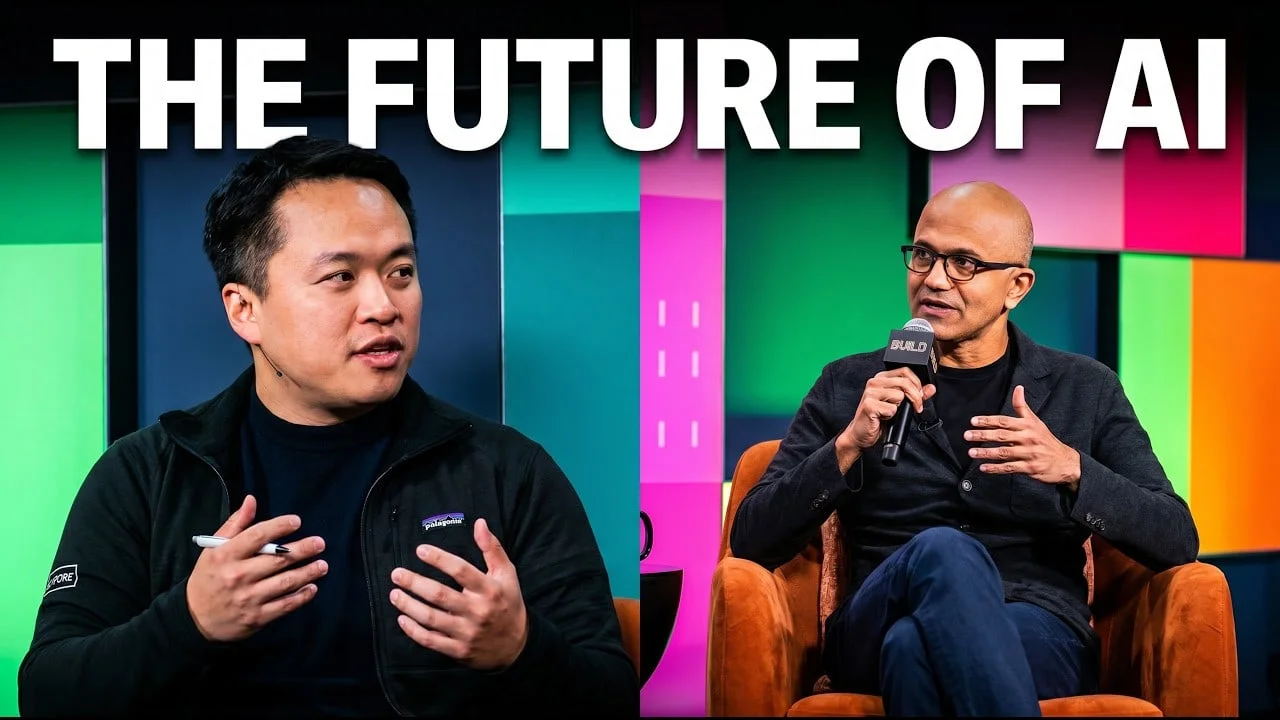
Satya Nadella sat down with No Priors hosts Sarah Guo and Elad Gil and Latent Space host Swyx for a 41-minute crossover episode recorded immediately after Microsoft's Build 2026 keynote. The conversation is worth reading carefully, because Nadella is precise in a way that CEO keynotes usually aren't. His framing of what Microsoft is trying to do — and what he thinks most companies are still getting wrong — runs counter to several prevailing assumptions about how enterprise AI shakes out.
正在加载内容卡片…
The thing Microsoft actually announced
The headline from the morning's keynote was a new suite of models called MAI, but Nadella redirected quickly when that topic came up. The model release is less important, he argued, than what the models enable: a stack any company can use to build what he calls "frontier intelligence" — a version of the AI frontier that belongs to the company, not to whichever API they're subscribing to.
"If there was one tagline for this entire developer conference, it's: can everybody operate at the frontier with their frontier intelligence? Without it, why have a developer conference? I can just come and have you all worship at the altar of one model. That's not a developer conference."1
The contrast he's drawing is with the lab-centric model, where the game is "which frontier model wins and then everything else is downstream." Nadella thinks that's architecturally unstable — if the value is all captured at the model layer, enterprises never accumulate compounding advantage. His Build thesis is the opposite: value should be locked in by the company's own data, evaluations, and the harness it builds around whatever models it uses.
MAI models and the hill-climbing scaffold
On the MAI training strategy, Nadella described a two-part approach: start with extremely clean pretraining lineage (aggressive ablations to filter out benchmark-contaminated data), then wrap the model in a "hill-climbing scaffold" that lets companies specialize it for their own domain without requiring pretraining from scratch.2
The demo that illustrated this was something called the Land O'Lakes example: using GPT-5.5 as the teacher to collect traces, then hill-climbing a 5B reasoning model on those traces until it outperformed the original teacher on the domain. The implication is that "operating at the frontier" doesn't require access to the largest model — it requires a good hill-climb scaffold and private evaluation data that competitors can't reproduce.
What Nadella is betting on is that this makes even a small model with good proprietary training more valuable than a large generic model with no customization. That's a provocative claim in an industry currently obsessed with frontier capabilities, and the Land O'Lakes demo is the most concrete existence proof he offered.
Private evals as the new corporate IP
The argument Nadella kept returning to — and which Swyx crystallized as "Microsoft's third act is being the harness/evals company" — is that a company's private evaluations may now be its most important intellectual property.1
The logic runs like this: public evals (benchmarks) are saturated. Every model scores well on them because everyone trains to them. What can't be replicated is a company's private eval — the dataset of tasks, judgments, and traces that accurately measures whether a model is actually useful for your specific workflows. If you can build an eval, use any frontier model to hill-climb against it, then switch to a different model without losing your eval-based advantage, you have model portability. If you can't, you're locked into whoever's model trained on your data.
The practical prescription Nadella offered: "You have an eval that's private. You're using model A. Can you switch it to model B and hill climb up? If you can, then you're in control. If you can't, you're not."
This is an interesting counter to the "hyperscaler lock-in" narrative that dominates enterprise AI coverage. Nadella's Microsoft is explicitly arguing against lock-in to any single model — including its own.
What's actually working: coding, autopilots, and Work IQ
Nadella named three categories of real-world deployment where he sees measurable value being created:
Coding agents have worked so well that they've created a new problem. Microsoft is rebuilding the IDE because running 100 parallel agent sessions transfers unsustainable cognitive load back to the developer. The chat-only interface and the canvas are both products of coding agents exposing the inadequacy of existing UI paradigms.
Long-running autopilots — agents that operate overnight on behalf of a user with delegated authority. Nadella's expectation: "Six months from now we'll all be saying, wow, all through the night there was a bunch of stuff that all these autopilots did on my behalf." He built his own chief-of-staff autopilot using Work IQ and a long-running Foundry agent with memory stored in Rayfin, then published it to Teams in one session.
Work IQ is what Nadella described as potentially the most underused corporate database: everything inside Microsoft 365 — emails, Teams conversations, Word docs, Excel models, meeting transcripts — now accessible to agents as structured context. He gave an example of querying a GitHub repo and asking an agent to cross-reference it with design meeting transcripts from the past week and generate a change plan. Previously impossible to automate; now trivial.1
The through-line across all three is what Nadella calls "glue work" — the coordination and judgment tasks that constitute most enterprise human capital but that were previously unautomatable because they required context spread across fragmented systems.
SaaS unbundling, rebundling, and why pricing isn't settled
Sarah Guo asked about "agent euphoria" inside enterprises — teams so excited about what they can now build that they're canceling SaaS contracts and starting internal rebuild projects. Will it last?
Nadella's answer was more conditional than expected: we need to go through one full budget cycle before the equilibrium becomes visible. His framework: you should acquire a SaaS product if and only if the marginal cost of building and maintaining an equivalent yourself is higher. That calculus has genuinely changed, but maintenance costs — including the security debt that AI agents will increasingly surface and someone will have to fix — are still real.
On pricing models, he was blunt: nobody has figured this out yet, and every model has a time and a place.2 Per-user pricing was always a proxy for usage entitlements. Consumption pricing is where the market is heading. Outcome-based pricing sounds attractive until someone gets a good outcome and realizes they're giving away royalties. GitHub Copilot's recently-announced per-user pricing change was cited as evidence: the original pricing was designed for an interactive, task-level tool and was never built to account for users running 10,000 simultaneous agents all day.
The deeper restructuring he described is that SaaS companies will need to unbundle their current packaging — which baked together a data model, business logic, and UI — and rebundle in configurations that make sense when agents are the primary consumers. The data model and business logic (Power BI's semantic layer, a general ledger schema) remain valuable. The UI packaging assumption breaks.
Engineering roles and the hyper-leveraged generalist
Elad Gil asked whether the common prediction — that engineering collapses into four roles (agent managers, forward-deployed engineers, security engineers, and infrastructure specialists) — holds up.
Nadella agreed with parts of it, citing LinkedIn's internal restructuring: they built a new discipline called "full-stack builder," combining design, product management, and front-end engineering into broader-scope roles. The premise is that AI substantially expands what a single person can take on, so specialists can give themselves larger scope without losing their core edge.
But the prediction Nadella was most confident in was simpler: the generalist role is where the maximum returns will be. His framing: what used to be siloed knowledge work — creating a Word doc, building a spreadsheet, writing a presentation — now exists on the same continuum as building an app. A generalist with agent tools has higher leverage than any point-specialist who stays narrowly scoped.
He also noted that infrastructure is getting harder, not easier. Building the RLE (reinforcement learning environment) for Excel — a consumer app team — now requires distributed systems expertise. That's a new staffing challenge that doesn't fit the conventional "apps team" vs. "platform team" divide.1
Data centers, community permission, and the societal wager
The closing section of the conversation turned to data center buildout and societal impact, and Nadella was more candid here than is typical for a developer conference context.
His position: the entire buildout — "in the last 15 months, more Azure capacity than in the first 15 years" — requires what he called "community permission," and that permission has to be earned with tangible local benefits, not with promises. The relevant evidence is jobs during construction and after, tax base, energy pricing effects, and whether local communities actually experience the productivity gains.1
"The world is going to be very skeptical of tech and tech companies that say 'trust us, we've got it, the future is going to be glorious.' You kind of have to deliver tangible benefits. It's too important this time around. It's too much of the economy for it not to be the case."
On education — which Sarah Guo noted has seen less measurable AI impact than healthcare — Nadella's prediction was pointed: the next major education startup may not be an AI tutoring app but a new kind of university with a different credential structure, built around how AI has changed the path from learning to economic opportunity. He mentioned Alpha School as an example of someone already rethinking the pedagogy model from first principles.
What he left open
Three tensions in the conversation that Nadella acknowledged but didn't resolve:
- Model portability vs. first-party advantage: Microsoft argues companies should build harnesses that work with any model. But Microsoft also has MAI models it wants companies to use. The pitch is "use our harness, which runs any model including ours" — but how that plays out in practice when first-party product margins are at stake is unclear.
- One budget cycle is a long time: Nadella said enterprises need a full budget cycle to reach equilibrium on build-vs-buy. That's 12 months of SaaS vendors negotiating with customers in a state of deliberate uncertainty. For startups building in that space, it's a real planning risk he didn't fully address.
- Agent traces as balance sheet assets: Nadella's claim that company-veteran agents — trained on internal traces — should eventually go on the balance sheet is theoretically interesting but has no accounting infrastructure behind it. He acknowledged the SEC would need to develop standards for "token expertise." That's a long road from where accounting standards actually are.
The episode is available on the Latent Space and No Priors YouTube channels, and both versions include chapter markers with timestamps.
正在加载内容卡片…
围绕这条内容继续补充观点或上下文。