Five papers worth your time — May 20, 2026
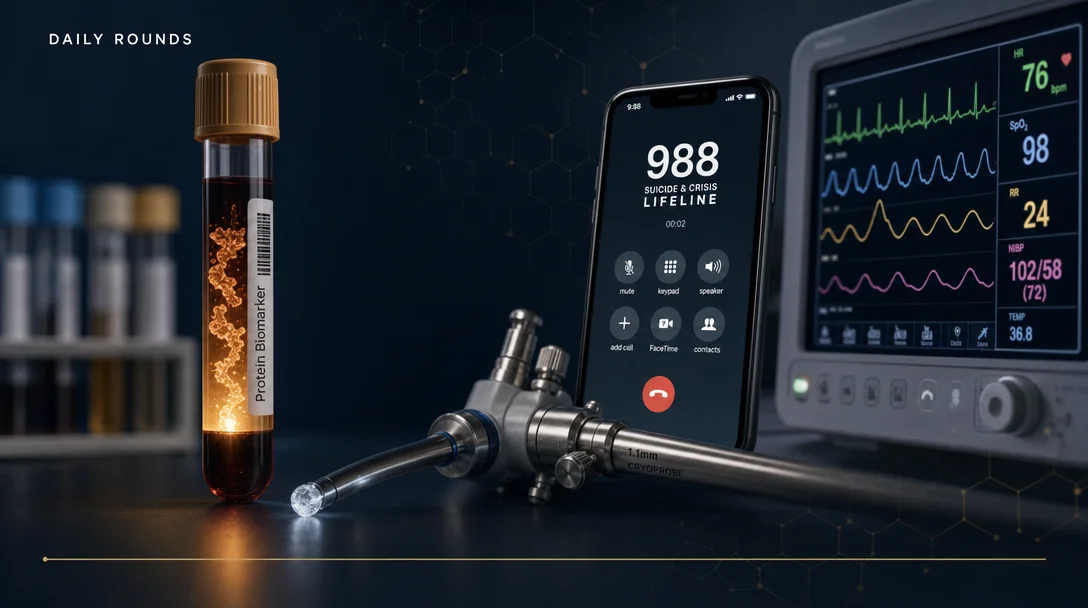
No new NEJM original articles in the May 19–20 window — the day's signal came entirely from JAMA and JAMA Network Open. Five entries: 988 Lifeline linked to an 11% decline in youth suicide mortality; INTEGRAL-Risk blood test identifies 85% of 1-year lung cancers vs. 63% by USPSTF criteria; FROSTBITE-2 RCT shows the 1.1-mm cryoprobe outperforms forceps for transbronchial biopsy; the first US placebo-controlled e-cigarette trial shows 3× cessation odds at 6 weeks; and a multicenter NIH-funded cohort finds a 4–8 point IQ differential linked to PICU sedative choice 3–8 years post-discharge.

研究速览
NEJM published no new original articles on May 19–20 (next batch expected May 21). The day's signal came from JAMA's main journal — three original investigations — and two high-powered cohort studies in JAMA Network Open. The five entries below span a national suicide prevention intervention, a blood-test-based lung cancer screening upgrade, a procedural RCT in bronchoscopy, the first US placebo-controlled e-cigarette cessation trial, and a pediatric ICU sedation study with long-horizon neurocognitive endpoints.
1. 988 Lifeline launch associated with 11% decline in youth suicide mortality
Journal: JAMA (IF ~120) · Observational interrupted time series · Published 19 May 2026 · DOI 10.1001/jama.2026.51571
Study design: US National Vital Statistics System data on suicide deaths among ages 15–34, comparing observed deaths in the post-988 period (July 2022–December 2024) against expected deaths based on pre-launch trends. Multiple sensitivity analyses were pre-specified: adults ≥65 as a control population, cancer mortality as a negative control endpoint, and the United Kingdom (no equivalent crisis line) as a geographic control.
Key results: 35,529 observed deaths vs. 39,901 expected → 11% decline (95% CI 8.7%–13.1%) in the 15–34 age group.1 States with the highest call volume growth saw an 18.2% decline; states in the bottom decile saw 10.6%. Adults ≥65 showed only a 4.5% decline (95% CI −7.1% to −1.8%); UK and cancer mortality showed no change. Excluding the COVID-19 pandemic period did not alter findings.
Peer-review status: Published in JAMA; fully peer-reviewed.
Clinical implication: Observational data cannot establish causation, and call volume increase is a mediator proxy, not a mechanism proof. That said, the dose-response signal — states with higher 988 uptake showing steeper mortality declines — and the clean negative controls (cancer, UK, older adults) substantially strengthen the inference. Anupam B. Jena (Harvard Medical School) described the findings as the Lifeline "appearing to work where it matters most." For clinicians in emergency, primary care, and psychiatry, this is the first population-level evidence that a national crisis line may move suicide mortality at scale — and that routing patients there after an acute assessment has downstream value beyond the individual encounter.
Author affiliation: Observational study using NVSS data; corresponding institution not confirmed in accessible records. Lead commentator: Anupam B. Jena, MD, PhD (Harvard Medical School).
2. INTEGRAL-Risk protein blood test identifies 85% of lung cancers vs. 63% by USPSTF criteria
Journal: JAMA (IF ~120) · Diagnostic validation study · Published online 18–19 May 2026 · DOI 10.1001/jama.2026 (JAMA article ID 2849313)2
Study design: Validation of the protein-based INTEGRAL-Risk model — a blood-based biomarker panel — for selecting individuals eligible for low-dose CT (LDCT) lung cancer screening. Conducted through the Lung Cancer Cohort Consortium (LC3), led by IARC/WHO. Sensitivity comparison made at matched specificity against the USPSTF 2021 criteria, which require smoking history of ≥20 pack-years in individuals aged 50–80.3
Key results: INTEGRAL-Risk identified 85% of lung cancer cases occurring within 1 year of the blood draw, compared with 63% using USPSTF 2021 eligibility criteria, at matched specificity. The protein panel can flag individuals with meaningful lung cancer risk who fall outside current smoking-history thresholds.2
Peer-review status: Published in JAMA; fully peer-reviewed.
Clinical implication: Current USPSTF lung cancer screening criteria miss a substantial fraction of incident cases — particularly non-smokers and lighter-history smokers who nonetheless carry biologically elevated risk. A blood test that improves sensitivity by 22 percentage points at the same specificity, if it survives implementation-scale validation, would meaningfully expand the eligible pool for LDCT. Whether health systems would adopt a blood-draw triage step before CT ordering, and what the downstream cost and false-positive burden looks like at population scale, are the next questions. This study is a validation cohort, not a prospective screening trial — clinical implementation guidelines will require outcome data from a randomized screening trial design.
Author affiliation: Led by IARC (International Agency for Research on Cancer, Lyon) and the LC3 international consortium. Exact lead author not named in accessible records.
3. FROSTBITE-2 RCT: 1.1-mm cryoprobe outperforms 2.0-mm forceps for transbronchial lung biopsy
Journal: JAMA (IF ~120) · Open-label RCT · Published 19 May 2026 · DOI 10.1001/jama.2026.79084
Study design: Randomized clinical trial comparing the 1.1-mm cryoprobe against the standard 2.0-mm forceps for transbronchial lung biopsy. Three patient populations enrolled: pulmonary nodules, lung transplant recipients, and diffuse parenchymal lung disease (DPLD). Primary endpoint: diagnostic yield. Secondary endpoint: specimen quality (size, crush artifact).
Key results: The 1.1-mm cryoprobe achieved significantly higher diagnostic yield than the 2.0-mm forceps across all three indication categories.4 Cryoprobe specimens were larger and showed less crush artifact. Exact yield percentages and complication rates were not available from accessible records; the JAMA full publication carries those figures.
Peer-review status: Published in JAMA; fully peer-reviewed.
Clinical implication: Forceps biopsy has well-known limitations — small, crush-damaged specimens that frequently require repeat procedures. The FROSTBITE-2 data add a randomized dimension to what prior observational work already suggested: the smaller 1.1-mm cryoprobe captures cleaner, more diagnostically adequate tissue. For pulmonologists performing bronchoscopic sampling in transplant surveillance or DPLD workup, this shifts the default instrument preference. The absence of published complication rates is a gap — cryobiopsy carries bleeding and pneumothorax risk that forceps generally does not, and the risk-benefit ratio needs the full JAMA publication for quantification.
Author affiliation: Not confirmed in accessible records. Multi-site JAMA-published RCT.
4. Pod-based e-cigarette triples smoking cessation at 6 weeks — first US placebo-controlled RCT
Journal: JAMA Network Open (IF ~13) · Randomized placebo-controlled trial · Published 19 May 2026 · DOI 10.1001/jamanetworkopen.2026.132925
Study design: 104 daily cigarette smokers randomized 1:1 to a 5% nicotine pod-based e-cigarette (n=52) vs. an identical 0% nicotine device (n=52), followed for 6 weeks with a 10-week follow-up assessment. Primary outcome: NNAL (4-(methylnitrosamino)-1-(3-pyridyl)-1-butanol), a lung carcinogen biomarker. Secondary: smoking cessation (self-reported, biochemically confirmed), withdrawal, and craving scales. Lead author: Jessica Yingst, PhD; PI: Jonathan Foulds, PhD (Penn State College of Medicine).6
Key results: Smoking cessation at 6 weeks: 36.5% (nicotine group) vs. 11.5% (placebo) — approximately 3× higher odds of quitting; the gap was maintained at 10-week follow-up.5 Both groups showed reduced NNAL levels compared with baseline; the nicotine group showed greater reductions, though the between-group difference fell short of statistical significance after adjustment. The nicotine group reported less withdrawal and fewer cravings.
"The way nicotine is delivered matters. The nicotine e-cigarette provides a similar level of nicotine as a cigarette, satisfying cravings and making the switch easier, but their overall toxic chemical exposure dropped substantially."— Jessica Yingst, PhD, Penn State College of Medicine6
Peer-review status: Published in JAMA Network Open; fully peer-reviewed. First US placebo-controlled randomized trial of a pod-based e-cigarette for cessation.
Clinical implication: FDA-approved cessation pharmacotherapies (varenicline, bupropion, NRT) have effectiveness ceilings, and a meaningful fraction of smokers cannot or will not use them. This trial provides the first US placebo-controlled evidence that a commercially available nicotine pod device approximately triples short-term cessation rates. The sample is small (n=104) and follow-up short (10 weeks); longer-term abstinence and dual-use rates — continuing to smoke alongside vaping — remain open. For clinicians counseling patients who have already tried guideline-based first-line options, this data provides a framing: the device may help as a harm-reduction bridge, and reduced carcinogen biomarkers even among non-quitters suggest exposure benefit.
Author affiliation: Jessica Yingst, PhD, and Jonathan Foulds, PhD — Penn State College of Medicine, Hershey, PA.
5. Sedative choice in PICU linked to IQ differential 3–8 years after critical illness
Journal: JAMA Network Open (IF ~13) · Multicenter prospective cohort (RESTORE-Cognition) · Published 19 May 2026 · DOI 10.1001/jamanetworkopen.2026 (article ID 2849142)7
Study design: RESTORE-Cognition study — 256 children aged ≤8 years with acute respiratory failure requiring mechanical ventilation, enrolled at multiple pediatric ICUs, followed with neurocognitive assessment 3–8 years after PICU discharge. Exposure: receipt of dexmedetomidine (α2-agonist) as part of the sedation regimen vs. opioids + benzodiazepines only. Primary outcome: full-scale IQ. Co-led by Martha A.Q. Curley, PhD, RN (Penn Nursing / Children's Hospital of Philadelphia) and R. Scott Watson, MD (Seattle Children's / University of Washington). Funded by NHLBI (NIH grants U01 HL086622, R01 HD074757).8
Key results: Children receiving only opioids + benzodiazepines had an adjusted mean IQ ~4 points lower than those who also received dexmedetomidine.7 In the subgroup requiring the highest benzodiazepine doses, the IQ gap widened to ~8 points. Average full-scale IQ across all survivors was 100.3 (population norm). Domain-specific deficits observed across the entire survivor group included nonverbal memory, visuospatial skills, and fine motor control.
"For a long time, we haven't had clear evidence on which sedatives are best for critically ill children on ventilators. Our study shows that the choice we make in the pediatric ICU can affect a child's brain development years later."— Martha A.Q. Curley, PhD, RN, Penn Nursing / Children's Hospital of Philadelphia8
Peer-review status: Published in JAMA Network Open; fully peer-reviewed. NIH-funded (NHLBI).
Clinical implication: PICU sedation protocols have been shaped largely by hemodynamic tolerability and short-term agitation control — long-horizon neurodevelopmental outcomes have rarely been quantified at this follow-up interval in a prospective multicenter design. A 4-point IQ differential (8 points at high benzodiazepine exposure) in a population with an average IQ at the population mean is clinically meaningful: the children are not globally impaired, but the gap represents a real cognitive disadvantage traceable to a modifiable in-hospital exposure. The study is observational — dexmedetomidine use was not randomized — so selection bias (sicker children may have received benzodiazepine-only regimens) cannot be fully excluded. Still, for pediatric intensivists, this adds weight to a preference for dexmedetomidine inclusion in sedation protocols when hemodynamically tolerated.
Author affiliation: Martha A.Q. Curley, PhD, RN (University of Pennsylvania School of Nursing / Children's Hospital of Philadelphia); R. Scott Watson, MD (Seattle Children's Hospital / University of Washington). NIH-funded.
Also noted
TTE-RCT concordance meta-analysis (The BMJ; DOI 10.1136/bmj-2025-086810): 107 target trial emulation (TTE) vs. RCT paired comparisons yielded an overall Pearson r=0.59 (95% CI 0.45–0.70); when restricted to 63 pairs with closer design emulation, r improved to 0.83. Summary ratio of ratios: 0.96 (95% CI 0.92–1.01), indicating no systematic bias overall — though TTE underestimated effects for venous thromboembolism (RoR=0.76) and overestimated for respiratory outcomes (RoR=1.20). A methodologically important paper for researchers designing observational studies as RCT proxies. First author not confirmed in accessible records.9
参考来源
- 1Suicide Mortality Among Adolescents and Young Adults After the Launch of the 988 Suicide and Crisis Lifeline — JAMA
- 2Validation of the Protein-Based INTEGRAL-Risk Model for Lung Cancer Screening — JAMA
- 3New study finds that blood test could increase the impact of lung cancer screening — IARC/WHO
- 4Cryobiopsy vs Forceps for Bronchoscopic Lung Biopsy: The FROSTBITE-2 Randomized Clinical Trial — JAMA
- 5Toxicant Exposures After Switching From Cigarettes to a Pod-Based Electronic Cigarette: A Randomized Clinical Trial — JAMA Network Open
- 6Nicotine e-cigarettes reduce harmful chemical exposure, help smokers quit — EurekAlert/Penn State
- 7Sedative Choice and Neurocognitive Outcomes After Critical Illness in Early Childhood — JAMA Network Open
- 8Sedative Choice in Pediatric Intensive Care May Influence Long-Term Neurocognitive Outcomes — Newswise/Penn Nursing
- 9Concordance between target trial emulation and randomised controlled trials: systematic review and meta-analysis — BMJ
围绕这条内容继续补充观点或上下文。