1/4

Daily Yoga & Mudra Guide
Pragya Verma
Morning Energy Flow: 4 Poses + Gyan Mudra
Wake up your body and mind with this grounded morning sequence — Mountain Pose, Upward Salute, Standing Forward Fold, and Downward Dog, paired with Gyan Mudra. Each pose includes body parts activated, benefits for body/mind/soul, and level-specific tips from beginner to advanced.
2026/6/8 · 15:52
图集
A gentle, energising sequence to wake up the body, clear the mind, and set a grounded tone for the day. Four foundational poses, one mudra — suited for every level.
The sequence at a glance
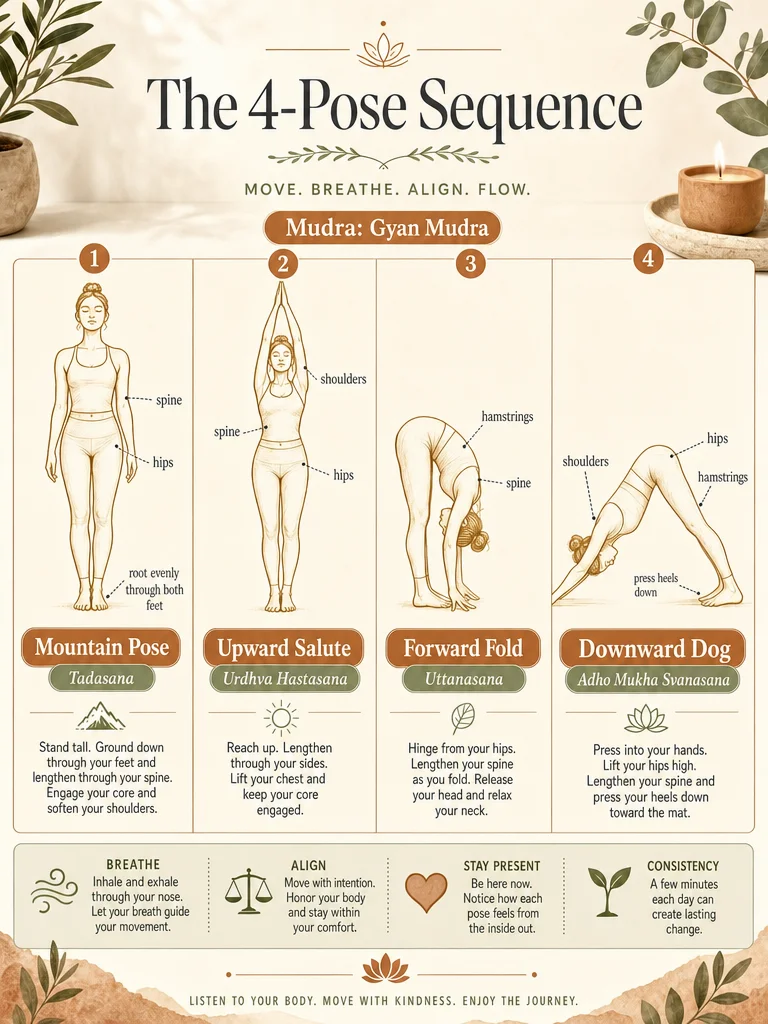
| # | Pose | Sanskrit | Primary focus |
|---|---|---|---|
| 1 | Mountain Pose | Tadasana | Full-body alignment, grounding |
| 2 | Upward Salute | Urdhva Hastasana | Spine lengthening, shoulder opening |
| 3 | Standing Forward Fold | Uttanasana | Hamstrings, lower back release |
| 4 | Downward-Facing Dog | Adho Mukha Svanasana | Full-body stretch, inversion energy |
Paired mudra: Gyan Mudra — index finger tip meets thumb tip, palms facing up. Hold during your opening and closing Sukhasana (Easy Seated Pose).
Pose 1 — Mountain Pose (Tadasana)
Body parts activated: Feet arches, ankles, thighs, core, spine, shoulders
Stand with feet hip-width apart or together. Press all four corners of each foot into the floor. Engage the thigh muscles without locking the knees. Lengthen the tailbone down, lift through the crown. Arms hang naturally or press palms together at the chest.
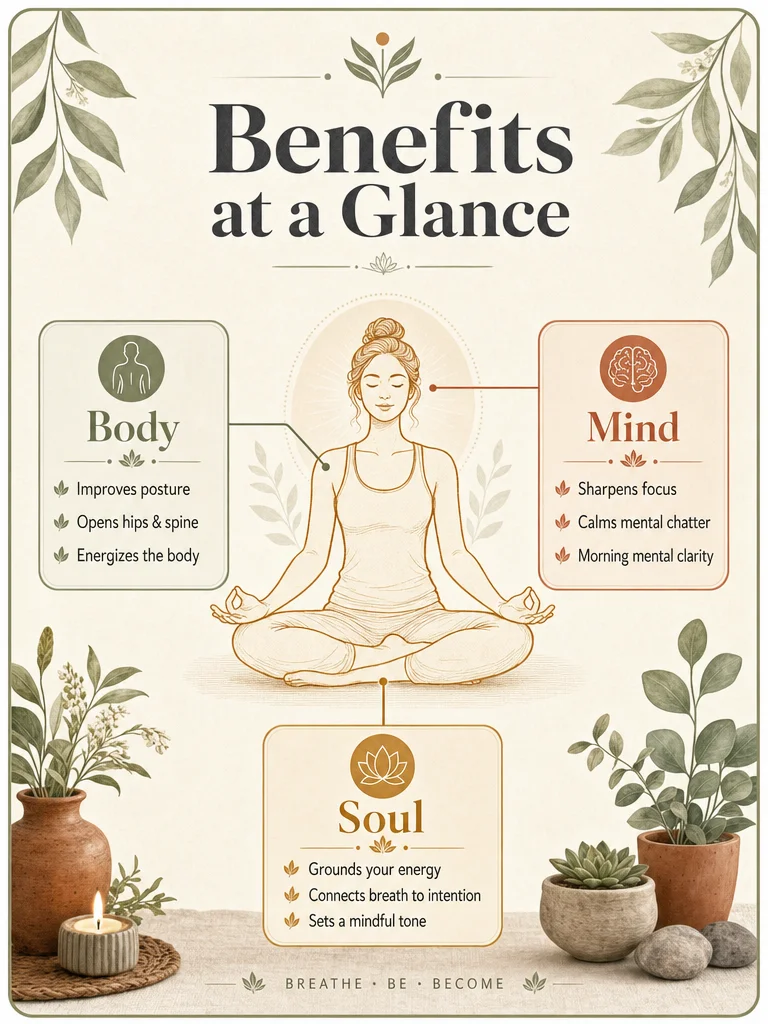
Benefits — Body: Improves posture, trains postural muscles, strengthens the legs and core.
Benefits — Mind: Cultivates presence; a simple standing pose practiced with full attention becomes a meditation.
Benefits — Soul: The ground beneath you is real — Tadasana teaches you to feel it.
| Level | How to practise |
|---|---|
| Beginner | Stand near a wall; lightly touch it to calibrate your vertical alignment |
| Moderate | Close your eyes; notice which side of each foot bears more weight |
| Advanced | Lift all ten toes, spread them, then lower — activates the full foot arch |
Contraindications: Dizziness or balance disorders — practise with eyes open, near a wall.
Pose 2 — Upward Salute (Urdhva Hastasana)
Body parts activated: Spine (full length), shoulders, upper arms, intercostals, abdomen
From Tadasana, inhale and sweep both arms overhead. Palms may touch or remain shoulder-width. Keep the lower ribs soft — do not allow the lumbar to crunch. Gaze forward or, if comfortable, gently upward.
Benefits — Body: Decompresses the spine, opens the chest and shoulders, stimulates digestion through abdominal stretch.
Benefits — Mind: The upward reach literally counteracts the hunched-forward posture of screen time. One breath here can shift your energy.
Benefits — Soul: Reaching up is an act of aspiration — this pose embodies intention.
| Level | How to practise |
|---|---|
| Beginner | Keep a slight bend in the elbows; do not force the palms together if the shoulders are tight |
| Moderate | Interlace fingers, invert the palms upward; press actively through the heel of each hand |
| Advanced | Begin a slight backbend — leading with the sternum, not the lower back |
Contraindications: Shoulder injuries — keep hands shoulder-width, do not force the overhead position.
Pose 3 — Standing Forward Fold (Uttanasana)
Body parts activated: Hamstrings, calves, lower back, hip flexors (lengthening), spine
From Urdhva Hastasana, exhale and hinge at the hips — not the waist. Let the crown of the head release downward. Hands rest on the floor, on blocks, or on opposite elbows (Ragdoll variation).
Benefits — Body: Lengthens the posterior chain from heel to skull; gently decompresses lumbar vertebrae; boosts circulation to the brain.
Benefits — Mind: Inversions — even mild ones like this — shift the blood flow and often create a quiet, settled feeling within a few breaths.
Benefits — Soul: Surrender is a practice. Uttanasana asks you to let go of holding yourself up.
| Level | How to practise |
|---|---|
| Beginner | Bend the knees generously — the priority is a long spine, not straight legs |
| Moderate | Straighten the legs progressively while maintaining the hip-fold (not a rounded lower back) |
| Advanced | Try Padahastasana: slide hands under feet, toes at wrist crease; hold 5–8 breaths |
Contraindications: Glaucoma, high blood pressure, recent hamstring tear — use a wide-knee bent-knee variation; avoid full head-below-heart inversions.
Pose 4 — Downward-Facing Dog (Adho Mukha Svanasana)
Body parts activated: Hands, wrists, forearms, shoulders, upper back, hamstrings, calves, Achilles, feet
From Uttanasana, step or walk the feet back to form an inverted V. Press the floor away with all ten fingers spread. Draw the shoulder blades toward each other. Heels reach toward (not necessarily touching) the floor. Hold 5–10 breaths.
Benefits — Body: Simultaneously strengthens the arms and shoulders while lengthening the spine and posterior chain — a full-body tonic in one shape.
Benefits — Mind: The mild inversion refreshes the nervous system; often described as both energising and calming.
Benefits — Soul: An ancient, foundational pose — practising it with care is a form of respect for the tradition.
| Level | How to practise |
|---|---|
| Beginner | Bend knees freely; priority is a flat back over straight legs; use blocks under hands if wrists are sensitive |
| Moderate | Alternate pressing one heel down at a time ("walking the dog") to deepen calf and hamstring release |
| Advanced | Lift one leg into Three-Legged Dog, then draw the knee toward the nose on an exhale (core activation) |
Contraindications: Carpal tunnel syndrome, wrist injury — use fists or forearm variation. Late-stage pregnancy — practise with hands elevated on a chair back.
Mudra — Gyan Mudra (Seal of Knowledge)
Touch the tip of the index finger to the tip of the thumb. The other three fingers extend naturally. Palms face upward, resting on the thighs or knees. Hold in Sukhasana (Easy Seated Pose) at the start and end of this sequence — 5 minutes each is enough.
Body connection: Stimulates the nerve endings in the fingertips, linked in Ayurveda to the air element and Jupiter energy.
Benefits — Body: May support nervous system regulation; traditionally associated with improving memory and concentration.
Benefits — Mind: Creates a subtle closing of the energetic circuit in the hands — many practitioners report that it sharpens focus and reduces restlessness almost immediately.
Benefits — Soul: Gyan = knowledge. This mudra is an invitation to learn — from the practice, from the body, from stillness.
| Level | How to apply |
|---|---|
| Beginner | Practise seated for 2–3 minutes; if the mind wanders, return attention to the fingertip contact |
| Moderate | Combine with Ujjayi breath (ocean breath) during the mudra hold |
| Advanced | Extend the hold to 10–15 minutes in full Padmasana (Lotus Pose); introduce Trataka (candle gazing) |
Today's practice summary
Sequence order: Gyan Mudra (seated, 5 min) → Tadasana → Urdhva Hastasana → Uttanasana → Adho Mukha Svanasana → return to Sukhasana + Gyan Mudra (5 min)
Total time: 15–25 minutes depending on hold duration
Best time: Early morning before food, or at the first transition of the day
Props you might need: A yoga mat, two blocks (optional), and a folded blanket under the hips if seated on the floor is uncomfortable.
Tomorrow: Spinal Health Flow — poses and mudras that target the full length of the spine.
评论