V-22 Osprey: engineering an aircraft that can't decide what it is
The V-22 Osprey is the only production aircraft that can hover like a helicopter, cruise at 500 km/h like a turboprop, and land on a ship without a runway. This case study traces every major design compromise that made that combination possible — from the 47° blade-twist proprotor and its 150 kg/m² disk loading, to the six-segment cross-shaft with 0.2 mm steel diaphragm couplings, to the fly-by-wire modal blending that transitions control laws continuously through the nacelle arc — and examines the vortex-ring-state and no-autorotation penalties that define the aircraft's safety envelope.
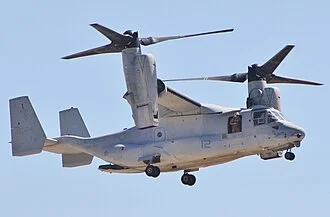
Image from Bell Boeing V-22 Osprey — Wikipedia
Every engineering programme is shaped by the problem it was built to solve. For the V-22 Osprey, that problem arrived on the night of April 24, 1980, in an Iranian desert, and it did not go well.
The failure that wrote the requirement
Operation Eagle Claw was the U.S. military's attempt to rescue 52 American hostages held inside the Tehran embassy. The plan required eight Navy RH-53D Sea Stallion helicopters to fly from USS Nimitz, some 96 km off the Iranian coast, to a desert staging point called Desert One — a distance that was already at the edge of the Sea Stallion's practical range. Tehran itself was roughly 1,400 km from the carrier, mandating a mid-desert refuelling stop that added logistical exposure the planners accepted as unavoidable. 1
A haboob — a wall of blowing desert dust — grounded two helicopters before they reached Desert One. A third was found to have a cracked rotor blade and was abandoned. That left five operational aircraft, one short of the commander's minimum of six. The mission was aborted on the ground. During the withdrawal, one helicopter struck a C-130 tanker, killing eight service members and ending any chance of a second attempt that night. 1
The lesson the military drew was blunt: conventional helicopters could land anywhere, but they could not reach deep targets quickly without high-risk refuelling stops. 2 What the Pentagon needed, as Wikipedia's summary of the post-mortem put it, was "a new type of aircraft, that could not only take off and land vertically but also could carry combat troops, and do so at speed." 1
The Joint-service Vertical take-off/landing Experimental (JVX) programme launched in 1981. Bell and Boeing Vertol submitted the only complete proposal, based on Bell's existing tiltrotor research, and were awarded a preliminary design contract in April 1983. The aircraft was named V-22 Osprey in January 1985. 1
Forty years of prototypes — from the XV-3's vibration crisis to the XV-15
Bell had been working on tiltrotor concepts since the early 1950s. The XV-3, developed in that period, put the piston engine inside the fuselage, behind the pilot, and drove two rotors mounted on slender stub pylons. In helicopter mode the machine flew acceptably. In conversion — when the rotors were transitioning from vertical to forward flight — the dynamic coupling between the spinning discs and the thin pylons generated rotor oscillations severe enough to knock test pilot Dick Stansbury unconscious, destroying the first prototype. 3
The XV-15, which first flew on May 3, 1977, solved this by moving the engines entirely to the wingtips. Shortening the mechanical path between engine and rotor eliminated the resonance problem. The XV-15's other key contribution was its synchronisation architecture: a cross-shaft running through the wing kept both rotors turning in phase, and an automatic clutch could transfer all power from one engine to both rotors if the other failed. Both features were directly inherited by the V-22. 4 The XV-15 reached a FAI speed record of 456 km/h (283 mph) and flew until 2003, giving engineers over two decades of data on what a production tiltrotor would need to do. 4
When the New York Times covered the XV-15 at the 1981 Paris Air Show, the reporter called it "the hit of the show" and "the most lovable plane" at the event. That was the engineering proof of concept. The V-22 would have to turn it into a warfighting machine.
The proprotor — every dimension is a settled argument
The most visible design decision on the V-22 is also the most constrained: the diameter of the proprotor (Bell's term for a rotor that must function both as a helicopter rotor and as an aircraft propeller). 2
A helicopter rotor is large — the CH-53E Sea Stallion's main rotor spans 21 m — because helicopters generate lift from rotor disc area, and bigger discs mean lower disk loading and better hover efficiency. A propeller is small, around 4 m on a C-130, because its job is to push the aircraft forward, not support its weight. The V-22's proprotor had to do both. Bell settled on 11.6 m (38 ft) — large enough to hover with meaningful payload, small enough that two could fit on a practical airframe without the tips colliding with the fuselage in flight. 2
The disk loading that results — approximately 150 kg/m² — is three times that of the UH-60 Black Hawk (around 50 kg/m²). 2 That gap shows up as a penalty at every hover: the V-22 requires significantly more power per unit of lift, its downwash reaches approximately 150 km/h (roughly 80 knots — Category 5 hurricane territory), and deck operations demand that ground crew stay well clear of the rotor disk. There is no way to recover this penalty within the tiltrotor concept; it is the direct arithmetic consequence of using a proprotor instead of a dedicated helicopter rotor.
The blade geometry is equally compromised. Helicopter blades are twisted 8–14° along their length to compensate for the fact that the blade tip travels faster than the root and would otherwise generate more lift at the tip than the root. The V-22's blades are twisted 47°. 2 At cruise speed in airplane mode, the incoming airstream combines with the blade's rotational velocity such that blade-tip airflow approaches supersonic. A 47° twist ensures that even at those conditions the entire blade span still generates useful lift rather than just the inner portion. As Real Engineering's Brian McManus put it: "These are small helicopter blades, but absolutely massive propellers." 2
The proprotor yoke — the hub structure that connects the blades to the gearbox — is made from S-2 fibreglass (a magnesium-aluminosilicate glass fibre composite), not carbon fibre. Carbon fibre is stiffer and stronger, but the yoke's job is to absorb and transmit oscillating centrifugal loads from the blades without exciting resonance in the structure. S-2's lower mechanical impedance makes it better at damping those loads. 2 The same material is used in high-performance vaulting poles and golf club shafts — the shared characteristic is vibration absorption rather than peak strength.
Each V-22 is powered by two Rolls-Royce AE 1107C-Liberty turboshaft engines, each rated at approximately 7,000 shp (shaft horsepower). 2 The gearboxes reduce engine output to proprotor speed: 412 rpm in helicopter mode, 333 rpm in cruise. A deliberate extra gear on the right-side gearbox makes the two rotors counter-rotate, cancelling the adverse rolling moment that would otherwise build up from two large gyroscopes spinning the same direction at the wingtips. 2 The engine intakes include inertial particle separators that exploit the mass difference between clean air and sand — the intake forces a sharp turn that clean air follows but sand cannot, routing debris out of a bypass duct before it reaches the turbine.
The cross-shaft — six segments connecting two flight modes
The V-22's cross-shaft runs through the forward-swept wing, linking both wingtip gearboxes. In normal flight it carries almost no torque: each engine drives only its own proprotor. If one engine fails, an automatic clutch disconnects it and the cross-shaft transmits all remaining power from the live engine to both rotors, keeping the aircraft controllable for a single-engine landing. 2
The shaft is a six-segment assembly. It must accommodate the wing's 13° forward sweep, a 3.5° dihedral (upward angle), the rotation of the nacelle as the aircraft transitions between modes, the elastic bending of the wing under aerodynamic load, and the whole wing's 90° rotation when the aircraft stows on a ship. Transmitting those rotations along a shaft that is never perfectly straight required a solution that no helicopter had needed before: multi-disk convoluted diaphragm flexible couplings. Each coupling is a stack of 0.2 mm stainless steel discs that can flex slightly out of alignment without fracturing. 2
McManus observed of these couplings: "In 25 hours this 0.2 mm thick disk goes through 10 million revolutions, and deals with being shoved, shook, and bent out of alignment over and over again." 2 They require no lubrication — a significant improvement over the XV-15's greased gear couplings — and a maintenance crew can hear a failing diaphragm before it fractures. Even with a failed coupling, the aircraft can continue flying at maximum torque for five hours, giving crew time to reach a suitable landing site. 2
The nacelle tilt mechanism uses a double telescoping screw driven by a hydraulic motor rather than a gear drive. Gears were rejected because the small gear faces that would be needed to handle the torque loads at the required speeds would wear and crack. The screw spreads the load across a larger contact area. A single large screw would create an unacceptable single-point failure — a jammed screw in the airplane-mode position would leave the aircraft unable to land vertically. Two telescoping screws provide redundancy. 2
The load on the nacelle screw reverses direction during the transition. In helicopter mode (nacelle at 90°), gravity tries to push the nacelle forward toward airplane mode, putting the screw in compression. As the nacelle passes about 80° on the way down, aerodynamic drag takes over and the net load reverses to tension. Near 45° it reverses again back to compression as the nacelle approaches the forward-locked position. The screw must handle all three phases per flight cycle. 2
Controlling an aircraft that transitions between two fundamentally different flight modes required fly-by-wire from the outset. In hover, the thrust control lever acts as collective pitch — it changes rotor blade angle to control altitude. In cruise, the same lever controls engine power and therefore airspeed, with altitude handled by the elevators. McManus called it accurately: "A fly by wire system was the only option to allow the control logic to flip like this." 2 The pilot commands the nacelle angle with a thumb wheel; the FBW computer blends helicopter and airplane control logic continuously through the transition rather than switching abruptly between them.
Composite structure — 45% carbon fibre before it was standard
V-22's structural weight is approximately 6,000 kg, of which roughly 2,700 kg (45%) is carbon fibre-reinforced epoxy. 2 The wing uses the stiffer IM-6 graphite/epoxy grade to handle the highly variable bending loads imposed by proprotor downwash and gust loads in two very different flight regimes. The fuselage and tail use the slightly less stiff AS4 graphite/epoxy. The distinction matters: IM-6 is harder to work with but resists the higher peak strains the wing sees. 2
The blade leading edges use two different protection strategies. For the inner three-quarters of each blade, hot-formed titanium strips are bonded to the leading edge — titanium is tough enough to absorb erosion from rain and sand without cracking, and light enough not to upset the blade's mass balance. The outermost section of each blade, where tip velocity is highest and impacts are most energetic, uses electroformed nickel caps instead. Nickel is harder and better at resisting high-velocity particle impact at the cost of additional weight, an acceptable trade at the blade tip where the structural loads are lower. 2
For shipboard stowage, the V-22 must fold its blades and rotate its entire wing 90° until it lies parallel to the fuselage. The folded height drops to 5.51 m (18 ft 1 in), fitting the aircraft into a standard carrier hangar. 1 The wing's 3.5° dihedral is not primarily aerodynamic — it ensures that when the wing rotates on its pivot ring the nacelles clear the fuselage without clipping it. The auxiliary power unit, central gearbox, and hydraulic pump all live inside the rotating wing section, which avoids routing high-pressure hydraulic fluid through the rotating joint. Wikipedia notes that part of the programme's cost growth was directly attributable to the folding requirement. 1 The fold cycle takes about 90 seconds.
In 1986, 45% composite construction was unusual enough that NASA produced a dedicated report on the state of the art in V-22 manufacturing. Automated fibre placement machines built the first three rear fuselage sections; the process is now routine, but the V-22 programme was an early industrialisation of what became the standard technique for large aerostructures. 2
Key specifications
| Parameter | Value |
|---|---|
| Proprotor diameter | 11.6 m (38 ft) each |
| Empty weight | 14,432 kg (31,818 lb) |
| Max vertical take-off weight | 23,859 kg (52,600 lb) |
| Max speed (airplane mode) | ~500 km/h (270 kn) |
| Engines | 2× Rolls-Royce AE 1107C-Liberty, ~7,000 shp each |
| Proprotor speed — helicopter mode | 412 rpm |
| Proprotor speed — cruise | 333 rpm |
| Disk loading | ~150 kg/m² |
| Blade twist | 47° |
| Composite fraction (structural weight) | ~45% (2,700 kg of 6,000 kg) |
| Troop capacity (MV-22, seated) | 24 fully equipped personnel |
| Internal cargo | up to 9,070 kg (20,000 lb) |
| Wing folded height | 5.51 m (18 ft 1 in) |
The vortex ring problem — and what you lose without autorotation
The V-22's most publicised aerodynamic hazard is the vortex ring state (VRS). In any rotary-wing aircraft, descending too quickly causes the downwash from the rotor to recirculate back up through the disc — the rotor starts chasing its own wake. When this happens, the centre of the disc, where blade speed is lowest, stalls first. Lift drops abruptly and the aircraft accelerates further downward, worsening the condition. 6
Conventional helicopters can escape VRS by accelerating forward or sideways, breaking out of the recirculating wake. The V-22 can do this too, but the consequences of triggering VRS in the first place are worse because the proprotor disc is smaller relative to the aircraft's mass — it loads up faster. On April 8, 2000, an MV-22 entering a steep training approach in Marana, Arizona entered VRS and impacted the ground, killing 19 Marines. The programme was grounded for investigation. Following that crash, the V-22's maximum descent rate was operationally restricted to 4 m/s in helicopter mode. 1 6
The second structural limitation is the absence of a reliable autorotation capability. In a conventional helicopter with a single engine failure, the pilot can lower collective pitch, allowing the rotor to spin freely driven by the upward airflow during the descent. The stored rotational energy in the rotor disc is then used to flare and cushion the landing. The V-22's proprotor has two problems with this approach: its rotational inertia is too low to store enough energy for a useful flare, and its 47° blade twist makes the aerodynamic energy harvesting during the descent far less efficient than on a conventional blade. In a dual engine failure, V-22 crews have no reliable emergency landing mode. 2 6
For single-engine failures, the cross-shaft handles the problem — the remaining engine drives both proprotors and the aircraft can land normally. The gap in the safety envelope is the dual-failure case, which designers accepted as an acceptable risk on statistical grounds.
The V-22's gear health monitoring relies on magnetic chip detectors in the gearbox oil circuits. Metal particles collect on a small magnet; when a chip bridges two electrical contacts, a pulse is supposed to burn it away. If a chip is too large to burn, the system alerts the crew. This process was working as designed on November 29, 2023, when a CV-22B operated by the 353rd Special Operations Wing reported five successful chip burns and then a sixth that the system could not clear. The crew elected to divert to Yakushima Airport, a 15-minute flight, rather than the nearest available field. Three minutes before landing, the left nacelle caught fire. Six seconds later the aircraft struck the water, killing all eight crew members. 7 Post-crash examination confirmed catastrophic failure of the left proprotor gearbox — the chip detector had been working correctly throughout. As McManus put it: "From that point forward, the crew could not have done anything to save the aircraft." 6
The entire global V-22 fleet was grounded for three months. A new proprotor gearbox design — the version-123 unit, using triple-melt X-53 steel to reduce the metallurgical inclusions that can initiate fatigue cracks — began fleet installation in January 2026. The V-22 Joint Programme Office (JPO) plans to complete the full fleet retrofit by 2027, at which point the current 30-minute divert-airfield proximity restriction is expected to be lifted. 7
Placed in statistical context, the V-22's safety record is not an outlier among large military rotorcraft. Since 1991, the aircraft has recorded 25 accidents (9 attributed to pilot error, 10 to mechanical failure, 2 to both, 2 still under investigation), resulting in 58 deaths and 52 injuries. 2 Its per-airframe accident rate of 0.0625 is lower than the H-60 Black Hawk (0.075) and the CH-47 Chinook (0.11). The H-60, in service since 1979, has accumulated 390 accidents and 970 deaths. 2 The V-22's fatality-per-flight-hour figure is elevated compared to both of those aircraft, but that reflects the arithmetic of a large aircraft — more people aboard means more deaths per accident, not a higher rate of accidents. McManus described the data clearly: "the V-22's safety record is not an outlier." 2
26 years and $84 million per airframe
The programme's budget history is a useful measure of how hard the engineering turned out to be. The initial full-scale development contract, awarded to Bell-Boeing in May 1986, was valued at $1.714 billion. 1 By 1988, before the first flight, projected programme costs had already risen to $30 billion. By 2008, the programme had spent $27 billion and needed another $27.2 billion to complete planned production. 1
The 2008 flyaway cost per aircraft was approximately $67 million; the average procurement unit cost, including development amortisation, was approximately $88.5 million per the Congressional Research Service. 8 In 2002 the Brookings Institution's Michael O'Hanlon calculated that V-22 production cost was roughly twice that of a CH-53E, which has a larger payload and can carry heavy equipment the V-22 cannot. His conclusion: "Its production costs are considerably greater than for helicopters with equivalent capability." 1
Between 1989 and 1992, Defense Secretary Dick Cheney tried four times to cancel the programme. Congress overrode him each time, inserting unrequested funding into the defence budget. 2 Two fatal crashes in 2000 — Marana in April (19 Marines killed) and a hydraulic-fire crash in December (4 killed) — suspended the programme again. It resumed after a redesign period that ran through 2005. The MV-22B reached Initial Operational Capability with the Marine Corps on June 13, 2007: 26 years after JVX was authorised. 1
NAVAIR's case for the cost was capability-based. Compared to the CH-46E Sea Knight it replaced, the V-22 delivers roughly twice the speed, six times the range, and three times the payload. 5 No rotorcraft in that price bracket comes close to those numbers.
Legacy — what the V-22 changed, and where the fleet stands now
The V-22 did something no previous tiltrotor had done: it operated continuously in a combat environment over two decades, accumulating more than 500,000 flight hours by 2019. 1 That operational mass validated — or specifically quantified — every one of the design compromises made in the 1980s.
The cross-shaft flexible diaphragm coupling became a reference design for subsequent tiltrotors. The fly-by-wire modal blending approach — gradually mixing helicopter and airplane control laws through the nacelle arc — is now the baseline assumption for any conversion aircraft. The composite construction methods, unusual in 1986, became standard across commercial aviation within twenty years. 2
The lessons that did not transfer cleanly are equally instructive. Bell's V-280 Valor, selected by the U.S. Army in December 2022 for the Future Long-Range Assault Aircraft (FLRAA) programme with a $1.3 billion contract, redesigned the most maintenance-intensive part of the V-22: the nacelle assembly. In the V-280 — formally designated the MV-75 Cheyenne II in 2026 — only the rotors tilt; the engines remain fixed. This eliminates the requirement for the nacelle to house both the engine and the complex rotating-joint plumbing that accounts for approximately 60% of V-22 maintenance man-hours on the CV-22 variant. 7 The MV-75's cruise speed exceeds 300 knots (approximately 555 km/h), faster than the V-22. 1
On the civil side, the AgustaWestland AW609 — now the Leonardo AW609 — is a direct XV-15 descendant in commercial certification. Its tiltrotor configuration traces directly to the XV-15 test data.
Meanwhile, the existing V-22 fleet is undergoing its own evolution. Bell's Nacelle Improvement (NI) Programme, which began with nine CV-22s at Bell's Amarillo Assembly Center in 2021, redesigned over 1,300 part numbers in the nacelle: simplified wiring architecture, redesigned hinges, latches, and access panels, and a shift toward reusable components. The results — verified against more than 10,000 CV-22 flight hours — show a 75% reduction in maintenance man-hours and a 10%+ increase in readiness. 9 The programme saved AFSOC more than 24,000 maintenance hours (over 1,000 maintainer-days) across the first nine aircraft. 9
As of May 2026, AFSOC's 51-aircraft CV-22 fleet has 31 aircraft through the NI modification, with the remaining aircraft cycling through Amarillo. 7 Congressional testimony in May 2026 confirmed that the 56-aircraft CV-22 procurement programme of record was completed in August 2025, shifting programme focus from production to sustainment and capability upgrade. The FY2027 budget request allocated $167.9 million ($25.7M RDT&E, $142.2M procurement) for safety upgrades, specifically the new proprotor gearboxes, the NI rollout, and the Osprey Drive System Safety and Health Instrumentation (ODSSHI) — a real-time sensor suite designed to give pilots predictive warning of drivetrain degradation before it becomes a chip-detector emergency. 10
The V-22 JPO's stated goal is to sustain the fleet into the mid-2050s, potentially through VeCToR (V-22 Cockpit Technology Replacement, planned for the 2030s–2040s) and a broader midlife upgrade covering the drivetrain, airframe, and avionics. The V-22, first flown in 1989, may reach 60 years of operational service. 7
That longevity was not obvious in 1989, or in 2000, or in 2023. What has proven durable is the underlying requirement that created the programme: the need to place a fully equipped platoon deep inside a denied area faster than a helicopter, without a runway, from a ship. No other aircraft currently in production meets that specification. The V-22 remains the only solution to the problem Operation Eagle Claw made visible 46 years ago.
Cover image: MV-22 Osprey at MCAS Miramar 2014 air show. Image from Bell Boeing V-22 Osprey — Wikipedia
参考来源
- 1Bell Boeing V-22 Osprey — Wikipedia
- 2The Insane Engineering of the V-22 Osprey — Real Engineering
- 3The V-22's prototype was even more dangerous — Real Engineering
- 4Bell XV-15 — Wikipedia
- 5MV-22B Osprey — NAVAIR
- 6The V-22 Osprey and why it keeps crashing — Real Engineering
- 7Bell says CV-22 maintenance down 75% after nacelle rework — AeroTime
- 8V-22 Osprey Tilt-Rotor Aircraft Program — CRS Report RL31384
- 9Nacelle Improvement Elevates Bell Boeing V-22 Readiness — Bell Textron
- 10Department of the Air Force FY2027 Budget Request Testimony — HASC
围绕这条内容继续补充观点或上下文。