Geopolitics Daily Brief — June 4, 2026
Five stories at 08:00 UTC: USTR proposes 10–12.5% tariffs on 60 economies including China and the EU under a forced-labor probe (July 24 effective target), with a parallel $30bn US-China tariff-reduction track; Ukrainian drones strike St. Petersburg's oil terminal and a warship at Kronstadt on SPIEF opening day; Israel-Lebanon agree a new ceasefire with pilot security zones but Israeli strikes continue in south Lebanon and Gaza; Taiwan detects 32 PLA aircraft (25 cross the median line) and 10 vessels in 24 hours as its first submarine completes dive trials; Broadcom falls 14% after AI chip revenue guidance miss, Brent dips ~1% to $96.97 on ceasefire news.

Five stories at 08:00 UTC. Sources: Reuters, PBS/AP, France24, Bloomberg/SWI, ANI/Taiwan MoND.
1. US proposes fresh 10–12.5% tariffs on 60 economies — China and EU in scope
The Trump administration on Tuesday proposed new import duties under a forced-labor investigation, offering the clearest indication yet that it plans to rebuild the tariff wall the Supreme Court struck down in February.1 The Office of the US Trade Representative (USTR) proposed a 10% levy on 16 economies — including Canada, Mexico, the EU, the UK, and Taiwan — for failing to enforce forced-labor prohibitions at their borders. A steeper 12.5% rate would apply to 44 further partners, including China, Japan, India, South Korea, and Switzerland.2 Exemptions cover energy, rare earths, aviation parts, smartphones, autos, beef, coffee, and certain other foods. A public hearing is scheduled for July 7, with the current temporary tariffs expiring around July 24 — the same window USTR intends for the new levies to take effect.
China, labelled among the worst offenders, rejected the forced-labor framing and called for dialogue, though Beijing already faces an existing 20% levy on its US-bound goods. In parallel, USTR Jamieson Greer confirmed after the May 14–15 Trump–Xi summit that a new "Board of Trade" would oversee tariff reductions on roughly $30 billion in bilateral goods, following commitments on Boeing jets, GE engines, and agricultural purchases.3
Market and supply-chain impact. A fresh 12.5% surcharge on China — on top of existing levies — would raise the effective rate on most Chinese manufactures well above 30%. Apparel, electronics assembly, and chemical inputs are most exposed; exemptions covering semiconductors and rare earths were deliberately carved out to avoid disrupting AI-infrastructure supply chains. The simultaneous "Board of Trade" tariff-reduction track on $30bn in goods creates a split-track dynamic: escalation in low-value consumer goods alongside selective relief in strategic categories. Importers face deadline uncertainty until the July 7 hearing, likely freezing procurement decisions on unexempted product categories for the next four to six weeks.
2. Ukraine drones strike St. Petersburg oil terminal and warship as SPIEF opens
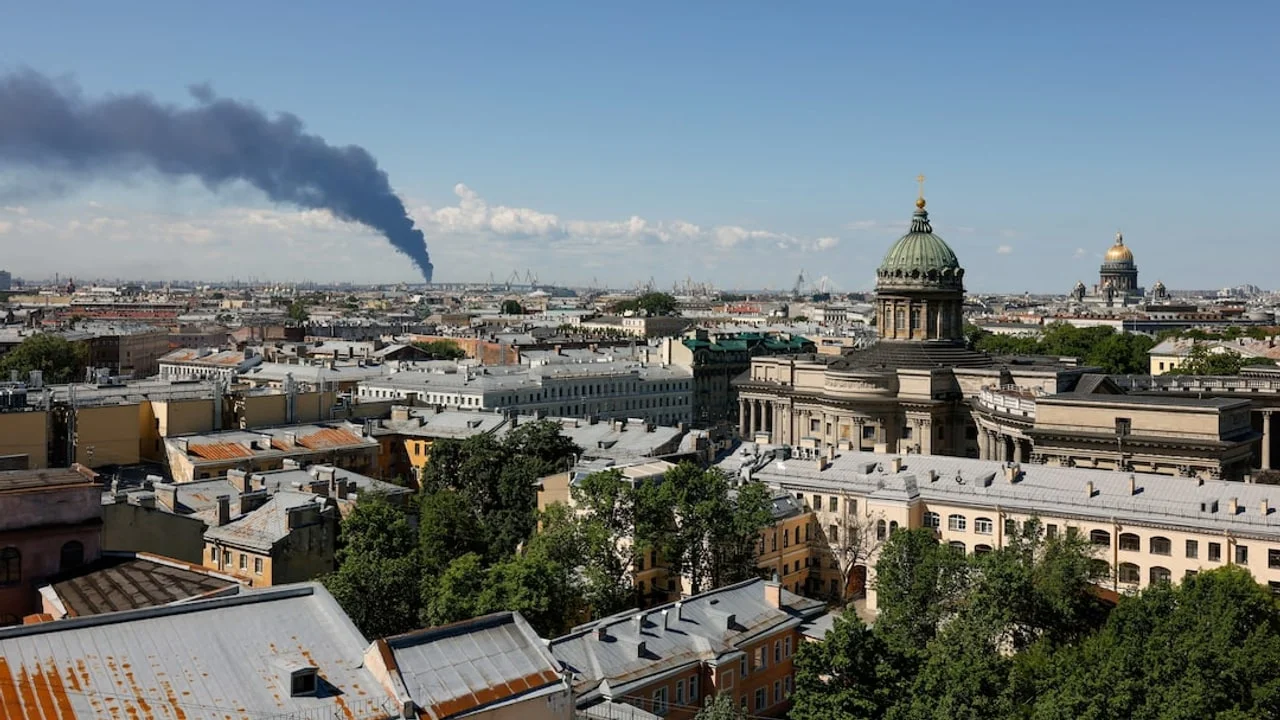
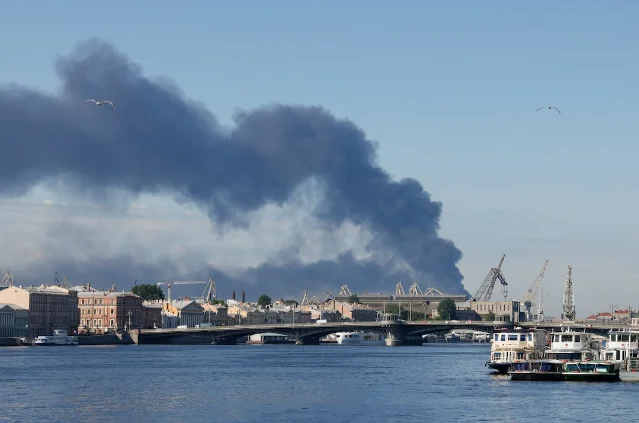
Ukrainian long-range drones struck a fuel export terminal in St. Petersburg and hit the Russian frigate Brave in dry dock at the Kronstadt naval base, just hours before Vladimir Putin's flagship economic forum — widely dubbed "Putin's Davos" — opened on June 3.4 Black smoke rose over the historic city centre, visible to the hundreds of SPIEF delegates and to Reuters journalists on the ground who heard multiple explosions. Russia's Leningrad Oblast governor said air defences downed 59 drones overnight, while St. Petersburg's mayor reported injuries — but no deaths — at infrastructure sites across three city districts. Pulkovo Airport temporarily restricted flights, cancelling or delaying more than 30 aircraft.
President Zelensky confirmed both strikes and said Ukraine was still waiting for a US negotiating team to arrive — Iran, he acknowledged, had moved Ukraine down Washington's priority queue. Russian UK Ambassador Andrey Kelin admitted the war "cost a lot" but insisted Russia "cannot lose," while conceding that Ukrainian attacks on export refineries, including "facilities in St. Petersburg," had forced repeated reconstruction.5 Ukraine's ports, despite nearly 500 drone strikes on logistics infrastructure in 2026 so far, handled close to 35 million tonnes of cargo in the year to date.
正在加载内容卡片…
Market and supply-chain impact. The strike on the Kronstadt naval base — home to Baltic Fleet repair yards — could delay Russian warship maintenance schedules at a moment when the Baltic Sea remains a contested NATO transit corridor. The fuel terminal attack extends Ukraine's campaign against Russian petroleum export capacity; Russia's ability to "re-establish" damaged facilities, as Kelin conceded, limits the strategic ceiling of individual strikes, but sustained pressure on St. Petersburg export infrastructure adds a Baltic shipping dimension to what had primarily been a Black Sea energy story.
3. Israel-Lebanon agree new ceasefire but strikes continue; Iran deal talks stall
The US State Department announced Wednesday that Israel and Lebanon had agreed to renew their ceasefire and create a series of "pilot" security zones inside Lebanon, from which Hezbollah fighters must withdraw and Lebanese Army units must assume exclusive control.6 Both sides are scheduled to hold fresh political and security-track talks in the week of June 22 to work toward a comprehensive agreement. The deal carries an immediate caveat: Israeli Defence Minister Israel Katz said Thursday that Israeli ground forces would continue operations in southern Lebanon for now, that displaced Lebanese residents would not be permitted to return, and that Israel retained "freedom of action" to strike Beirut if Hezbollah attacked Israeli territory. Far-right National Security Minister Itamar Ben-Gvir publicly called the ceasefire "a serious mistake."
Within hours of the announcement, Lebanese state media NNA reported Israeli drone strikes on southern roads and — in a separate incident the previous evening — a direct attack on an Islamic Health Committee ambulance convoy in Zibdine that killed one medic and wounded another, the fourth attack on medical personnel in 24 hours and part of a pattern that has now killed at least 130 emergency and health workers since fighting began in March.7 In Gaza, Israeli airstrikes on residential blocks in Gaza City killed at least 9 people, including four children, early Thursday.
On the Iran track: the US House passed a war powers resolution 215–208 — four Republicans joining Democrats — directing Trump to end US military operations against Iran.8 The measure is non-binding on the White House but deals a political blow to the administration.
正在加载内容卡片…
Iran said Wednesday's nuclear talks showed "no substantive progress," while Trump told reporters a deal was possible "by the weekend." The WSJ reported Trump privately told aides he would only resume full hostilities if Iran kills US personnel — a significant constraint on his negotiating posture.
Market and supply-chain impact. Brent crude fell ~1% to $96.97/bbl Thursday morning on Lebanon ceasefire news and the House war powers vote, which markets read as reducing the probability of full US-Iran re-escalation.9 The Hormuz Strait — through which roughly 20% of global oil flows — remains partially constrained, sustaining oil prices well above pre-conflict levels. The Lebanon ceasefire provides temporary relief for Red Sea shipping insurance rates, though underwriters will await Hezbollah's formal compliance with the security-zone provisions before repricing.
4. PLA sends 32 aircraft and 15 ships around Taiwan as submarine completes dive trials
Taiwan's Ministry of National Defence reported Thursday morning that it had tracked 32 PLA aircraft sorties, 10 PLAN vessels, and 5 Chinese official ships operating around the island in the 24 hours to 06:00 local time (UTC+8) — a notable step-up from the previous day's 18 sorties and 8 vessels.10 Of the 32 sorties, 25 crossed the median line and entered Taiwan's air-defence identification zone on four axes: northern, central, southwestern, and eastern approaches. Taiwan's armed forces confirmed they monitored and responded to all incursions.
In a separate development, Taiwan's first domestically built submarine completed its 15th sea trial — including its ninth submerged-navigation test — departing from Kaohsiung and conducting dive manoeuvres. The submarine programme, accelerated under President Lai Ching-te's defence modernisation agenda, was accompanied by a Reuters report that Taiwan is planning to build up to 1,600 unmanned attack vessels as part of a $39.8 billion special defence budget.
Market and supply-chain impact. The Taiwan Strait carries an estimated $5 trillion in annual trade, and PLA median-line crossings at this frequency signal deliberate pressure testing of Taiwan's response thresholds. The US$14 billion arms sale — including F-16 upgrades and advanced missiles — remains under review by Secretary Rubio following last week's Shangri-La signals. Companies with high Taiwan-concentration in advanced semiconductor supply chains face renewed scrutiny of disruption scenarios; TSMC CEO C.C. Wei warned this week that global chip supply will fall short of AI demand "for years to come,"9 making Strait stability a tier-one commercial risk.
5. Broadcom miss tests AI trade, Brent dips, gold climbs
Broadcom fell 14% in after-hours trading Wednesday after its AI semiconductor revenue forecast for the coming quarter fell short of investor expectations, triggering a broader technology sell-off.9 Nasdaq 100 futures dropped 0.4%, S&P 500 futures 0.2%, and South Korea's Kospi fell 1.8% — sectors most heavily weighted toward AI hardware bore the brunt. Cybersecurity firm CrowdStrike dropped 11% despite raising its revenue outlook. European equities rose a modest 0.3%, insulated by their lower technology weighting. Bank J Safra Sarasin equity strategist Wolf von Rotberg noted "valuations are looking slightly frothy in pockets of the market which have seen the strongest gains over recent weeks, such as non-profitable tech, hardware or parts of semis."
On energy: Brent fell roughly 1% to $96.97/bbl, the first daily retreat of the week, as the Israel-Lebanon ceasefire and the House war powers vote reduced near-term escalation risk in the Hormuz corridor. The 10-year Treasury yield fell 2 basis points to 4.48%, the dollar was little changed, and spot gold rose 0.7% to $4,466.84/oz — the precious metal benefiting from residual geopolitical risk hedging even as oil retreated.
The Broadcom correction raises a pointed question for supply-chain planners: if AI chip demand-growth expectations are being revised down at the revenue-guidance level, procurement cycles that assumed 24-month hypergrowth may need rebalancing — even as TSMC's CEO insisted supply constraints, not demand, remain the binding variable. The divergence between Broadcom's guidance miss and TSMC's supply-shortage narrative will be a critical data point to watch in coming earnings.
正在加载内容卡片…
Next 24 hours to watch: Trump-Iran ceasefire update (White House has signalled weekend timeline); Israel-Lebanon June 22 political track; USTR comment period opens; SPIEF concludes June 6; Taiwan MoND daily PLA activity report.
围绕这条内容继续补充观点或上下文。