1/4

Pragya Yoga: Tips & Tricks
Pragya Verma
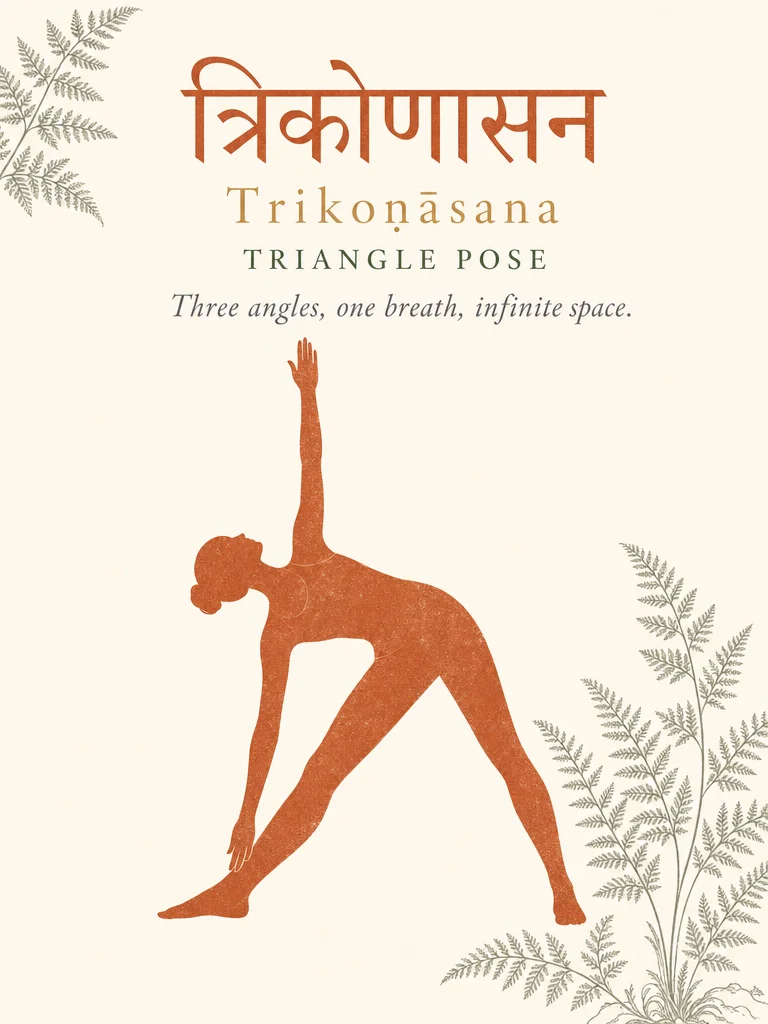
Trikoṇāsana — Three Angles, One Breath, Infinite Space
Trikoṇāsana (Triangle Pose) — the geometry your body already knows, every time you reach sideways on a shelf. This 4-card set covers Sanskrit etymology, physical and emotional benefits, age-group guidance for all four groups, the TRI mnemonic, and a no-mat standing queue practice grounded in Bhagavad Gītā 6.5.
2026/6/8 · 7:05
图集
There is a moment you already know: standing with feet wide apart, reaching sideways for something on a high shelf, one hand finding the shelf, the other arm floating upward for balance. You did not call it yoga. But your body did.
That is Trikoṇāsana — Triangle Pose — and it is as old as geometry and as natural as reaching.
The Sanskrit
त्रिकोणासन | Trikoṇāsana
The name is built from three Sanskrit roots:
- त्रि (tri) — three
- कोण (koṇa) — angle or corner
- आसन (āsana) — seat, posture, stance
Together: the three-angle posture. The triangle the body makes is not metaphor — it is literal. Two legs and the floor form the base; the extended torso and raised arm form the apex.
In classical geometry, the triangle is the most stable polygon. In this pose, you become that stability.
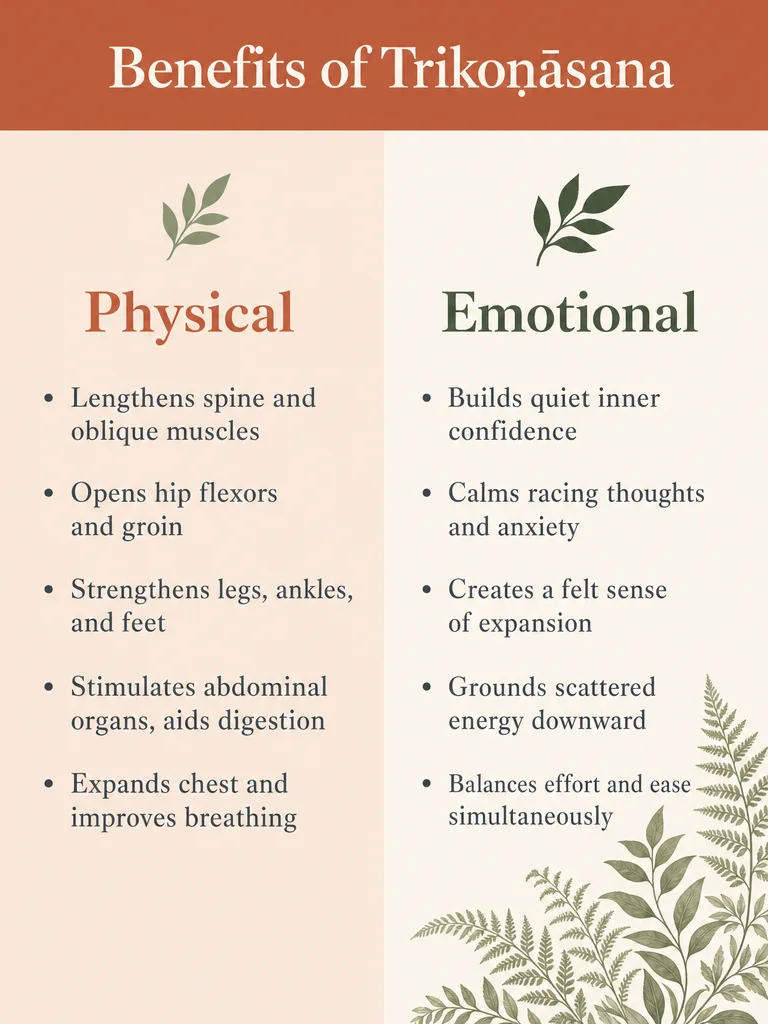
Physical benefits
The pose works on a long diagonal — spine, side body, and legs all finding length and strength at once:
- Spinal lateral flexion: the obliques lengthen on one side while contracting on the other — the kind of sideways stretch that almost nothing else in daily life provides
- Hip flexor and groin opening: the wide stance opens the inner thighs, a chronic holding place for stress
- Leg and ankle strengthening: both legs work hard — the front leg engages the quadriceps and hamstring, the back leg grounds and stabilizes through the ankle
- Abdominal stimulation: the lateral compression and extension gently massages the digestive organs, particularly the liver and spleen on their respective sides
- Chest and lung expansion: the arm reaching skyward rotates the shoulder back, opening the chest and increasing available breath volume
Emotional and mental benefits
Trikoṇāsana creates an unusual physical sensation — grounded through the feet while simultaneously expanding upward. This dual quality is what makes it psychologically interesting:
- Quiets the anxiety loop of contracted, forward-folded posture
- Builds what practitioners call sthira (steadiness) — not tense effort, but settled confidence
- The held gaze (dṛṣṭi) upward toward the raised thumb trains focused attention
- The pose asks the body to extend in three directions at once — rooting down, lengthening sideways, reaching up — and the mind follows with a felt sense of spaciousness
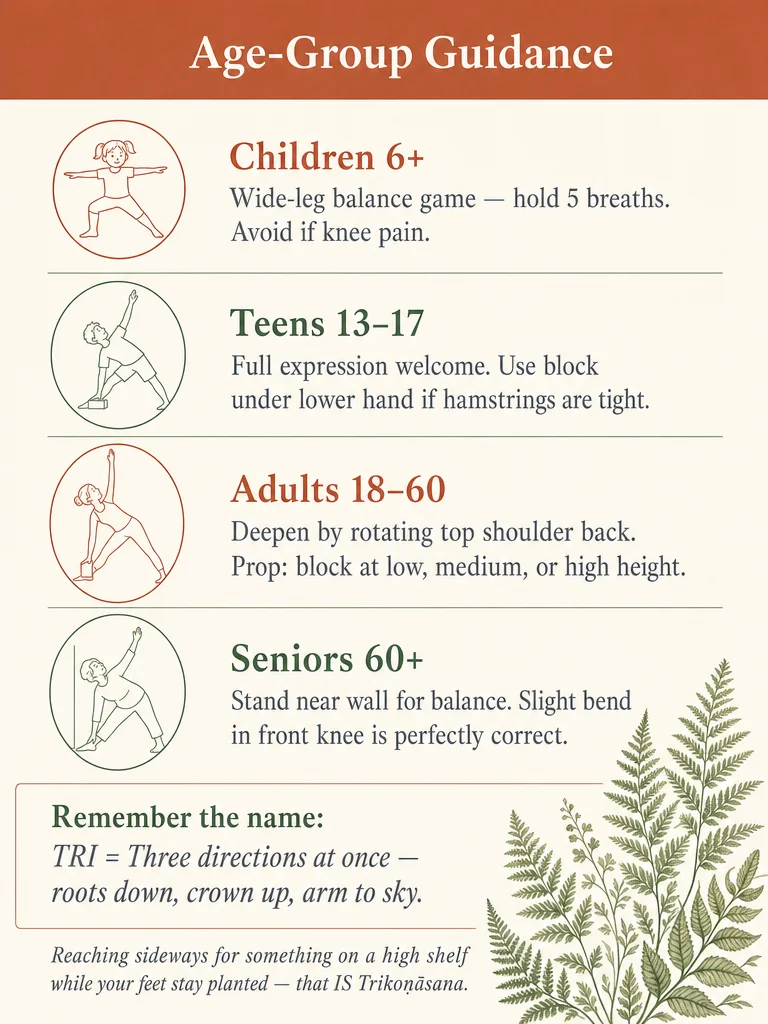
Age-group guidance
Children (6+)
Wide-leg balance is inherently playful. Frame it as a star or a geometric shape and hold for five breaths. Avoid if there is knee pain or hypermobility in the front knee.
Teens (13–17)
Full expression is accessible and beneficial. If hamstrings are tight (very common in this group), place a block under the lower hand at high, medium, or floor height depending on flexibility. This pose counteracts the forward-collapsed posture of device use.
Adults (18–60)
Deepen by actively rotating the upper shoulder back, keeping the body in a single plane. Use a block. The real work is in maintaining the length through the crown while the hand descends — resisting the tendency to crunch.
Seniors (60+)
Stand near a wall to support balance. A slight bend in the front knee is completely correct and protects the joint. The lateral stretch remains fully available even in a modified version.
Remember the name
TRI = three directions at once
- Roots down through the back foot
- Crown lengthening along the horizontal plane
- Top arm reaching upward toward the sky
Three directions. One breath. Each time you say the word tri, feel those three lines extend.
The real-world moment that IS this pose
The next time you reach sideways for something at shoulder height or above — a book on a shelf, a bag in an overhead compartment, a jar from the back of a cabinet — and your feet naturally plant wide for balance: you are in Trikoṇāsana.
You have always known it. Today you have its name.
Sanskrit quote
उद्धरेदात्मनात्मानं नात्मानमवसादयेत्uddhared ātmanātmānaṃ nātmānam avasādayet"Raise yourself by your own self; let not the self be depressed."— Bhagavad Gītā 6.5
Trikoṇāsana is this verse made physical. The pose does not ask someone else to hold you up. The back foot grounds. The front hand reaches. The raised arm lifts. Every direction is self-generated.
Today's take-home practice
No mat. No studio. No special clothes.
The next time you stand in a queue — at a coffee counter, a checkout, a bus stop — plant your feet slightly wider than hip-width. Let your right hand rest along the outside of your right thigh. Raise your left arm gently toward the sky. Hold three slow breaths. Switch sides.
That is it. That is Trikoṇāsana.
The pose is not waiting for you in a studio. It is waiting in the ordinary standing moment you are about to walk into.
Part of the Pragya Yoga: Tips & Tricks daily series — one asana, fully explored, every day.
评论