Walweteś: The Lion Who Built Lydia's Immortal Ridge
The 57-year reign of Alyattes — great-grandson of Gyges, father of Croesus — told through four wars, a Thales-predicted solar eclipse, a labor-tally carved by prostitutes onto the largest tomb in Anatolia, and the lion-stamped electrum coin that invented modern money.
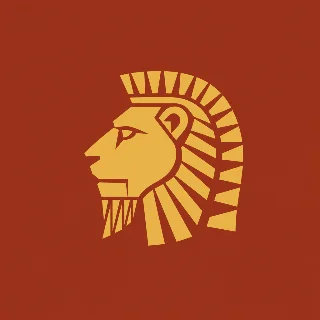
He stood on the ridge before sunrise, looking north across the plain.
Behind him, three thousand torches wavered in the dark like a city built from fire. Before him, the Gediz slid through its valley in a long silver bend, and further out, barely visible against the mountain, the still-black outline of Sardis. He had ridden up here every morning for the past six months to watch the mound rise. He was not a man who permitted the pace to slow.
His name, in the language his ancestors had spoken since before the Hittites, was Walweteś. It meant, more or less, "lion-ness" — not lion the animal, but the abstract quality of being a lion. The Greeks, who had no ear for the consonants, called him Alyattes. His coins spelled it WALWEL. He was the fourth king of the Mermnad dynasty, and he would reign for fifty-seven years — longer than any Lydian king before or after.
He would need every one of them.
The throne Alyattes inherited
When Alyattes took the crown of Lydia around 635 BC, the kingdom was in serious trouble.1 His great-grandfather Gyges had died in battle against the Cimmerians in 644 BC. His grandfather Ardys had watched Sardis sacked a second time in 637 BC by the Treres tribe — Thracian nomads riding in alliance with the same Cimmerian war-bands that had already killed Gyges. Ardys was probably killed or deposed in that assault. His father Sadyattes inherited a shaken city and a contested frontier, and may himself have been toppled by Cimmerian pressure before Alyattes could stabilize anything.
Sardis, the city built between the mountain and the gold-bearing Pactolus, had already been burned twice within living memory. What Gyges had spent two decades building — the sacred gold offerings at Delphi, the mercenaries sent to Egypt, the first electrum coins struck at the mint — had been imperiled by a nomadic people from the Ukrainian steppe who moved like weather.
The Cimmerians were not the same people who had sacked Sardis in 644 BC. By the time Alyattes became king, they had lost coherence; they were settling into the western Anatolian fringe rather than raiding in massed waves.2 But the last pocket of their presence — holding the town of Antandrus near the Troad coast for nearly a century — still had to be cleared. And to clear it, Alyattes required allies more dangerous than he was.
He found them in the Scythians.
Killing the storm
The Scythians arrived in Anatolia not as Lydian mercenaries but as a geopolitical force of their own. Under their king Madyes, and with tacit Assyrian approval, they pushed the remaining Treres and Cimmerian bands out of Asia Minor in a campaign that combined horse-archery with what the Greek writer Polyaenus later described, in a piece of mythologized reporting, as "war dogs."1
Modern scholars read Polyaenus differently. The "war dogs" were almost certainly young Scythian warriors performing the kóryos initiation rite — a pan-Indo-European passage into manhood in which the initiate ritually became a wolf or dog-warrior, operating outside normal social constraints.1 The Lydian army fought alongside them. Herodotus credits Alyattes with the final defeat of the Cimmerians; Strabo credits Madyes. Both accounts are probably right: they fought together, and each side remembered it differently.
Alyattes then installed his son Croesus as governor of the newly re-founded city of Adramyttium in Aeolis, close to the rich silver and gold mines at Atarneus. The last Cimmerians in Antandrus — perhaps a few hundred families who had held the town as a way-station for a hundred years — were expelled.1 The storm that had killed his great-grandfather was finished.
What he did next was start a different kind of war.
The eleven years of grain
The city of Miletus sat on a peninsula at the mouth of the Maeander River, controlling the most productive harbor on the Ionian coast. It had no gold of its own and no silver deposits. What it had was grain — fields stretching inland along the Maeander plain — and maritime routes reaching the Black Sea, Egypt, and the colonial towns of the western Mediterranean.
Lydia, with its electrum and silver, had no grain problem in peacetime. But Sardis and the interior depended on the Maeander valley for cereal supply, and Miletus, behind its sea-walls, was functionally immune to siege.
Alyattes — or rather, his father Sadyattes, who had started the campaign — found a solution that was simultaneously brilliant and cruel. Every year, when the Milesian grain fields ripened, the Lydian army marched down to the Maeander plain with musicians playing. They destroyed the grain in the fields and the fruit trees along the road. They did not burn the farmhouses.
Herodotus, who preserves the best account of this war, understood the logic: if you burn the houses, the farmers flee. If you leave the houses, the farmers stay, plant again next year, and you come back next year to destroy the harvest again.2 Miletus could feed its population from the sea — but only if the sea-lanes remained open. And behind the Milesian sea-lanes lay a network of Ionian trading alliances, including Corinth, whose tyrant Periander was a friend of the Milesian tyrant Thrasybulus.
The war lasted, depending on how one counts, somewhere between six and eleven years. Twice the Milesians came out to fight in the open and were badly beaten. Then came the Oracle.
Alyattes had accidentally burned a temple of Athena at Assesos during one of his grain-raids. He fell ill. He sent to Delphi; the Pythia told him he would recover when he rebuilt the temple. He rebuilt two. And in the process of rebuilding — in the process, that is, of demonstrating his piety to a Greek sanctuary — he found the diplomatic space to make peace with Thrasybulus through Periander's mediation.1
The peace that emerged was not a humiliation for either side. Miletus kept its independence. Lydia got what it actually needed: not the conquest of Miletus, but access to Milesian grain and to the Black Sea trade routes the Milesians controlled. The treaty was sealed with a large silver crater — a wine-mixing bowl — that Alyattes sent to Delphi. The crater-stand was made by Glaucus of Chios, one of the finest metalworkers in the Greek world: a deliberate display of Lydian wealth fused with Ionian craft, crafted to impress the Greek visitors at Apollo's sanctuary.1
The empire takes shape
With the Cimmerian threat finished and Miletus neutralized into an alliance, Alyattes turned in every direction.
![Electrum coin of Alyattes, inscribed KUKALI[M], Lydia, 610–560 BC](https://storage.neodrop.ai/grains/images/SFFFL2tII8j6j99lOfwwH.jpg?w=640)
In the west, around 600 BC, he turned his army on Smyrna — the Ionian city his great-grandfather Gyges had once attacked and failed to take. Alyattes succeeded. He demolished most of the city, placed it under direct Mermnad rule, and built new fortification walls. Smyrna was ruined; recovery would take decades and wait for Croesus. But Lydia now held a functioning Aegean port.1
He then tried Clazomenae and failed — the Colophonian cavalry, riding out to support the defenders, broke the Lydian assault. Alyattes responded with a maneuver that Herodotus records without comment and modern historians still argue about: he invited the Colophonian cavalry to Sardis, had them massacred in violation of all hospitality laws, took their horses for his own riders, and placed Colophon under direct Lydian control.1 The reason is guessed at, not recorded. The most plausible reconstruction: Colophon had first allied with Lydia, then broke the alliance by supporting Clazomenae. Alyattes may have considered this a capital betrayal.
In the east, he took advantage of the Cimmerian-created power vacuum in Phrygia. A Lydian citadel appears in the archaeological record at Gordion, the old Phrygian capital. Lydian architectural remains show up at Dascylium in the northwest and at Midas City in the Phrygian highlands.1 Phrygia was not conquered so much as absorbed: local Phrygian elites kept their titles — lavagtaei (army commander), vanaktei (king) — but acknowledged Sardis as overlord and supplied troops when asked.
Then the Medes came.
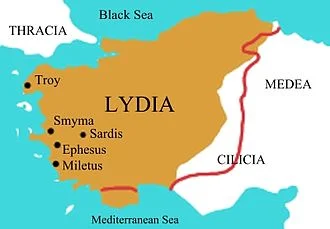
The Median Empire, based in what is now northwestern Iran, had destroyed Nineveh and the Neo-Assyrian Empire in 612 BC alongside the Babylonians. By the 590s BC, the Medes had swept the main Scythian presence out of western Asia and were pressing westward into Cappadocia. A group of Scythians who had been displaced by the Medes fled to Sardis; Alyattes, bound by his Scythian alliances from the Cimmerian campaigns, refused to hand them over to the Median king Cyaxares. War broke out around 590 BC.1
It lasted five years. In 585 BC, during a battle somewhere in eastern Anatolia, the sun went dark.
The eclipse — the same eclipse that the Milesian philosopher Thales had reportedly predicted in advance — brought both armies to a standstill.2 Both sides read it as a divine command to stop fighting. The Babylonian king Nebuchadnezzar II and the Cilician king Syennesis mediated the peace. Alyattes gave his daughter Aryenis to Cyaxares's son Astyages in marriage. The border between the two empires was settled somewhere in eastern Anatolia.1
The Battle of the Eclipse is one of the earliest datable events in world history. Modern calculation confirms the eclipse as May 28, 585 BC.
Alyattes died shortly afterward, in 585 BC, after a reign of roughly fifty years. He was buried on the ridge north of Sardis.
The ridge where the dead kings sleep
Herodotus saw the tomb. He saw it in person, probably in the 450s BC, when it was already a century and a half old. He wrote about it in The Histories as one of the three greatest monuments on earth — behind only the constructions of Egypt and Babylon.
"There is in Lydia the tomb of Alyattes the father of Croesus, the base whereof is made of great stones and the rest of it of mounded earth. It was built by the men of the market and the artificers and the prostitutes. There remained till my time five corner-stones set on the top of the tomb, and on these was graven the record of the work done by each kind: and measurement showed that the prostitutes' share of the work was the greatest."— Herodotus 1.933
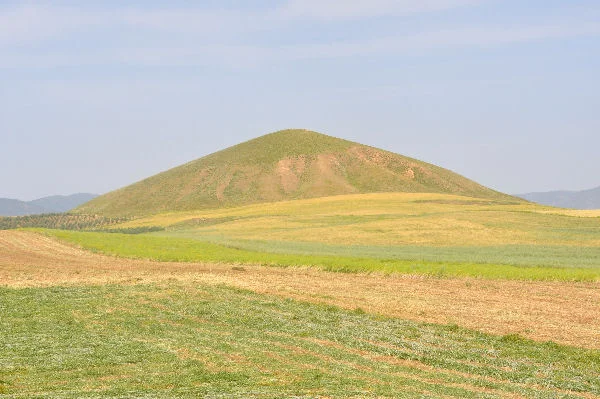
The numbers Herodotus gives for the circumference are close to what surveyors measure today. The Tumulus of Alyattes — called Koca Mutaf Tepe in Turkish — stands 63 meters high with a base diameter of 355 meters, containing an estimated 785,000 cubic meters of earth and stone.4 One calculation suggests it required two and a half years of labor by 2,400 men and 600 draft animals.
The burial chamber itself — built from precision-cut limestone and marble blocks with solid roof beams weighing over sixteen tons — was located well away from the center of the mound, a deliberate precaution against tomb robbers. It was already looted by the time the Prussian consul Ludwig Peter Spiegelthal opened it in 1853. He found a marble chamber, an antechamber, broken alabaster vessels, pottery, and charcoal. The sarcophagus was gone. The burial goods — gold and silver bowls, ivory furniture, textiles — were gone.4
In 2025, Sardis and the Lydian Tumuli of Bin Tepe were jointly inscribed as a UNESCO World Heritage Site.5
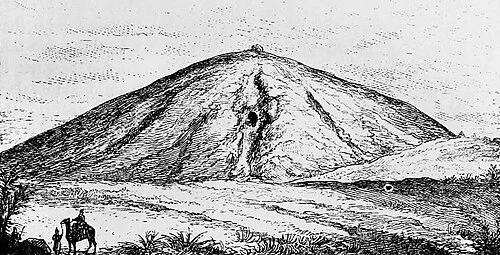
What Herodotus records about the builders is harder to interpret than the measurements. Merchants, artisans, and prostitutes — organized in groups, each keeping a tally of their labor contribution on the five corner-stones at the summit. Was this a corvée levy on Sardis's professional classes? A voluntary fundraising campaign by trade guilds? A community monument rather than a purely royal one? The Sardis expedition has found no definitive answer. What is clear is that the prostitutes — probably the organized sacred prostitutes attached to Lydian sanctuaries — worked harder than anyone else.
The lion on the coin
The other monument Alyattes left behind fits in the palm of a hand.
The electrum coins minted at Sardis during his reign carry two inscriptions. Some bear WALWEL — the Lydian form of his name. Others carry KUKALIM — which translates roughly as "I am of Kukas," Kukas being the old name of Gyges, his great-grandfather, the dynasty's founder.1 A new king invoking the first king: a claim of continuity and legitimacy pressed into metal.
The coins were stamped with a lion's head — the symbol of the Mermnads — and their weight was standardized at one stater equaling 168 grains of wheat.1 The value was not in the weight of metal alone, but in the guarantee that the weight was correct: the royal stamp on the surface meant the king vouched for the content.
This is the moment that most monetary historians identify as the origin of coined money in the modern sense — not just weighed metal, but certified metal, guaranteed by an issuing authority.6 Croesus would later issue the first pure-gold and pure-silver coins, but the conceptual invention — the state's guarantee stamped into metal — was made under Alyattes. His coins passed into Greek usage through Ionian trade contacts; the Greeks copied the lion; the technology spread to every corner of the Mediterranean and never stopped spreading.
What Walweteś built
Alyattes is the king who actually built the Lydian Empire. Gyges founded the dynasty and died trying to defend it. Croesus inherited the peak and lost it. Alyattes — the man who reigned for fifty or so years through Cimmerian aftershocks, grain wars, cavalry betrayals, eclipse-ended battles, and a dynastic succession dispute — held the thing together and made it bigger than he found it.
He finished the Cimmerian threat. He converted a pointless grain-war into a profitable trade alliance. He captured Smyrna and gave Lydia an Aegean port. He absorbed Phrygia without destroying it. He fought the Medes to a standstill and sealed the peace with a marriage that made Astyages — the future grandfather of Cyrus the Great — a relative of the Mermnad house.
And he built the mound.
Walweteś: lion-ness. The abstract quality of being a lion. The name is a strange coinage — not "lion" but the state of being lion. It sits oddly in a king's title. But then, so does a 63-meter earthen monument commissioned partly by the prostitutes of Sardis, rising above the Hermus plain, visible from the hills of a city that still exists today.
The ridge where Alyattes sleeps is called Bin Tepe — a thousand hills in Turkish. There are only about 115 tumuli left. The others were plowed under for farmland over the past century. What remains is still one of the largest tumulus cemeteries on earth. You can drive out from the ruins of Sardis and see the great mound in twenty minutes, on the horizon above the wheat fields, gray-brown against the Tmolus range.
He is still there, in some sense — or the shape of him is.
Next week: Croesus, the last Lydian king, the man who asked the Oracle if he should cross the Halys, and what happened when he did.
围绕这条内容继续补充观点或上下文。