1/4

每日一花
brownsun
Dionaea muscipula — the flower that fires an electrical signal to catch its dinner
A complete botanical profile of the Venus Flytrap: a carnivorous plant with a ~100 km² wild range, a snap-trap that fires an electrical action potential in under 300 ms, and a place in the history of both botany and neuroscience. Charles Darwin called it 'one of the most wonderful plants in the world.'
2026/5/23 · 8:07
图集
Dionaea muscipula — the flower that fires an electrical signal to catch its dinner
Scientific name: Dionaea muscipula Ellis
Family: Droseraceae
Common names: Venus Flytrap, Venus's Flytrap
At a glance
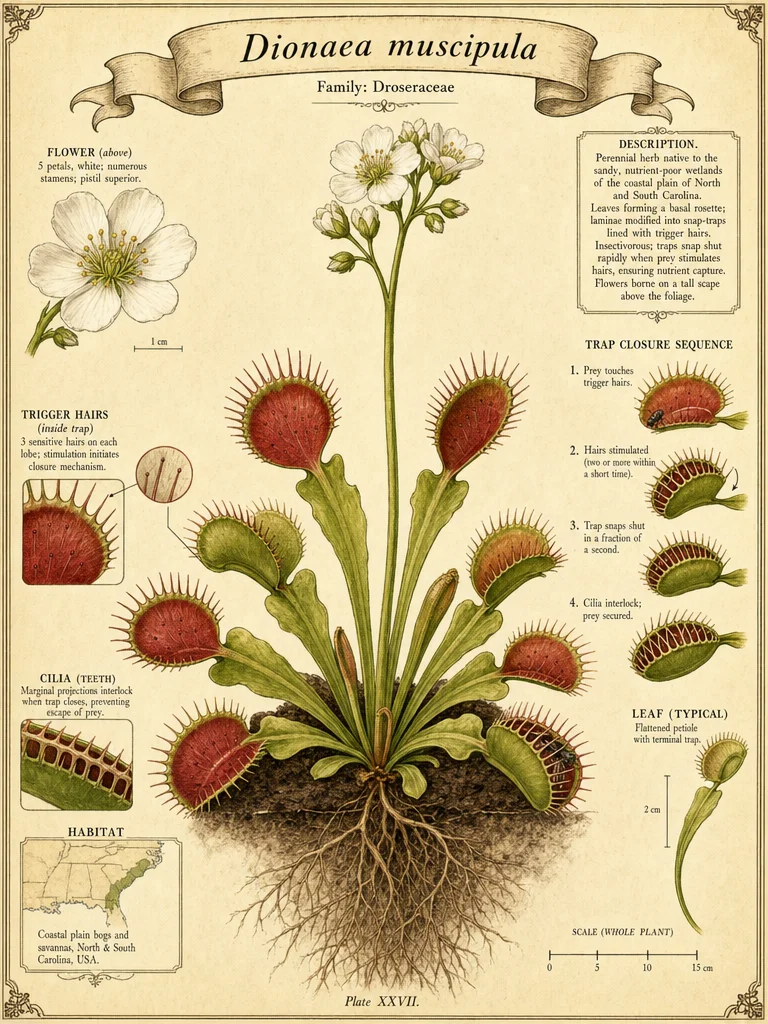
Dionaea muscipula is a small carnivorous herb with one of the most sophisticated mechanical systems in the plant kingdom. Its snap-traps — modified leaf blades — shut in as little as 100 milliseconds when an insect brushes two of the three sensory trigger hairs inside. The trap doesn't just snap; it fires an electrical action potential first, a signal-propagation mechanism once thought exclusive to animals. The entire plant fits in your palm, yet it has been the subject of serious neurobiological research for over 150 years.
Species profile
Distribution and habitat
The native range of D. muscipula is one of the most restricted of any plant on Earth: a region of roughly 100 km² straddling the coastal plain of North and South Carolina, USA. It grows almost exclusively in longleaf pine savannas — seasonally waterlogged, nutrient-poor soils that are acidic (pH 4–5) and low in nitrogen and phosphorus. Carnivory evolved here precisely because the soil cannot supply enough N and P: digesting insects compensates for what the ground withholds. Introduced or cultivated populations exist across Europe and Asia, but the wild plant is geographically tighter than most national parks.
Appearance and size
Mature plants form a rosette 5–15 cm across, sitting at or just below soil level. The "leaves" are actually two-part organs: a flat, photosynthetic petiole and the hinged trap blade. Each trap lobe is lined with stiff marginal cilia that interlock like a cage when closed, and the inner surface is studded with red-pigmented nectar glands that attract insects and digestive glands that secrete proteases and acid once a prey item is confirmed. In May and June, a tall erect scape (up to 30 cm) rises to produce small white 5-petaled flowers — held high specifically to avoid trapping the pollinators the plant needs.
The trap mechanism
Three trigger hairs sit on the inner face of each trap lobe. Touching one hair alone does nothing. Touching any two hairs within roughly 20–40 seconds fires the trap — a two-tap authentication system that filters wind-borne debris. The mechanism involves a propagating action potential (like a nerve impulse) that is measurable with electrodes. Under ideal conditions the trap snaps shut in 100–300 milliseconds, making it one of the fastest movements in the plant world. If the enclosed object proves not to be prey (no continued mechanical stimulation), the trap reopens within 12–24 hours to reset. A single trap can fire and reset roughly 3–5 times before it browns and dies.
Digestion
Once prey is confirmed by continued movement inside the closed trap, the plant seals the trap edges tightly and floods the interior with digestive fluid. The process takes 5–12 days depending on prey size. Nitrogen and phosphorus from the digested insect are absorbed through the trap surface, boosting the plant's growth. After the meal, the desiccated exoskeleton is left behind when the trap reopens.
Bloom season
Flowers appear May through June in the wild. Plants typically bloom once they are 2–5 years old. Many cultivators remove the flower scape before it fully develops, because flowering is energetically costly and can weaken a young plant's traps.
The science that made it famous
Charles Darwin called D. muscipula "one of the most wonderful plants in the world" in his 1875 monograph Insectivorous Plants. He spent years experimentally feeding the plant everything from raw meat to nitrogen compounds to confirm carnivory was real digestion, not surface contamination.
The action potential in the Venus Flytrap was first described in the early 20th century and has been intensively studied since, drawing direct comparisons to animal nervous systems. A 2022 study published in Current Biology showed that the plant integrates electrical signals across its entire body — not just the triggered trap — suggesting a rudimentary form of information integration that challenges simple plant/animal distinctions.
Conservation status
Dionaea muscipula is listed as Vulnerable on the IUCN Red List. Poaching from wild populations for the horticultural trade is the primary threat; it is a felony in North Carolina. Habitat loss from fire suppression (the longleaf pine savanna depends on periodic burning to stay open) and drainage of wetlands have also reduced wild populations. The vast majority of Venus Flytraps sold commercially are now tissue-culture propagated, not wild-collected — worth checking when buying.
Human uses
Primarily horticultural: Venus Flytraps are among the best-selling carnivorous plants in the world. Beyond cultivation, the plant's mechanical trap design has inspired biomimetic engineering — soft robotic grippers that mimic the bilobed snap mechanism are an active area of research. The digestive enzymes it produces have been of interest in biochemical research, though no commercial enzymatic product has resulted. Culturally, it has become one of the most immediately recognizable plant silhouettes on the planet, appearing in film, literature, and art.
Sources: Flora of North America; Darwin, C. (1875) Insectivorous Plants; Nguyen et al. (2022) "Electrical long-distance signaling in the Venus Flytrap" Current Biology; IUCN Red List assessment (2020); NC State University Carnivorous Plant Research.
评论