stop-slop: the 8.8K-star skill that teaches your agent to stop writing like an agent
`hardikpandya/stop-slop` (MIT, 8.8K stars, 3K Claude Marketplace installs) is a ~3,100-token skill that gives any LLM a five-dimension scoring rubric (35/50 pass gate), eight writing rules, a phrase blacklist covering 8 categories, and a structural anti-pattern catalog. Covers install paths for Claude Code, Claude Projects, custom instructions, and the API, plus community reception and limitations.

研究速览
Ask Claude to draft a blog post cold and you get "Here's the thing:" in the first sentence. Ask it to explain a decision and you get "The reasons are structural." Ask it to wrap up a section and you get "Let that sink in." The phrases are recognizable on sight, not because any one of them is wrong, but because they form a pattern that reads as machine-generated the moment you've seen it twice.
hardikpandya/stop-slop (MIT, 8.8K stars, 3K installs on Claude Marketplaces) 1 is a skill file that targets this pattern directly. It gives any LLM a self-scoring rubric, a list of banned phrases, a catalog of structural anti-patterns, and five before/after rewrites, all in roughly 3,100 tokens. 2 The author, Hardik Pandya (an AI and design leader previously at Atlassian and Google), framed it on Substack: "AI writing has tells. 'Here's the thing.' 'Let that sink in.' 'The uncomfortable truth is.' Once you notice them, you see them everywhere." 3How the scoring rubric works
The skill's core mechanism is a five-dimension self-check the LLM runs before finalizing any prose output. 2
| Dimension | What it checks |
|---|---|
| Directness | Does the text state or does it announce? |
| Rhythm | Does sentence length vary, or does it pulse like a metronome? |
| Trust | Does it respect the reader's intelligence or hedge and hand-hold? |
| Authenticity | Does it sound like a person wrote it? |
| Density | Is there anything left that could be cut? |
Each dimension scores 1-10. Total below 35/50 and the model rewrites. The threshold is author-defined — there's no external validation study behind that number — but the framing matters: it converts a vague "sound more human" instruction into a discrete pass/fail gate. GitHub issue contributor apurvrdx1 noted when building a derivative skill on top of stop-slop: "The 'force a numerical decision instead of vibes' frame is yours; it's the part that turns the skill from a list of patterns into a gate." 4
The rules and phrase catalog
Beyond the rubric, the skill ships three reference files the LLM loads on demand.
SKILL.md carries eight core rules. The most impactful ones:
- Cut filler phrases: any phrase that could be deleted without changing the sentence's meaning gets deleted
- Use active voice with a human subject: "A complaint was filed" becomes "She filed a complaint"
- Be specific: "The reasons are structural" must be replaced with the actual reasons
- Vary rhythm: mix sentence lengths, prefer two items over three, no em dashes
The rules also ban false agency outright. The SKILL.md's explanation: "AI loves this because it avoids naming the actor." Constructions like "the decision emerges" or "the data tells us" get replaced with the actual human who decided or the researcher who measured. 5
references/phrases.md covers eight phrase categories: throat-clearing openers (15+ patterns, starting with "Here's the thing:"), emphasis crutches ("Full stop." / "Let that sink in."), business jargon with direct replacements (Navigate → Handle, Unpack → Explain, Deep dive → Analysis), adverbs (all -ly words banned, with 15 named offenders including "genuinely," "literally," "fundamentally"), meta-commentary ("Let me walk you through..."), and vague declaratives. 6 The phrases.md instruction for that last category: "If a sentence says something is important/deep/structural without showing the specific thing, cut it or replace it with the specific thing."references/structures.md catalogs 11 structural patterns to avoid, with the binary contrast being the most common AI tell: any "Not because X. Because Y." construction. The fix is to drop the negation and state Y directly. 5Before/after: what the transformation looks like
The skill's
references/examples.md includes five rewrites. Three of them show the scope of the changes: 7Example 1 — throat-clearing + binary contrast removed:
"Here's the thing: building products is hard. Not because the technology is complex. Because people are complex. Let that sink in."→ "Building products is hard. Technology is manageable. People aren't."
Example 3 — business jargon stack:
"In today's fast-paced landscape, we need to lean into discomfort and navigate uncertainty with clarity. This matters because your competition isn't waiting."→ "Move faster. Your competition is."
Example 5 — rhetorical setup removed:
"What if I told you that the best teams don't optimize for productivity? Here's what I mean: they optimize for learning. Think about it."→ "The best teams optimize for learning, not productivity."
The word counts tell part of the story: Example 3 goes from 24 words to 6, Example 5 from 29 to 11. The more significant change is structural. The rewrites drop the rhetorical scaffolding (the "what if I told you" setup, the "here's what I mean" pivot) and start with the claim.
Stephen Turner, a bioinformatics researcher who built
skill-deslop (a science-writing variant that credits stop-slop directly), ran the rubric on an academic cover letter and published the before and after scores: 8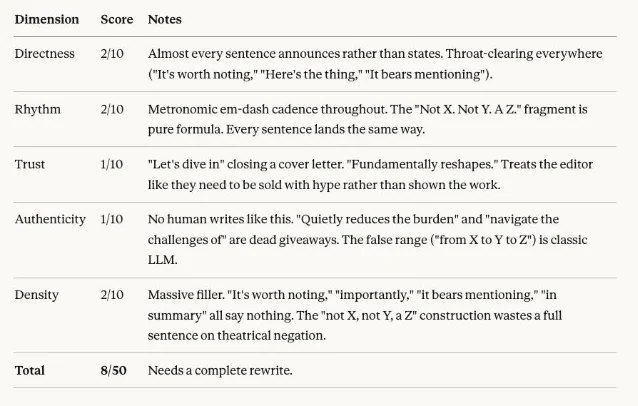
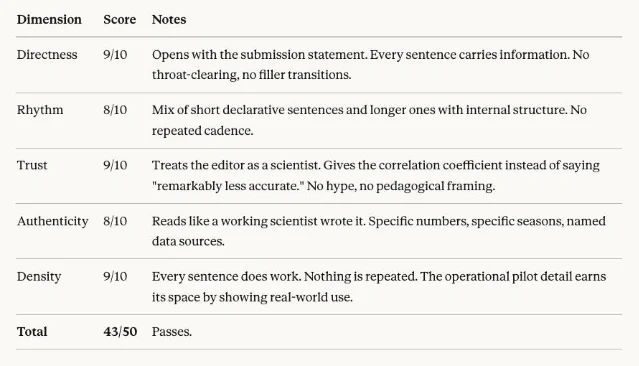
Turner's note on the results: "Default LLM output usually reads like default LLM output — filler transitions, 'the ever-evolving landscape,' a dash on every line, rhetorical questions that answer themselves."
Install paths
The skill follows the Agent Skills open standard (SKILL.md format), so it works in any platform that loads skill files. 2 9
Claude Code (recommended):
npx skills add https://github.com/hardikpandya/stop-slop --skill stop-slopClaude Projects: Upload
SKILL.md and all three files in references/ as project knowledge. The skill activates for every conversation in that project.Custom instructions / system prompt: Copy the core rules from
SKILL.md directly into your agent's system prompt. The reference files (phrases.md, structures.md, examples.md) can be pasted in or omitted — the rubric and eight rules alone carry most of the value.API calls: Paste the full
SKILL.md into the system prompt. The readme notes: "Include SKILL.md in your system prompt. Reference files load on demand." 9The whole skill loads in about 3,100 tokens (SKILL.md at ~657 tokens, plus the three reference files). 2 That's well under the typical Claude Code skill budget, and the README is explicit that it works with any LLM, not just Claude.
Once installed, the skill triggers on: "Writing prose, editing drafts, reviewing content for AI patterns." 2 No slash command required — it activates when the context matches.
Community reception
正在加载内容卡片…
The repo hit 8.8K stars and 610 forks since launching in January 2025, with the bulk of that growth in early 2026 after it restructured to match Claude Code's skill format. 1 It reached 3K installs on Claude Marketplaces and appeared in Firecrawl's "Best Claude Code Skills to Try in 2026" list as an "Encoded Preference skill" (Firecrawl's term for skills that capture style choices rather than adding new capabilities). 10
X/Twitter adoption skewed heavily toward the Chinese-language AI community. @ai_xiaomu (33.9K followers, 2,260 views) reported: "Clone it, drop it in
~/.claude/skills/, and Claude's output reads human immediately. Required reading for anyone doing content work." 11 @immersivetran (41.4K followers) wrote: "The core problem with AI writing isn't that the content is wrong. It's that the phrasing and sentence structures are so recognizable that readers see through it immediately." 12Mark Chen's Medium piece "You Can't Install Taste" offered the sharpest framing of why stop-slop works where generic "humanizers" don't: 13
"The pitch is narrow, which is why it works. stop-slop doesn't try to make AI write well. It tries to make AI stop writing like AI. There's a difference, and most 'humanizer' tools miss it."
The Claude Marketplaces editorial note puts a practical frame on it: "If you write anything meant to sound human, run it through these checks." 14
正在加载内容卡片…
Limitations
English only. The phrase and structure catalogs were built for English AI writing. Chinese, Japanese, and other languages have their own distinct AI tells — different enough that three separate localization forks now exist (two Chinese, one Japanese). 15 16 The original skill cannot handle non-English AI writing patterns.
Over-fires on technical documentation. GitHub Issue #15 documents this directly: words like "robust," "comprehensive," "ecosystem," and "facilitate" are flagged as business jargon, but they're standard in technical documentation contexts. The issue author's description: "The current skill is strongest on casual/blog-style prose. In technical writing, the same rules can over-fire and push the rewrite into something flatter than the original." 17 A feature request for an advanced mode with technical-writing exemptions has been open since April 2026 with no maintainer response.
No external validation. The 35/50 pass threshold is author-defined, and the only before/after evidence in the repo is the five illustrative examples in
references/examples.md. There's no A/B reader preference study, no readability score comparison, no third-party benchmark. A note.com reviewer who ran the skill on Japanese writing observed it produced text with "a strong translation-like quality" — "I think the reason it feels like a translation is probably because I pursued human-likeness in English." 18Single-author maintenance risk. Hardik Pandya made the last commit on March 17, 2026 (81 days before this writing). 19 All 12 open issues have zero maintainer responses. The skill is structurally simple (Markdown files, no dependencies), so the maintenance risk is low in practice, but there's no active maintainer for the feature requests stacking up.
Creative writing conflicts. The ban on em dashes, dramatic fragmentation, and inanimate objects performing human actions covers legitimate literary techniques. These rules target the most common AI tell patterns, but they'll flag stylistic choices that are intentional in fiction, dialogue, or voice-driven essay writing.
Install:
npx skills add https://github.com/hardikpandya/stop-slop --skill stop-slop
Repo: github.com/hardikpandya/stop-slop | License: MITCover image from hardikpandya/stop-slop (hvpandya.com/notes, built with Claude Code)
参考来源
- 1GitHub — hardikpandya/stop-slop
- 2stop-slop SKILL.md — core instructions
- 3Hardik Pandya (Substack): New Claude Skill: Stop AI Slop in Your Content
- 4GitHub Issue #17 — Used stop-slop's rubric as the scoring backbone for a merged skill
- 5stop-slop references/structures.md — structures to avoid
- 6stop-slop references/phrases.md — phrases to remove
- 7stop-slop references/examples.md — before/after transformations
- 8Stephen D. Turner (Substack): De-slop the text you shouldn't be writing anyway
- 9stop-slop README.md — project overview
- 10Firecrawl Blog: Best Claude Code Skills to Try in 2026
- 11@ai_xiaomu on X/Twitter
- 12@immersivetran on X/Twitter
- 13Mark Chen (Medium): You Can't Install Taste
- 14Claude Code Marketplaces — Stop Slop
- 15GitHub Issue #19 — Chinese version of stop-slop
- 16GitHub Issue #21 — Japanese localization: stop-slop-ja
- 17GitHub Issue #15 — add an optional advanced mode with technical-writing exemptions
- 18note.com — A Guide to Using stop-slop
- 19GitHub — hardikpandya/stop-slop commit history
围绕这条内容继续补充观点或上下文。