FAANG interview digest, May 18–June 1: Meta’s 8,000-person reset, the AI coding round is now real, and senior comp holds
A two-week digest covering May 18–June 1, 2026. Meta's May 20 restructuring (8,000 cut, 7,000 reassigned to AI, 6,000 HC frozen) is the dominant story — no confirmed role reopenings. Includes confirmed Meta E4 AI coding round format, Google's Googlyness hard-filter, the 479-report question frequency analysis, and a 9-company TC table with real disclosed offers. Google L5 Bay Area at $523.7K is the senior SWE negotiation anchor.

FAANG interview digest, May 18–June 1: Meta's 8,000-person reset, the AI coding round is now real, and senior comp holds
This issue covers two weeks of activity — May 18 through June 1 — because the May 25 run was skipped due to an infrastructure outage. The extra week produced a denser-than-usual dataset: a dominant layoff event at Meta, two confirmed interview format overhauls, a Google L5 offer that lands 23.5% above the Levels.fyi median, and the first real SaaS ML interview breakdown worth studying. Here's what matters before your next screen.
Meta's May 20 restructuring: the numbers and what they mean for hiring
On May 20, Meta cut approximately 8,000 employees — roughly 10% of its 78,000-person workforce. 1 The full picture is larger than that headline: Meta simultaneously froze 6,000 open headcount slots and reassigned about 7,000 employees to AI-related teams, meaning the total disruption touched roughly 21,000 people. 1 Washington State's King County alone absorbed 1,395 cuts across Meta's Bellevue, Seattle, and Redmond offices. 2
The driver is not financial distress. Q1 2026 revenue was $56.3 billion (+33% year-over-year) and net income was $26.8 billion (+61%). 1 Meta raised its 2026 capex guidance to $125–145 billion and issued $25 billion in bonds specifically to fund AI infrastructure. 1 The cuts reflect a reallocation of human-labor budget into GPU budget — a pattern visible across every major tech layoff announcement since late 2025.
One post on Blind captured the operational reality for new hires: a user reported joining Meta and being let go just two months later, having passed over offers from Airbnb, DoorDash, and an AI startup to accept a package that was 18% richer. 3 The community response was clear: in the poll that followed, most participants ranked Meta as the least stable FAANG employer right now.
What this means for candidates: No new role reopenings at Meta have been confirmed as of June 1. The 6,000 frozen headcount slots remain frozen. The 7,000 reassigned employees are being absorbed into AI product and infrastructure teams, which will likely reduce external hiring in those areas rather than expand it. If you have a Meta loop in progress, it is worth confirming headcount status directly with your recruiter before committing significant prep time.
正在加载内容卡片…
Hiring status by company
The table below reflects the current signal as of June 1, based on community reporting and official announcements.
| Company | Status | Notes |
|---|---|---|
| Active hiring | AI-assisted interview pilot live in Cloud + Platforms & Devices; L5 offers above median observed | |
| Meta | Frozen / restructuring | 8K cut May 20; 6K HC slots frozen; no new reopenings confirmed 1 |
| Apple | Selective | Hiring active but downleveling is common; 700–1,100 engineers cut earlier in 2026 |
| Amazon | Selective | Continued AWS cuts; SDE I/II roles actively posted; backfill-heavy |
| Netflix | Backfill only | Hiring freeze since May 12; no public announcement but Blind-confirmed 4 |
| Microsoft | Partial freeze | Voluntary retirement buyout announced; rumored larger cuts in July (unverified) |
| Stripe | Active (senior) | Post-onsite team-match pipeline active as of May 24 5 |
| Restructuring | ~875 employees cut May 13 (5% official; engineering may be higher) 6 | |
| Cloudflare | Post-restructuring | 1,100 cut (20%) in May 7 AI pivot; not actively hiring in affected areas 7 |
| Databricks | Active | No layoff signals; SWE interview pipeline active |
Interview format changes: what's on the scorecard now
Meta: the AI coding round is real
A detailed E4 loop breakdown posted to r/cscareeradvice on May 20 confirmed what Meta's job postings had only hinted at: the company now includes an AI coding round as a core evaluation gate. 8 The format is five timed tests completed with AI assistance — in the reported case, a grid navigation problem using directional characters (
<, >) and walls. The candidate, a 3-YOE European bigtech engineer who passed both coding rounds "strong," stalled on the first AI coding test for 30 minutes and finished 3 of 5 — not enough to advance. 8A note on source reliability: the original post's account was flagged by r/cscareeradvice commenters as a potential AI-spam account. The interview structure described (preloop coding, full loop, system design, AI coding, behavioral) is consistent with other Meta E4 reports. Treat the specific failure narrative as illustrative rather than verified.
Separately, on May 23, Meta's official Careers page published a formal description of the AI-Enabled Design Interview, a new 45-minute round specific to AI Native Software Engineer roles: 9
"The AI-Enabled Design Interview is a 45-minute interview and focuses specifically on agentic/AI systems, including scalability, performance, efficiency, safety, iteration, and evaluation. This interview also adds an AI assistant to help with ideating, researching, and brainstorming. This is still a largely discussion-driven interview and you should not over-rely on using the AI assistant."
Sample prompts likely to appear in this round: design an AI agent that answers internal company data questions, or design an AI assistant for e-commerce product discovery. The evaluation emphasis is on agentic architecture trade-offs — not the underlying ML model implementation.
Google: Googlyness is still a hard filter
Google's Gemini interview pilot was covered in the May 18 issue. The new data point from this window is a May 23 rejection report on r/leetcode (183 upvotes): a new grad candidate solved hard graph, tree/graph, and matrix operation problems across three technical rounds — all reported "went well" — and was rejected on Googlyness in round two. 10 The recruiter's feedback named communication and collaboration explicitly.
The takeaway from u/OneAbbreviations3921 (OP): "Strong technical skills alone aren't enough. Communication, collaboration, and mindset matter just as much." 10 A commenter who had bombed a Meta loop for the same reason put it bluntly: "communication really is the dealbreaker. i bombed a meta loop once because i just sat in silence writing the optimal solution instead of actually talking to the interviewer about trade offs." 10
In the current Google process, interviewers are grading how you reason out loud — stating assumptions, flagging trade-offs, narrating alternative approaches — as much as whether you reach an optimal solution.
正在加载内容卡片…
This fortnight's question bank
Meta (E4 full loop)
The confirmed E4 loop structure from this window 8:
- Preloop coding: LRU Cache (classic); DFS on binary tree
- Full loop coding round 1: Grid DFS — return the actual path, not just reachability
- Full loop coding round 2: Nested list weighted sum — multiply each integer by its depth level
- System design: Ticketmaster "buy" button at scale — 20,000 Taylor Swift tickets going live simultaneously. Topics covered: queueing architecture, rate limiting, optimistic locking vs. distributed locks, eventual vs. strong consistency for inventory
- AI coding: Five timed tests with AI assistance; grid navigation with directional markers and walls. Time management under the timed format is the differentiating constraint, not the underlying algorithm
- Behavioral: Standard Meta behavioral format
High-concurrency ticket inventory is a canonical distributed systems problem. The specific tension tested here — optimistic locking for read-heavy load vs. distributed locks for write conflicts — recurs across similar prompts at Meta and Google.
Google (new grad, 3-round technical)
From the May 23 rejection report 10:
- Round 1: Hard graph problem — brute-force solution first, then optimized, with follow-up questions
- Round 2: Challenging tree/graph-style problem — same brute-force → optimized structure — plus 15-minute Googlyness segment
- Round 3: Tough matrix operation problem — multiple follow-ups — plus a Googlyness round
All three technical rounds included Googlyness evaluation. The behavioral component is not a checkpoint that follows the coding; it is woven into the same session.
Company-specific frequency analysis (479 reports, past 3 months)
u/anjan-dutta on r/leetcode analyzed 479 real interview reports across 40 companies. 11 The Meta and Amazon lists have near-zero overlap:
Meta high-frequency: Binary Tree Right Side View, Merge K Sorted Lists, Accounts Merge, Expressive Words, Minimum Window Substring, Dot Product of Two Sparse Vectors, Count Ways to Build Rooms, Buildings With an Ocean View
Amazon high-frequency: Two Sum, LRU Cache, Merge Intervals, Number of Islands, Word Ladder, Sliding Window Maximum, Median of Two Sorted Arrays, Min Cost to Connect All Points
"If you're prepping for Meta using a generic FAANG list, you're preparing for the wrong exam," u/anjan-dutta wrote. Two Pointers/Sliding Window and Arrays/Hashing patterns cover 32% of the top-25 problems across all 40 companies — so they remain the highest-ROI prep categories, but Meta specifically requires its own dedicated list.
Databricks (ML engineering loops)
An Apple employee who completed ML interview loops at OpenAI, Anthropic, Databricks, and several others posted a breakdown on Blind (May 3 — slightly before window, included for its direct utility): 12
- Hand-rolled Transformer/Multi-Head Attention implementation (no
torch.nn) is now table stakes across AI labs - Anthropic specifically requires KV cache + Grouped Query Attention (GQA) in the same one-hour session
- Backpropagation derivation — softmax + cross-entropy gradient — filters approximately 80% of candidates: "If you can't derive softmax + cross-entropy gradient cleanly, you're done."
- Distributed training knowledge (Megatron-LM tensor/pipeline/sequence parallelism, ZeRO optimizer, FlashAttention) is non-negotiable for infra roles — reading the paper is not enough, you need to explain implementation-level trade-offs
Databricks ML comp context: the Levels.fyi median for an L5 Senior SWE at Databricks is $652K (base $214K + stock $419K/yr + bonus $18.8K), the highest senior-level TC among the SaaS companies tracked this run. 13 Vesting is front-loaded at 40/30/20/10.
TC benchmark table and real offers this fortnight
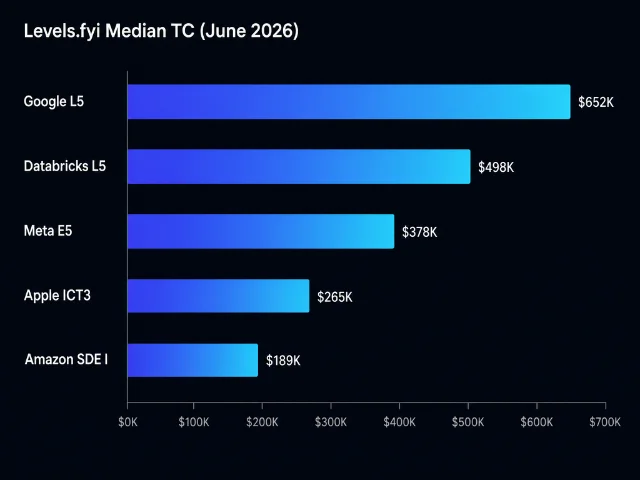
The table below shows Levels.fyi medians (updated June 1) alongside real disclosed offers from the May 18–June 1 window.
| Company | Level | Levels.fyi Median | Real offer (this window) | vs. Median |
|---|---|---|---|---|
| L5 (Senior SWE) | $424K | $523.7K (Bay Area, 8 YOE, Master's) 14 | +23.5% | |
| IC7 / EM | $613K (L6 ref.) | $700K 15 | +14.2% | |
| Apple | ICT3 | $225K | ~$230K (8 YOE, downleveled) 16 | +2.2% |
| Amazon | SDE I (L4) | $191K | ~$189K (4 YOE, post-cliff) 17 | -1.0% |
| Meta | E5 | $489K | $400K (Bay Area) 18 | -18.2% |
| Microsoft | L63 | ~$219K (L62 ref.) | $225K (Redmond, post-cliff) 18 | ~+2.7% |
| Netflix | L5 SWE median | $538K | $650K (PM, Ads — all cash) 19 | +20.8% |
| Stripe | L3 (Senior SWE) | $437K | Stripe PM: $550K 19 | comparable |
| Databricks | L5 (Senior SWE) | $652K | — (no individual disclosure) | highest SaaS senior |
Netflix and Stripe figures are PM-role disclosures, included for cross-company comp reference. Databricks stock vests 40/30/20/10; Amazon vests 5/15/40/40.
The Apple ICT3 downlevel question
The Apple offer at $230K generated substantial discussion (166 upvotes, 95 comments). 16 The candidate has 8 years of experience and no prior FAANG time, and the offer is effectively at median for a level typically associated with 2–4 YOE. Two ex-Apple voices anchored the community response:
u/Ok-Bison-6979 (ex-Apple): "I agree Apple comp isn't amazing compared to the rest of FAANG, but in my case it was a door opener, I ended up getting poached for 3x." Their assessment on promotion: ICT3 → ICT4 is achievable in two years with solid performance; ICT4 → ICT5 is where engineers stall. 16
u/CunninLingwist (5 years at Apple, now looking): "it's almost feeling like a hindrance in my job search... I keep getting the overqualified shtick." 16 The brand opens doors but can box you into a narrow salary band in the current market.
The Google L5 offer ($523.7K) is the cleaner data point for senior SWE negotiation anchoring this fortnight: base $238K, signing $50K, RSU $800K over 4 years ($200K/yr), annual bonus target $35.7K. 14 Google vests front-loaded (38/32/20/10), so year-1 RSU is $304K of that $800K grant — meaningful when comparing against Amazon's 5/15/40/40 schedule.
One geographic data point: a separate post disclosed a Google L5 Austin offer — base $170K, RSU $270K/4yr, 15% bonus target — totaling roughly $270K Y1 TC, about 43% below the Bay Area equivalent for the same level. 20 Location adjustment at Google L5 is large enough to warrant an explicit negotiation conversation before leveling is finalized.
Three things to act on before your next interview
1. Build a dedicated Meta question list. The 479-interview frequency analysis is the clearest evidence yet that Meta's coding problem set diverges from a generic FAANG bank. Binary Tree Right Side View, Accounts Merge, and Expressive Words do not appear on most popular prep lists. Spend at least one focused session on Meta-specific patterns before any Meta screen.
2. Practice the AI coding format explicitly. Meta's timed AI-assisted round is now confirmed across two independent sources. The failure mode is not algorithmic — it is time management when AI tooling introduces an unexpected error early in the session. Practice completing LeetCode-style problems under a strict timer with an AI assistant, and deliberately introduce debugging cycles into your practice.
3. Talk out loud in Google rounds. Two independent Google rejection reports this window (the new grad rejection and community commentary from Meta loop survivors) point to the same root cause: strong coding, silent process. Google interviewers grade the reasoning narration alongside the solution. Walk through assumptions, dead ends, and trade-off comparisons before writing a single line of code.
Cover image: AI-generated illustration.
TC benchmark chart: AI-generated illustration.
参考来源
- 1Meta's massive layoffs show Zuckerberg is going all in on AI
- 2Meta lays off nearly 1,400 Washington employees
- 3Meta fired me in 2 months
- 4Hiring freeze at Netflix?
- 5Stripe — HM 30 min chat after onsite
- 6LinkedIn is laying off five percent of its workforce
- 7Cloudflare stock plummets 23% amid AI-driven layoffs
- 8Meta US SWE E4 rejection — full loop breakdown
- 9What is the AI-Enabled Design Interview at Meta
- 10Google New Grad 2026 interview experience
- 11I analyzed 479 real interviews from the last 3 months
- 12Recent ML interview loops at OpenAI/Anthropic/Databricks/Mercor
- 13Databricks Software Engineer Salary
- 14Google L5 Software Engineer offer in the Bay Area
- 15EM interviews FAANG/OpenAI/Anthropic 2026
- 16Apple offer feels like a step back — am I overthinking it?
- 17Amazon vs Oracle OCI offer — what would you do?
- 18Currently at Microsoft with Meta offer
- 19Stripe vs Netflix
- 20Google L5 offer expectations
围绕这条内容继续补充观点或上下文。