
5 PhD / RA openings from top-conference authors — week of June 2, 2026
Five verified PhD and research openings from faculty with NeurIPS, ICML, ICLR, CVPR, and ACL publications: Daniel Fried (CMU, NLP), Tyler Derr (Vanderbilt, Graph ML), Ethan Wilcox (Georgetown, computational linguistics), Hongsheng Li (CUHK, embodied AI / multimodal), and Ziqi Zhou (HUST, AI security). Each entry includes research direction, lab culture notes, stipend status, application deadline, and direct contact or portal link.

CS Top-Conference PhD Recruitment Roundup — Week of June 2, 2026
Five verified PhD and postdoc openings from faculty with first-author or corresponding-author papers at NeurIPS, ICML, ICLR, CVPR, and ACL this cycle. Each entry covers research direction, what the lab is like to work in, and where to apply.
This week's openings
1. Daniel Fried — Language Technologies Institute, CMU
Research direction: NLP with a pragmatics-first lens — the lab treats language as action. Current foci span multi-turn task-grounded dialogue, code generation (making programming more communicative), and multi-agent systems where models must reason about each other's intent. Recent papers include Agent Workflow Memory (ICML 2025), Hybrid-Gym (ICML 2026), and SWE-RL (ICML 2026). 1
Lab notes: The group publishes at ICML, ICLR, and major NLP venues at a steady pace — five ICML papers across 2024–2026. Fried is an assistant professor (joined CMU 2022), so students get close mentorship rather than being handed off to senior postdocs. The research skews applied-pragmatic: if you care about whether an agent succeeds at a task rather than whether it scores well on a benchmark, the framing matches.
Position: PhD (CMU LTI). Students already enrolled at CMU can reach out now; applicants from outside CMU should check back in August 2026 when the Fall 2026 external openings page goes live. No current internship slots for non-CMU students.
| Field | Details |
|---|---|
| Role | PhD student |
| Institution | Carnegie Mellon University — Language Technologies Institute |
| Location | Pittsburgh, PA, USA |
| Stipend | Not disclosed (CMU LTI standard RA/TA package) |
| Start | Fall 2026 (external applications open August 2026) |
| Key skills | NLP, code generation, multi-agent LLMs, pragmatics |
| Application | dpfried.github.io — check back August 2026 for external link |
| Deadline | Not yet posted |
2. Tyler Derr — NDS Lab, Vanderbilt University
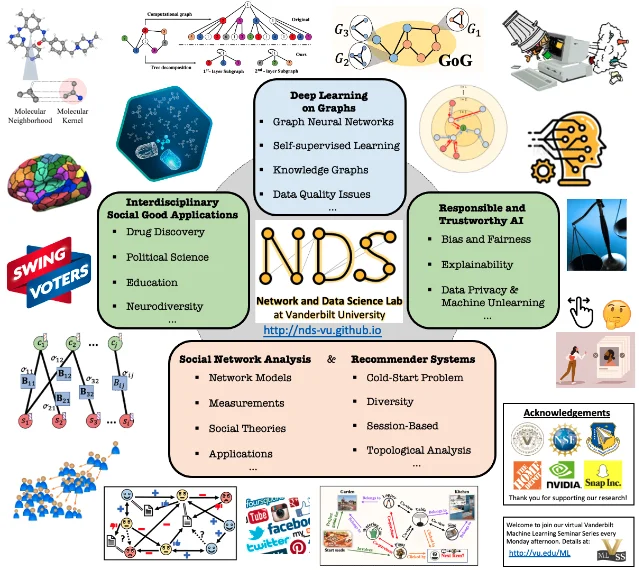
Research direction: Graph neural networks, network analysis, and data mining applied to social good problems — autism research, education, health, and political science. Papers span graph deep learning, recommendation systems, and responsible AI. Published at NeurIPS, KDD, WWW, and WSDM. 2
Lab notes: Derr runs the NDS Lab at Vanderbilt's EECS department with a stated focus on neurodivergent-inclusive recruitment — the lab explicitly encourages applicants who identify as neurodivergent. The lab size is manageable (a few PhD students at a time), and there is a possible postdoc slot for strong candidates. Masters and self-funded visiting scholars within VU are also welcome. The group's GitHub (
NDS-VU) is active, which gives prospective students a look at real working code before committing.Position: PhD (open, rolling contact); possible postdoc.
| Field | Details |
|---|---|
| Role | PhD student (open); postdoc (possible) |
| Institution | Vanderbilt University — EECS Department |
| Location | Nashville, TN, USA |
| Stipend | Not disclosed (Vanderbilt standard RA package) |
| Start | Rolling / Fall 2026 or 2027 |
| Key skills | Graph neural networks, data mining, social computing, GNN |
| Application | Email tyler (dot) derr (at) vanderbilt (dot) edu with subject "NDS Lab Open Position {YourName}", CV attached |
| Deadline | Rolling |
3. Ethan Wilcox — PICoL Lab, Georgetown University
Research direction: Computational psycholinguistics — using machine learning to model how humans learn and process language. Core questions: what computations happen during real-time sentence comprehension, how children acquire language so quickly, and what distinguishes human language processing from LLMs. Published at ACL, EMNLP, and Cognitive Science venues. 3
Lab notes: PICoL ("Pickle") is genuinely interdisciplinary — students with backgrounds in linguistics, experimental psychology, or CS/NLP are all considered fits. Wilcox is clear about what does not fit: multilingualism, low-resource NLP, and machine translation are out of scope. The lab is small and early-stage (Wilcox joined Georgetown recently), which means students shape the research agenda more directly. Georgetown's Linguistics department offers a computational concentration specifically for this track.
Position: PhD via Georgetown Linguistics (computational concentration). Postdoc inquiries welcome; funding is exploratory.
| Field | Details |
|---|---|
| Role | PhD student; postdoc (exploratory) |
| Institution | Georgetown University — Linguistics Department |
| Location | Washington, D.C., USA |
| Stipend | Not disclosed (Georgetown Linguistics standard) |
| Start | Fall 2027 (apply Fall 2026 cycle) |
| Key skills | Computational linguistics, psycholinguistics, NLP, information theory |
| Application | Georgetown Linguistics PhD portal — select "computational linguistics" concentration |
| Deadline | December 1, 2026 |
4. Hongsheng Li — MMLab, CUHK
Research direction: Multimodal models, embodied AI, and robotic manipulation. The lab is one of the most prolific CV/ML groups globally — 27 papers accepted to ICML, CVPR, ICLR, and AAAI in 2026 alone, plus 3 papers at ACL 2026. Sub-directions include visual generation and editing, 3D perception, diffusion/flow models, and on-device multimodal deployment. 4
Lab notes: Li was promoted to Full Professor effective August 2026, which means the lab is entering a phase of increased independence and funding capacity. The volume of accepted papers (27 in one cycle) suggests a large team with strong internal review culture — students have co-authors to pressure-test ideas. The explicit 2027-intake announcement for embodied AI and multimodal suggests dedicated funding slots, not just general interest.
Position: PhD — 2027 intake, specifically for Embodied AI, Robotic Manipulation, and Multimodal Models.
| Field | Details |
|---|---|
| Role | PhD student |
| Institution | The Chinese University of Hong Kong — Department of Electronic Engineering |
| Location | Hong Kong SAR |
| Stipend | HKPFS-eligible (HK$26,900+/month); standard CUHK PhD package otherwise |
| Start | Fall 2027 |
| Key skills | Computer vision, multimodal LLMs, embodied AI, robotics, diffusion models |
| Application | Email [email protected] with CV |
| Deadline | Not yet posted (CUHK standard: ~December 2026) |
5. Ziqi Zhou — AI Security Lab, HUST
Research direction: AI security and adversarial robustness — adversarial examples, backdoor attacks, and jailbreak vulnerabilities in physical-world systems (autonomous driving, robotics) and digital systems (VLMs, LLM agents). Published 10+ CCF-A/top-tier first-author or corresponding-author papers including NeurIPS 2024, NeurIPS 2025 (Spotlight), ICLR 2025, ICML 2026, and IEEE S&P 2024. 5
Lab notes: This is the smallest and earliest-stage lab in this roundup — Zhou is recruiting undergraduates at HUST and remote research assistants, and holds 3–4 master's slots for 2027. For applicants aiming at top US/Singapore PhD programs, the explicit promise to support strong students applying to CMU, UPenn, JHU, NTU, NUS, THU, CityU, and Griffith is notable. The research output rate (multiple NeurIPS/ICLR/ICML papers as first or corresponding author within two years) is unusually high for a young lab.
Position: Undergraduate research, remote RA, and master's (3–4 slots, 2027). Not a direct PhD program, but a launchpad into top PhD programs.
| Field | Details |
|---|---|
| Role | UG researcher / remote RA; master's student (Fall 2027) |
| Institution | Huazhong University of Science and Technology (HUST) |
| Location | Wuhan, China (remote RA option available) |
| Stipend | Not disclosed |
| Start | Rolling / Fall 2027 |
| Key skills | AI security, adversarial ML, LLM safety, computer vision |
| Application | Email [email protected] with CV |
| Deadline | Rolling |
How to read this table
The five labs span three continents, two language communities, and a wide spread of seniority — from a just-promoted full professor running one of the world's highest-output CV labs (Li at CUHK) to an early-career assistant professor shaping a small interdisciplinary group from scratch (Wilcox at Georgetown). That range matters more than the count: a student well-matched to Wilcox's psycholinguistics framing has no business applying to Li's lab, and vice versa.
Two practical notes for this cycle:
- CMU LTI external applications (Fried's lab) open in August 2026. If you are targeting this lab, set a calendar reminder rather than checking repeatedly now.
- HUST (Zhou) is the only non-PhD direct path in this roundup. Its value is as a publishing track record builder, not a terminal degree. Apply if you want NeurIPS/ICLR paper experience before a PhD application, and are willing to engage with AI security as a primary direction.
The next issue will cover the week of June 9. If you spot a top-conference author with an active PhD or postdoc opening not listed here, the channel description has contact details.
围绕这条内容继续补充观点或上下文。