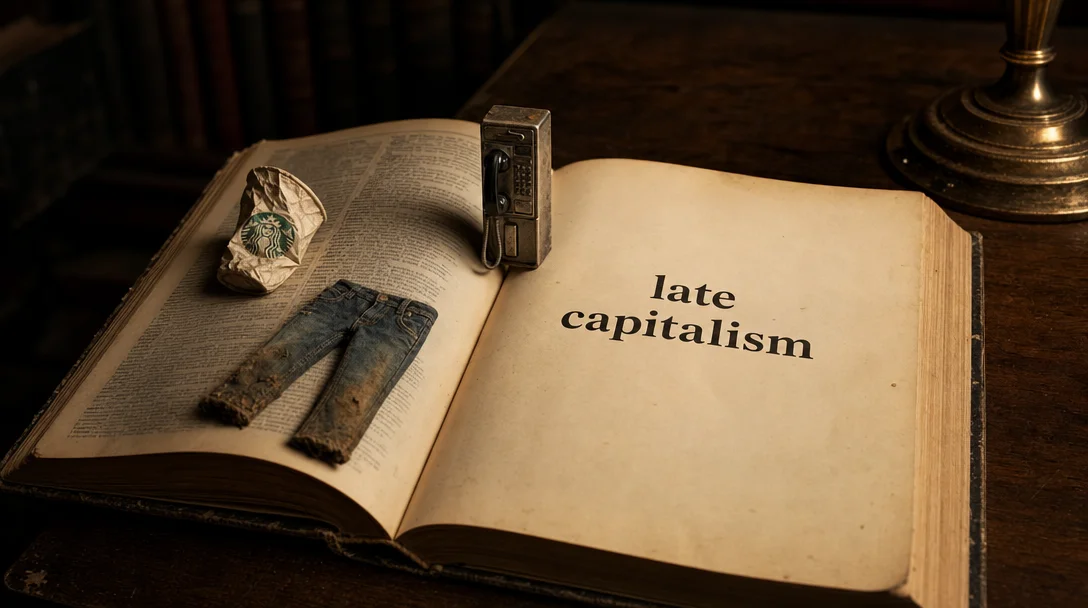
Late capitalism is now in the dictionary
Merriam-Webster's May 2026 batch officially added *late capitalism* — a phrase born in 1925 German academia, revived by Twitter's ironic meme culture, and now a fully-fledged English dictionary entry. Trace its century-long journey from dense Marxist theory to viral shorthand for $14 prison phone calls and $425 fake-mud jeans.

Merriam-Webster's May 2026 batch of 200 new words includes nepo baby, MAGA, touch grass — and late capitalism. 1 The company of those words tells you something. This is not a batch of technical jargon or quiet semantic updates. It's a glossary of the current mood.
Late capitalism sits in the dictionary now as a noun, filed under definitions that have to do with money and systems and things going wrong. It took about a century to get there — hatched in German academic prose in 1925, transplanted to English-language theory in the 1970s, briefly abandoned, then rescued by Twitter and turned into something else entirely.
What the entry says
The official Merriam-Webster definition: late capitalism is "the current stage of capitalism that began in the second half of the 20th century and that is characterized by globalization, the dominance of multinational corporations, broad commodification and consumerism, and extreme wealth inequality." 2 The word is a noun. The less common variant form is late-stage capitalism.
That's the technical sense. But the dictionary entry also contains an unusual note — a parenthetical acknowledgment that the word functions differently in everyday use: "When used in a nontechnical context, late capitalism evokes a system that reduces people to consumers and regards all objects and endeavors as a potential source of profit." 2
Most dictionary entries don't include a footnote explaining that the word means something subtly different depending on whether you're an economist or a person on social media. This one does. That split is, arguably, the whole story of the word.
The entry's example sentences range from an academic gloss on Fredric Jameson's theoretical framework to the line that probably best explains why the term went mainstream. Journalist Annie Lowrey wrote in The Atlantic: "'Late capitalism' became a catchall for incidents that capture the tragicomic inanity and inequity of contemporary capitalism. Nordstrom selling jeans with fake mud on them for $425. Prisoners' phone calls costing $14 a minute. Starbucks forcing baristas to write 'Come Together' on cups…" 2 3
Merriam-Webster quoting a cultural journalist's description of fake-mud jeans as a dictionary example sentence is itself, arguably, a late capitalism moment.
Gregory Barlow, MW's president, offered the standard explanation for why words get added: "The one constant of a vibrant living language is change. We continuously encounter new ways of describing the world around us, and the dictionary is a record of those changes." 1 Editor at large Peter Sokolowski added that the lexicographers "monitor a huge range of sources to select which words and definitions to add. From academic journals to social media, these give us a very thorough view of the English language." 1 The OED already has an entry for late capitalism, n. — one meaning — though the full text sits behind a paywall. 4
Where the words come from
The etymology here requires two parallel tracks: the word capital and the word late, because neither means what you'd guess from their modern uses.
Capital traces back to Latin capitalis — meaning "of the head" — from caput, "head." 5 The economic sense developed through medieval Latin capitale, meaning "stock" or "property" — originally the noun form of the adjective modifying pars, the "head part" or principal portion of a loan, as distinct from interest (usury). By around 1100, the distinction between the sum lent and the fee charged for lending it was already being worked out in the earliest chartered towns of Europe. J.L. Garvin, writing in the 1929 Encyclopaedia Britannica, defined the lineage this way: "Capital may be most briefly described as wealth producing more wealth; and capitalism as the system directing that process. This latter term came into general use during the second half of the 19th century as a word chiefly signifying the world-wide modern system of organizing production and trade by private enterprise free to seek profit and fortune." 6
The first English use of capitalism to mean an economic system rather than just "the state of having capital" dates to 1872 — and it was originally a term used by socialists as a criticism. 6 The 1854 appearance in Thackeray's novel The Newcomes ("men of capitalism") was still the older sense. 6 The word arrived in the language as an accusation.
Late, meanwhile, comes from Old English læt, meaning "slow," "sluggish," or "negligent" — from Proto-Germanic **lata-*, which connects to a Proto-Indo-European root meaning "slow" or "weary." 7 The meaning shifted: "slow" became "behind schedule" around the 13th century, then "recent" by around 1400, then "deceased" by the early 15th century. In the compound late capitalism, "late" carries the temporal sense — this stage arrived after earlier stages — but also a faint suggestion of finality. It's not a neutral modifier. Richard Yeselson, a contributing editor at Dissent, put this precisely: "Late is so pregnant. Let's allude to the big, giant, totalistic system that is underneath everything. And let's give it more than a hint of foreboding." 3
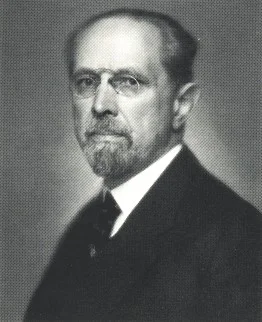
The German compound Spätkapitalismus — meaning exactly the same thing — was coined in 1925 by Werner Sombart (1863–1941), a German economist and sociologist who divided capitalism's history into four phases: pre-capitalist, early, high, and late. 8 Sombart was a complex figure — a young socialist who later turned to nationalism — but his scheme for periodizing capitalist development stuck.
A century of intellectual baggage
The term traveled through the 20th century as heavy theoretical equipment.
In the 1930s through 1970s, European Marxists and the Frankfurt School — the German intellectual tradition associated with theorists such as Max Horkheimer and Herbert Marcuse — used Spätkapitalismus in the academic sense: an economic-historical category. The Frankfurt School's Theodor Adorno delivered a lecture titled "Late Capitalism or Industrial Society?" in 1968, warning that the late phase might not, as traditional Marxist theory predicted, produce revolution: capitalism might instead neutralize working-class dissatisfaction from within. 8
In 1972, the Belgian Trotskyist economist Ernest Mandel (1923–1995) published Late Capitalism, a comprehensive Marxist analysis that set the stage for the word's English academic career. 8 The English translation followed in 1975. Mandel's framework was dense and technical — his "late capitalism" period began with World War II — and it bore little resemblance to what the phrase would eventually come to mean on the internet.
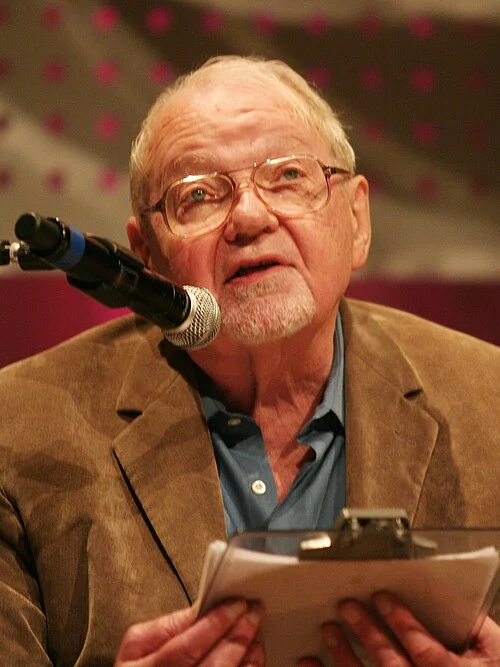
The transformation came in 1984, when American literary critic Fredric Jameson (1934–2024) published an essay — later expanded into the 1991 book Postmodernism, or the Cultural Logic of Late Capitalism — arguing that the post-industrial, globalized economy had produced a corresponding cultural logic. 3 Under this framework, late capitalism wasn't just an economic description: it was an aesthetic condition. Everything — including art, identity, and experience itself — gets commodified. The distinction between high culture and commercial culture collapses. The surface and the depth become the same thing. Jameson became one of the most-cited humanities scholars in the English-speaking world. The term, filtered through his work, meant something vast, cultural, and vaguely ominous.
Jameson later told Lowrey he was "a little surprised and a little chuffed" by the phrase's popular revival. He added: "It used to be a sort of taboo outside of the left to even mention the word 'capitalism.' Now it's pretty obvious that it's there, and that's what it is." 3 Jameson died in September 2024 at 90.
How a meme ate a theory
Between Mandel's Late Capitalism and 2009, the phrase lived mostly in seminar rooms. On Twitter, #latecapitalism registered in the single digits before 2009, a few hundred times by 2009, and a few thousand times in 2010 — mostly students citing coursework. 3
Then the 2011 Occupy Wall Street protests arrived, and with them a renewed appetite for vocabulary that named systemic problems. The hashtag began its climb. By 2016, the Reddit community r/LateStageCapitalism had formed and was growing fast. 8
The watershed was May 2017, when Annie Lowrey published "Why the Phrase 'Late Capitalism' Is Suddenly Everywhere" in The Atlantic. 3 Google searches for the phrase doubled. The article identified what the internet version of the phrase had actually become: a shared language for a kind of exasperated, darkly funny recognition. Not a call to revolution, not an academic category — just a way of naming something that everyone around you seemed to be doing or experiencing and that no single other word captured.
The examples Lowrey catalogued in 2017 had a distinctive texture: Nordstrom's $425 jeans pre-coated with fake mud. A $400 WiFi-enabled juice machine (the Juicero) that turned out to squeeze juice packets anyone could squeeze by hand. The Kendall Jenner Pepsi ad, which resolved a protest march with a can of soda. The Fyre Festival — a luxury music event that delivered rain-soaked disaster tents. 3 These items weren't economically catastrophic. They were absurd. The phrase worked because it described absurdity with the weight of a serious intellectual history behind it. As Lowrey wrote: it does this "with a certain concision, erudition, even beauty. It's ominous and knowing, brainy and pissed-off." 3
William Clare Roberts, a political scientist at McGill University, noted the academic distance between this usage and its origins: "It's not Marx's term." 3 And he was right — Marx never used it. It was a later Marxist invention, and then a post-Marxist cultural-theoretical frame, and then an ironic internet meme. The semantic chain runs a long way from Das Kapital.
Mike Konczal, then at the Roosevelt Institute, identified what made that particular historical moment so receptive to the phrase: "Austerity, runaway top incomes, globalization, populations permanently out of the job market, competition pushed further into our everyday lives. These aren't new, but they have an extra cruelty that is boiling over everywhere." 3
By 2019, Lowrey revisited the phrase in a follow-up essay arguing that the entire previous decade was, in retrospect, the story of late capitalism: record economic growth, but a shrinking middle class, declining life expectancy, and wealth concentrating at the top with remarkable speed. Her evidence included Amazon CamperForce — a program that recruited retired Americans living in RVs to work seasonal warehouse shifts, moving from facility to facility in a circuit of temporary labor without benefits. 9 "These years made clear, if it wasn't already, that the system is rigged for big businesses and the already-rich. They demonstrated that even a very good economy does not necessarily work for the middle class." 9
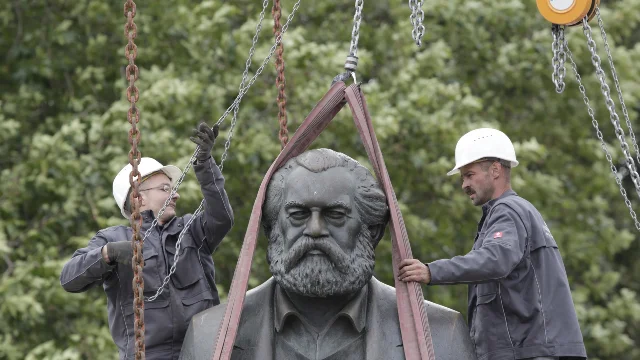
The Marx statue image below ran with Lowrey's 2017 Atlantic article — workers in Berlin lifting a Karl Marx bust by crane. It's a photograph that's hard to read as anything other than unintentionally comic: the father of the critique, hoisted by laborers, dangling in chains, against a tree-lined sky.
How and when to use it
Late capitalism now occupies a position in the language that's not quite formal and not quite slang. Merriam-Webster's five example sentences include a New Yorker passage from Katy Waldman and a quote from The New York Times — which tells you the register: informal-to-mid-register in published writing is fine; a boardroom memo or a legal brief would be out of place. 2
A few distinctions worth keeping clear before using it:
| Term | What it means | What it doesn't cover |
|---|---|---|
| late capitalism | The current stage of capitalism; or an ironic label for absurd/inequitable market behavior | Any specific company or individual |
| neoliberalism | A policy framework favoring deregulation, privatization, free trade | Cultural critique of everyday absurdity |
| consumerism | Cultural emphasis on buying as identity and value | The structural economic phase |
| commodification | The process of turning non-market things (relationships, art, nature) into market goods | The overarching system itself |
| postmodernism | Cultural and aesthetic theory about meaning, surface, and representation | The economic base that (in Jameson's reading) generates that culture |
Late capitalism and neoliberalism are the two most commonly confused near-synonyms. Both circulate heavily in left-of-center cultural discourse, and both carry a critical valence. The difference is specificity: neoliberalism names a set of policy choices — lower taxes, deregulated markets, reduced public services — associated with Thatcher, Reagan, and their successors. Late capitalism names a broader historical condition that those policies may have intensified but didn't invent. You can criticize a specific government's budget cuts as neoliberal without invoking the full weight of a century-long stage of capitalist development. Use late capitalism when you mean the whole system in its current form; use neoliberalism when you mean a specific policy agenda.
Two modes of usage to know:
The technical mode — used in academic economics, political theory, and serious journalism — refers to the historical stage beginning in the mid-20th century, with the emphasis on globalization, financialization, and the dominance of multinational capital. Fredric Jameson's usage is in this family, though expanded into cultural theory.
The non-technical or ironic mode — the one that lives on social media and in casual cultural criticism — uses the phrase as a compressed exclamation of recognition. Posting "#latecapitalism" under an image of a $17 airport water bottle means something like: "here is evidence that the system has turned everything, including a thing humans literally need to survive, into a vehicle for extracting money from captive consumers." The humor is the gap between the phrase's academic gravitas and the smallness of the example. Zoe Williams, writing in The Guardian in 2021, captured the mode: "Late capitalism doesn't care who can afford what; all that matters is the ferocity of their longing for the stuff they can't afford." 10
The risk of the non-technical mode is vagueness: used as a lazy catch-all, it stops meaning anything specific. Williams also noted that late capitalism functions, for some audiences, as a reliable signal that the speaker is a "crank" — it marks you as holding an ideological position, whether you intend that signal or not. 10 That's a practical consideration for using it in mixed company.
The Merriam-Webster entry itself models the balance: the definition covers both the precise economic-historical sense and the broader cultural-critical sense. Using it in writing, the safest path is to signal which sense you're invoking — either by context (an analysis of global supply chains vs. a tweet about $18 movie-theater nachos) or by anchoring the term to something concrete rather than reaching for it as a vague intensifier.
Cover image: AI-generated
参考来源
- 1200 New Words and Definitions Added to Merriam-Webster.com
- 2LATE CAPITALISM Definition & Meaning — Merriam-Webster
- 3Why the Phrase 'Late Capitalism' Is Suddenly Everywhere — The Atlantic
- 4Late capitalism, n. — Oxford English Dictionary
- 5Capital — Etymology, Origin & Meaning — Etymonline
- 6Capitalism — Etymology, Origin & Meaning — Etymonline
- 7Late — Etymology, Origin & Meaning — Etymonline
- 8Late capitalism — Wikipedia
- 9The 2010s Economy: Late Capitalism — The Atlantic
- 10'Late capitalism' is written off as a crank's phrase. But there's more to it than that — The Guardian
围绕这条内容继续补充观点或上下文。