
Disco Elysium — The Detective Game Where Your Own Mind Argues With You
Today's pick: Disco Elysium (ZA/UM, 2019). Metacritic 91 (PC), 97 for The Final Cut. This guide covers how the skill-as-inner-voice system works, what players love and what frustrates them, and a spoiler-free setup for the detective who wakes up with no memory in a waterfront slum that is quietly furious about everything.

| Developer | ZA/UM |
| Release | Oct 15, 2019 (PC) / Mar 30, 2021 (The Final Cut — PC, PS4/5, Xbox, Switch) |
| Genre | Narrative RPG / Detective |
| Platforms | PC, PlayStation 4/5, Xbox Series X, Nintendo Switch |
| Metacritic | 91 (PC original, 64 critic reviews) · 97 (The Final Cut PC, 12 reviews) |
| User score | 8.5 on Metacritic (2,078 ratings) |
| Playtime | ~25–35 hours (main story) |
How it plays
Disco Elysium has no combat. None at all. 1
Instead, every obstacle in the game — a locked door, a hostile witness, an embarrassing personal question — is handled through dialogue and dice-based skill checks. You roll two six-sided dice, add the result to the relevant skill, and compare against a target number. Fail, and you lose a point of health or morale; succeed, and the world opens up a little wider.
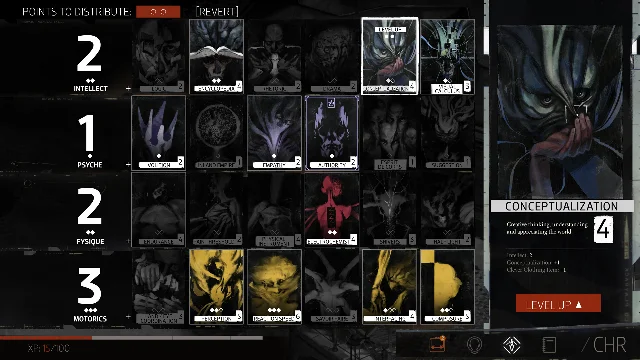
The character sheet has 24 skills organized into four core attributes:
- Intellect — Logic, Rhetoric, Drama, Encyclopedia, Conceptualization, Visual Calculus
- Psyche — Volition, Inland Empire, Empathy, Authority, Suggestion, Esprit de Corps
- Physique — Endurance, Pain Threshold, Physical Instrument, Electrochemistry, Shivers, Half Light
- Motorics — Perception, Reaction Speed, Savoir Faire, Interfacing, Composure, Hand/Eye Coordination
What makes this unusual: each of those 24 skills is also a voice in your head. A high Empathy will spontaneously cut into a conversation with an observation you didn't ask for. Inland Empire (your gut feeling, your weird hunches) will warn you about something before you understand why. Logic will butt in with a cold analysis of whatever lie you're about to tell. You don't just assign points to a stat — you're deciding which parts of your protagonist's fractured psyche to amplify.
There's also the Thought Cabinet, where you can internalize philosophical stances, obsessions, and memories. These take a few in-game hours to process, then permanently alter your stats or unlock new dialogue. The catch: you won't know the full effect until you've committed. 2
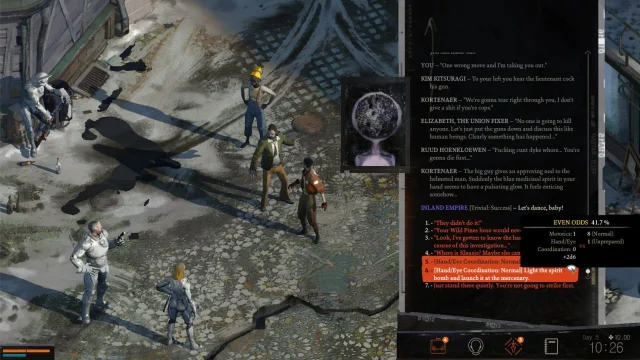
There's no grinding in the traditional sense. XP always costs 100 points regardless of character level, so no quest becomes obsolete. Skill checks come in two types: white (can be retried after investing a point) and red (fail once and that path is gone). The world doesn't pause to punish failure — it just takes a different shape.
What players are saying
Critics were nearly unanimous. Adventure Gamers gave it 100/10: "A murder mystery set in a rich, fictional setting, told with sweeping profundity and hilarious absurdity. With no combat to impede story progression, this is a choice-driven role-playing adventure that deftly raises the bar of quality for the medium." 3
Shacknews called it "dangerously well-written" and "truly one of the greatest RPGs ever released." 4 Meristation compared it to Planescape: Torment, calling it "the triumphant return of the spirit" of that classic. 5
Players are more divided. The Metacritic user score sits at 8.5, but 9% of the 2,078 ratings are negative — a higher dissatisfied minority than most 91-scored games carry.
What fans love:
- Writing quality at a level most games don't approach — philosophical, funny, and genuinely surprising
- The skill-as-personality system, where your character's inner voices feel like actual characters
- The oil-painting art style and the tight, dense map of Martinaise
- Full voice acting in The Final Cut version (added 2021) lifts the experience further
- Replay value: wildly different builds produce wildly different dialogue
What critics and skeptics say:
- The middle section of the game is slow. A lot of it is optional worldbuilding that can feel like reading an encyclopedia about a fictional country. One reviewer (two playthroughs in) described the midgame as "a structureless morass of huge walls of text." 6
- The dice system has odd incentives: there's rarely a reason to invest points into a skill before you fail a check, which makes optimization feel like save-scumming in disguise 6
- Players who expected an action RPG or choice-and-consequence game in the Detroit: Become Human mold often find the agency more cosmetic than real
- The Steam store page has a fraction of negative reviews pointing to the game as "more of an e-book than a game" — a fair description for some, a selling point for others
- The console ports (The Final Cut on PS4/5) launched with notable bugs, dragging the PS5 Metacritic to 89 vs. the PC's 97
The story — spoiler-free
You are a cop. You wake up in a trashed hotel room in a waterfront slum called Martinaise, in the fictional city of Revachol. You don't remember your name, your job, or anything about yourself. Your clothes are scattered across the floor. There is, somewhere outside, a body hanging from a tree that you're apparently supposed to be investigating.
Your partner, Lieutenant Kim Kitsuragi, is patiently waiting. He has been patiently waiting for days.
Revachol is a city that lost a revolution fifty-three years ago and has never quite recovered — occupied, economically gutted, and quietly furious about it in twelve different ideological directions. The waterfront district you're working is run by a union in an uneasy standoff with a private security company. Everyone has a grievance. Nobody trusts a cop, especially one who can barely remember he is one.
What you are — what kind of cop, what kind of person, what ideology you reconstruct yourself around — is the actual game. The murder mystery is the frame. The game is a detective trying to figure out who he is before he has to figure out who killed someone else.
The tone slides between tragedy and absurdism without warning. One scene will make you feel like you're reading a serious literary novel about failure and nostalgia; the next involves trying to retrieve your tie from a ceiling fan. Both feel completely natural.
Should you play it?
Yes, if: You enjoy narrative games, tabletop RPGs, or detective fiction. You're willing to read — a lot. You like the idea of building a character through personality and philosophy rather than a skill tree. You're curious about games that treat politics and failure as serious subjects without being preachy about it.
Be cautious if: You need action to stay engaged. You want decisions that feel like they bend the story's major arc. You are put off by a slow middle act. You have limited patience for dense worldbuilding delivered through NPC conversations.
The most accurate summary anyone has found: it plays like a very expensive choose-your-own-adventure book, with remarkable writing, a painterly visual style, and a skill system that functions as a philosophical argument about what kind of person you want to be.
The recommended version is Disco Elysium: The Final Cut — full voice acting, additional quests, available on all major platforms. It's also frequently on deep discount on Steam.
5
围绕这条内容继续补充观点或上下文。