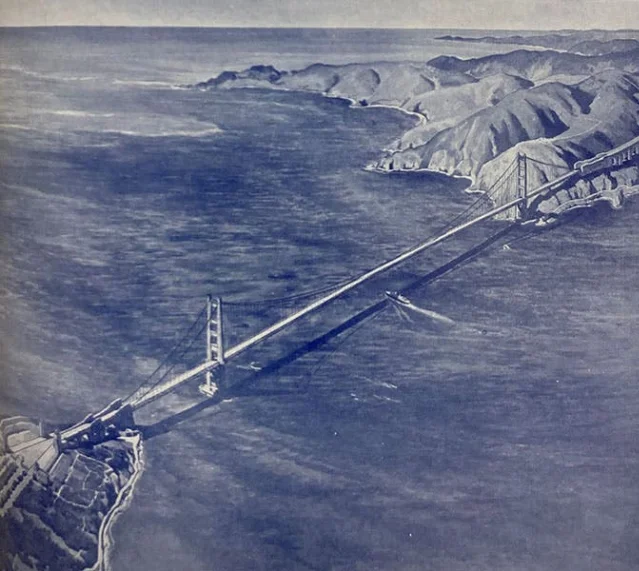
Golden Gate Bridge: the 90-year engineering negotiation

A 5,000-word case study tracing the Golden Gate Bridge's full engineering arc: how Charles Ellis (not Joseph Strauss) executed the structural calculations using Leon Moisseiff's deflection theory, how the open-ocean Fort Point foundation required a cofferdam fender in 100-ft seas, how the 1937 deck required aerodynamic retrofits after the Tacoma Narrows collapse, and how a 2026 $870M seismic campaign is now reinforcing the towers with 26,000-lb energy dissipation devices — with a further $900M main-span phase still to follow.
Engineering Marvel Teardown
2026/5/24 · 23:46
4 订阅 · 7 内容
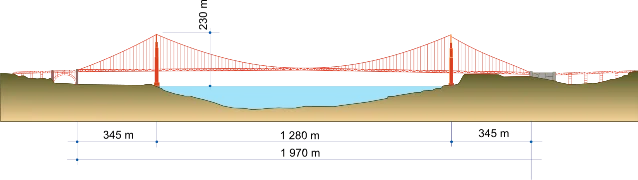
Golden Gate Bridge elevation diagram showing main span, tower height, and clearance dimensions
Bridge elevation showing the 4,200-ft main span, 746-ft towers, and 220-ft tide clearance. 1
In 1930, the dominant engineering opinion was that a bridge across the Golden Gate strait was impossible. The reasons were precise: a 1-mile-wide opening to the Pacific, water 372 feet deep at the channel center, tidal currents reaching 6.5 knots, sustained winds, and dense fog throughout much of the year. 1 When the bridge opened on May 27, 1937 — on schedule, $1.3 million under its $35 million budget — those doubts looked like failures of imagination. 1
What followed, across the next nine decades, complicates that triumphant picture. The bridge closed in a windstorm 14 years after opening. Its concrete deck was replaced wholesale in the 1980s. A magnitude 6.9 earthquake in 1989 revealed that a single structural failure at Fort Point could bring the whole span down. And a seismic retrofit program — now in its fourth phase, with a budget of approximately $870 million for the current phase alone — is still actively under construction as of 2026. 2
That arc — visionary 1930s engineering followed by 90 years of retrofit and re-engineering — is the actual story. The bridge that stands today is not the bridge that opened in 1937. It is a negotiated structure, revised repeatedly as tools improved and vulnerabilities became apparent.

The problem at the Golden Gate

The Golden Gate is the only sea-level break in the Coast Ranges along the California coast. The strait is roughly a mile wide between Fort Point on the San Francisco side and the Marin headlands to the north. At its deepest, the channel floor sits about 113 meters below water, with tidal currents strong enough to challenge anchored construction equipment. 1
Before the bridge, the only crossing was a ferry service that carried over 6 million passengers annually — a figure that underrepresented latent demand, since car ownership and road travel in California were both growing rapidly in the 1920s. The economic case for a fixed crossing was clear. The engineering case for its feasibility was not.
Joseph Strauss, a Cincinnati-born bridge engineer, had been promoting the idea of a Golden Gate bridge since 1919 and secured the political authorization to develop it through the Golden Gate Bridge and Highway District, formed in 1928. Strauss would eventually be listed as Chief Engineer on the completed structure. The question of what he actually contributed to the design — and what others contributed — is a documented controversy examined below.
The final structure's vital statistics establish the scale of the problem that was solved. The main span reaches 4,200 feet (1,280 m) — the longest suspension bridge span in the world from 1937 until 1964, when New York's Verrazzano-Narrows Bridge surpassed it. 1 The towers rise 746 feet (227.4 m) above the water surface, holding that record until 1993. 1 The roadway deck clears the water by 220 feet (67 m) at high tide — enough for large naval vessels to pass beneath. 1 Construction ran from January 5, 1933, to April 19, 1937. 1

Who actually designed it

Strauss's original 1921 concept was a hybrid cantilever-suspension structure: two massive cantilever arms on each side of the strait, connected by a central suspension segment. Architecturally, the result has been described by the Linda Hall Library as a "rat-trap mishmash of girders and cables." 3 It was rejected — not on structural grounds but on aesthetic ones. The final design had to be beautiful enough to pass the scrutiny of San Francisco's civic culture and the artistic sensibility of consulting architect Irving Morrow.
The pivot to a pure suspension form came from two engineers who are far less famous than Strauss.
Leon Moisseiff (1872–1943) was a Latvian-born engineer who had worked on the Manhattan Bridge and developed what he called deflection theory: the insight that a thin, flexible roadway would flex under wind load, transmitting forces up through the suspension cables to the towers rather than resisting those forces in the deck itself. This dramatically reduced the deck's required structural depth and mass, yielding an elegant, slender form. Moisseiff championed the pure suspension concept for the Golden Gate and provided its intellectual framework. 4
Charles Alton Ellis (1876–1949) executed that concept in structural detail. A mathematics graduate turned engineer, Ellis was hired by Strauss in 1922 and spent 1929–1931 as the principal design engineer of the bridge, working in continuous telegraphic contact with Moisseiff in New York. In November 1931, Strauss fired Ellis — ostensibly for "wasting too much money sending telegrams back and forth to Moisseiff." 3 Ellis kept working anyway. During the Depression, unemployed and unpaid, he continued producing calculations for 70 hours a week, eventually submitting ten volumes of hand calculations — the structural backbone of the bridge. 5
What happened next is documented in the ASCE Journal of Professional Issues in Engineering Education and Practice: "Strauss fired Ellis in late 1931 and systematically removed any mention of Ellis' name in his final report on the bridge issued in 1938." 5 Ellis was also excluded from the 1937 contributors' plaque. When Ellis died in 1949, the Linda Hall Library notes, "hardly anyone knew that he was the principal design engineer of the Golden Gate Bridge, and that Strauss was not." 3
The historical record was corrected slowly. John Van der Zee's 1986 book The Gate used Purdue University archives to document Ellis's role. In May 2007, the Golden Gate Bridge District issued a formal report giving Ellis major credit — 70 years after the bridge opened. 1 Francis E. Griggs Jr. of the American Society of Civil Engineers (ASCE) concluded that "Strauss violated one of the fundamental ethical canons — that of giving credit where credit is due." 5
Western Construction News cover (September 10, 1930) showing Ellis's pure suspension design
Western Construction News, September 10, 1930 — Ellis's pure suspension design on the cover, marking the pivot away from Strauss's hybrid cantilever concept. 3
The Moisseiff connection carries a further irony. The deflection theory that produced the Golden Gate's elegant proportions was pushed to its logical extreme on Moisseiff's later project, the original Tacoma Narrows Bridge in Washington State. On November 7, 1940 — three years after the Golden Gate opened — the Tacoma Narrows deck failed in a 40-mph wind through aeroelastic flutter, twisting and oscillating until it tore apart. The two bridges are cause and consequence of the same theoretical framework: one correctly applied within the bounds of what was then understood, the other an overextension that clarified where those bounds lay.

Foundations in open ocean

The Golden Gate's two tower foundations present entirely different engineering problems.
The south tower sits at Fort Point on the San Francisco shore, founded on serpentinite — a fractured metamorphic rock. Consulting geologist Andrew C. Lawson confirmed the serpentinite provided adequate bearing capacity, though its fractured character required careful assessment. 1 Fort Point itself is a pre-Civil War masonry fortress (built 1853–1861) that was deemed historically significant and therefore off-limits for demolition. Ellis designed a solution: a graceful steel arch spanning 1,125 feet that carries the approach roadway over the fortress to reach the bridge's south anchorage — effectively a smaller bridge built within the larger one, preserving the fort while threading the approach geometry. 1
The north tower required working in open ocean. The foundation site sits roughly 1,100 feet offshore in water approximately 100 feet deep, exposed to tidal currents reaching 6.5 knots and Pacific swells. Pacific Bridge Company built a large concrete fender — a protective barrier — around the planned excavation area to break the current and provide a calm working environment. Divers working on the foundation experienced water pressure of approximately 40 psi. 1 When the 2026 seismic retrofit crews need access to this tower, they still face the same logistical problem: the south tower sits 1,000 feet from shore, and workers must enter the tower structure to perform what the bridge's current chief engineer calls "very surgical work." 2

Spinning 80,000 miles of wire

The two main cables are the bridge's primary load-carrying elements. Each is 36.5 inches (93 cm) in diameter — about the size of a large truck tire — and contains 27,572 individual galvanized steel wires wound in parallel. 1 The total wire length for both cables combined is approximately 80,000 miles (130,000 km) — enough to circle the Earth more than three times at the equator. 1
The cables were manufactured by John A. Roebling's Sons Company of Trenton, New Jersey, using the parallel wire spinning method that John A. Roebling himself had invented in the 1800s for the Brooklyn Bridge. The spinning process began in October 1935 and took eight months to complete. 6
The technique works as follows. Temporary catwalks strung from tower to tower and down to the anchorages provided the working surface. A grooved "spinning wheel" — essentially a large pulley on a continuous loop of haul rope — carried individual wire loops back and forth between the two concrete anchorages at speeds up to 700 feet per minute. 6 Each pass deposited one wire loop; the wires accumulated in parallel, controlled by steel tramway sheaves set into the anchorage structure.
The geometry had to be precise. Each wire followed a catenary curve whose sag was calculated to account for temperature variation, wind loading, and the increasing weight of wire already in place. After spinning, the accumulated bundle was compacted hydraulically into a circular cross-section, then wrapped with soft galvanized wire to form a weather-resistant outer skin. The cables terminate in massive concrete anchorages — on the north side, built into the Marin headland rock; on the south side, into Fort Point's geological formation. Each of the two towers contains approximately 600,000 rivets (roughly 1.2 million across both towers), driven hot and bucked in place during construction. 1

Aerodynamics: the Moisseiff paradox

Moisseiff's deflection theory produced a structurally lighter and aesthetically cleaner bridge than any previous suspension span. It also embedded an aerodynamic risk that took 14 years and a catastrophe on another bridge to fully diagnose.
The original Golden Gate deck was engineered to withstand sustained winds up to 68 mph (109 km/h). 1 The Tacoma Narrows collapse in November 1940, which Moisseiff had helped design using the same deflection principle, made clear that slender bridge decks could fail not from static wind pressure but from aeroelastic flutter — a dynamic interaction between the deck's flexibility and the wind's oscillating lift forces. The Tacoma deck had torsionally twisted itself to failure at 40 mph.
The Golden Gate had already demonstrated alarming tendencies. On December 1, 1951, a windstorm with 69-mph gusts caused the bridge to sway laterally and roll — an instability serious enough to force the bridge's first weather-related closure. 1 Two more closures followed: December 23, 1982 (70 mph), and December 3, 1983 (75 mph). 1 In total, the bridge has closed due to weather only three times in its history — but the 1951 closure was the catalyst for a structural fix.
Between 1953 and 1954, engineers added lateral and diagonal bracing connecting the lower chords of the two side trusses, stiffening the deck against torsional rotation. 1 This bought aerodynamic margin, but it added weight to an already-heavy deck.
The deeper solution came between 1982 and 1986, when all 747 original concrete deck sections were replaced with steel orthotropic deck panels — a welded cellular steel structure that is approximately 40% lighter than the concrete it replaced, while being considerably stiffer against torsion. 1 The work was done in a rolling overnight program: construction crews worked between roughly midnight and 5 a.m., removing and replacing sections one at a time across 401 nights without a full road closure. The project cost over $68 million and also widened each traffic lane by two feet. 1
The next aerodynamic intervention came from an unexpected direction. Between 2019 and 2020, new railing slats were installed on the bridge's west side to improve wind tolerance — raising the rated aerodynamic resistance from 68 mph to 100 mph (161 km/h). 1 The slats achieved their structural purpose. They also caused the bridge to sing.
In June 2020, residents across San Francisco and Marin County began reporting an unsettling sound: a high-pitched drone, sometimes shrill, audible for miles on windy days. Investigation confirmed it was an Aeolian tone — a resonant vibration produced when wind passes through the gaps between the new railing slats at specific speeds. Two distinct profiles were identified: winds at 22 mph (35 km/h) produced a low-pitched tone between 280–700 Hz; winds at 27 mph (43 km/h) arriving at an angle produced a higher tone near 1.1 kHz. 1 An independent acoustic analysis by Tom Irvine in 2020 identified tones at 354, 398, 439, and 481 Hz — corresponding to the musical notes F4, G4, A4, and B4, forming an F Lydian Tetrachord.
In December 2021, the Bridge District approved a $450,000 fix: 12,000 U-shaped clips with rubber dampers installed between the slats to disrupt the resonant condition. 1 The fix was expected to reduce the tonal output by approximately 75%; a residual low-frequency tone was projected to occur about 18 hours per year and the higher tone about 70 hours per year.
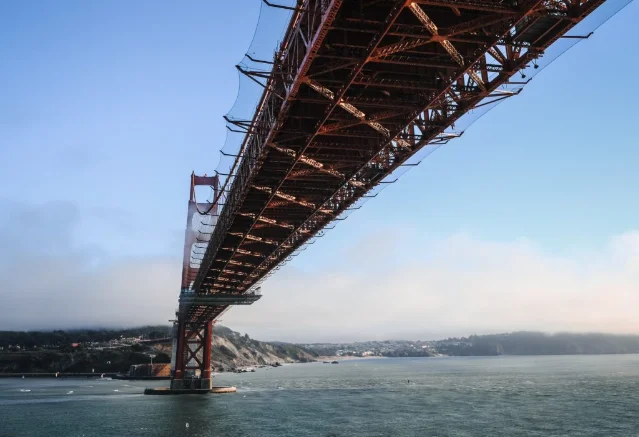
Underside of the Golden Gate Bridge showing the red steel stiffening truss and lateral bracing system
The stiffening truss beneath the bridge deck — the 1953–54 torsional bracing retrofit is visible in this cross-bracing system between the lower chord members. 7
RWDI wind engineering consultant Erik Marble presented research at the 2025 International Bridge Conference (IBC) in Pittsburgh emphasizing that bridge retrofits create their own aerodynamic risks: temporary materials like tarps, scaffolding, and working platforms change the shape of the bridge deck and the airflow around it, sometimes in ways that reduce stability. 7 As the Golden Gate moves into its largest retrofit since the 1982–86 deck replacement, wind analysis will be an active part of the construction planning — not a historical footnote.

Art Deco and the accidental color

The bridge's celebrated appearance was not part of Strauss's original brief. Irving Morrow (1884–1952), a San Francisco residential architect with relatively little major infrastructure experience, was engaged as consulting architect and became responsible for the bridge's entire visual identity. 1
Morrow's contributions were:
  • The vertical fluting of the towers — Art Deco streamlining that gives the towers their characteristic stepped-pillar silhouette instead of the utilitarian trusswork that had been the default for bridge towers
  • The lighting scheme that outlines the cables and tower edges at night
  • Details throughout the bridge: streetlights, handrails, pedestrian walkway treatment, expansion joint covers
The color choice became the most discussed decision of all — and it was almost an accident. The steel arrived from the fabricators coated in a red lead primer — a standard corrosion-inhibiting undercoat, orange-red in hue. Morrow noticed how that color read against the California hills, the blue water, and the fog, and advocated making it the final color. 1
The U.S. Navy had a competing preference: black and yellow stripes for maximum visibility to ship traffic. The Navy's proposal lost. The color Morrow specified — officially "International Orange," an orange-vermilion — enhances visibility in the Golden Gate's persistent fog while harmonizing with the ochre headlands on both shores. It has since become one of the most recognized colors in architecture.
The paint system has been updated repeatedly. The original lead-based topcoat was replaced in the mid-1960s with zinc silicate primer and vinyl topcoats. Since 1990, acrylic topcoats have been used for air-quality compliance. 1 A crew of 38 painters works continuously on the bridge, touching up corroded areas rather than ever completing a full repaint. The Phase 3B1 retrofit underway in 2026 adds a significant paint-related task: the original 1930s paint system — which testing has found to contain approximately 68% lead — must be fully abated from the tower sections being modified. 2

Safety below the deck

When construction began in 1933, the standard industry fatality rate on large bridge projects was roughly one death per million dollars of project cost — which, on a $35 million project, implied roughly 35 deaths. 1
Strauss introduced a requirement that broke from industry norm: a movable safety net, suspended beneath the entire construction deck and moved along as work progressed. It was the first large-scale use of such a net on a major bridge project. Over the course of construction, the net saved 19 men who fell from the working deck. These survivors formed an informal club — the Half Way to Hell Club — reasoning that workers who fell to their deaths "went to hell," while those caught by the net only went "half way." The first confirmed member was ironworker Al Zampa, who fell into the net in October 1936. 8
"There were ten of us that fell into the nets those first few weeks. Four got hurt. I was one of them. We were in the hospital together. We formed the club right there in St. Luke's Hospital." — Al Zampa 8
The net did not eliminate fatalities. 11 workers died during the project, 10 of them in a single incident. On February 17, 1937, a temporary scaffold platform carrying 12 men tore loose — its mounting bolts had been undersized. The scaffold fell, struck the safety net with sufficient force to break through it, and dropped the men 200 feet into San Francisco Bay. Ten died. Two survived. It remains the worst accident in the bridge's construction history. 8
The net innovation entered bridge engineering practice as a direct result of the Golden Gate's example. The final toll of 11 deaths on a project of this scale was, by the standards of the era, unusually low.

Seismic retrofit: 1989 to the 2026 campaign

正在加载统计卡片…
At 5:04 p.m. on October 17, 1989, a magnitude 6.9 earthquake struck the Santa Cruz Mountains 60 miles south of San Francisco. The Loma Prieta earthquake killed 63 people, collapsed a section of the Bay Bridge, and buckled a double-deck freeway in Oakland. The Golden Gate Bridge sustained no structural damage and was reopened within hours.
The structural studies that followed over the next two years were sobering. Engineers found that the bridge was actually vulnerable to complete structural failure triggered by a specific mechanism: the failure of the supports on the 320-foot steel arch over Fort Point — the "bridge within a bridge" designed by Ellis to span the historic fortress — could initiate a progressive collapse of the entire south approach. 1 The bridge had survived 1989 not because it was adequately earthquake-resistant but because the 1989 event had not loaded that particular vulnerability.
The resulting retrofit program has run across four phases with a total authorized budget of approximately $392 million for the first three phases. 1
  • Phase 1 (1997–2001, ~$79M): Strengthened the north (Marin) approach viaduct
  • Phase 2 (2001–2008, ~$189M): South approach viaduct, Fort Point arch, south pier foundation work
  • Phase 3A (2008–2014, ~$125M): North anchorage and north tower pier
  • Phase 3B (ongoing): The main suspension structure
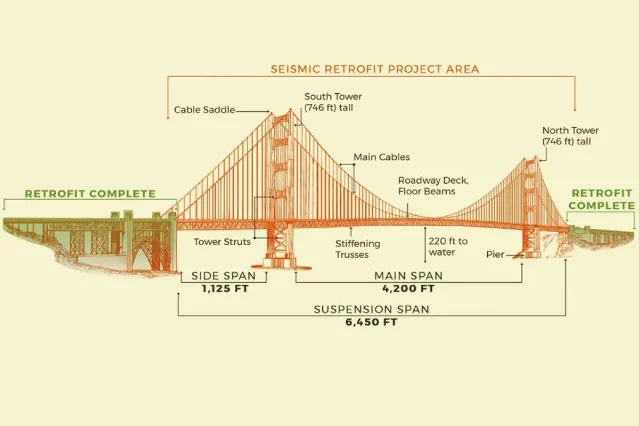
Golden Gate Bridge seismic retrofit diagram annotating the tower reinforcement zones, side spans, and energy dissipation device locations
Seismic retrofit scope diagram showing Phase 3B1 work areas on the towers and 1,125-ft side spans. 9
Phase 3B1 — the current phase — is the most technically complex work yet attempted on the bridge. Halmar International was engaged in March 2024 under a Construction Manager/General Contractor (CM/GC) model that brings the contractor into the design phase to provide constructability input before the contract is finalized. The construction contract was scheduled for award in December 2025, with a Notice to Proceed issued in January 2026. Completion of Phase 3B1 is projected for 2031. 2
The Phase 3B1 scope focuses on four elements:
Tower reinforcement. Steel plates 2 inches (50 mm) thick and approximately 40 feet (12 m) tall are being wrapped around the base sections of both 746-foot towers. The plates are bolted to the existing tower structure using fasteners installed through the tower walls by crews working inside the hollow tower legs — a process the bridge's chief engineer, John Eberle, has characterized as "very surgical work, removing existing fasteners and putting on new steel plates without damaging or creating havoc with the existing structure and the stresses in it." 2
Energy dissipation devices on the side spans. Twenty-eight (28) stainless steel energy dissipation devices — each weighing 26,000 pounds and capable of extending 20 feet — are being installed in the two 1,125-foot side spans. (Note: one source, GovMarketNews, reported 38 devices 10; ENR 2 and CEG 9 both cite 28; the discrepancy has not been publicly resolved.) Eberle described the device strategy directly: "The devices will dissipate energy from an earthquake so that that force will not be imparted into the stiffening truss; they'll reduce the force so you don't have to retrofit every single member of the bridge." 2
Lateral bracing at deck level. The existing lateral bracing connecting the towers to the roadway deck at the main span entry points is being upgraded.
Lead paint abatement. The 1930s-era paint system covering the tower sections under modification contains approximately 68% lead by weight. Full removal is required before new steel can be installed. 2
The Phase 3B1 budget is approximately $870 million, funded through three streams: $400 million in federal Bridge Investment Program grants, $200 million from Caltrans (the California Department of Transportation), and $270 million from the Bridge District's capital reserve. 2 10 After Phase 3B1, a further Phase 3B2 — targeting the 4,200-foot main suspension span itself — is estimated at approximately $900 million and will not begin until 3B1 concludes in 2031.
The stated goal of the complete seismic program is specific and quantitative: after a major earthquake, the bridge should be open to emergency vehicles within 24 hours and to the general public within 72 hours. 2 GGBHTD spokesperson Paolo Cosulich-Schwartz has noted that the previously completed phases mean the bridge "can safely withstand a large earthquake today" — but added that "the main suspension span between the towers still requires major strengthening work." 10
Construction logistics present their own challenge. At peak activity, approximately 200 workers will be on site simultaneously. The south tower sits 1,000 feet from shore, reachable only by boat or by traversing the bridge deck, while active commuter traffic continues. Halmar has used 3D printing to evaluate construction sequencing scenarios and test physical mock-ups of the tight-clearance steel installation work before committing crews. 2
正在加载链接预览…

Legacy and open threads

The Golden Gate's engineering legacy operates at two levels: the specific techniques it established, and the pattern of vulnerabilities and remediation it exemplifies.
Parallel wire cable spinning — the Roebling method applied here at unprecedented scale — became the standard for all major suspension bridges that followed. Every large post-1937 suspension span worldwide uses essentially the same spinning-wheel technique for main cables. The Golden Gate's 80,000-mile wire achievement set the scale benchmark that subsequent bridges (Humber, Akashi Kaikyō, Çanakkale) built upon. 1
Deflection theory and its limits. The Tacoma Narrows collapse forced a fundamental revision of how suspension bridges are analyzed for wind. The lesson was not that Moisseiff was wrong in principle but that aerodynamic behavior at the deck scale — particularly torsional flutter driven by von Kármán vortex shedding — requires physical model testing, not calculation alone. Every major suspension bridge designed since 1940 undergoes wind tunnel testing of its deck section before construction. The Golden Gate's 1953–54 bracing retrofit and 1982–86 deck replacement are direct descendants of Tacoma Narrows.
Ship-strike risk. In November 2025, the National Transportation Safety Board (NTSB) — the U.S. independent federal agency that investigates transportation accidents — released its final report on the March 2024 collapse of Baltimore's Francis Scott Key Bridge — caused when a container ship lost power and struck a pier. The NTSB identified 68 bridges built before 1991 that cross commercially navigable waterways and have not been evaluated for current vessel-collision vulnerability; the Golden Gate Bridge is on that list. 11 The Golden Gate Bridge, Highway and Transportation District (GGBHTD) responded that the Golden Gate has "one of the strongest ship collision protection systems on the West Coast" and has already retained an engineering firm to assess vessel-strike risk. 12 A 206-page engineering report, reported by the San Francisco Chronicle, is said to conclude the bridge is "extremely unlikely to collapse" from a ship strike, though that report has not been publicly released.
The suicide deterrent net. A separate engineering project completed January 1, 2024, after more than five years of construction and at a cost of $224 million, addresses a different kind of life-safety problem. A marine-grade stainless steel cable net — 4 mm wire diameter, positioned 20 feet below and 20 feet outward from the roadway deck along the bridge's full 1.7-mile length — now lines both sides. 13 The net functions primarily as a deterrent rather than a capture device — the fall into the net is likely to cause serious injury, and that prospect appears to discourage most attempts. Through the first eight months of 2024, four suicides occurred at the bridge, compared to an estimated 15–20 over the same period in a pre-net year. GGBHTD spokesperson Cosulich-Schwartz has stated: "In a typical year before the net, there would have been 15 to 20 suicides at this point." 13 The first three consecutive months with zero recorded suicides occurred in 2024 — in the bridge's nearly 90-year history, those were the first such months on record. 13
The larger pattern the Golden Gate illustrates is this: a 1930s structure that remains in continuous heavy use will require engineering investment equivalent to — and possibly exceeding — its original construction cost just to keep it functional at contemporary safety and reliability standards. The original bridge cost roughly $35 million in 1937 dollars. The seismic retrofit alone has already spent approximately $392 million across the first three phases, with another $1.77 billion authorized for Phase 3B1 and 3B2 combined. 2 10 The 2024 suicide net added another $224 million. The original engineers could not have anticipated any of this — not the 1940 Tacoma lesson, not the 1989 earthquake, not the Loma Prieta analysis that identified the Fort Point arch as a collapse trigger, not the Key Bridge event that prompted the NTSB to flag ship-strike vulnerability across a generation of infrastructure. Every one of those retrofit programs was a response to information that did not exist when the bridge was designed.
That is not a failure of the original designers. It is a description of what long-lived infrastructure actually is.

Cover image: Golden Gate Bridge, view from below showing towers and main cables. Photo: Wikimedia Commons

围绕这条内容继续补充观点或上下文。

  • 登录后可发表评论。