Amgen (AMGN) — $57B in debt, falling FCF, and a GLP-1 moonshot

Amgen (AMGN) — $57B in debt, falling FCF, and a GLP-1 moonshot

Amgen Inc. (NASDAQ: AMGN) passes all three hard screening criteria — GAAP ROE of 21–22% for FY2023–FY2025 (SEC EDGAR verified), positive FCF in every measured year, and a trailing P/E of 24.33× that sits 5% below Amgen's own 5-year average. The central tension: a $57.3 billion debt load from the 2023 Horizon Therapeutics acquisition is compressing FCF as biosimilar erosion accelerates on Prolia/XGEVA and ENBREL — while the obesity drug MariTide represents a genuine pipeline option. Closes with a structured bull/bear framework.

US Stock Pick: 3-Year ROE > 15%
2026/6/7 · 21:32
1 订阅 · 21 内容
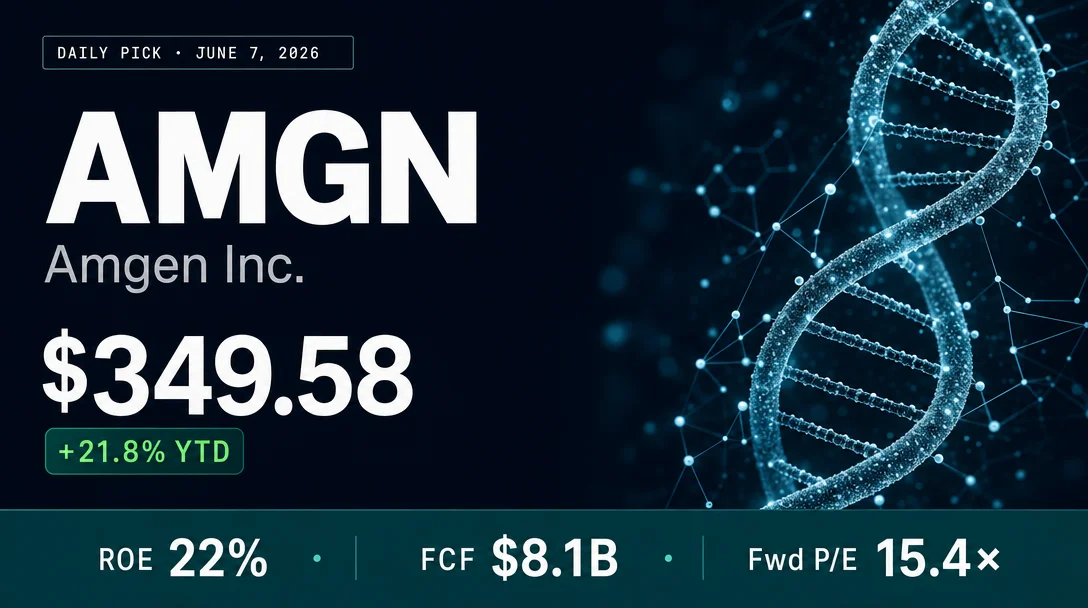
Current price: $349.58 (June 5, 2026 close) · Market cap: $188.7B · Sector: Healthcare / Biotechnology 1
Amgen Inc. (NASDAQ: AMGN) clears all three hard screening criteria. Return on equity has held in a narrow band of 21.04% / 22.04% / 22.17% for FY2023–FY2025 (GAAP, SEC EDGAR verified) — each year comfortably above the 15% threshold — and is 22.14% on a trailing-twelve-month basis. 2 Free cash flow has been positive in every measured year. Valuation sits at a trailing P/E of 24.33×, roughly 5% below Amgen's own 5-year average of 25.68×. 3
The central tension: Amgen funded its 2023 acquisition of Horizon Therapeutics (the largest biotech deal of that year) with $27.8 billion in cash, financed almost entirely through debt. Total debt now stands at $57.3 billion. 4 At the same time, the Prolia/XGEVA franchise — which generated $6.5 billion in FY2025 — is being steadily eroded by biosimilar competition, and ENBREL faces IRA-mandated Medicare price reductions. FCF peaked at $10.4 billion in FY2024 and has since compressed to $6.3 billion TTM. Whether the obesity drug MariTide — with 10+ Phase 3 trials now enrolling — eventually justifies that debt load is the question the next three years will answer.

What Amgen does and how it makes money

Amgen Inc. (founded April 8, 1980, headquartered in Thousand Oaks, California) is one of the world's largest biotechnology companies. 5 It develops and manufactures human therapeutics derived from advanced biological processes rather than traditional chemical synthesis. The company covers four therapy areas: General Medicine, Rare Disease, Inflammation, and Oncology. Its products include biologics — large-molecule medicines with manufacturing processes that are inherently difficult to replicate exactly, creating partial competitive barriers even after patent expiry. 5
Amgen operates in approximately 100 countries, employs roughly 31,500 people worldwide, and is a component of both the Dow Jones Industrial Average and the Nasdaq 100. 5 Its top revenue contributors in FY2025 included ENBREL (rheumatoid arthritis, psoriasis), Prolia and XGEVA (bone health), OTEZLA (psoriasis), BLINCYTO and Lumakras (oncology), TEPEZZA (thyroid eye disease, acquired via Horizon), and KRYSTEXXA (severe gout, also from Horizon). 6
FY2025 total revenue reached $36.75 billion, up approximately 10% year-over-year. 6 Amgen pays a quarterly dividend: $2.52 per share as of Q1 2026, equating to an annualized $10.08 and a yield of approximately 2.88% at current prices. The dividend has grown for 16 consecutive years. 1

ROE track record — FY2023–FY2025

All three fiscal years pass the 15% threshold, with GAAP ROE stable in a narrow band around 21–22%. The figures below are derived from SEC EDGAR XBRL 10-K data (CIK 0000318154) using the standard net income divided by year-end stockholders' equity method. 2
Fiscal yearNet incomeStockholders' equity (year-end)ROE
FY2023 (ended Dec 31, 2023)$6,509M$30,935M21.04%
FY2024 (ended Dec 31, 2024)$7,377M$33,476M22.04%
FY2025 (ended Dec 31, 2025)$7,922M$35,729M22.17%
TTM (ended Mar 31, 2026)$8,011M$36,182M22.14%
A data-source note worth flagging: commercial platforms like StockAnalysis and Macrotrends show Amgen's ROE at 67–106%, far above the GAAP figures in the table. The difference traces entirely to how they compute book equity. Amgen has repurchased $83.3 billion of its own stock over its lifetime, which shows up as a treasury stock deduction that collapses reported book equity down to roughly $9 billion on commercial platforms versus $36 billion on a full GAAP basis. 2 Both methodologies pass the 15% screen; the GAAP figure is used here because it is consistent with prior channel picks and is directly comparable across companies.

Free cash flow — positive but declining

Amgen's FCF was positive in every year from FY2021 through FY2025, but the trend since FY2023 is a meaningful compression driven by higher capital expenditures and, in the FY2024–FY2025 transition, a surge in interest payments on the Horizon acquisition debt. 7
正在加载图表…
FCF figures from StockAnalysis and Macrotrends (OCF minus CapEx methodology). 7 8
PeriodFCFFCF marginFCF yield (at $188.7B market cap)
FY2021$8.38B
FY2022$8.79B
FY2023$7.36B
FY2024$10.39B29.1%
FY2025$8.10B22.0%
TTM$6.32B~3.35%
FY2025 FCF of $8.1 billion declined 22.1% from FY2024's $10.4 billion peak. 6 Amgen's FY2025 capital expenditures were $2.54 billion, up 17% from $2.16 billion in FY2024, as the company expands manufacturing capacity for MariTide and other pipeline candidates. The TTM figure of $6.32 billion means the FCF yield at current prices is 3.35% — below the peer group median of approximately 6.4% — which is the primary reason Amgen does not look cheap on this metric relative to peers such as Regeneron Pharmaceuticals (REGN, FCF yield 6.36%) or Biogen (BIIB, FCF yield 8.40%). 1

Valuation — trailing discount, forward parity

正在加载统计卡片…
Metrics as of June 5, 2026 close. 1 9
Historical context. Amgen's trailing P/E has averaged 25.68× over the past five years, with the 5-year range running from 21.69× to 34.48×. 10 At 24.33×, today's multiple sits 5.3% below that 5-year average and 12.2% above the 5-year trough — not a dramatic discount. The forward P/E of 15.42× is where the story gets more interesting: it assumes analysts are right that Amgen's Non-GAAP earnings will accelerate sharply, driven by the $3,482M annual gap between GAAP and Non-GAAP earnings that flows from the Horizon intangible amortization charges. Amgen's 2026 guidance is GAAP diluted EPS $15.45–$16.94 vs. Non-GAAP diluted EPS $21.60–$23.00; at the Non-GAAP midpoint of $22.35, the stock trades at roughly 15.6× forward earnings. 6
Peer comparison. All peer data from StockAnalysis, as of June 5, 2026 close.
CompanyTrailing P/EFwd P/EP/BEV/EBITDAFCF yieldOne-line description
AMGN (Amgen)24.33×15.42×20.53×13.83×3.35%Biologics leader; four therapy areas; Horizon acquisition; MariTide obesity pipeline
GILD (Gilead Sciences)17.57×71.64×⚠6.82×11.65×6.38%Antivirals (HIV, hepatitis); expanding oncology via CAR-T
REGN (Regeneron)15.48×13.10×2.06×11.14×6.36%Antibody-based therapies; Dupixent (atopic dermatitis), Eylea (eye disease)
BIIB (Biogen)21.01×14.45×1.55×8.66×8.40%Neurology; multiple sclerosis, SMA, Alzheimer's
LLY (Eli Lilly)40.19×30.34×32.40×28.90×1.17%GLP-1 weight-loss (Mounjaro/Zepbound) and diabetes market leader
MRK (Merck)33.78×19.55×6.50×11.58×4.73%Keytruda oncology franchise; vaccines (Gardasil); animal health
BMY (Bristol-Myers Squibb)16.04×9.36×5.83×8.04×10.18%Oncology (Opdivo), hematology, immunology (Eliquis)
Peer median21.01×15.42×6.50×11.58×6.36%
AMGN vs. median+15.8%0.0%+215.8%+19.4%−47.3%
⚠ GILD's forward P/E of 71.64× is an anomaly from near-term earnings compression; excluded from forward P/E median. All data from StockAnalysis Statistics pages. 1
Several features stand out. On trailing P/E, Amgen trades at a 15.8% premium to the peer median (21.01×), which is modest but not negligible — it is priced above cheaper peers like GILD, REGN, BIIB, and BMY. On forward P/E, Amgen sits exactly at the peer median of 15.42×, suggesting the analyst consensus has it fairly priced relative to peers once Horizon amortization is stripped out. The P/B of 20.53× looks extreme but is distorted by the $83.3B in treasury stock buybacks compressing book equity — its informational value as a valuation metric is limited in Amgen's case. The more relevant concern is FCF yield: at 3.35%, Amgen generates only half the cash yield of most biotech peers, which limits the margin of safety for a company carrying $57 billion in debt.
Amgen's current valuation is best characterized as fairly priced relative to its own history and forward consensus, at a modest premium to biotech peers on a trailing basis — the discount case requires Non-GAAP earnings acceleration that depends heavily on biosimilar-erosion stabilizing and, longer-term, MariTide succeeding.

Revenue and earnings growth

Amgen's revenue has compounded at approximately 9% annually over the past five years, growing from $25.98 billion in FY2021 to $36.75 billion in FY2025 — though the $3.7 billion step-up in FY2024 was almost entirely from the Horizon acquisition adding TEPEZZA, KRYSTEXXA, and other rare-disease drugs. 8
正在加载图表…
Revenue and margin data from StockAnalysis (SEC 10-K source). 8
PeriodRevenueYoY growthNet incomeOperating marginNet margin
FY2021$25.98B$5.89B29.4%22.7%
FY2022$26.32B+1.3%$6.55B36.3%24.9%
FY2023$28.19B+7.1%$6.72B28.0%23.8%
FY2024$33.42B+18.5%$4.09B21.7%12.2%
FY2025$36.75B+10.0%$7.71B24.7%21.0%
TTM$37.22B$6.37B28.4%17.1%
Q1 2026$8.62B+6.0%$1.82B~31%21.1%
Revenue data from StockAnalysis and Amgen earnings press releases. 8 4
Four observations from the table. First, FY2024 net income collapsed to $4.09 billion despite revenue growing 18.5% — the direct result of $4+ billion in non-cash intangible asset amortization from the Horizon acquisition hitting cost of goods and operating expenses. Second, FY2025 saw a strong earnings recovery: net income rebounded to $7.71 billion (+88.5%) as the amortization burden was partially absorbed. 6 Third, Q1 2026 GAAP EPS of $3.34 (+4.4% year-over-year) versus Non-GAAP EPS of $5.15 (+5.1%) underscores the ongoing GAAP/Non-GAAP gap. 4 Fourth, 16 brands posted double-digit growth in Q1 2026, with CEO Robert Bradway stating: "Our first quarter results demonstrate the strength of our business, with 16 brands achieving double-digit growth, enabling us to grow through expected patent expirations." 4
FY2026 guidance: total revenues $37.0–$38.4 billion and Non-GAAP diluted EPS $21.60–$23.00. 6

Balance sheet health

The Horizon acquisition transformed Amgen's balance sheet. Pre-acquisition, Amgen's debt was manageable; today it carries the largest debt load of any pure-play biotech company.
MetricFY2025Q1 2026 (TTM)
Total debt$54.6B$57.3B
Cash & equivalents$9.1B$12.0B
Net debt$45.5B$45.3B
Debt / equity (GAAP, D/E)6.31×
Debt / EBITDA3.83×~3.2× (mgmt est.)
Interest coverage (EBIT / interest)3.30×3.93× (TTM)
Current ratio1.14×1.26×
S&P credit ratingBBB+ / Stable
Moody's credit ratingBaa1 / Stable
Fitch credit ratingBBB+ / Stable
Balance sheet data from StockAnalysis and Amgen earnings releases. 11 6
The D/E of 6.31× looks alarming but is somewhat misleading for the same reason the P/B is distorted: the equity denominator is compressed by $83.3 billion of treasury stock. The more informative leverage metric is Debt/EBITDA at 3.83×, which Amgen management guided to approximately 3.2× as of year-end 2025 — and is declining. 4 Amgen retired $6.0 billion of debt during FY2025 and issued multi-tranche senior unsecured notes in February 2026 (maturities 2031–2056) to refinance near-term obligations, extending the maturity profile. 6
Interest coverage at 3.93× TTM is tighter than most investment-grade peers — Adobe, for comparison, runs 33.9× — but it is improving from 2.30× in FY2024. 4 Three rating agencies have stable outlooks on the debt: Fitch upgraded Amgen to BBB+ on December 22, 2025, citing improving leverage and stronger interest coverage post-Horizon integration; S&P revised its outlook to Stable (affirming BBB+) on similar reasoning. 12 13 All three ratings are lower-medium investment grade — three notches above speculative — which limits but does not eliminate refinancing risk if operating cash flows deteriorate.

Risk factors

1. Biosimilar erosion accelerating on core franchises
Prolia and XGEVA (both denosumab, a RANKL antibody) together generated $6.5 billion in FY2025 product revenue. The core patent expired in February 2025, and multiple biosimilar denosumab products have since entered the US market. The revenue impact arrived immediately: Q1 2026 Prolia revenue fell 34% year-over-year to $727 million; XGEVA fell 27% to $411 million. 4 Separately, ENBREL (etanercept, rheumatoid arthritis) was subject to IRA Medicare Part D price negotiation that took effect January 1, 2026, driving Q1 2026 ENBREL revenue down 37% to $320 million against a 35% net selling price reduction. OTEZLA was also selected for IRA negotiation, triggering a $1.2 billion FY2025 intangible impairment charge. 4 The combined IRA + biosimilar pressure on ENBREL, Prolia, and XGEVA — which collectively represented over $8 billion of FY2025 product revenue — is the direct cause of FCF declining from $10.4 billion in FY2024 to $6.3 billion TTM.
2. TAVNEOS FDA withdrawal proceeding — existential threat to a $459M product
TAVNEOS (avacopan), which Amgen acquired as part of ChemoCentryx, treats ANCA-associated vasculitis, a rare autoimmune kidney disease. On April 27, 2026, FDA's Center for Drug Evaluation and Research (CDER) formally proposed to withdraw TAVNEOS's approval, asserting lack of substantial evidence of effectiveness and alleging that ChemoCentryx's original NDA contained untrue statements of material facts. 14 TAVNEOS FY2025 revenue was $459 million (+62% year-over-year). Amgen has refused to voluntarily withdraw the drug and may request a hearing. The drug remains on market during the proceedings. Amgen's official statement: "There have been no known deaths in the U.S. linked to serious liver injury, including vanishing bile duct syndrome (VBDS), in the more than 8,000 patients in the U.S. treated with TAVNEOS." 14 Separately, Japan reported 20 deaths linked to serious liver dysfunction among approximately 8,500 Japanese patients. The FDA proceeding represents an existential risk to a product that represented approximately 1.3% of FY2025 product revenue. If withdrawn, the $459M annual revenue would disappear and the remaining TAVNEOS intangible asset would likely be fully impaired.
3. Debt refinancing risk and interest burden
At $57.3 billion total debt and an estimated blended interest rate of approximately 4.8%, annual interest expense runs roughly $2.5–$3.0 billion. With TTM FCF of $6.3 billion, approximately 40–48% of free cash flow is consumed by interest payments before any debt principal repayment. Amgen paid $5.1 billion in dividends in FY2025 and conducted no share repurchases in FY2025 or Q1 2026 — all available cash after capex and dividends went to debt service. 6 If FCF continues to fall — whether from further biosimilar erosion, IRA pricing on additional products, or MariTide R&D costs escalating — Amgen's ability to maintain its dividend, service its debt, and fund pipeline simultaneously would come under pressure.
4. Management transitions — dual leadership exits
CFO Peter Griffith announced retirement on May 19, 2026, and CTO David Reese announced retirement on April 22, 2026. Griffith had rejoined as a "boomerang CFO" after a 2022 departure and received a $12.5 million retention bonus; his departure removes the executive most familiar with the Horizon debt structure from the finance function at a critical deleveraging period. 4 The simultaneous loss of both the CFO and CTO creates execution risk at a time when Amgen is managing a $57 billion debt load, a Phase 3 obesity program, and a concurrent FDA regulatory proceeding.
5. Insider ownership and recent transactions
Insider ownership stands at approximately 0.23% of shares outstanding. The most recent disclosed transaction: CEO Robert Bradway exercised options and sold shares worth approximately $18.7 million in early 2026. No insider has made a public market purchase in the past 12 months. 9 Short interest is approximately 3.9% of float — modest for a large-cap, not indicative of heavy institutional short conviction.

Near-term catalysts

Q2 2026 earnings — approximately August 2, 2026. Amgen traditionally reports Q2 results in late July or early August. The critical data points to watch: (1) Prolia/XGEVA/ENBREL trajectory — are the biosimilar-driven declines stabilizing or accelerating; (2) TEPEZZA subcutaneous formulation progress — a Phase 3 trial read out positive results on April 6, 2026, showing 77% proptosis response rate vs. 19.6% for placebo (p<0.0001), with a mean proptosis reduction of −3.17mm, comparable to IV formulation efficacy; if approved, subcutaneous dosing would materially expand TEPEZZA's addressable market; (3) TAVNEOS FDA update — any hearing request or FDA timeline announcement; (4) MariTide Phase 3 enrollment progress. 4
Analyst consensus. Among 35 analysts tracked by StockAnalysis, the consensus rating is Buy, with an average price target of $352.23 — implying 0.76% upside from $349.58. 1 The distribution is wide: Barclays maintains an Equal Weight target of $185 (the most bearish published target, implying 47% downside), while UBS carries a Buy at $380 and Scotiabank holds Sector Outperform at $385. The average target sitting within 1% of the current price suggests the analyst community has effectively priced in both the near-term headwinds and the MariTide optionality — neither a strong sell nor a strong buy signal at current levels. Analyst price targets carry systematic optimism bias and should be read directionally rather than literally. 1
52-week context. The 52-week range is $267.83 (low) to $391.29 (high). 1 At $349.58, the stock is 10.6% below its 52-week high and 30.5% above its 52-week low. The 5-year beta is 0.42 — Amgen moves significantly less than the market, making it more typical of a bond-like defensive holding than a pure-growth biotech play.
Dividend. The quarterly dividend of $2.52 per share ($10.08 annualized) has grown for 16 consecutive years. The FY2025 payout ratio at GAAP EPS was approximately 71%, which is elevated — suggesting limited room for additional dividend increases unless GAAP earnings grow materially. 1

Competitive positioning and moat

Amgen's competitive advantages rest on three reinforcing structures, each with a meaningful caveat.
Biologics manufacturing complexity. Unlike small-molecule drugs (where generic manufacturers can precisely replicate a chemical compound), biologics are manufactured through living cell lines. Even after patent expiry, biosimilar manufacturers must demonstrate comparable efficacy and safety through expensive clinical trials — a process that takes years and hundreds of millions of dollars. This created a partial "biosimilar lag" that gave Amgen revenue continuity on products like Prolia and XGEVA even after patent expiry. The caveat: that lag is now running out. Multiple denosumab biosimilars have received FDA approval, and the Q1 2026 revenue erosion numbers confirm the lag is over. 4
Pipeline depth and R&D scale. Amgen spent $7.18 billion on R&D in FY2025 (20.4% of product revenue), with Q1 2026 R&D up 16% year-over-year driven largely by MariTide Phase 3 clinical trials. 6 At this R&D scale, Amgen can run 10+ Phase 3 trials simultaneously for a single asset (MariTide has studies in obesity without T2D, obesity with T2D, cardiovascular outcomes, heart failure with preserved ejection fraction, sleep apnea, and tirzepatide/semaglutide switching). Very few biotechs have the financial resources to pursue a full-spectrum obesity program concurrently with a large oncology pipeline. 4 IMDYLLTRA (tarlatamab), approved by the EU Commission in June 2026 for small-cell lung cancer, posted Q1 2026 revenue of $258 million (+219% year-over-year), demonstrating the pipeline's ability to generate commercial-scale revenues at a pace that matters for the P&L. 4
MariTide — the option that changes the valuation math. MariTide (maridebart cafraglutide, AMG 133) is a monthly or quarterly injectable that activates GLP-1 and antagonizes GIPR — differentiated from Novo Nordisk's Wegovy (weekly semaglutide) and Eli Lilly's Zepbound (weekly tirzepatide) by its lower dosing frequency. Phase 2 Part 2 52-week extension data showed the "large majority of participants maintained the weight loss achieved in Part 1 for an additional 52 weeks on a lower monthly dose or quarterly dose," and the drug was "very well tolerated, including at quarterly doses, with a very low incidence of nausea and vomiting and no new safety signals observed." 4 Phase 3 topline data is not expected before 2027, but Amgen is simultaneously running MARITIME trials in obesity, T2D, cardiovascular outcomes, heart failure, obstructive sleep apnea, and a switching study for patients coming off tirzepatide or semaglutide. The obesity market today is dominated by Lilly and Novo; a monthly or quarterly dosing option with maintained efficacy would be a meaningful clinical differentiator. The caveat: this is a Phase 3 drug in a crowded field. Phase 3 failure rates in obesity programs have historically been significant, and Lilly and Novo have a multi-year manufacturing and commercial head start.

Bull vs. bear thesis

The bull case rests on three linked arguments.
First, MariTide is a genuine once-in-a-decade commercial opportunity if the Phase 3 data validates the Phase 2 maintenance results. The obesity drug market is projected to reach $150+ billion annually — and a monthly injectable with maintained efficacy after dose reduction would be well-positioned against weekly injectables. At $188.7 billion market cap, Amgen does not appear to be pricing in much MariTide success. 4
Second, the Non-GAAP earnings trajectory supports the forward valuation. As the Horizon intangible amortization rolls through over the next 3–5 years, the GAAP/Non-GAAP gap shrinks, GAAP EPS will rise toward the Non-GAAP figure, and the trailing P/E will fall from 24.33× toward the forward P/E of 15.42× on the same price — without the stock needing to move at all. The 2.88% dividend provides a floor for income-oriented holders. 6
Third, Amgen is actively deleveraging: $6 billion of debt was retired in FY2025, the February 2026 refinancing extended the maturity profile, and all three rating agencies moved to Stable. If FCF stabilizes around $7–9 billion over the next two years while debt continues to shrink, the risk profile improves materially without requiring any pipeline success. 12 13
The bear case focuses on three compounding problems.
The biosimilar and IRA headwinds are structural, not one-time. Prolia, XGEVA, and ENBREL collectively generated roughly $9 billion in FY2025 product revenue. The Q1 2026 data shows declines of 27–37% year-over-year on all three — at that trajectory, $3–4 billion of annual revenue could erode over 24 months. If no new product (MariTide, TEPEZZA SC, IMDYLLTRA) grows fast enough to compensate, revenue growth stalls and FCF falls further, making the debt load increasingly burdensome. 4
MariTide's Phase 3 data readout is at least 12–18 months away, and Lilly's and Novo's manufacturing scale advantages are real. Amgen has never launched a weight-loss drug, and building the commercial infrastructure to compete in that market — while also servicing $57 billion in debt — stretches capital allocation simultaneously in two directions.
Finally, the TAVNEOS FDA withdrawal proceeding and the dual CFO/CTO departures together represent two simultaneous management and regulatory crises, neither of which existed six months ago. The Barclays equal-weight target of $185 — the most skeptical in the analyst community — reflects a scenario where biosimilar erosion accelerates, MariTide disappoints, and the debt load requires a dividend cut. That scenario is not the base case, but it is not absurd either.
The key verification points at Q2 2026 earnings (~August 2, 2026): the sequential FCF trajectory (is Q2 FCF recovering from Q1?), Prolia and XGEVA quarterly run-rates (are declines stabilizing at a new baseline?), CFO succession announcement, and any new MariTide Phase 3 enrollment or safety data.

All financial data sourced from SEC EDGAR XBRL 10-K filings, StockAnalysis, Finviz, Macrotrends, and Amgen's official investor relations releases as cited throughout. Price data represents the June 5, 2026 close. This article is for informational and research purposes only and does not constitute investment advice or a recommendation to buy or sell any security. All data should be independently verified before making any investment decision.

围绕这条内容继续补充观点或上下文。

  • 登录后可发表评论。