
AI Sector Daily Digest — June 5, 2026
Today's five: bipartisan House lawmakers drop the 269-page Great American AI Act that would freeze state AI laws for three years; Ramp raises $750M at a $44B valuation; NVIDIA Nemotron 3 Ultra lands on Amazon SageMaker with one-click deploy; Illinois passes the first US law requiring third-party audits of frontier AI models; and Arizona's largest utility proposes a 45% electricity surcharge on AI data centers.

Five stories from the past 24 hours: a bipartisan federal AI bill that would freeze state laws for three years, Ramp's $44B fintech raise, NVIDIA's flagship open reasoning model on Amazon SageMaker, Illinois sending its frontier-model audit law to the governor, and Arizona's largest utility proposing a 45% electricity surcharge on AI data centers.
1. House drops a 269-page federal AI governance bill — and it would kill state laws for three years
Two House members — Rep. Lori Trahan (D-MA) and Rep. Jay Obernolte (R-CA) — released a 269-page discussion draft on June 4 called the "Great American AI Act." The bill would formally codify the Center for AI Standards and Innovation (CAISI) in the Commerce Department with $100 million per year authorized for FY2027–2029, require frontier developers to report critical safety incidents to the federal government, and add penalties for using AI to impersonate officials. 1
The headline provision: a three-year preemption of state AI development laws. States could still regulate deployed models and pass laws of "general applicability," but could not impose new development-stage requirements on frontier model makers during the freeze period. 2 More than 40 states have passed or are weighing AI legislation; Colorado's comprehensive AI Act takes effect June 30, just 26 days away.
The bill is still a discussion draft, not formally introduced. Consumer group Public Citizen said the bill "hands AI oversight to a federal government that has failed to act," while the Information Technology Industry Council — representing major tech firms — backed the national standard. 1
2. Ramp raises $750M at a $44B valuation — nearly triple last year's number
Corporate expense-management platform Ramp closed a $750 million Series F on June 4, valuing the company at $44 billion — close to triple its valuation from roughly a year ago. 3 The round was led by ICONIQ, GIC, and Ontario Teachers' Pension Plan, with new participation from Goldman Sachs Alternatives, D.E. Shaw, Morgan Stanley Investment Management, Generation Investment Management, Insight Partners, and BroadLight Capital.

Ramp says annualized revenue has crossed $1 billion (Bloomberg puts run-rate at $1.5 billion), and the company has 70,000 customers, including Visa, Uber, Shopify, and Figma. It has reached positive free cash flow. The AI angle: Ramp built out AI agents across its expense, procurement, accounting, and budgeting products, and recently launched a corporate credit card designed specifically for AI agents to spend on behalf of users. CEO Eric Glyman said the company sees token spend management — helping businesses track and control costs across AI providers — as a new growth vector. 3 Ramp has now raised over $3 billion in total.
3. NVIDIA Nemotron 3 Ultra lands on Amazon SageMaker with one-click deploy
NVIDIA's 550-billion-parameter open reasoning model, Nemotron 3 Ultra, became available on Amazon SageMaker JumpStart on June 4 with day-zero access and one-click deployment. 4
The model uses a hybrid Transformer-Mamba mixture-of-experts architecture with 55 billion active parameters, a 1-million-token context window, and NVFP4 quantization. NVIDIA says it delivers 5x higher throughput than comparable open models in its class, at up to 30% lower cost per token for agentic workloads. It supports toggleable reasoning mode, letting developers trade off compute cost against output depth per query.
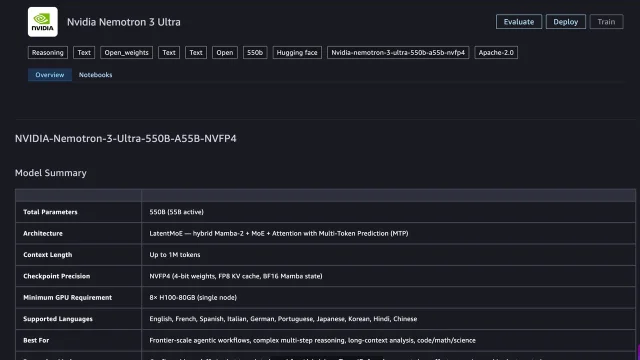
The SageMaker deployment runs on
ml.p5en.48xlarge or ml.p5.48xlarge GPU instances. For regulated industries — healthcare, finance, defense — that cannot route data through third-party APIs, this gives access to frontier-class open weights on their own AWS infrastructure.4. Illinois passes the first US state law requiring third-party audits of frontier AI models
Illinois lawmakers passed Senate Bill 315 and it is now with Governor JB Pritzker, who has signaled he will sign it. 5 The House vote was 110-0; the Senate passed it 52-5 earlier.
SB 315 targets frontier AI developers with annual revenue above $500 million — companies like OpenAI and Anthropic are in scope. Requirements: publish a transparency framework covering risk management, capability evaluation, and incident response; hire a third-party auditor to verify compliance; submit a disclosure statement and pay a proportional administrative fee. Violations carry civil penalties up to $3 million per incident, enforceable by the state attorney general. Private lawsuits are not permitted.
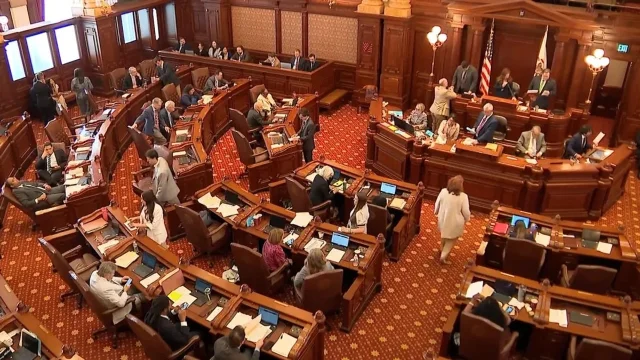
The law takes effect in 2028, pushed back from an earlier 2027 date during amendments. 5 It is the first US state law to mandate third-party audits of frontier models specifically, and it lands the same week the federal Great American AI Act draft would try to freeze exactly this kind of state-level development requirement.
5. Arizona's largest utility proposes a 45% electricity surcharge on AI data centers
Arizona Public Service (APS), which serves 1.5 million customers, asked the Arizona Corporation Commission to approve a 45% rate increase for large industrial customers — primarily AI data centers and chip manufacturers — as part of a broader rate case filed in 2025. Residential rates would rise 14%; solar homes 16%. 6
APS argues that its current rate structure — priced on 2021-2022 costs — no longer reflects the actual cost of serving data centers whose load has expanded sharply since then. Transformer costs alone rose 64% after those rates were set. The company is also requesting an annual formula review mechanism to prevent ongoing cost-shifting from industrial users to residential customers.
An administrative law judge is currently reviewing testimony, including an objection from Arizona Attorney General Kris Mayes, who opposes the residential portion. The full five-member commission is expected to decide in the second half of 2026; if approved, the data center surcharge would take effect by year-end. Utility regulators in Virginia, Texas, Georgia, and Ohio are watching the outcome. 6
Published Friday, June 5, 2026 · Sources: Reuters, FedScoop, TechCrunch, AWS Machine Learning Blog, Capitol News Illinois, WSJ
参考来源
- 1Bipartisan 'Great American AI Act' draft — FedScoop
- 2US House lawmakers release draft bill to prohibit state AI rules — Reuters
- 3Ramp raises $750M at $44B valuation — TechCrunch
- 4NVIDIA Nemotron 3 Ultra now available on Amazon SageMaker JumpStart — AWS
- 5Illinois lawmakers pass landmark AI accountability bill — Capitol News Illinois
- 6Phoenix Is a Data-Center Mecca — WSJ
围绕这条内容继续补充观点或上下文。