1/4
Day 7: The Spine — Your Body's Central Highway
33 bones stacked in an S-curve — and that geometry is what keeps your brain safe every time you walk. Day 7 of your body journey: how the five vertebral regions divide labor, why intervertebral discs are smarter than any shock absorber humans have built, how a disc herniation triggers sciatica, and a 30-second Wall Angel exercise to map your own spinal mobility.
2026/6/10 · 8:13
图集
Bones don't work alone. Neither do muscles. What holds the whole architecture together — and keeps your brain safe every time you take a step — is a column of 33 stacked bones running from your skull to your tailbone.
Today: the spine.
What you're looking at
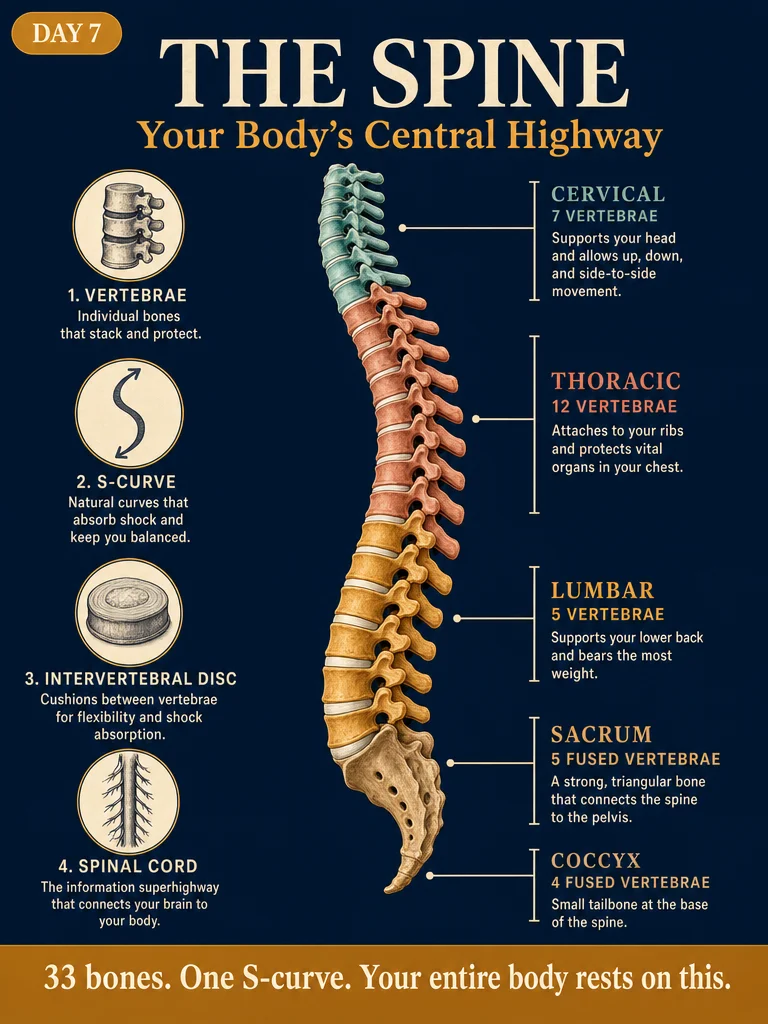
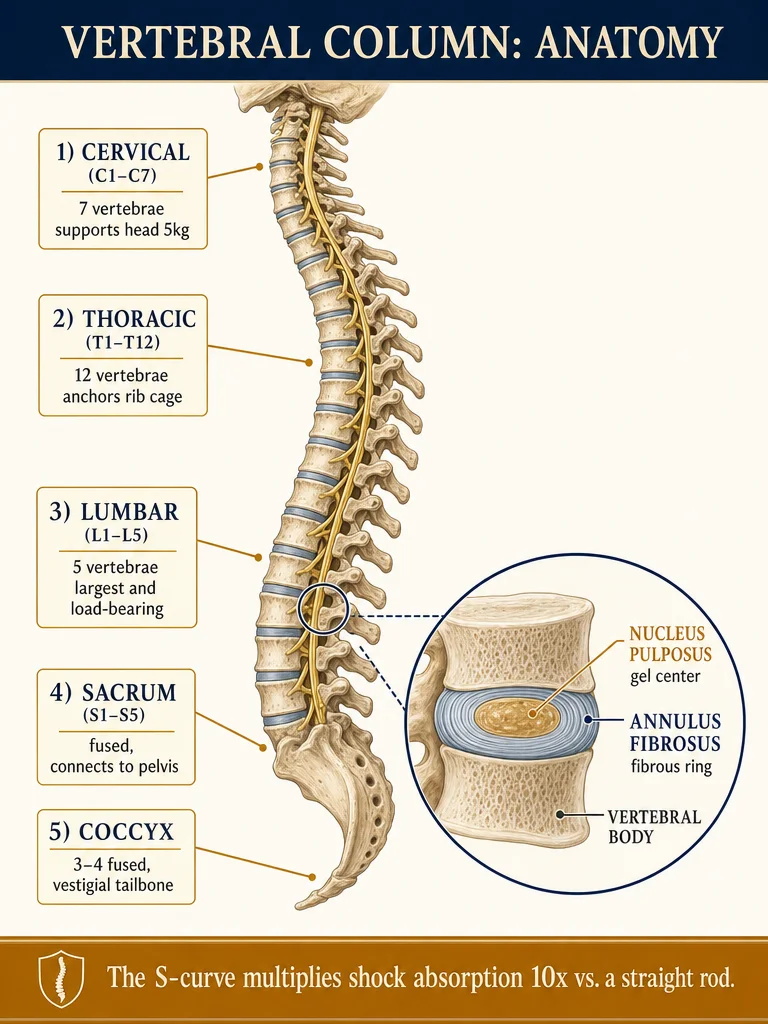
The vertebral column has five regions, each with a distinct job:
| Region | Vertebrae | Role |
|---|---|---|
| Cervical | C1–C7 | Supports the skull (~5 kg); allows head rotation |
| Thoracic | T1–T12 | Anchors the rib cage; protects heart and lungs |
| Lumbar | L1–L5 | Largest vertebrae; bears the weight of the upper body |
| Sacrum | S1–S5 (fused) | Connects spine to pelvis; transfers load to legs |
| Coccyx | 3–4 (fused) | Vestigial tailbone; attachment for pelvic floor muscles |
Between nearly every pair of vertebrae sits an intervertebral disc — a two-part shock absorber. The outer ring (annulus fibrosus) is made of concentric layers of tough collagen fibers. The inner core (nucleus pulposus) is a gel of water and proteoglycans that deforms under pressure and springs back when load is removed. You are measurably taller in the morning than at night: discs rehydrate overnight as spinal compression relaxes, then compress again through the day.
The S-curve is the design
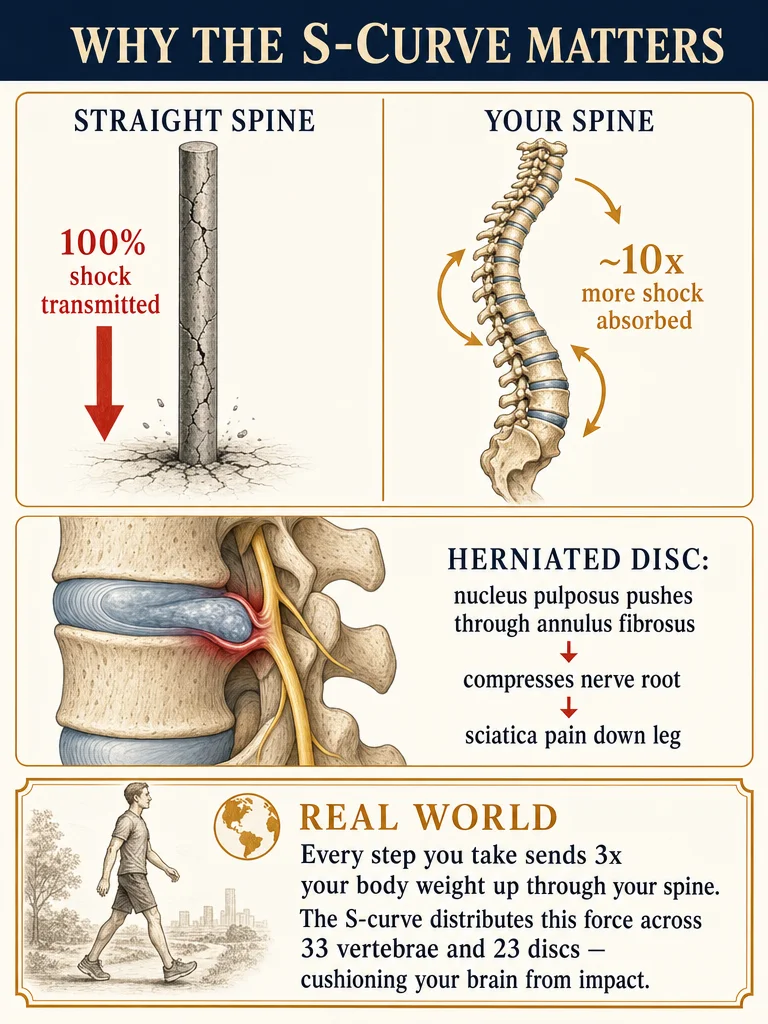
A straight spine would transmit every impact directly into your skull. The S-curve — cervical lordosis (curves forward), thoracic kyphosis (curves back), lumbar lordosis (curves forward again) — distributes force in a wave pattern across all 33 vertebrae and 23 discs simultaneously. Engineering analysis puts the shock-absorption advantage at roughly 10× compared to a straight rod of the same material.
Every walking step sends a force equal to about 3× your body weight up through your spine. Without that curve, you'd need the neck of a giraffe to keep from concussing yourself.
When the design fails
The most common failure mode: disc herniation. The nucleus pulposus pushes through a crack in the annulus fibrosus and presses against a nearby nerve root. In the lumbar region, this is what causes sciatica — sharp or burning pain that runs from the lower back down through the buttock and into the leg, following the path of the sciatic nerve. About 1–3% of adults experience a clinically significant herniation at some point; most resolve without surgery within 6–12 weeks.
Discs also thin with age. By 40, most adults have measurable disc dehydration on MRI. By 60, some degree of disc space narrowing is nearly universal. The spine doesn't degrade passively, though — regular axial loading (walking, carrying weight) keeps discs hydrated; prolonged sitting compresses them without the rhythmic relief of movement.
Today's exercise: the Wall Angel (30 seconds)
Stand with your back against a flat wall, heels about 6 cm out from the baseboard. Press the back of your head, shoulder blades, and lower back toward the wall — you'll notice your lumbar region doesn't touch (that's your natural lordotic curve). Raise your arms to a 90° "goalpost" position with the backs of your arms touching the wall. Slowly slide them upward, keeping all contact points against the wall. Hold at the top for 5 seconds, then lower. Repeat three times.
What you're feeling: each vertebra's position relative to the ones above and below it, plus where your thoracic spine is stiff vs. mobile. The spots where your back lifts off the wall are the zones with the least mobility — worth knowing.
Day 7 of 30 · Human Body Daily Micro-Lesson
评论