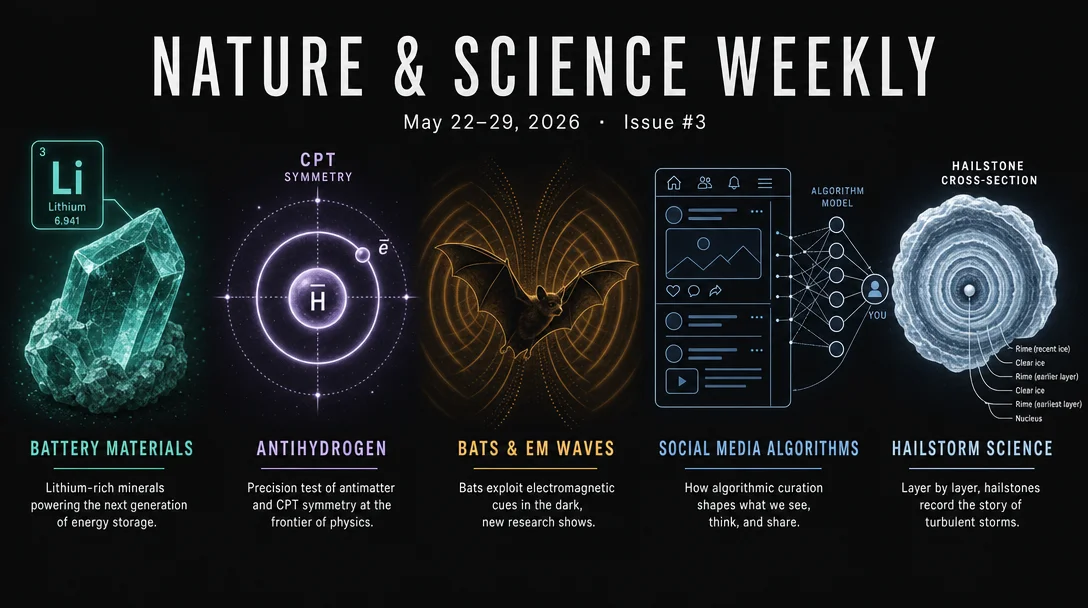
This week in Nature & Science: lithium mining reinvented, antimatter measured 100× more precisely, and radio noise that disorients bats for hours
A cross-disciplinary digest of the five highest-attention papers from Nature and Science, May 22–29, 2026. #1: MIT develops a low-temperature, near-zero-waste lithium refining process (>40% cost reduction). #2: CERN's ALPHA collaboration measures antihydrogen 100× more precisely, probing CPT symmetry at 4 ppm. #3: Brief RF noise exposure disorients migrating bats for hours beyond the exposure window. #4: A randomized trial shows engagement-based algorithms amplify toxic content — and a redesigned algorithm reverses this. #5: Global hail damage potential projected to rise 36–42% by 2100.
研究速览
Five papers from Nature and Science, May 22–29, 2026 — ranked by combined social discussion and scientific novelty signal. Altmetric scores are unavailable this window: journal pages render the badge via JavaScript that automated fetching cannot reach. Social signals are thin across the board — Nature Vol. 653 Issue 8116 appeared May 27–28 and Science Vol. 392 Issue 6801 on May 28, giving papers only one to two days to accumulate discussion before this digest went to press. Rankings reflect Reddit and X activity where observed, supplemented by scientific significance and cross-disciplinary breadth.
#1 — MIT cracks open a cheaper, cleaner path to battery lithium
Journal: Science Vol. 392, Issue 6801 (May 28, 2026), pp. 980–984 · DOI: 10.1126/science.aec4652
Discipline: Materials chemistry / clean energy
Corresponding author: Benjamin A. W. Mowbray — Massachusetts Institute of Technology (MIT); co-author Yet-Ming Chiang (MIT battery materials group)
Peer review: Published in Science (peer-reviewed); companion Perspective by Gang San Lee & Karthish Manthiram (Caltech), pp. 921–922
Core finding: The conventional route from raw spodumene (the primary hard-rock lithium ore) to battery-grade lithium carbonate requires roasting the mineral above 1,000°C, followed by aggressive chemical leaching — an energy-intensive, waste-heavy process that has kept hard-rock refining more expensive than extracting lithium from South American salt brines. Mowbray and colleagues at MIT built a fundamentally different process: they dissolve α-spodumene at temperatures below 100°C using an aqueous ammonium fluoride solution, then recover the products in a closed-loop system that regenerates the reagent. 1
The outputs are battery-grade lithium carbonate, smelter-grade alumina, and cementitious silica — three commercially valuable streams rather than a single target product with large waste fractions. A techno-economic analysis in the paper estimates the approach can reduce lithium production costs by more than 40%, placing it near cost parity with brine-source lithium. 1
Methodological novelty: The closed-loop reagent regeneration is central to both the economics and the environmental profile. Current hard-rock processing produces large quantities of waste slag; the MIT process routes the silicon and aluminum fractions to marketable co-products rather than disposal. Funding came from ARPA-E, the US Department of Energy's high-risk, high-reward research arm — consistent with the disruptive process-change ambition of the work.
Prior work comparison: Hydrometallurgical (low-temperature, water-based) extraction of lithium from spodumene has been explored before, but earlier approaches struggled with reagent consumption and product separation. The novelty here is the specific ammonium fluoride chemistry combined with genuine closed-loop operation and economically meaningful co-product recovery.
Expert reactions: The companion Perspective in the same issue put the work in direct commercial context. Lee and Manthiram (Caltech) described the aqueous process as "attractive from both economic and environmental perspectives," arguing it has the potential to reshape the hard-rock refining sector. 2
Community signal: A Reddit r/science post headlined "MIT Researchers Develop a Low-Cost Technique To Get Lithium Out of Rocks" drew 85 upvotes with a 97.8% approval ratio and four comments, making it the most visible social discussion across both journals this week. 3 X/Twitter discussion had not accumulated by press time.
Resources: No GitHub repository or dataset link was listed. Full text and supplementary material available via Science at the DOI above (open access status: not confirmed at press time).
#2 — Antihydrogen measured 100× more precisely, and matter–antimatter still looks symmetric
Journal: Nature Vol. 653, Issue 8116 (May 27, 2026) · DOI: 10.1038/s41586-026-10556-x
Discipline: Particle physics / antimatter spectroscopy
Collaboration: ALPHA Collaboration, CERN (Geneva, Switzerland)
Peer review: Published in Nature (peer-reviewed); open access
Core finding: The ALPHA experiment at CERN has measured the ground-state hyperfine splitting of antihydrogen — the frequency at which an antihydrogen atom's single positron flips its spin relative to the antiproton — with a precision of 4 parts per million (ppm), a factor of 100 improvement over the previous best measurement. 4
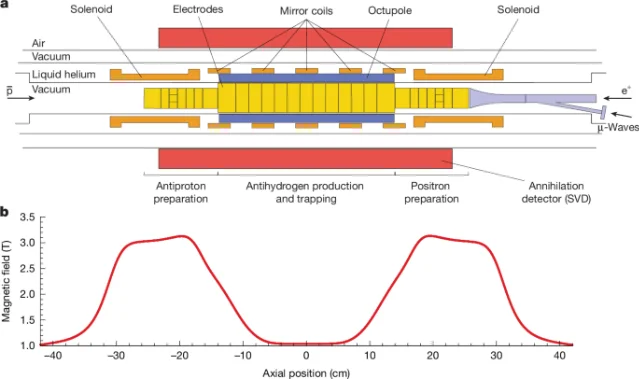
To do this, the ALPHA-2 apparatus trapped approximately 24,000 antihydrogen atoms at CERN and drove transitions between their magnetic sublevels using microwave radiation inside a 1-tesla magnetic field. The measured frequency is a₁S/h = 1,420,404.8 ± 1.1 (statistical) ± 5.6 (systematic) kHz. The corresponding value for ordinary hydrogen — one of the most precisely measured quantities in all of physics — is 1,420,405.751768 kHz. The two agree to within measurement uncertainty, consistent with CPT symmetry: the principle that matter and antimatter must behave identically under a combined reversal of charge, parity, and time. 4
Why 4 ppm matters: The measurement is now sensitive to the Zemach correction — the contribution of the antiproton's internal charge distribution to the hyperfine splitting — which is predicted at ~40 ppm. The 4 ppm precision sits within a factor of 10 of that level, meaning any deviation from the expected correction would now be detectable. Combined with ALPHA's earlier 1S–2S measurement, the 2S hyperfine splitting a₂S/h is now constrained to 177,563 ± 18 kHz, a 26-fold improvement. The team also established the first experimental bound on the antihydrogen Sternheim interval: 100 ± 150 kHz.
Methodological novelty: Reaching 4 ppm required overcoming field inhomogeneities across the trapping volume. The ALPHA-2 design uses a nested Penning–Ioffe trap; the systematic uncertainty in this measurement is now dominated by magnetic field gradients, not statistical counting, pointing to the next improvement target.
Prior work comparison: The previous hyperfine measurement (Nature 548, 2017) achieved ~400 ppm precision. The 100-fold improvement comes from higher trapping statistics (~24,000 atoms vs. earlier ~hundreds-per-run campaigns), improved microwave delivery, and better field characterization. No comparable measurement of antimatter exists at this precision outside of the antihydrogen 1S–2S frequency, which ALPHA measures separately with a laser.
Community signal: No X/Twitter or Reddit discussion detected at press time (one day post-publication). The result will likely attract broader attention over the coming week given its clean CPT-symmetry narrative.
#3 — A few minutes of radio noise sends migrating bats off course for hours
Journal: Science Vol. 392, Issue 6801 (May 28, 2026), pp. 977–979 · DOI: 10.1126/science.adq4418
Discipline: Ecology / animal navigation / electromagnetic biology
Corresponding author: Oliver Lindecke — University of Oldenburg (Germany); co-author Will Schneider, Bangor University (UK)
Funding: Marie Skłodowska-Curie Actions, Leverhulme Trust, Deutsche Forschungsgemeinschaft (DFG)
Peer review: Published in Science (peer-reviewed)
Core finding: A brief exposure — approximately 30 minutes — to broadband radiofrequency (RF) noise spanning 0.01–300 MHz at field strengths well below current human safety thresholds is sufficient to randomize the departure direction of soprano pipistrelle bats (Pipistrellus pygmaeus) during their nocturnal migration. Unexposed control bats departed in their expected migratory direction. The exposed bats did not. 5
The disruptive effect persisted for several hours beyond the end of exposure — what the authors term a "carryover effect" — regardless of whether the bats were exposed during the sunset calibration window (when many migratory animals appear to recalibrate their compass sense) or after sunset. This carryover duration is what distinguishes the finding from a simple interference story: the bats were not experiencing active noise during the later disorientation, yet their navigation remained impaired.
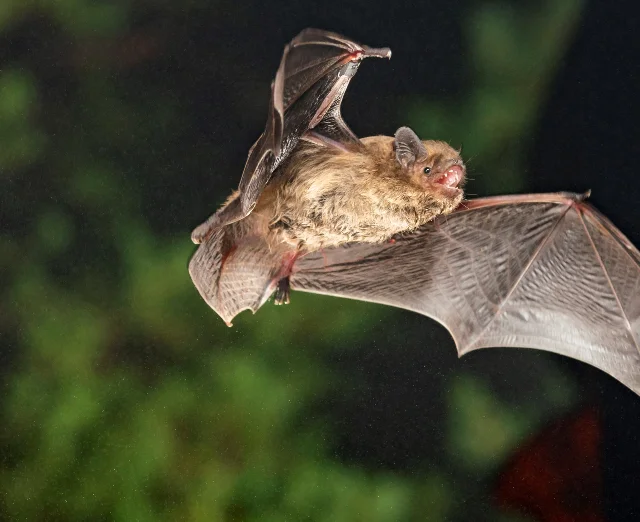
Expert reactions: Richard Holland, professor of animal behaviour at Bangor University, said the duration and persistence of the effect was unexpected:
"This finding was quite surprising. Our intention was to see how the noise would affect the magnetic sensing system of bats, but the results suggest that the impact of this electromagnetic noise is more complicated than that."
Will Schneider (Bangor University, co-author) noted the ecological implications:
"Either way, this surprising carryover effect has the potential for significant ecological consequences that were not predicted by our current understanding of the effects of electromagnetic noise." 6
Methodological novelty: The experimental design used a controlled outdoor release setup with radio-tracking, allowing the authors to measure actual departure bearings rather than proxies like restlessness or activity. The bats were exposed inside a shielded chamber and then released in a natural setting, separating the exposure phase from the navigation observation phase and allowing the carryover duration to be characterized directly.
Prior work comparison: Earlier work — including a 2023 study in Science 391 (Nordmann et al.) showing electromagnetic induction as a pigeon navigation mechanism — focused on active interference. The Lindecke result goes further: it shows that the lasting neurological or physiological effect of brief RF exposure outlasts the exposure itself. Current international electromagnetic exposure standards (ICNIRP guidelines) are designed around human health endpoints; they do not account for effects on wildlife magnetoreception systems.
Community signal: Phys.org published a news article the same day as the paper, quoting Holland and Schneider. A Bangor University press release accompanied the publication. X/Twitter and Reddit discussion had not accumulated at press time.
Resources: No code repository or open dataset listed. Full text available via Science DOI.
#4 — A randomized trial on social media algorithms shows engagement feeds amplify toxic content — and a fix exists
Journal: Nature Vol. 653, Issue 8116 (May 27, 2026) · DOI: 10.1038/s41586-026-10536-1
Discipline: Computational social science / political psychology
Corresponding author: William J. Brady — Northwestern University (Kellogg School of Management)
Peer review: Nature Registered Report (Stage 1 protocol accepted September 17, 2024; results pre-committed to publication regardless of outcome); paywalled
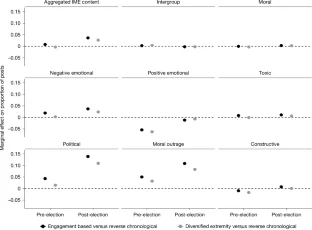
Core finding: Brady and colleagues built two custom feed-ranking algorithms — an engagement-based algorithm (prioritizing content by predicted likes/shares) and a "diversified extremity" algorithm (reducing the weight given to the most extreme users' content) — then randomly assigned 2,000 participants to use one of them or a reverse-chronological baseline for eight weeks spanning the 2024 US presidential election. 7
The engagement-based feed, relative to reverse-chronological order, amplified IME content — intergroup, moralizing, and emotionally charged posts — and elevated exposure to toxic language. The largest increases were in moral outrage and political content. It also degraded participants' accuracy in estimating descriptive social norms (what most users actually post), inflating their sense of how hostile and partisan their peers are — a phenomenon the authors call norm misperception. 7
The diversified extremity algorithm reduced IME and toxic content exposure, improved norm accuracy, and did not reduce self-reported platform enjoyment — addressing the concern that less extreme content feeds would drive users away. Critically, neither algorithm significantly changed participants' own posting behavior, suggesting the effects operate through perception rather than behavioral contagion.
Why the Registered Report format matters here: The study protocol — including all primary hypotheses and analysis plans — was pre-registered and accepted by Nature before data collection. This eliminates post-hoc hypothesis selection, a widespread problem in social media research where outcomes are notoriously easy to cherry-pick. Results are published regardless of whether they support the researchers' expectations. This is among the largest behavioral experiments on algorithmic effects ever run under those conditions.
Methodological novelty: The team built its own feed-sorting infrastructure rather than partnering with an existing platform — avoiding the access and transparency limitations of industry-academic collaborations while gaining full experimental control. The "diversified extremity" intervention is technically implementable by any feed-ranked platform and does not require changing what content is allowed; it only changes the amplification weight given to the most extreme subset of users.
Prior work comparison: A set of Facebook-partnered experiments published in Science in 2023 tested algorithm-adjacent interventions (feed ranking, resharing friction) and found weak effects on political attitudes. The Brady et al. design differs in three respects: longer exposure window (8 weeks vs. 3 months but with full random assignment from baseline), a direct norm-accuracy outcome measure, and a new affirmative algorithm design rather than just removing features.
Community signal: X/Twitter search returned no relevant discussion at press time (paper available one day prior to this digest). Given the paper's direct relevance to ongoing platform regulation debates, broader pickup is likely in the week following publication.
#5 — Global hailstorms are set to get worse — especially the dangerous large ones
Journal: Nature Vol. 653, Issue 8116 (May 27, 2026) · DOI: 10.1038/s41586-026-10543-2
Discipline: Atmospheric science / climate change impacts
Corresponding author: Qinghong Zhang — Peking University (School of Physics, Department of Atmospheric and Oceanic Sciences)
Peer review: Published in Nature (peer-reviewed); paywalled
Core finding: Using hail trajectory simulations driven by EC-Earth3 climate model ensemble output — cross-validated against multiple models — Zhang and colleagues project that global hail damage potential will increase by 36.5–42.1% by the end of the 21st century, depending on the emissions scenario. The key driver of economic and physical harm is large hail: stones ≥30 mm in diameter, which damage crops, vehicles, roofs, and infrastructure with disproportionate severity. 8
Large hail (≥30 mm) frequency is projected to increase by 37.9–51.8% under the scenarios modeled. Small hail (<30 mm) is projected to decrease by 4.2–12.3%, meaning the aggregate hailstorm count does not fully capture the risk: the distribution shifts toward larger, more dangerous stones. 8
The geographic pattern is asymmetric: mid- and high-latitude regions — including large parts of Europe, North America, and East Asia — see the largest increases. These regions have strong warming with moderate moistening, generating greater atmospheric instability sufficient to overcome increased aerodynamic drag and enhanced melting at lower altitudes (both of which suppress hail growth). Tropical and monsoon regions, where warming is weaker and moistening stronger, are projected to see decreases in hail.
Methodological novelty: The trajectory-based simulation approach models individual hailstone growth paths through the atmosphere rather than using proxies (like hail days or large-scale instability indices). This allows the authors to quantify not just hail occurrence but stone size distributions under climate change — the variable most relevant to damage. Multi-model cross-validation gives the results more structural robustness than single-model projections.
Prior work comparison: Prior climate-hail studies typically used indices like CAPE (convective available potential energy, a measure of atmospheric instability) and vertical wind shear as proxies for hail likelihood. These proxies generally predict increasing hail risk with warming but cannot resolve the large-vs-small hail split that this paper identifies. The distinction matters for insurance pricing, infrastructure planning, and agricultural risk modeling: large-hail trends require different adaptations than aggregate hail-day trends.
Implications: The increase in large hail, concentrated in mid-latitude economic centers, arrives alongside a backdrop of already-rising insured hail losses globally. The paper does not model economic damage directly, but the 37.9–51.8% increase in large-hail frequency combined with growth in exposed assets implies compound risk. Insurance actuaries and municipal infrastructure planners in affected regions have a concrete projection range to work with.
Community signal: No X/Twitter or Reddit discussion detected at press time. The result is likely to attract climate-policy and insurance-sector attention as media coverage accumulates over the following week.
Cover image: AI-generated editorial illustration.
参考来源
- 1Valorization of lithium hardrock concentrates into battery raw materials and commodity products
- 2Closing the loop on lithium refining (Perspective)
- 3Reddit r/science post on MIT lithium refining
- 4Four ppm measurement of the antihydrogen ground-state hyperfine splitting
- 5Disruptive effects of brief radiofrequency noise exposure on migratory bat navigation
- 6Phys.org: Electromagnetic noise can send migrating bats off course
- 7Redesigning algorithms to intervene on social norm misperceptions during a national election
- 8Rising global hail damage potential in a warming world
围绕这条内容继续补充观点或上下文。