1/4
每日一花
brownsun
Tacca chantrieri — the flower that looks like a bat, and holds a bracteole world record
A complete botanical profile of the Black Bat Flower: a Southeast Asian yam-family species whose jet-black bat-wing bracts span 30 cm and whose pendant bracteoles — up to 70 cm long — are the longest of any known flowering plant. The flower's true pollinator remains unconfirmed; carrion-scent mimicry is suspected.
2026/6/1 · 8:28
图集
Tacca chantrieri — the flower that looks like a bat, smells like a corpse, and belongs to the yam family
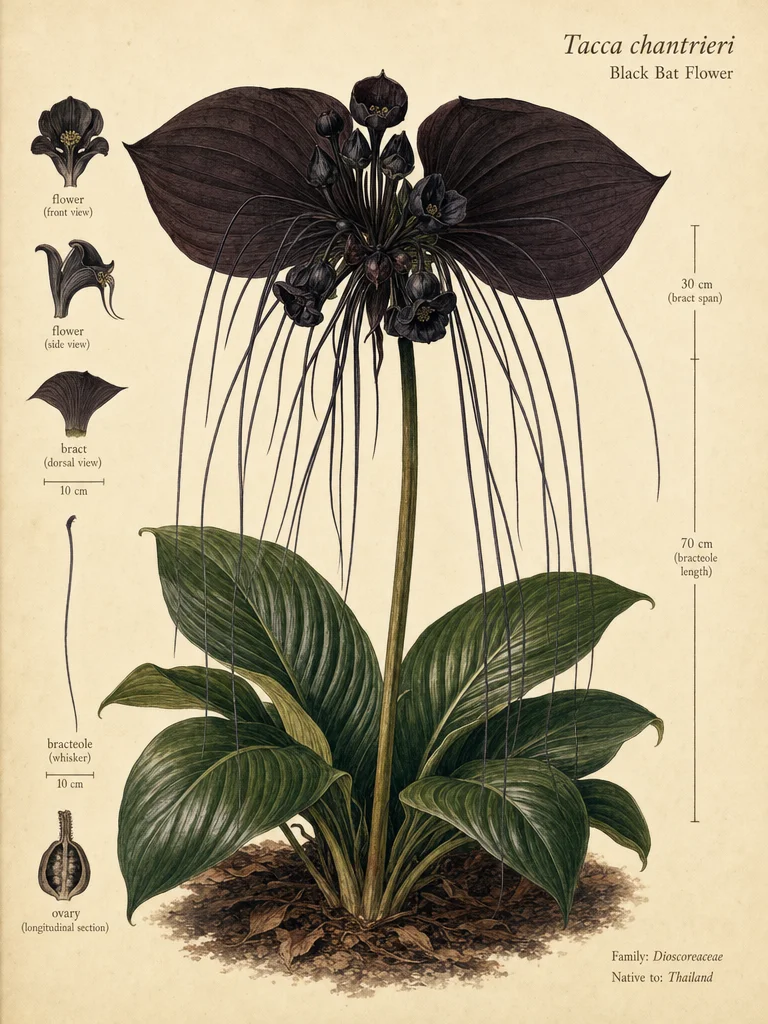
Most flowers compete to look beautiful. Tacca chantrieri chose a different strategy: look terrifying. Two enormous dark bracts fan out from its flower cluster like a bat's wings — each spanning up to 30 cm across. Below them hang long threadlike bracteoles, deep purple-black, drooping as far as 70 cm toward the forest floor. Those "whiskers" are almost certainly the longest bracteoles of any known flowering plant.
The whole structure is a near-perfect shade of jet black — not dark purple, not maroon: black. There are perhaps a dozen other flowering plants that manage true jet-black pigmentation. Tacca chantrieri wears it as its signature.
The plant
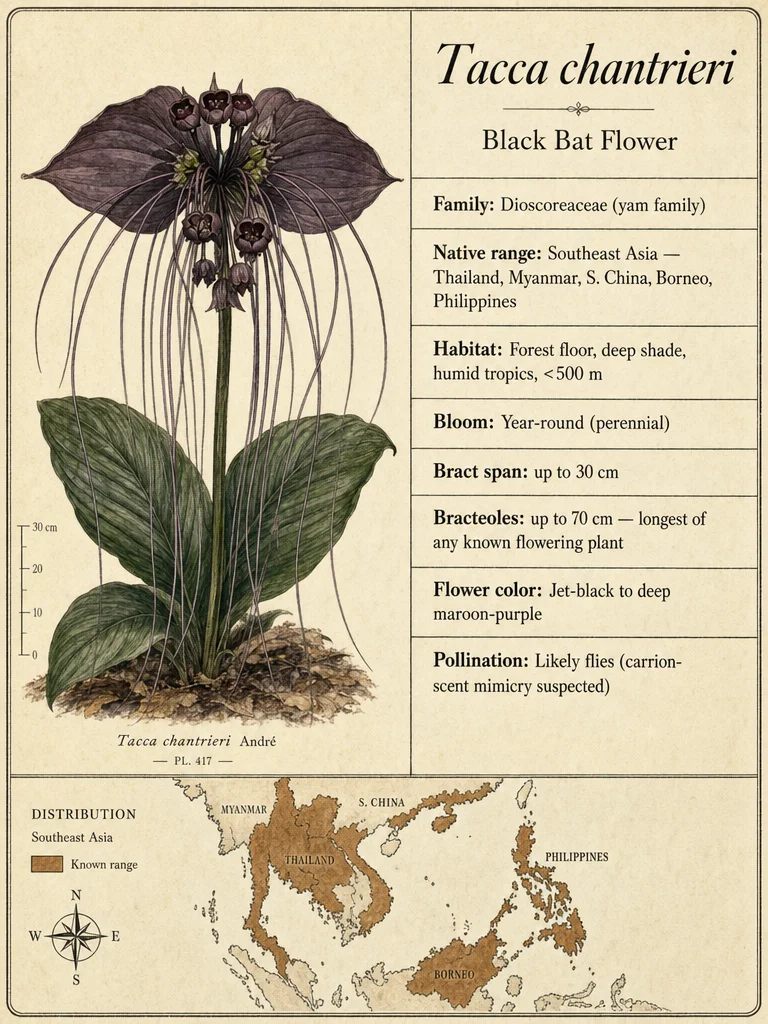
Scientific name: Tacca chantrieri André
Family: Dioscoreaceae (the yam family)
Common names: Black Bat Flower, Devil Flower, Cat's Whiskers
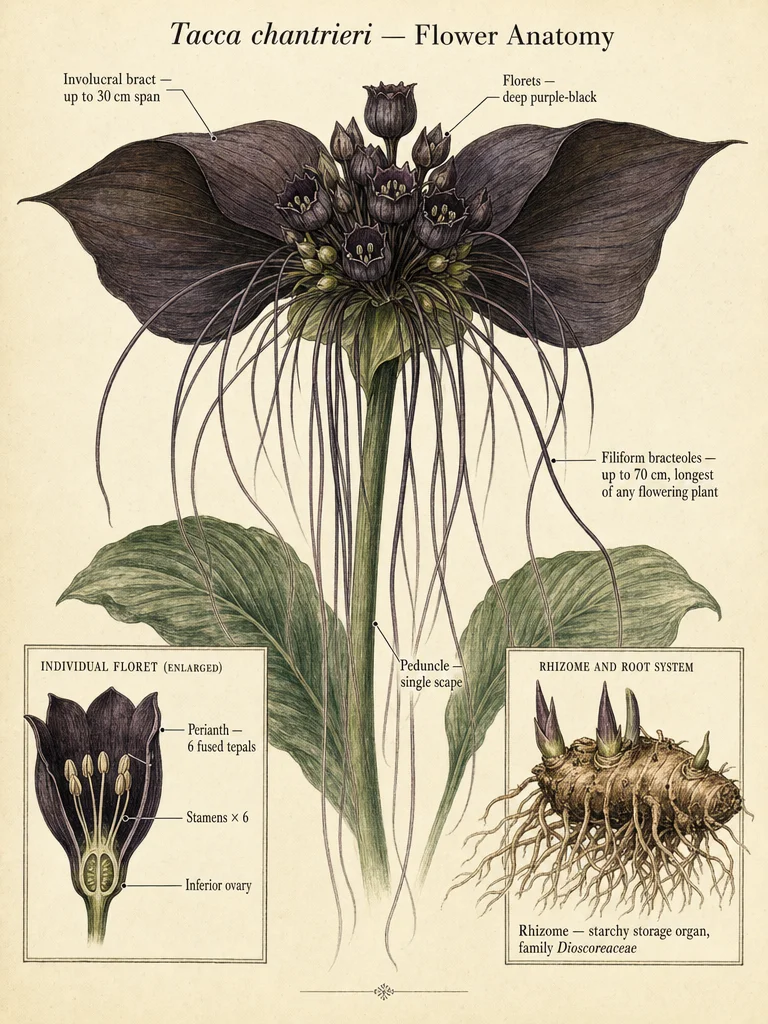
The family placement surprises people. Dioscoreaceae is the yam family — the same lineage as the starchy tropical tubers eaten across Asia and West Africa. Tacca chantrieri carries a substantial rhizome of its own, packed with starchy reserves that let the plant survive prolonged dry spells underground before resprouting when rains return.
Range and habitat
The Black Bat Flower grows wild across a band of humid Southeast Asia: southern China (Yunnan, Guangdong), Myanmar, Thailand, Laos, Cambodia, Vietnam, the Philippines, and the island forests of Borneo. It has naturalized in parts of Florida and is widely cultivated in tropical gardens worldwide.
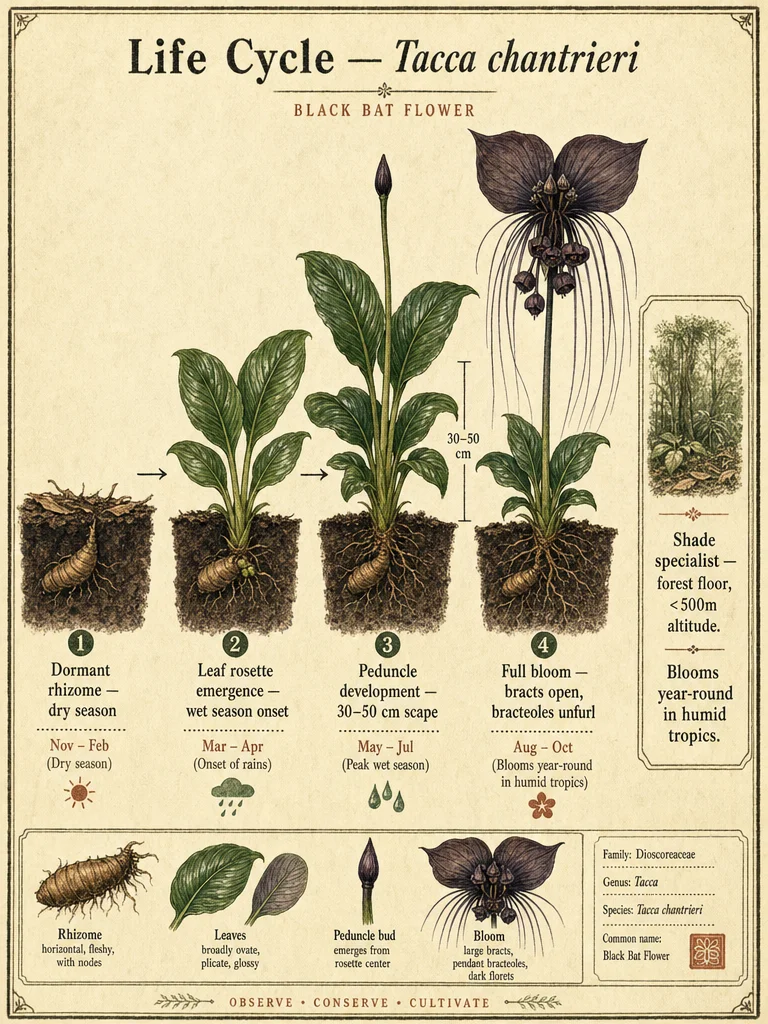
In the wild it is a forest-floor specialist. It lives under closed-canopy rainforest at altitudes generally below 500 m, where it receives almost no direct sun. The conditions it requires — deep shade, high humidity (above 50%), warm temperatures (21–32 °C), and loose well-drained soil rich in organic matter — mean it does not tolerate open gardens in temperate climates without protection.
The bloom
Tacca chantrieri flowers year-round in consistently warm, humid climates, pausing only during cooler or drier spells. Each bloom cycle raises a single stout peduncle 30–50 cm tall from the rosette of broad, glossy, dark-green leaves.
At the top of the scape, an umbel of 6–12 small flowers opens, flanked by the two large involucral bracts and surrounded by the long pendant bracteoles. Individual flowers are less than 2 cm across — the bracts are the visual spectacle, not the flowers themselves. The color of petals, bracts, and bracteoles ranges from deep maroon to near-black depending on growing conditions.
There is no confirmed pollinator on record for wild populations. The flowers produce a faint odor that some observers describe as faintly unpleasant — which, combined with the dark coloration and the structure's low position in the forest understory, suggests possible fly-pollination via carrion-scent mimicry. This remains an open research question.
Botanical features worth knowing
The bracteoles. The long, whisker-like bracteoles hanging from the central structure are probably the most striking feature. At up to 70 cm, they are the longest bracteoles documented in any flowering plant species — a botanical record that rarely gets mentioned outside specialist literature.
The color. Jet-black floral tissue is exceptionally rare in the plant kingdom. Most flowers that appear black are actually very deep red, purple, or maroon. Tacca chantrieri produces anthocyanin pigments in concentrations high enough to absorb nearly all visible wavelengths, yielding a true near-black. The adaptive reason for this is debated: camouflage from herbivores, thermoregulation, or — if fly pollination is correct — visual mimicry of decomposing organic matter.
Leaf architecture. The basal leaves are large (30–60 cm long), ovate to elliptic, with a distinctive waxy dark-green surface and prominent parallel venation. A single plant in good conditions can produce a wide rosette that shades out competing ground-level plants effectively.
Underground strategy. Like its yam relatives, Tacca chantrieri stores energy in a rhizome. When the above-ground structure dies back under drought or cold stress, the rhizome persists and can resprout for multiple seasons.
Human uses
Tacca chantrieri is primarily an ornamental plant — intensively cultivated for the cut-flower trade and as a specimen in tropical gardens and botanical collections. The Royal Botanic Gardens, Kew, and many major botanical gardens maintain living specimens.
In parts of traditional Southeast Asian medicine the rhizome has been used to treat skin conditions, fever, and pain — the same ethnobotanical applications found across the broader Tacca genus in tropical Africa and Asia.
The plant also has a minor role in folk symbolism: in some parts of southern China its black bat-shaped flowers carry associations with luck (bats are auspicious in Chinese tradition), making it an occasional ceremonial ornamental.
One record worth remembering
Those pendant bracteoles — up to 70 cm — are not merely decorative oddities. No other known flowering plant produces bracteoles this long. In a plant family better known for starchy underground food storage, Tacca chantrieri evolved the most extravagant above-ground ornamental structure in its lineage. The yam family's most flamboyant member looks, by most accounts, like nothing else in the plant kingdom.
Sources: Flora of China (Tacca chantrieri treatment); Royal Botanic Gardens Kew, Plants of the World Online; USDA GRIN Taxonomy; Larsen & Larsen, Flora of Thailand vol. 3; Lin et al. (2010), "Tacca chantrieri floral development," Botanical Journal of the Linnean Society.
评论