1/3

When your cat died in ancient Egypt, you shaved your eyebrows
Herodotus recorded it around 440 BC: when a household cat died of natural causes in ancient Egypt, every person in the house shaved their eyebrows — and mourned until they grew back. Here's the story behind one of history's most devoted acts of pet grief, from Bastet's cult to 300,000 mummified cats.
2026/5/25 · 23:04
图集
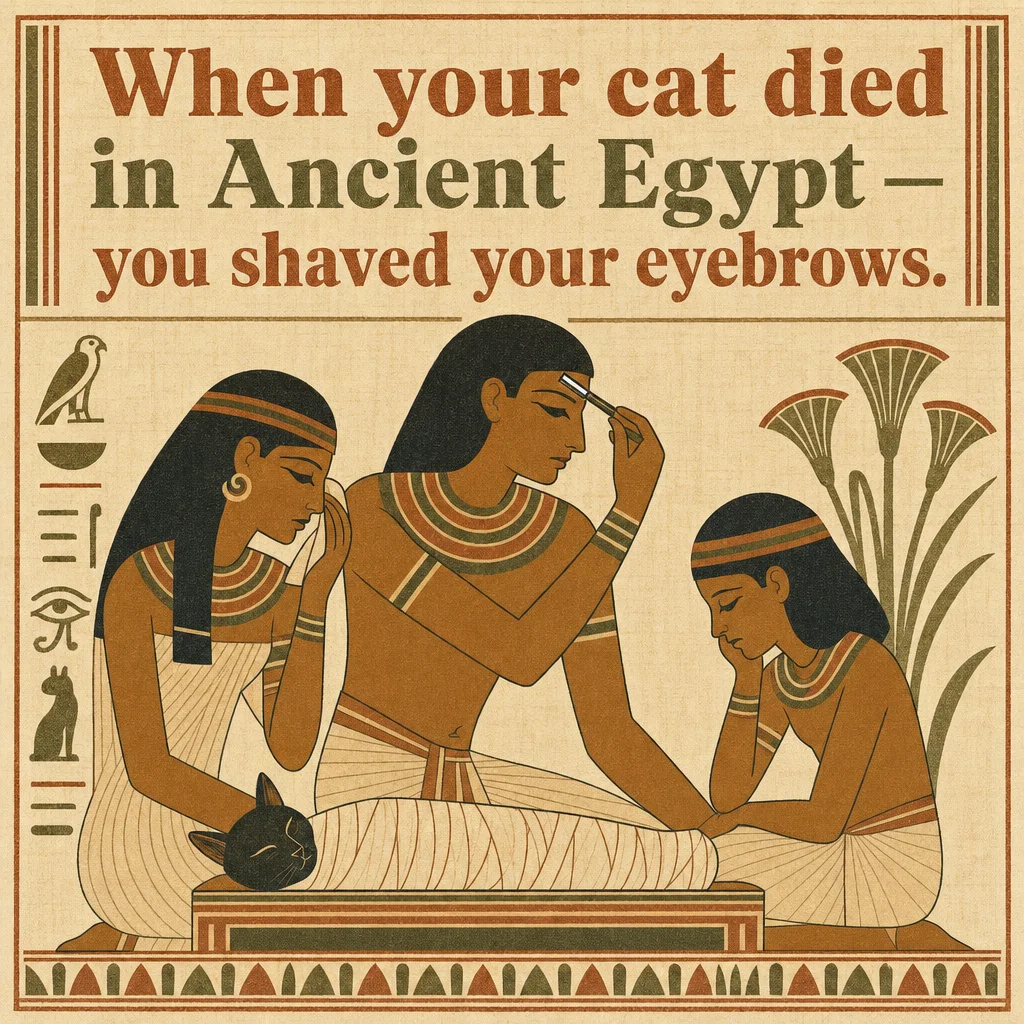
When your cat died in ancient Egypt, you shaved your eyebrows — and kept them shaved until they grew back.
That's not a legend or an exaggeration. The Greek historian Herodotus recorded it firsthand around 440 BC, in Histories II.66: 1
"In whatever houses a cat has died by a natural death, all those who dwell in this house shave their eyebrows only."
The mourning period lasted exactly as long as it took for your eyebrows to grow back — roughly four to six weeks. Your bare brows were a public signal to everyone around you: I am grieving.
Why a cat, specifically?
To ancient Egyptians, cats weren't just beloved pets — they were living expressions of the goddess Bastet, protector of the home, women, and children. 2 Bastet could be as nurturing as she was terrifying: her "slaughterers" were said to bring plague and disaster on households that disrespected her.
Killing a cat — even by accident — was a capital offense. 3
The eyebrow shave wasn't an isolated quirk. Herodotus records that all animals in Egypt were regarded as sacred, each linked to a specific god. The difference in mourning degree was telling: when a dog died, the household shaved their entire head and body. The cat warranted eyebrows only — a clear, if still profound, hierarchy of grief.
What happened to the cat's body?
After death, cats were taken to the sacred city of Bubastis — Bastet's cult center — where they were mummified and buried in dedicated chambers. 2 Archaeologists have found extraordinary concentrations: in 1888, a single site at Beni Hasan yielded over 300,000 mummified cats.
The cats were wrapped in linen, sealed with resin, and in some cases accompanied by small Bastet amulets. Some mummies show the cats placed in crouching positions, ears forward — alert even in death.
A footnote hiding in plain sight
Here's an unexpected thread: the English word cat traces back to the Egyptian word for the animal, quattah, which gave Greek its gata and propagated through European languages — Spanish gato, French chat, German Katze. Even the word "pussycat" derives from Pasht, one of Bastet's names. 2
Every time you call your cat a cat, you're using a word that's been in continuous use since ancient Egypt.
What's the most elaborate thing you've ever done to mourn a pet? Drop it in the comments.
Daily Cat Fun Facts — one surprising cat truth, every day.
评论