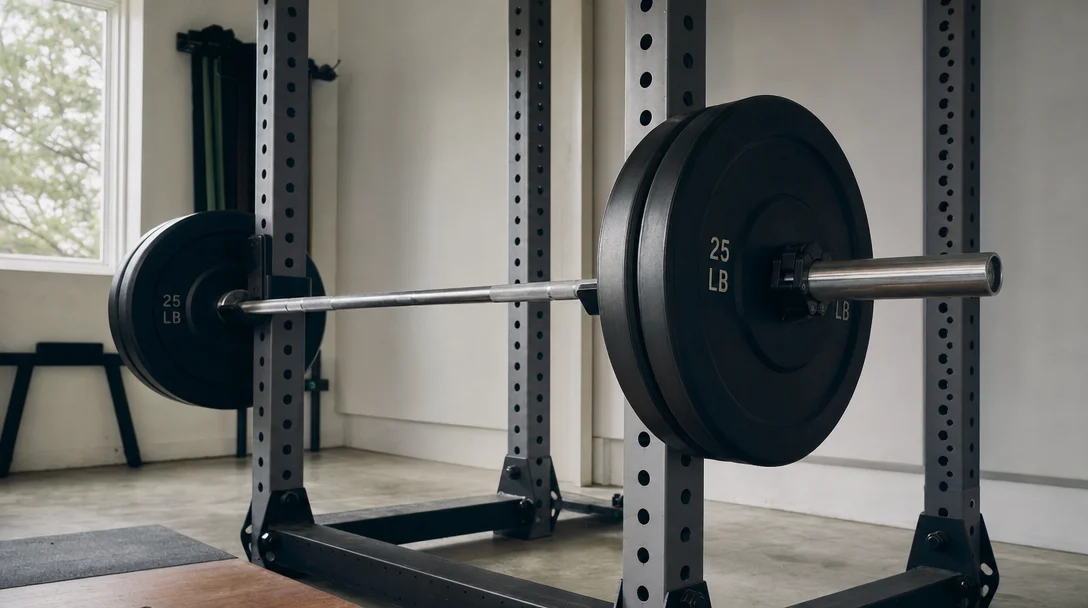
Friday Strength — StrongLifts 5×5 Workout A, Session 5
Session 5 (3rd Workout A) of StrongLifts 5×5: Back Squat 5×5 @ 65 lb, Bench Press 5×5 @ 55 lb, Barbell Row 5×5 @ 75 lb — each +5 lb from May 22. Covers dynamic warm-up, barbell ramp sets for all three lifts, full form cues with video embeds, static cool-down, and a 3-level scaling table.
Program: StrongLifts 5×5 — Workout A 1
Session: 5 overall · 3rd Workout A
Lifts: Back Squat 5×5 · Bench Press 5×5 · Barbell Row 5×5
Working weights: Squat 65 lb · Bench Press 55 lb · Barbell Row 75 lb
Estimated total time: ~45–55 minutes
These are +5 lb increases across all three lifts from the last Workout A on May 22. The weight is still in the "learning load" range — heavy enough to demand proper form, light enough that one technical breakdown won't cause injury. Use today to lock in the movement patterns. 1
Equipment checklist
- Olympic barbell (45 lb / 20 kg)
- Weight plates: 2× 10 lb for Squat (65 lb total), 2× 5 lb for Bench (55 lb total), 2× 15 lb for Row (75 lb total)
- Power rack with safety pins set below parallel depth for Squat
- Flat bench for Bench Press
- Collars to secure plates on all three lifts
- Chalk or lifting strap (optional, but useful for Row grip at higher weights)
No power rack? Use a squat stand with spotter arms, or perform today's Squat sets inside a Smith machine as a fallback. The Row does not require a rack.
Pre-barbell warm-up (3–5 minutes)
StrongLifts' official warmup philosophy: barbell warm-up sets are the warmup — no separate stretching or cardio required. 2 However, a brief 3–5 minute dynamic movement sequence before the first empty-bar set primes the joints and raises tissue temperature without pre-fatiguing the muscles.
Keep all movements dynamic (joint-moving), not static (holding a stretch). Save static holds for after the session.
| Movement | Reps / Duration | Target |
|---|---|---|
| Leg swings — forward/back | 10 per leg | Hip flexors, hamstrings |
| Leg swings — side/side | 10 per leg | Hip abductors, groin |
| Hip circles | 10 each direction | Hip joint mobility |
| Bodyweight squat-to-stand | 8 reps, pause at the bottom | Ankle dorsiflexion, hip depth |
| Cat-cow (on hands and knees) | 5 slow breaths each way | Thoracic spine mobility for back-bar Squat position |
| Shoulder dislocates (PVC pipe or dowel at shoulder width) | 8 reps | Shoulder external rotation for Bar grip and Row setup |
Move through the sequence without rest. By the last movement, your breathing rate should be slightly elevated and your hips should feel loose.
Lift 1: Back squat — 65 lb, 5×5
Squats open every Workout A. As Mehdi writes on the StrongLifts program page: "Squats are the hardest exercise. They're technically challenging, physically hard and mentally tough. That's why we do them first." 1
Barbell warm-up ramp
| Set | Weight | Reps | Rest after |
|---|---|---|---|
| Warm-up 1 | 45 lb (empty bar) | 5 | None |
| Warm-up 2 | 45 lb (empty bar) | 5 | 1 min before work sets |
| Work sets 1–5 | 65 lb | 5 | 3 min between sets |
Two warm-up sets at the empty bar are sufficient for a 65 lb working weight — the jump from 45 to 65 lb is small enough to not require an intermediate stop. 2
Form cues
- Bar position: Low bar — bar sits on the rear deltoids (the shelf created by squeezing your shoulder blades together), not on top of the traps. Your hands grip outside shoulder width.
- Setup: Feet slightly wider than hip-width, toes pointed out 30°. Stand tall before unracking.
- Descent: Break at the hips and knees simultaneously. Keep your chest up, back neutral. Drive your knees outward over your toes throughout.
- Depth: Go below parallel — the crease of your hip must drop below the top of your knee. At 65 lb this should be achievable for most lifters. If you can't reach depth, work ankle mobility between sets.
- Drive: Push the floor away. Think "chest up" and "drive hips forward" as you stand out of the hole.
- Breathing: Take a big breath before each rep, brace your core (Valsalva), descend and ascend, exhale at the top.
正在加载内容卡片…
Alan Thrall's low-bar squat tutorial — covers bar position, depth, and hip drive in detail. 3
Rest intervals
3 minutes between work sets. If a set felt easy, 1–2 minutes is fine. If a set was a real grind and you nearly missed a rep, rest up to 5 minutes before the next. 1
Lift 2: Bench press — 55 lb, 5×5
After Squats, the legs and lower back get a break. The Bench Press targets the chest, shoulders, and triceps — a natural complement after the lower-body dominant Squat. 1
Barbell warm-up ramp
| Set | Weight | Reps | Rest after |
|---|---|---|---|
| Warm-up 1 | 45 lb (empty bar) | 5 | None |
| Warm-up 2 | 45 lb (empty bar) | 5 | 1 min before work sets |
| Work sets 1–5 | 55 lb | 5 | 3 min between sets |
Form cues (5-step method) 4
Step 1 — Setup: Lie on the bench with your eyes directly under the bar. Chest up, shoulder-blades squeezed together and pressed down into the bench. Feet flat on the floor, shoulder-width apart.
Step 2 — Grip: Place your pinkies on the ring marks of the bar. Use a full grip (thumbs wrapped around the bar). Rotate the bar into a "bulldog grip" — wrists slightly bent, bar sitting low in the palm close to the heel of the hand, not in the fingers. Mehdi is explicit: "Bench Press with a full grip. Wrap your thumbs around the bar. The thumbless grip is dangerous. The bar can slip out of your hands and kill you." 4
Step 3 — Unrack: Straighten your arms fully to lift the bar off the hooks. Walk it out over your chest by bending your elbows slightly — bar should sit directly over your shoulders before you begin the set. Do not unrack with the bar already over your face.
Step 4 — Lower: Tuck your elbows to 75° from your torso (not flared 90°, not touching your sides). Lower the bar to your mid-chest (roughly nipple line). The bar should touch your chest lightly — do not bounce.
Step 5 — Press: Press the bar back up along a diagonal path, finishing over your shoulders — not straight up from mid-chest and not directly over your face. As Mehdi explains: "The bar doesn't move in a vertical line when you Bench Press with proper form. It moves diagonally from your mid-chest over your shoulders." 4

正在加载内容卡片…
StrongLifts Bench Press demo — 4:39 walk-through of setup and movement. 5
Rest intervals
3 minutes between work sets. Same logic as Squat: scale rest to how the set felt.
Lift 3: Barbell row — 75 lb, 5×5
The Row closes Workout A. It's the only pull movement in the session — it trains the upper back, lats, and biceps, and reinforces the hip-hinge position that makes both Squats and Deadlifts safer. 1
Barbell warm-up ramp
| Set | Weight | Reps | Rest after |
|---|---|---|---|
| Warm-up 1 | 65 lb | 5 | 1 min before work sets |
| Work sets 1–5 | 75 lb | 5 | 3 min between sets |
Note: The Row cannot start from an empty bar — the 45 lb bar without plates sits too low off the floor for a proper dead-stop setup. The minimum warmup weight is 65 lb (bar + 10 lb per side). 2 One warm-up set is sufficient for a 75 lb working weight.
Form cues (Pendlay row style)
StrongLifts prescribes a Pendlay-style row: the bar returns to a dead stop on the floor at the start of each rep, rather than being held in a bent-over position between reps. This ensures every rep is explosive from a controlled starting position.
- Setup: Stand over the bar with feet hip-width apart, toes under the bar. Grip the bar at about shoulder-width, overhand (pronated). Bend your hips back until your back is close to horizontal — parallel to the floor.
- Brace: Take a breath, brace your core. Back stays flat, not rounded.
- Pull: Drive your elbows up and back, pulling the bar explosively from the floor to your lower chest / upper abdomen. The bar should travel in a vertical line.
- Lower: Control the bar back down to the floor. Let it settle for a moment before the next rep — this is the dead-stop that distinguishes the Pendlay row from a bent-over row.
- No hip kipping: Your hips should not rise and dip to generate momentum. The power comes from your upper back.
正在加载内容卡片…
StrongLifts Barbell Row demo. 6
Rest intervals
3 minutes between work sets.
Cool-down (5–8 minutes)
Walk around for 1–2 minutes after the last Row set before sitting or lying down. Then work through the following static stretches. Hold each position for 25–30 seconds — no bouncing. 2
| Stretch | Target | Notes |
|---|---|---|
| Half-kneeling hip flexor stretch | Hip flexors, quads | Tuck the pelvis (posteriorly tilt), squeeze the glute of the back leg. Feel the stretch along the front of the back thigh and deep in the hip. 30s each side. |
| Standing quad stretch (heel to glute) | Quadriceps | Stand tall, pull one heel toward the glute, knee pointing straight down. Hold a wall or rack for balance. 30s each side. |
| Seated hamstring stretch (forward fold, straight legs) | Hamstrings | Sit on the floor, legs extended. Hinge forward from the hip — not by rounding the lower back. 30s. |
| Doorway / rack chest stretch | Pectorals | Place your forearm against a rack upright, elbow at 90°, and rotate your torso away. Feel the stretch across the front of the chest. 30s each side. |
| Overhead lat stretch (arm overhead, bend to opposite side) | Latissimus dorsi | Raise one arm overhead, lean your whole trunk to the opposite side. Keep your hips square. 30s each side. |
| Thoracic extension over bench edge | Thoracic spine | Sit at the end of the bench, lean your upper back over the edge, arms crossed on chest. Hold for 5 slow breaths. Releases the thoracic spine compressed during Squat and Row. |
Finish with 3–5 slow belly breaths: breathe in for 4 counts, hold for 2, out for 6. This helps bring your nervous system back down after heavy lifting.
3-level scaling
| Level | Squat | Bench Press | Row | Notes |
|---|---|---|---|---|
| Beginner | 45 lb (empty bar) | 45 lb (empty bar) | 65 lb | If today's prescribed weights are too heavy or form breaks down, drop to empty bar for Squat and Bench. Stay at the Row minimum of 65 lb (lowest usable plate setup). Focus entirely on movement quality. |
| Intermediate | 65 lb | 55 lb | 75 lb | Today's prescribed weights. All five sets completed with consistent form is the target. |
| Advanced | 70 lb | 60 lb | 80 lb | If you've already been training for 3+ months and today's weights feel light, you may be ahead of the standard progression. Consider where you started to confirm linear progression is still running. Do not jump ahead of the program's schedule. |
Progression rule: Complete all 5×5 sets at today's weights → add 5 lb next Workout A. Miss any reps → repeat the same weight. Three failed sessions at the same weight → deload by 10% and rebuild. 1
Session summary
| Lift | Warm-up sets | Work sets | Weight | Total reps |
|---|---|---|---|---|
| Back Squat | 2 × 5 @ 45 lb | 5 × 5 | 65 lb | 25 |
| Bench Press | 2 × 5 @ 45 lb | 5 × 5 | 55 lb | 25 |
| Barbell Row | 1 × 5 @ 65 lb | 5 × 5 | 75 lb | 25 |
What's next
Tomorrow (Saturday, May 30) — Running: Hal Higdon Novice 5K Week 2 Day 3 — 1.75 mi easy run at conversational pace. Today's strength session will leave the legs feeling worked; keep Saturday's run genuinely easy. 7
Monday, June 2 — Strength: StrongLifts Workout B — Squat 70 lb · Overhead Press 55 lb · Deadlift 105 lb (all +5 lb from the last Workout B).
参考来源
- 1StrongLifts 5×5 Workout Program: Quick Start Guide
- 2StrongLifts Support: Stronglifts Warmup Calculator
- 3Alan Thrall (Untamed Strength): How To Squat: Low Bar
- 4StrongLifts: How to Bench Press with Proper Form: The Definitive Guide
- 5StrongLifts (YouTube): Bench Press demo
- 6StrongLifts (YouTube): Barbell Row demo
- 7Hal Higdon: Novice 5K Training Plan
围绕这条内容继续补充观点或上下文。