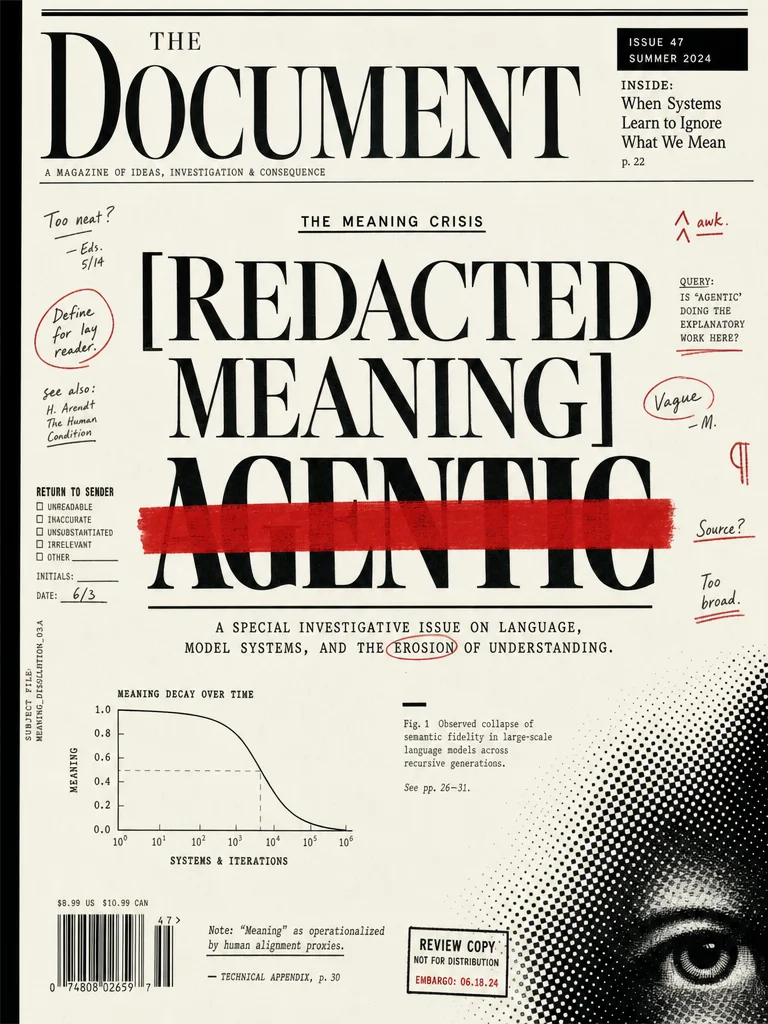
"Agentic": The Word That Already Knew It Was Too Good for You
A forensic autopsy of 'agentic' — how it traveled from Bandura's psychology papers and 1990s AI research to a Silicon Valley T-shirt in under a year, what Andrew Ng's June 2024 newsletter post set off, and what (if anything) the concept still usefully describes beneath all the noise.

研究速览
The word that already knew it was too good for you
There's a tell in the way Silicon Valley adopts an adjective. The borrowed word arrives trailing genuine precision — a term of art from some other discipline, doing real work in a specialist vocabulary. Then a prominent figure uses it in a blog post, hedges with "for now," and within six months every enterprise software deck has it in the hero slide.
"Agentic" made this journey in under a year. That's not a record, but the speed reveals something about how meaning evaporates when demand outpaces supply.
What "agentic" actually meant
The word predates AI by decades. In academic psychology, agentic has a precise home: Albert Bandura's social cognitive theory. His 2001 Annual Review of Psychology paper, cited nearly 32,000 times, defines human agency through four core properties — intentionality, forethought, self-reactiveness, and self-reflectiveness. To be agentic, in Bandura's framework, is to exercise genuine causal influence over one's life: not just to respond to stimuli, but to set intentions, model futures, regulate behavior against those futures, and reflect on one's own capacity to do so. 1
Chemistry uses "agentic" in a similarly narrow sense. Neither field would recognize what happened next.
In AI, the older concept was "agent" — software that perceives its environment and acts within it. Russell and Norvig's Artificial Intelligence: A Modern Approach (first edition: 1995) defines agents this way: rational agents select actions to maximize performance given percepts. The first International Conference on Multi-Agent Systems met in San Francisco in 1995, the same year. Milind Tambe, now at Harvard, has been studying these systems since then. The research community accepted a certain definitional looseness early on: "people agreed that some software appeared more like an agent, and some felt less like an agent, and there was not a perfect dividing line," Tambe told AP in November 2025. 2
"Agent" survived thirty years in the field with its meaning intact, roughly. The adjective "agentic" was mostly borrowed from psychology when AI researchers needed to describe something more than a chatbot and didn't want to say "autonomous" yet.
The moment it crossed over
On June 11, 2024, Andrew Ng published Issue 253 of The Batch, his DeepLearning.AI newsletter. His letter that week argued that AI practitioners should use "agentic" as a descriptor for complex, multi-step AI workflows — ones where a model plans, executes, and adapts rather than responding to a single prompt. He wrote that he liked mainly technical people were using the word at that point. "When I see an article that talks about 'agentic' workflows, I'm more likely to read it, since it's less likely to be marketing fluff and more likely to have been written by someone who understands the technology." 3
He added — in parentheses, with an awareness that felt almost pre-emptively rueful — "for now!"
The parenthetical was the tell. Ng knew what was coming. The word had a half-life the moment he typed it.
Within weeks, Swami Sivasubramanian took the title Vice President of Agentic AI at Amazon Web Services. By late 2024 and into 2025, Amazon, Google, IBM, Microsoft, OpenAI, and Salesforce all had product lines, press releases, and developer conferences built around the term. Google searches for "agentic" went from near zero to a peak in fall 2025. 2 Merriam-Webster, which hadn't formally added the term, began listing it under slang and trending vocabulary, defined as: "Able to accomplish results with autonomy, used especially in reference to artificial intelligence."
Sam Altman predicted in late 2024 that AI agents would "materially change the output of companies" in 2025. Marc Benioff promised a "digital labor revolution" worth trillions. The word had become the container for a bet.
How it diluted
正在加载图表…
The dilution happened in three overlapping stages.
正在加载内容卡片…
Stage one: legitimate expansion. The word started doing real descriptive work. In the context of LLM-based systems, "agentic" usefully distinguished systems that could chain actions, call tools, and loop on their own results from ones that just completed a single inference. Tambe's and Dietterich's communities had reasonable technical grounds for the term. This stage lasted approximately three months.
Stage two: VC adoption. Once the word appeared in Ng's newsletter and started circulating among technical founders, it moved into pitch decks. A system didn't need to do anything particularly autonomous to be described as "agentic AI" — it just needed to be an AI system being pitched to investors. The word did marketing work. "Agentic is becoming the new meaningless AI buzzword," wrote one LinkedIn post from the head of AI at a $3.5 billion company in late 2024. "Because everyone throws it around." 4 A Salesforce VP noted the term was "rapidly losing its meaning in Big Tech marketing." 5
正在加载内容卡片…
Stage three: enterprise press-release saturation. By 2025, the term had fully entered the realm where any software with an API call and a for-loop could be marketed as "agentic." The PROS enterprise blog coined a useful term for this: "agent-washing" — analogous to greenwashing, the practice of slapping "agentic" on systems that do none of the goal-directed, multi-step, adaptive behavior the word was meant to describe. 6
The 2025 reckoning was blunt. Sam Altman reportedly de-emphasized agent development internally. Cal Newport wrote in The New Yorker that agents "don't work." Andrej Karpathy called them "cognitively lacking." The industry quietly shifted its horizon from "Year of the Agent" to "Decade of the Agent." 7 Ng didn't respond to AP's request for comment on whether he still believed "agentic" was a reliable signal of technical seriousness. 2
The parenthetical was right. "For now" expired faster than he probably expected.
What's left worth salvaging
This is the part where the honest analysis gets harder, because the answer is: quite a bit, actually, beneath the noise.
The concept behind "agentic AI" describes something real and technically distinct. A chatbot that answers a single question and a system that decomposes a goal into subgoals, selects and calls tools, checks its own outputs, and iterates on failure are genuinely different architectures. The distinction matters — for reliability, for safety reasoning, for deployment decisions, for accountability questions about who is responsible when a multi-step autonomous system causes harm.
The problem is not the concept. The problem is that the concept has been detached from the word. "Agentic" now means, in most enterprise contexts, approximately "has AI in it." That's not a signal. That's noise.
Thomas Dietterich, professor emeritus at Oregon State and a decades-long researcher in AI assistants, drew the useful line. He objected to companies using "agentic" to describe "any action a computer might do, including just looking things up on the web," while remaining genuinely enthusiastic about systems with "the freedom and responsibility to refine goals and respond to changing conditions" — systems that can orchestrate subagents, adapt to new information, and behave meaningfully differently depending on what they encounter. 2 That distinction — between systems that execute a fixed script with AI flavoring and systems that genuinely adapt and orchestrate — is worth preserving.
A practical test, borrowed loosely from Bandura's original framework: does the system exhibit intentionality (it commits to a plan based on a goal, not just the next token), forethought (it models consequences before acting), self-reactiveness (it adjusts behavior based on its own outputs), and self-reflectiveness (it can reason about whether it's capable of a task)? A system that passes all four is doing something qualitatively different from one that generates text on demand. Most things marketed as "agentic" in 2025 fail this test at steps two and three.
That gap — between the word's current use and what the word was meant to carve out — is the useful residue. The concept still has edges. The label no longer does.
Verdict
| Dimension | Status |
|---|---|
| Original precision | High — borrowed from psychology with clear technical meaning in multi-agent AI research |
| VC/founder adoption | June 2024 → rapid (Ng's blog post as proximate cause; Altman/Benioff as accelerants) |
| Dilution vector | Enterprise marketing decoupled the word from any system-architecture requirement |
| Current signal value | Near zero in marketing contexts; still usable in technical papers and architecture discussions |
| Salvageable core | Yes — goal-directed, multi-step, adaptive, self-monitoring AI systems are genuinely distinct and the distinction is consequential |
| Recommended replacement | Describe the architecture: "multi-step tool-calling system with self-monitoring loops" is clunkier but honest |
The word is probably gone. The concept is not. That's actually the better outcome — the concept has now been stress-tested by a year of failed products, and anyone who still wants to describe a system that genuinely plans, acts, adapts, and reflects can reach for the underlying architecture rather than the adjective.
Ng was right to add "for now." He was also right that the property he was pointing at was real. The tragedy of "agentic" is that it collapsed under the weight of things that were neither agentic in Bandura's sense nor in Russell and Norvig's, but that needed a word that sounded like both.
Next issue: "vibe coding" — from Karpathy's precise phenomenological claim about a flow state to the thing your nephew said he does on weekends.
参考来源
- 1Social Cognitive Theory: An Agentic Perspective, Bandura 2001
- 2What does 'agentic' AI mean? Tech's newest buzzword is a mix of marketing fluff and real promise, AP
- 3The Batch Issue 253, Andrew Ng, DeepLearning.AI
- 4Agentic AI overuse on LinkedIn
- 5Agentic AI loses meaning in Big Tech marketing, LinkedIn
- 6Agent-Washing: How to Spot Hype, PROS
- 7The Agentic AI Delusion, Medium
围绕这条内容继续补充观点或上下文。