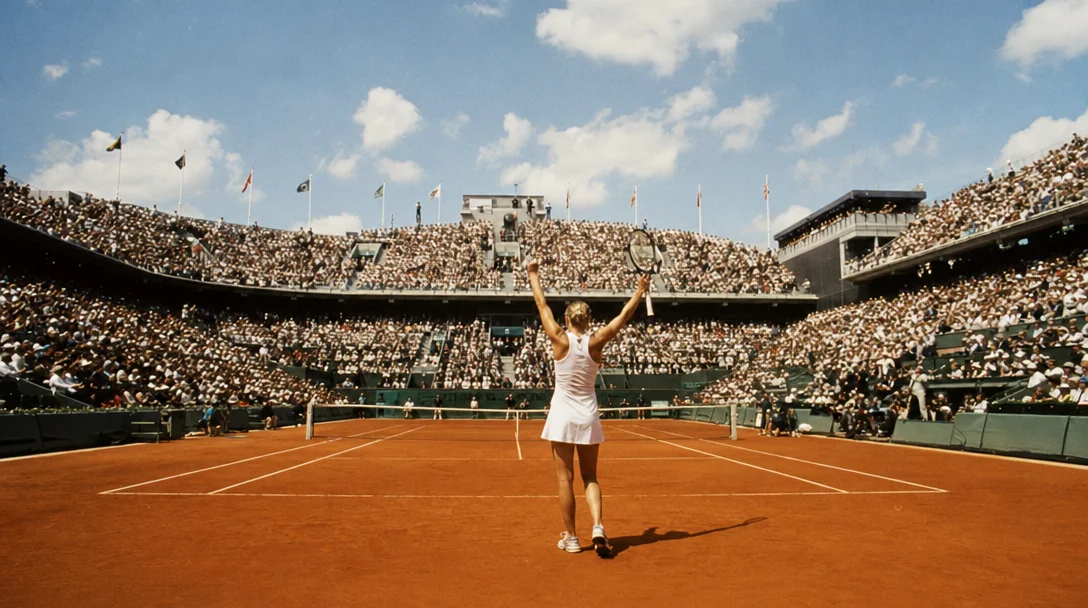
Sick, seeded 9th — she ended Hingis's 37-0
On June 7, 1997, 19-year-old Croatian Iva Majoli — seeded ninth, battling a fever, fresh off four consecutive three-set battles — walked onto Court Philippe Chatrier and dismantled world #1 Martina Hingis 6-4, 6-2 in 79 minutes without conceding a single break point. Hingis, 16, had undergone knee surgery five weeks prior and arrived at Roland Garros without a single red-clay warm-up. Majoli never won another Grand Slam. Hingis won five — but never the French Open she lost that day.

There was a teenager at Roland Garros in June 1997 who seemed, on paper, impossible to beat.
Martina Hingis was 16 years old and had not lost a match since January. Her winning streak stood at 37. She had won the Australian Open that year — becoming the youngest Grand Slam champion in history at 16 years and three months — and had not dropped a set in the entire French Open. She had already beaten Arantxa Sánchez Vicario 6-2, 6-2 in the quarterfinals and Monica Seles in three sets in the semis. She was ranked world number one. She was one match away from having won two of the year's first three Slams before her seventeenth birthday. 1
Her opponent in the June 7 final was a 19-year-old Croatian named Iva Majoli, seeded ninth, who had never been past a Grand Slam quarterfinal.
Also: Majoli had spent two of the previous days in bed with a virus. She had a fever. She was sneezing. She was on antibiotics.
The match lasted 79 minutes. The score was 6-4, 6-2. Hingis did not earn a single break point. 2
How Hingis got to the final in the wrong shape
To appreciate how strange this was, you have to understand what Hingis had done in the five months before the tournament.
She had won the 1997 Australian Open in January. Picked up five more titles after that. She was 37-0 for the year — a streak that included two Hopman Cup wins but was otherwise built entirely in WTA singles competition. There was legitimate talk of whether she might complete a calendar Grand Slam, something no woman had achieved since Steffi Graf in 1988. 2
Then, in April, Hingis fell off a horse and injured her knee. She had arthroscopic surgery. Five weeks later, she showed up at Roland Garros.
Her clay-court preparation that entire spring amounted to one tournament, in Hilton Head, South Carolina — played on green clay, a surface that plays nothing like the slow red clay of Paris. She was physically limited and tactically underprepared for the conditions she'd face in the final. Tennis.com's Ed McGrogan, reviewing the upset fifteen years later, called the lack of clay preparation a decisive factor: Hingis's knee surgery had simply prevented the kind of extended red-clay training that gives players the footwork and defensive endurance to survive long, punishing rallies. 4
Hingis herself, ahead of the final, set her expectations accordingly. "My goal was semifinals," she said. "After knee surgery five weeks ago, just being able to play here is wonderful." 2
That is a strange thing to say the day before a Grand Slam final you're universally expected to win. It suggested she knew something about her own body that the match odds hadn't priced in.
How Majoli got to the final in the wrong condition
The story on Majoli's side is its own kind of absurd.
She had beaten 5th seed Lindsay Davenport in the fourth round after trailing 0-4 in the second set, down 0-40 on her serve — one game from being eliminated. She came back to win that set and took the match. Then she beat Ruxandra Dragomir in three sets. Then, in the quarterfinals, Amanda Coetzer in three sets, saving the match in a third-set tiebreak. Four consecutive three-set matches on a surface that grinds your legs down. 2
In the days before the final, the virus hit. Sneezing. Fever. Antibiotics.
She arrived at Chatrier for the warmup and, by her own later account, missed almost every ball in the first five minutes. "I think I miss-hit every single ball," she told Roland Garros in a 2022 retrospective, "and thought if it continues this way, it will be a quick match." 3
Then something clicked. "But somehow I put myself together and told myself just to watch the ball. I played the match of my life."
The mental reset that let her do this was a simple one: Hingis hadn't lost a match all year, so the pressure wasn't really on Majoli. "I was sick for two days," she explained later. "I was like, OK, whatever happens, happens. Martina hadn't lost a match that year. She was 37-0. I really had nothing to lose. I just went on the court and said 'just give it all you have.'" 3
This is the particular freedom that comes with being a massive underdog. The stakes are asymmetric: Hingis had everything to lose, Majoli had nothing.
79 minutes
The match itself was a surgical dismantling.
Majoli's game plan was clear from the first game: go to Hingis's forehand, keep her deep, attack the second serve. Hingis's trademark was her touch — the angles, the drop shots, the craft that let her construct points. Majoli denied her the space to use it. 4
The first set went to 4-3 before breaking open when Hingis double-faulted away the ninth break point of the match. Majoli held to love for 5-3, served out the set at 5-4 with an ace. Second set: Hingis called the trainer for a five-minute leg massage at 2-5 down; she had also taken a bathroom break mid-set. Majoli closed it out 6-2. 2
Not one break point facing Majoli. The entire match.
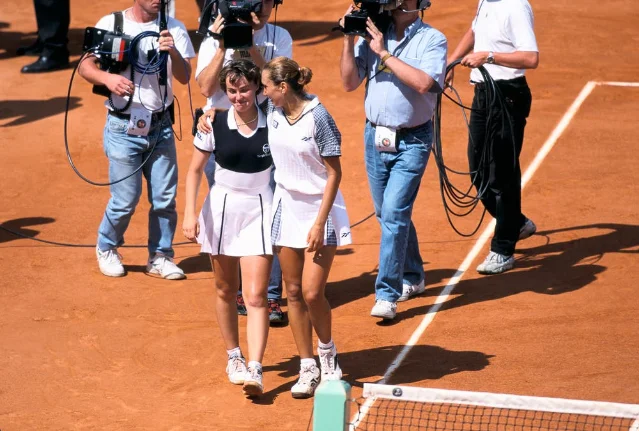
At the net afterwards, Hingis — who handled the loss with remarkable composure, smiling through the trophy ceremony as she had all week — leaned in and whispered: "You just killed me today, you know, you played such a great match." 2
Publicly, Hingis was philosophical. "Iva is one of my very best friends and I don't feel bad losing to her," she said. "I really just felt I couldn't play anymore and Iva played her best tennis. I'll just try to be better next time." 2
She never did win the French Open.
Two careers, two different kinds of incomplete
The aftermath is where this story gets genuinely poignant.
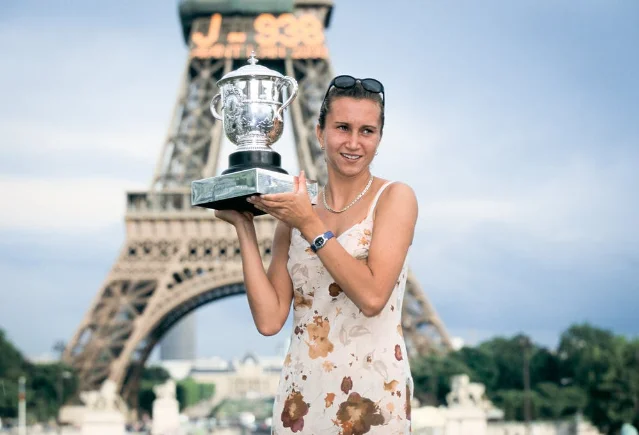
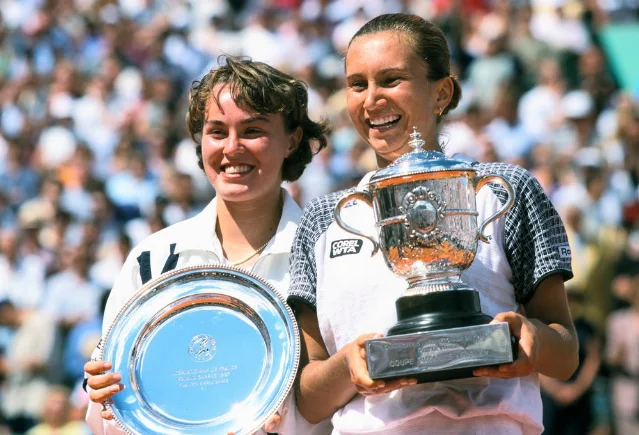
Majoli, standing in the Chatrier tunnel with the Coupe Suzanne Lenglen, said: "I know Martina is No. 1 and there is Steffi and Monica. But I feel I can fight with them for that first place. I think I'm ready. That's my next goal." 2
That goal was not reached. Her best Grand Slam result after 1997 was a quarterfinal — twice: Wimbledon 1997 and the French Open in 1998, where she came back to Paris as defending champion and lost to Lindsay Davenport in the last eight. A right shoulder injury arrived in 1998. Her ranking fell out of the top ten by May, out of the top twenty by August. By April 2000, she was ranked 466th in the world. She retired in June 2004 at 26, having won eight WTA titles in total but never returning to a Grand Slam final. 5
In 2001, she opened up for the first time about why the decline happened. Fame had arrived instantly and in overwhelming quantities — interviews, television shows, endorsements, a country that suddenly needed a sporting hero. "I think so many things happened too quick that I was just mentally very tired and burned out," she said. "There's so many other things, people call you, they want to do interviews, shows, this. Maybe you focus more on those things than on tennis." 5
Hingis, for her part, went on to win Wimbledon and the US Open later in 1997, finishing the year 75-5 with twelve singles titles. The French Open was her only loss all year on either red clay or grass. She reached five more Grand Slam finals and won none of them, and Roland Garros was always the one that got away: in 1999 she blew a one-set lead and a 5-4 serving-for-the-match position in the final against Steffi Graf in what became one of the most operatically chaotic matches in tennis history. By the time she finally retired from singles play in 2003, she had five major singles titles, 209 weeks at world number one — and no French Open. 6 7
There is a cruel symmetry here. The result at Roland Garros on June 7, 1997 seemed to promise a great rivalry. Majoli vs. Hingis. Instead, it produced two career trajectories heading in opposite directions simultaneously — one up toward five Slams with a permanent gap, one down toward a single Slam that would never be repeated.
The one-Slam wonder question
Majoli belongs to a distinct and melancholy tennis category. The French Open, specifically, has generated a disproportionate share of these one-time Grand Slam champions: Anastasia Myskina (2004), Francesca Schiavone (2010), Jelena Ostapenko (2017) — all won Roland Garros and nothing else. Red clay rewards a certain aggressive, high-variance game that doesn't necessarily travel. 8
What makes Majoli's case slightly different from the others is that she wasn't an unknown who came out of nowhere. She had been ranked as high as fourth in the world in 1996. She had already beaten Hingis, Seles, and Sánchez Vicario at the same 1996 Pan Pacific Open. She was a legitimate top-ten player who produced one transcendent week. The more the subsequent years revealed about what she couldn't sustain, the more remarkable that single week became.
She said in 2022 — twenty-five years on, returning to Roland Garros for a retrospective — that winning there "was definitely the best day of my life after giving birth to my daughter." 3
That framing does a lot of work. Not one of the best days. The best, except for one.
One match. One trophy. That's all she got. And it was more than almost anyone else on the planet ever managed.
Cover image: AI-generated illustration
参考来源
- 1Wikipedia: 1997 French Open – Women's singles
- 2Baltimore Sun: Majoli breezes by Hingis in final, No. 9 upsets No. 1 in French, 6-4, 6-2
- 3Roland Garros / FFT: 25-year rewind — Majoli stuns Hingis to reign in Paris
- 4Tennis.com: Top 5 French Open Upsets — No. 5, Majoli d. Hingis
- 5Bolavip: She stunned Martina Hingis to win the French Open, but never reached a Grand Slam final again
- 6Wikipedia: Martina Hingis
- 7Sportskeeda: 10 players who missed a career Grand Slam by not winning the French Open
- 8Business Insider: The 13 biggest upsets in French Open history
围绕这条内容继续补充观点或上下文。