
Principles: Dalio's Idea Meritocracy — and Why Nobody Has Ever Fully Copied It
A practitioner close-read of Ray Dalio's Principles: Life and Work (2017, 5M+ copies sold): the Idea Meritocracy formula, six operational frameworks with mechanism-layer breakdowns, the 2018 finding that zero organizations fully adopted the system, Coinbase's Dot Collector experiment, the internal contradictions exposed by Rob Copeland's The Fund, and five Monday moves derived from what practitioners report actually works.

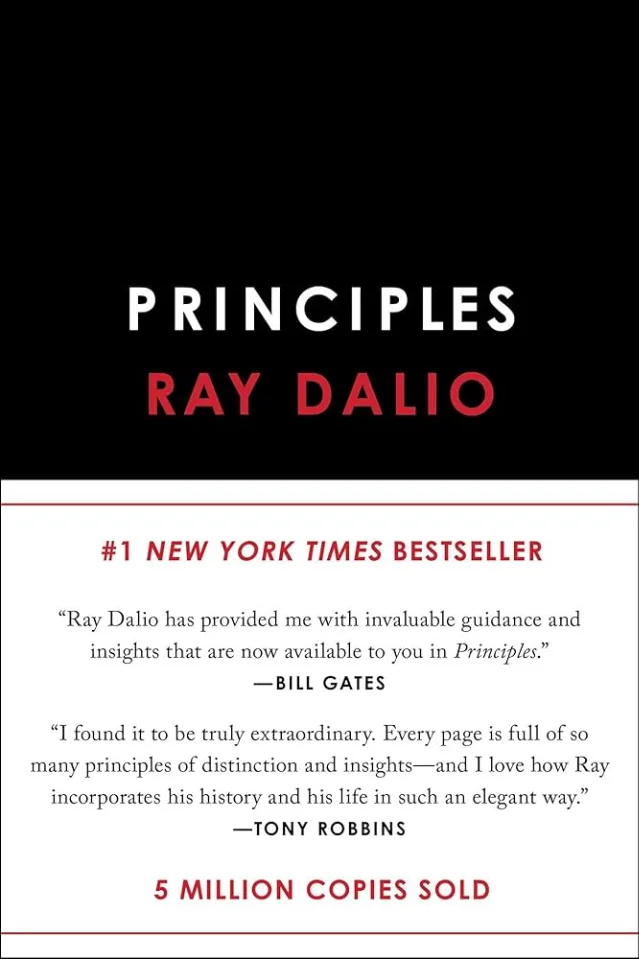
Ray Dalio's Principles: Life and Work arrived in September 2017 with unusual credentials: the man behind it had built Bridgewater Associates from a two-bedroom New York apartment into the world's largest hedge fund, managing around $150 billion at its peak. The book had already circulated in its internal memo form for years. When the trade edition landed, it sold nearly one million copies in its first year and reached #1 on the New York Times business bestseller list. By the time of this writing, the cover marks 5 million copies sold. 1
The book is, at once, a management manual, a philosophical treatise, and an autobiography. It runs 592 pages. Its central claim is that Dalio has reverse-engineered his own decision-making into a set of explicit, transferable principles — and that you can do the same. That claim deserves serious examination, because the evidence on whether anyone else has actually done it turns out to be both illuminating and unusual.
This article is a practitioner's close-read. It covers what Dalio actually argues, which frameworks transfer to normal organizations, where the full system breaks down, and what you can put into practice this week.
The book and the man
Dalio founded Bridgewater in 1975 from his apartment in Manhattan. He had been fired from his Wall Street job at Shearson/American Express after punching his boss and, separately, hiring a stripper for a congressional agriculture meeting. At 26, he was starting over. The early years taught him something he never forgot: in 1982, he publicly and confidently predicted a global debt crisis. Markets moved the opposite direction. Bridgewater nearly collapsed. He had to lay off his entire staff.
Rather than treating that catastrophic miscall as bad luck, Dalio turned it into the seed of his management philosophy. He began asking: why was I so confident and so wrong? The answer he arrived at — that smart, experienced people routinely deceive themselves and each other in the absence of enforced honesty — is the organizing premise of everything that follows.
Principles was published as a trade book by Avid Reader Press / Simon & Schuster on September 19, 2017. 1 It has three parts: a short autobiography, Part 2 covering Life Principles, and Part 3 covering Work Principles with 210 numbered rules. Most practitioners who engage with it seriously end up reading Part 2 closely and treating Part 3 as a reference dictionary — flipping to specific sections when they hit specific problems.
The central argument and six frameworks
The book's core formula is stated explicitly:
Idea Meritocracy = Radical Truth + Radical Transparency + Believability-Weighted Decision Making.
This is not incidental. Dalio argues that most organizations run on one of two broken systems: autocracy (the boss decides) or false democracy (everyone gets an equal vote). Both fail for the same reason — they do not route decision-making authority to whoever is actually right. The Idea Meritocracy is his answer: a system where each person's input is weighted by their demonstrated accuracy and competence in that domain.
Strategic Intelligence's 2025 analysis of Bridgewater's practices identifies seven operational mechanisms inside this framework: Radical Truth and Transparency, Thoughtful Disagreement, Believability-Weighted Decision Making, Triangulation, Disagree and Commit, Get and Stay in Sync, and WHO > WHAT (caring who makes a claim, not just what the claim is). 2 The six frameworks below are the ones that recur across practitioner accounts.
Pain + Reflection = Progress
This is Dalio's most personal framework, and the one that travels best. The formula holds that setbacks are diagnostic instruments, not just obstacles. Pain is a signal that something important can be learned. The mechanism: when you experience failure, your brain is typically in a threat state — defensive, rationalizing, rewriting the story. If you reflect in that state, you learn nothing. Dalio's prescription is to capture the pain first (he built an app for this), let the emotional charge subside, then conduct the analysis.
John Missikos, an entrepreneur in Australia, reverse-engineered Dalio's official app (which was US-only) and built his own version using iOS Shortcuts linked to Notion. 3 The implementation captures the pain moment with a single tap, then flags it for structured review 24 hours later. Missikos's summary of what the app does: exactly what Dalio designed it to do, except available outside the United States.
Dalio writes: "I believe Pain + Reflection = Progress. In other words, pain is an important signal that there is something to be learned, and if you reflect on your pain well, you will almost always learn something important." 3
The catch: Bridgewater institutionalized this formula as a surveillance and performance system — filming senior executives being publicly disciplined and using the footage as new-hire training material. The formula is sound; the implementation Dalio chose is not portable and, according to multiple accounts, was harmful at scale. More on this in the critics section.
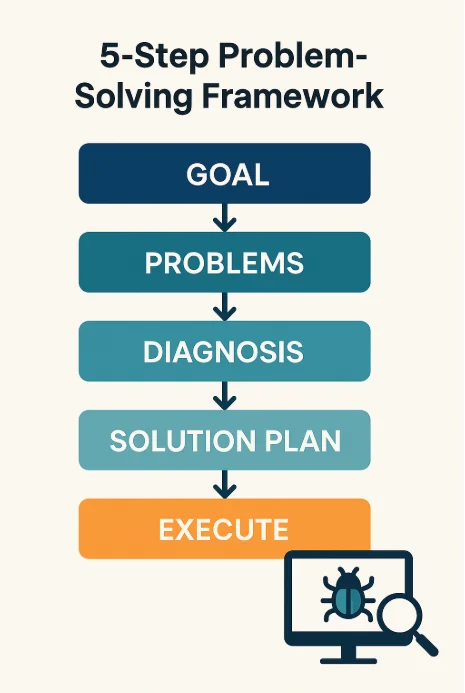
The 5-Step Process
Goals → Identify Problems → Diagnose Root Causes → Design Solutions → Execute.
The mechanism layer here is the diagnostic step, which is where most managers stop too early. The common failure: identify a symptom and jump to a solution, skipping the question of why the symptom exists. Dalio's framework insists that diagnosis must establish root causes, not surface causes, before any solution is designed.
Lukasz Glegola, a QA test automation engineer, applied this to a bug-reduction initiative at his team. Goal: reduce production-escaping bugs by 50%. His diagnostic step surfaced four root causes that wouldn't have been obvious otherwise — the regression suite hadn't been updated in months, test data for edge cases was poor, negative test cases were too few, and QA time was being lost to meetings and unclear priorities. The design phase directly addressed all four. The team didn't fully hit the 50% target but "got close." More importantly, Glegola writes, the process "established a habit of continuous refinement and introspection. That mattered more than any short-term metric." 4
The framework's limitation is its linearity. Goodreads reviewer Zach, who gave the book two stars, makes the underlying argument: "the main issue is that Dalio doesn't understand what a principle is. You can turn hypotheses into algorithms which can be applied everywhere, but not principles. Principles require judgment." 5 The implication for the 5-Step Process: as a linear framework it oversimplifies, since real diagnosis and design are iterative and non-sequential. That critique holds against using it as doctrine. As a starting template for structured problem-solving — a place to begin, not an algorithm to follow — it still works.
Idea Meritocracy and Believability-Weighted Decision Making
The core operational mechanism of Bridgewater's culture. Dalio's definition of a "believable person" for any given decision: someone who has "repeatedly and successfully accomplished the thing in question — who has a strong track record with at least three successes — and has great explanations of their approach when probed." 6
The mechanism: by weighting input based on demonstrated accuracy rather than rank or volume, the system routes decision authority away from the loudest voice and toward the most reliable one. Dalio claims he never overruled a believability-weighted decision in 40 years at Bridgewater — a claim he makes in his own writing and that is impossible to independently verify, but which practitioners who find the framework useful tend to cite as its aspirational standard. 2
In practice, Bridgewater operationalized this through the Dot Collector — an iPad app where employees rate each other on 75 attributes in real time during meetings. Even Dalio can be rated: he shared in a TED talk that a 24-year-old recruit once gave him a poor score for leading a discussion, and Dalio published the rating publicly. 7
Radical Truth and Radical Transparency
"Being radically truthful and transparent," Dalio writes, "helps create a culture of openness that leads to the best thinking." 2
At Bridgewater, this means recording virtually every meeting and archiving it in a "Transparency Library." Any employee can pull up the recording of any meeting they weren't in. If a manager talks about an employee behind closed doors, that employee has the right to listen to the tape. Junior analysts can give senior portfolio managers low scores on "open-mindedness" during debates. The system, at its design intent, strips hierarchical authority from the communication layer. 8
LeapAhead identifies four diagnostic axes for whether a transparency implementation is healthy or weaponized: ego-driven vs. mission-driven feedback; one-directional vs. omnidirectional; lacking context vs. systematic; personal attacks vs. behavioral critique. 8 The healthy version requires all four axes to be on the right side simultaneously.

Dalio states his two diagnostic questions for any conversation: "Should I tell you what I really think? And, can you be free to tell me what you really think?" 9
Reality as a machine
Dalio's worldview organizes all of life, organizations, and economics into a machine metaphor: everything has component parts, inputs, outputs, and diagnostic feedback loops. When something fails, you do not get frustrated — you analyze the machine. You find the broken part. You fix the part or replace it. Emotions are noise in the diagnostic signal.
This framing has genuine utility as a mental discipline. When you are emotionally flooded after a project failure, switching to "let me identify the broken component" is a concrete cognitive move that creates distance from the emotion and enables clearer analysis.
Its limitation is equally concrete: Dalio spent over a decade and at least $100 million trying to build a software system — variously called PriOS, Vassal, Book of the Future, "Prince" — that would literally encode his management principles as an algorithm. The project's stated goal, per reporting in The New Yorker, was "to make Ray's brain into a computer." 10 In 2021, Bridgewater quietly shut down the project and laid off most of the staff working on it. 10
Historian Niall Ferguson (Harvard University) was invited to advise on Bridgewater's economic modeling. When he challenged Dalio's historical modeling, pointing out that "there isn't a way of modeling the historical process," Dalio reportedly rose from his chair and shouted: "Where's your fucking model, Niall?" 10 The machine metaphor breaks at the boundary of human judgment and historical contingency.
Thoughtful Disagreement and Triangulation
The Thoughtful Disagreement framework asks both parties to genuinely consider the other's point of view before advocating for their own — not to debate, but to understand. Dalio's "two-minute rule" gives each speaker uninterrupted time to complete their thought before any response. The mechanism: without that protection, conversations collapse into rapid-fire rejoinders where neither party has actually heard the other.
Triangulation is the practice of seeking the input of trusted third parties when two people are stuck in disagreement. As Dalio writes: "By triangulating with others, you stress-test your own thinking and reduce the chances of error." 2
Both practices transfer well in smaller settings. Both become structurally difficult at scale — two-minute rules in a 15-person all-hands, and triangulation when no one is confident who the "believable" third party is.
How practitioners actually use it
In 2018, Angelo Calvello — an investment professional writing for Institutional Investor — set out to find a single organization that had adopted Dalio's Principles in the full Bridgewater manner: the complete Idea Meritocracy, the Dot Collector, the Transparency Library, the Baseball Cards (Bridgewater's system of employee profile cards tracking 77 personal attributes). 11 He contacted Bridgewater, all nine celebrity endorsers from the book's New York Times advertising campaign (including Bill Gates, Jamie Dimon, and Reed Hastings), 37 additional endorsers listed on the Principles website, and a cross-section of asset management industry participants.
He found zero organizations. 11 Gates was "not available." Mark Cuban replied he had "not yet" adopted the principles. Bridgewater declined to comment on the record. Not one of the 37 website endorsers produced a case study. Calvello's conclusion: "Bridgewater is a one-of-a-kind convergence of personality, vision, message, and technology that cannot be fully duplicated." 11
The closest any public company has come was Coinbase's 2022 experiment. According to Fortune, citing The Information, Coinbase began trialing a version of the Dot Collector that allowed employees to rate each other on 10 of Coinbase's core values — including "clear communication" and "positive energy" — with thumbs-up, thumbs-down, or neutral scores. 7 Ethan Bernstein, a behavioral scientist at Harvard Business School, warned at the time that constant observation can "leave employees feeling exposed and vulnerable" and trigger a paradox: executives increase monitoring in response to employees becoming more guarded, which increases monitoring further. 7
At the individual level, the picture is different. The frameworks that transfer well are the ones that don't require organizational authority to run. An r/PromptEngineering post from December 2025 — which received 147 upvotes and 93% positive votes — described translating six Dalio frameworks into AI prompt patterns for personal decision-making. 12 The author used them for business pivots, relationship decisions, and investment choices, framing the AI as "a team of thoughtful disagreers who actually want you to succeed."
A former Bridgewater employee, posting on r/startups in 2017 when the book first landed, described the culture as: "like coffee, not for everybody." When pressed on the cult reputation: "In my experience it's the opposite of a cult — it pushes free thought. The company wants you to think for yourself." 13
The Reddit community consensus, as summarized by LeapAhead's review: Part 2 (Life Principles) is "gold" and practically useful for nearly anyone. Part 3 (Work Principles) is "exhausting" and reads as a field guide to one specific company's operating environment. The recommended approach is to treat the book as a reference dictionary rather than a linear read. 14
What the critics get right
The structural criticism of Principles is not "this is bad advice." It is more specific than that: Dalio could enforce this culture because he was the billionaire founder writing the checks, and replicating it requires authority that no mid-level manager actually has.
LeapAhead puts it directly: "If you try to import Dalio's unvarnished 'radical truth' into a standard corporate office in Chicago or Seattle, you will not build an idea meritocracy. You will likely just get fired for being perceived as a toxic coworker." 14 Dalio himself acknowledged in a TED talk that 25–30% of people will resist the evaluation intensity of his system, and that new employees need approximately 18 months to fully adapt. Bridgewater was losing roughly 25% of staff within the first 18 months as recently as 2016. 9
The deeper problem with Believability-Weighted Decision Making is circularity: who decides who is believable? In theory, the system calibrates itself through track records and peer input. In practice, at Bridgewater, the credibility scores were anchored to Dalio's own assessments. The New Yorker reported that "on only rare occasions did Dalio receive honest feedback himself." 10 As Copeland observes: "The incentive structure — Dalio's opinion could send any rating plummeting — gave employees almost no incentive to be candid with their boss." 10 The system's claim to be an objective truth-seeking engine was contradicted at its summit.
The most substantive external accounting of Bridgewater's internal culture comes from Rob Copeland (then of the New York Times), who published The Fund: Ray Dalio, Bridgewater Associates, and the Unraveling of a Wall Street Legend in November 2023. Copeland reported: 10
- The Transparency Library contained "tens of thousands of hours" of archived meeting recordings.
- Dalio publicly disciplined a female executive referred to as "Ice Queen" until she was, in Copeland's account, "sobbing uncontrollably" — and turned the episode into a training video presented to job applicants under the title "Pain + Reflection = Progress."
- Dalio instructed James Comey (who later became FBI director, then serving as Bridgewater's general counsel) to investigate a senior executive named Eileen Murray. The resulting dossier, titled "Eileen Lies," was produced as a video series and shown company-wide for nine months.
- Bridgewater paid former employees additional sums to prevent them from speaking with journalists, and threatened the publisher of The Fund with a multi-billion-dollar lawsuit through three separate law firms.
Dalio's response was instructive. He called Copeland's book a "tabloid book" on LinkedIn, attributed it to "distorted accounts from disgruntled former employees," and noted that Copeland had applied to work at Bridgewater in 2009 and had been rejected. 15 He also threatened to publish Copeland's decade-old job application: "We still have the notes that were gathered at that time, which, if we get into it, we'd be happy to make public." 10
The New Yorker's Tarpley Hitt, reviewing the situation, noted the obvious: "Copeland's portrayal of Dalio doesn't dramatically depart from what the hedge fund manager himself has been willing to show." Dalio had spent decades publicly discussing his fund and philosophy in almost every outlet that would have him. His reaction to Copeland's book — threatening litigation, attacking the author's past job application, denouncing critics as disgruntled — was, as Hitt observed, the opposite of the self-dissolving humility his principles prescribe. 10
The table below summarizes the practitioner consensus on which frameworks transfer:
| Framework | Field verdict |
|---|---|
| Pain + Reflection = Progress | Transfer directly — works at individual level without organizational authority |
| 5-Step Process | Transfer with awareness — useful as a starting diagnostic template, but linear; real problems require iteration |
| Believability Weighting (conceptual) | Transfer selectively — the idea of weighting credibility by track record is sound; the Dot Collector implementation requires founder-level authority |
| Radical Truth (personal) | Transfer at individual level — asking "am I telling myself the truth here?" is useful; mandating it org-wide at Bridgewater intensity is high-risk |
| Radical Transparency (organizational) | Adopt with caution — requires all four diagnostic axes (mission-driven, omnidirectional, systematic, behavioral) to work; partial implementation can be worse than none |
| Machine Metaphor (diagnostic discipline) | Transfer as a mental model only — the $100M+ PriOS failure is evidence of its hard limits |
| Full Idea Meritocracy (complete system) | Do not attempt to replicate wholesale — zero documented full adopters outside Bridgewater |
Monday moves — five things to try this week
These are derived from what practitioners actually report works, not from the full Bridgewater playbook.
1. Apply the 5-Step Process to one stuck problem. Pick something on your plate that has been cycling — discussed multiple times, no resolution. Work through it in writing: What is the goal? What are the symptoms? What are the root causes of those symptoms (not the symptoms themselves)? What would directly address each root cause? What is the first concrete action? The value is in step 3 — most stalled problems are stalled because diagnosis stopped at symptoms.
2. Build a simple Pain Log. For the next two weeks, when something at work frustrates or stings — a bad meeting, a failed pitch, an unexpected piece of feedback — write it down within 24 hours. Not to process it immediately, but to capture it before your brain rewrites it into a more comfortable story. Then, at the end of each week, look at the log and ask: what pattern is visible here? One week of honest logging typically reveals something the real-time experience obscures.
3. Identify your three "believable people" on one current decision. For a decision you are wrestling with right now, list three people who have done this specific thing successfully at least twice, and whose track record you respect. Before you decide, ask for their input — not their opinion in the abstract, but their experience with this type of problem specifically. Note: "someone senior" and "someone with relevant track record" are often not the same person.
4. Run a Thoughtful Disagreement session with one person you disagree with. Before your next tense conversation or alignment meeting, agree in advance: each person speaks for two uninterrupted minutes before the other responds. No interruptions. No pre-emption. The goal is not to debate — it is to make sure both of you have actually heard the other's full argument before responding. This alone changes the quality of most disagreements.
5. Write your actual principles — not your aspirational ones. Dalio's most portable idea may be the most personal: take your last 10 significant decisions and ask, "What principle was I actually operating from?" Not what you would have said if asked, but what your behavior reveals. The gap between stated principles and operating principles is, as one Reddit practitioner put it, "terrifying and useful." 12
Cover image: AI-generated editorial illustration for this article.
参考来源
- 1Principles: Life and Work — Amazon product page
- 2Idea Meritocracy according to Ray Dalio — Strategic Intelligence
- 3Pain Button: Capture Learning to Progress — LinkedIn / John Missikos
- 4How Ray Dalio's 5-Step Framework Changed the Way I Solve Problems in QA and Life — Medium
- 5Principles: Life and Work — Goodreads community reviews
- 6Book review: 'Principles' by Ray Dalio — Medium/MAA1
- 7What is radical transparency, the management concept Coinbase is reportedly adopting? — Fortune
- 8Radical Transparency by Ray Dalio: High-Performance Culture or Toxic Workplace? — LeapAhead
- 9Is 'Radical Transparency' the Way to Go? — CFO.com
- 10A Hedge-Fund Founder's Obsessive Storytelling — The New Yorker
- 11Ray Dalio's Book Has Sold a Million Copies. But Who's Actually Implementing His Ideas? — Institutional Investor
- 12I turned Ray Dalio's Principles into AI prompts and now I have a brutally honest decision-making partner — Reddit r/PromptEngineering
- 13Anyone here tried building an A+ team based on Ray Dalio's Principles? — Reddit r/startups
- 14Principles Ray Dalio Review: Genius System or Billionaire Survivor Bias? — LeapAhead
- 15New book calls bs on Wall Street legend Ray Dalio — Morning Brew
围绕这条内容继续补充观点或上下文。