AI Voices, May 23: Doerr Says AI Is Underhyped, Huang Opens a $200B New Market
Two AI industry heavyweights, speaking on the same day 10,000 km apart, deliver complementary readings of where the field stands. Kleiner Perkins' John Doerr argues the public has systematically underestimated AI — it is the largest technology wave in recorded history, bigger than PCs, the internet, or mobile. Nvidia's Jensen Huang lands in Taipei and maps one reason why: agentic AI just opened a brand-new $200 billion CPU market, and China is part of that forecast despite ongoing export tensions.

Two reads from the same day, 10,000 km apart. One calls the entire AI build-out underappreciated. The other maps out exactly why.
John Doerr — "We have underhyped this"
Venture capitalist John Doerr, the Kleiner Perkins chairman who backed Google in 1999 and Amazon before it, published an op-ed in the Wall Street Journal on May 23 arguing that generative AI is not just another tech wave — it is the largest wave on record, and the public has not caught up to that fact. 1
Doerr tracks innovation in waves he says arrive roughly every 13 years: personal computers, the internet, mobile. Each reshaped the economy. He argues generative AI is bigger than any of them.
"People in Silicon Valley talk about waves of innovation. Venture capitalist John Doerr calls them tsunamis — and they come about every 13 years."
The WSJ piece was part of the paper's USA250 series examining America's most consequential forces, and Doerr's choice of subject carries its own signal: of all the topics available to a veteran technologist on that occasion, he chose AI's scale.
His core claim is a correction to the dominant media frame. While news coverage has focused on job displacement fears, regulatory debates, and the question of whether current valuations are inflated, Doerr positions that conversation as missing the larger point. AI is not overhyped — it is, if anything, underhyped.

What makes this notable as a market signal: Doerr sits on no AI company board that needs defending, does not run a fund with a direct stake in positioning the public narrative, and is well past the stage of his career where he needs to talk up an investment. His view is one of pattern recognition from someone who lived through every prior wave. The argument also inverts the standard VC pitch — instead of explaining why AI is special, he is saying the problem is that the rest of the world still does not appreciate how mundane an observation that is.
Jensen Huang — a $200 billion market that didn't exist two years ago
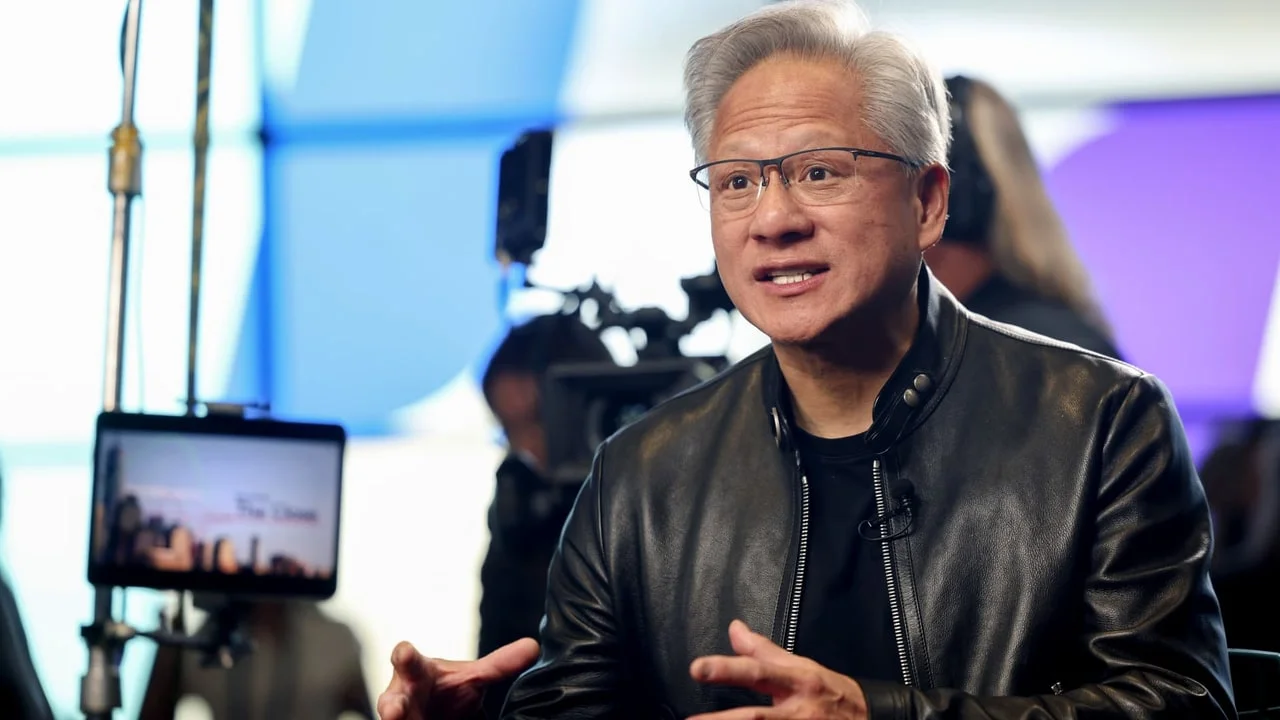
Arriving in Taipei on Saturday morning ahead of Computex, Nvidia CEO Jensen Huang told reporters that the company's forecast of a $200 billion CPU market — announced during Wednesday's earnings call — includes China. 2
The question matters because China is the contested ground in the U.S.–China chip standoff, and because CPUs are the new growth vector: agentic AI has shifted demand toward general-purpose compute for inference and autonomous task execution, not just the GPUs used to train large models.
Huang's "Vera" CPU — the processor half of Nvidia's next-generation Vera Rubin platform — opens that $200B market. He told reporters at Taipei's Songshan airport: "I would think so," in response to whether China was included in that forecast. It's a short answer, but geopolitically it registers as significant given the state of U.S. export restrictions. 2
Three practical details from the airport statement:
- H200 licensed, not shipped. The U.S. has issued licenses for Nvidia to sell its H200 chips to China, but no deliveries have occurred. Beijing has not approved Chinese firm purchases. The Trump–Xi meeting in Beijing earlier this month produced no breakthrough on this. Huang said: "H200 has been licensed to ship to China. It would be terrific to be able to serve that market. The Chinese market is very important. It's very large, of course." 2
- Vera Rubin ramp. Digitimes reports Huang described Vera Rubin as "the most successful product generation in Nvidia's history" and potentially the largest product rollout Taiwan's electronics industry has ever seen. 3
- Chip compliance. Asked about Super Micro's smuggling investigation — three people charged in March with helping divert $2.5B in Nvidia hardware to China — Huang said Nvidia is "very rigorous" in educating partners about export compliance but put responsibility on Super Micro: "Ultimately, Super Micro has to run their own company." 2
Huang is staying in Taiwan through Computex. He confirmed plans to meet TSMC executives, and said AMD's $10B+ Taiwan investment announced Thursday is consistent with a supply-chain expansion Nvidia has also been quietly funding for years: "We haven't announced anything in the past, but we've invested in and supported our partners here far more than that." 2
How they fit together
| John Doerr | Jensen Huang | |
|---|---|---|
| Role | Founder/Chairman, Kleiner Perkins | CEO, Nvidia |
| Context | WSJ op-ed, May 23 | Taipei press availability, May 23 |
| Main claim | AI is the biggest technology wave in history — and it's underestimated | Agentic AI created a brand-new $200B CPU market; China is part of that forecast |
| Stance on current hype | We have underhyped AI | Demand exists even in constrained markets |
| Key number | ~13-year innovation cycles; AI tops them all | $200B CPU market; $1T AI chip forecast for Blackwell |
| Geopolitical posture | None stated | Cautiously optimistic on China; H200 licensed, waiting on delivery |
The connection between the two is structural. Doerr is arguing AI is bigger than people have modeled. Huang is providing one concrete data point for why: an entirely new hardware category — CPU-driven agentic inference — just opened up a market that was not in anyone's TAM two years ago, and it is large enough that Nvidia is tracking it as a distinct $200B line item. Doerr says the wave is big. Huang is showing where the water is going.
围绕这条内容继续补充观点或上下文。