NVIDIA RTX PRO 4500 Blackwell Server Edition: specs, pricing, and what changes from Ada

NVIDIA's RTX PRO 4500 Blackwell Server Edition packs 10,496 CUDA cores and 32 GB of GDDR7 ECC into a single-slot 165 W passive card — delivering roughly 2× the memory bandwidth and ~1.9× the AI-workload throughput of its Ada predecessor, while adding MIG partitioning for the first time at this tier. Here's the full spec breakdown, pricing, and how it stacks up against the L4 and RTX 4000 Ada SFF.

NVIDIA's RTX PRO 4500 Blackwell Server Edition ships with the same GB203 die powering consumer Blackwell cards, shrunk into a single-slot passive form factor at 165 W — a design choice that tells you exactly who this card is for. It's not chasing benchmark headlines. It's trying to slot into racks that couldn't accommodate its predecessor without rethinking airflow.

What it is

The RTX PRO 4500 Blackwell Server Edition launched on March 17, 2026, and began shipping through OEM partners in April. 1 2
It targets mainstream enterprise data centers and edge deployments — the segment that NVIDIA historically served with Ampere- and Ada-generation cards like the L4 and the RTX 4000 Ada SFF. The pitch is straightforward: Blackwell architecture, double the memory of its direct predecessor, and hardware-level MIG partitioning in a package that draws 35 W less than the workstation version of the same chip.

Specifications

SpecRTX PRO 4500 Blackwell Server Ed.
ArchitectureBlackwell (GB203 die)
CUDA Cores10,496
RT Cores82 (4th Gen)
Tensor Cores5th Gen
Memory32 GB GDDR7 ECC
Memory interface256-bit
Memory bandwidth800 GB/s
PCIeGen 5.0 x16
TDP165 W
Form factorSingle-slot, passive
MIGYes — up to 2 instances (16 GB each)
Base / boost clock1,215 MHz / 2,415 MHz

How it compares to what it replaces

The most relevant comparison is the RTX 4000 Ada SFF — the previous generation's mainstream server SKU — and the NVIDIA L4, which has been widely deployed for AI inference at scale.
SpecRTX PRO 4500 Blackwell ServerRTX 4000 Ada SFFNVIDIA L4
ArchitectureBlackwell (GB203)Ada LovelaceAda Lovelace
CUDA Cores10,4967,4247,680
Memory32 GB GDDR7 ECC24 GB GDDR6 ECC24 GB GDDR6 ECC
Memory bandwidth800 GB/s300 GB/s300 GB/s
MIG supportYes (2x 16 GB)NoYes (up to 3x)
TDP165 W70 W72 W
5
The bandwidth jump — from 300 GB/s to 800 GB/s — is the most significant change on paper. That figure matters most for inference workloads where models are memory-bandwidth-bound, and for visualization pipelines pushing high-resolution frames through VDI sessions.
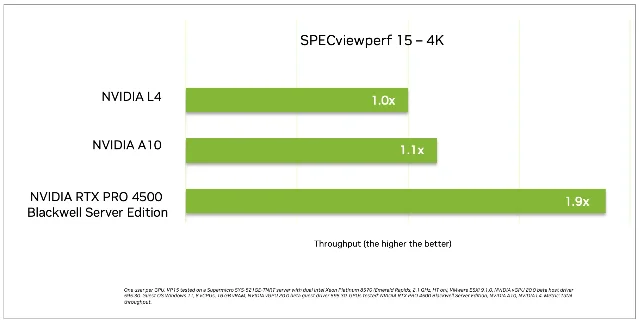
NVIDIA's internal testing shows roughly 1.9× better throughput versus the L4 on AI-enhanced workloads in virtualized environments, and approximately 2× the SPECviewperf 15 4K throughput in 4K graphics workloads — both at 4Q vGPU configuration. 1
Performance comparison: RTX PRO 4500 Blackwell Server Edition vs. NVIDIA L4 SPECviewperf 15 4K throughput — shows approximately 2× advantage for the new card
Source: NVIDIA Developer Blog — SPECviewperf 15 4K vGPU throughput, L4 vs. RTX PRO 4500 Blackwell Server Edition
There's a real catch here: the RTX 4000 Ada SFF draws 70 W; this card draws 165 W. That's more than double the thermal load per slot. Organizations running very dense Ada SFF deployments will need to verify that upgrading stays within rack power budgets — the performance gain is real, but it doesn't come free.

MIG and vGPU 20

The addition of Multi-Instance GPU (MIG) support is new for this tier of pro GPU. 5 The RTX 4000 Ada SFF had no MIG capability; here you can split one physical card into two 16 GB instances, and NVIDIA's vGPU 20 software takes it further by enabling mixed-size vGPU configurations — for example, running a 16Q, a 4Q, and a 3B instance simultaneously on the same card. 1
For IT teams managing shared VDI environments or running mixed AI inference workloads, this changes the math on GPU density meaningfully.

Pricing and availability

NVIDIA did not publish an official MSRP. European channel prices at launch were €3,676–€4,299, according to market tracking data. 2
The card is available through NVIDIA's OEM and system integrator ecosystem: Cisco, Dell, HPE, Lenovo, and Supermicro have all announced configurations. Add-in board partners PNY, Leadtek, and ELSA are selling standalone cards.

Positioning

This is a data center workstation and edge AI GPU — not a hyperscale training card. It sits below the RTX PRO 6000 Blackwell (the high-end pro workstation SKU) and well below the H-series and B-series data center accelerators. The target buyer is a corporate IT team modernizing from Ampere or early Ada infrastructure, or an enterprise adding AI-enhanced capabilities to an existing VDI deployment without redesigning their racks.
The passive single-slot design is a deliberate signal. NVIDIA is telling rack-scale operators that they can swap this in where the L4 or Ada SFF lived, add Blackwell-generation Tensor Cores and double the memory bandwidth, and not have to touch their physical layout — assuming they can absorb the higher per-card power draw.
正在加载链接预览…

围绕这条内容继续补充观点或上下文。

  • 登录后可发表评论。