Geopolitics Daily Brief — May 30, 2026
Five stories at 08:00 UTC: Trump-Iran deal stalls on Hormuz and nuclear terms as a White House decision remains imminent and Brent posts its worst weekly drop in seven weeks (−11%); Israel crosses the Litani and into Beirut suburbs while Pentagon Lebanon-Israel talks are declared productive; Hegseth softens China tone at Shangri-La, omits Taiwan from speech, defers $14bn arms package to Trump; Russian Geran-2 drone strikes a Galati apartment block — first NATO-soil casualties, Russian consul expelled; equities push to records on deal hopes.

Five stories at 08:00 UTC. US-Iran deal fractures on Hormuz and nuclear terms; Hegseth softens China tone at Shangri-La while dropping Taiwan from his speech; Israel pushes across the Litani and into Beirut suburbs as Lebanon-Israel security talks proceed in Washington; a Russian Geran-2 drone strikes a Galati apartment block — the first time a person has been hurt by a Russian drone on NATO soil; and oil posts its worst weekly fall in seven weeks on ceasefire-deal hopes.
1. US-Iran Deal Stalls on Hormuz and Nuclear Terms — Decision Imminent
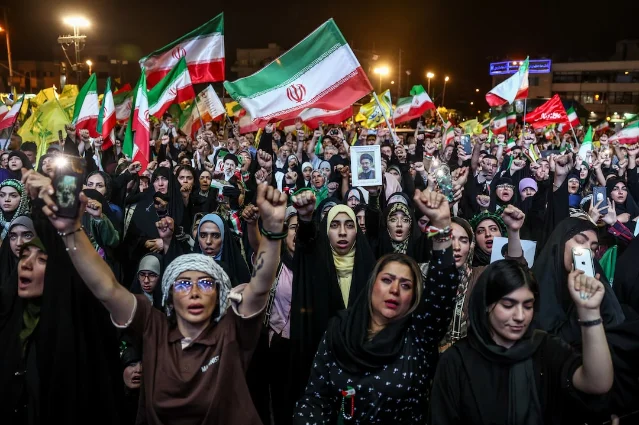
Trump convened his national security team in the White House Situation Room on Friday for roughly two hours to make what he called a "final determination" on a proposed 60-day ceasefire extension with Iran.1 No announcement had been made by 08:00 UTC Saturday. A White House official stated: "President Trump will only make a deal that is good for America and satisfies his redlines. Iran can never possess a nuclear weapon."
Trump publicly demanded two conditions Tehran has not accepted: immediate reopening of the Strait of Hormuz with no tolls, and Iran's agreement to dismantle nuclear-weapons capability.1 Iran's Foreign Ministry said management of the strait "must be decided by Iran and Oman"; semi-official Fars news agency called Trump's framing "a fabricated victory." A senior Iranian source told Reuters that the prospective deal contains no nuclear-related provisions and that a deal remained close but unapproved.1 Fars separately reported a $12 billion frozen-assets release was agreed; Trump said "no money" would be exchanged "until further notice."
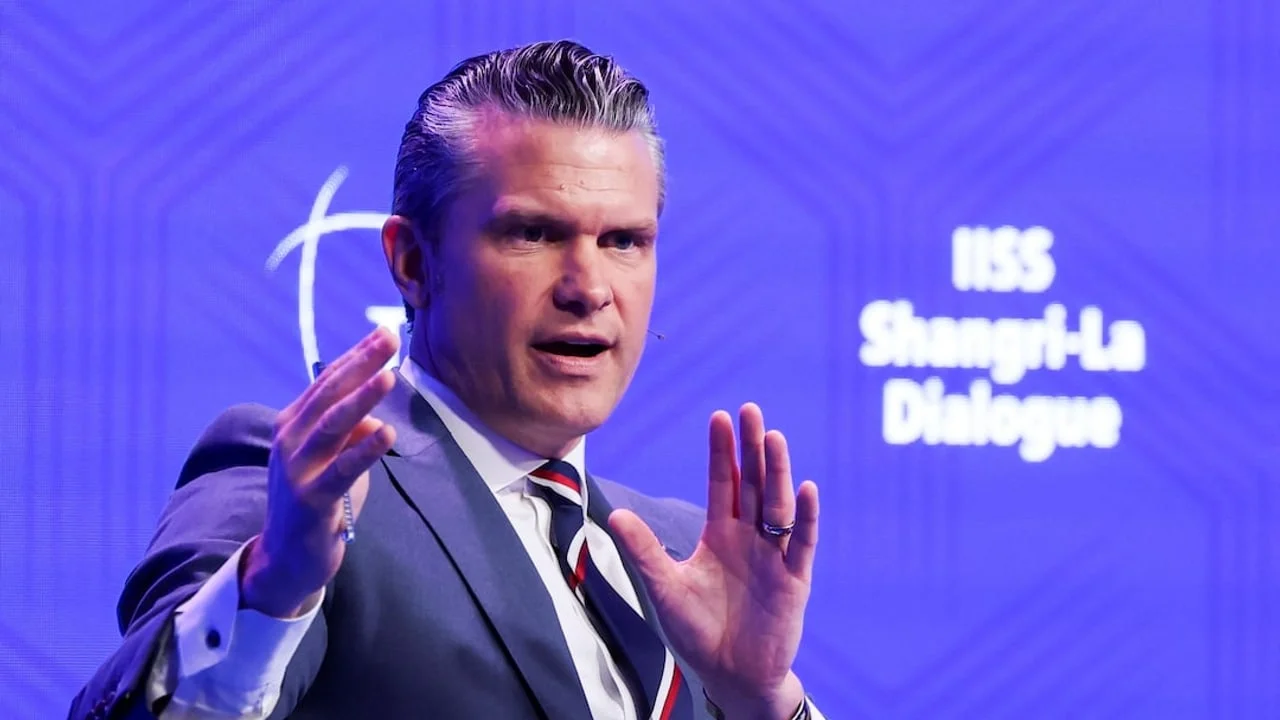
Hegseth, speaking in Singapore on Saturday, confirmed: "Our ability to recommence if necessary… we are more than capable," adding Trump was being patient and seeking a "strong deal."2
Market / supply-chain impact. Brent crude fell roughly 11% on the week to around $91 — the steepest weekly decline in seven weeks — as markets priced ceasefire-extension optimism.3 The Hormuz gap persists: analysts warn that even under a deal, mine-clearance and restoration of normal tanker transit could take months, keeping a residual risk premium in place. European refiner margins and Asian LNG spot prices remain elevated. If Trump signs Friday-night (Washington time), expect another leg down in Brent at the Asian open; failure to sign will likely reverse part of the week's drop.
2. Israel Crosses the Litani; Lebanon-Israel Pentagon Talks Called "Productive"
Israeli Prime Minister Benjamin Netanyahu confirmed on Friday that IDF ground forces had crossed north of the Litani River, around 30 km inside southern Lebanon, describing the advance as reaching "controlling positions."4 Israeli military chief Eyal Zamir said troops would continue pursuing Hezbollah "launch squads" and commanders at every level: "Wherever we identify a threat, we will strike it." Lebanese security sources told Reuters the advance was at an eastern point of the river near the Israeli border, and that troops briefly retreated before crossing back on Friday — characterising it as not a major strategic push.
In Washington, Israeli and Lebanese military delegations met at the Pentagon to discuss implementation of the April 16 ceasefire, extended 45 days on May 15. A U.S. official described talks as "productive" and said the "only path to lasting peace is through direct negotiations between the two sovereign governments."4 Diplomatic-track talks are scheduled next week at the State Department. Lebanon's delegation sought a "comprehensive implementation of the ceasefire and a halt on ongoing hostilities," per AP.5
Lebanon's health ministry reports more than 3,200 killed and over 1.2 million displaced since March 2. Israel says 23 soldiers and four civilians killed on its side over the same period.
Market / supply-chain impact. Lebanon's offshore gas infrastructure and eastern Mediterranean shipping lanes remain exposed to escalation. The Beirut-Tripoli corridor — a primary road for Turkish and European goods into the Levant — is disrupted by evacuation orders now extending to the Zahrani River (10 km north of the Litani). Freight forwarders routing cargo to Jordan, Iraq, and the Gulf via Beirut face continued rerouting to Aqaba and Gulf ports, pushing up logistics costs. A diplomatic breakthrough at State Department next week could partially reopen the corridor; a Litani entrenchment would lock in diversions for months.
3. Hegseth at Shangri-La: "No State, Including China" — Taiwan Arms Package Left to Trump
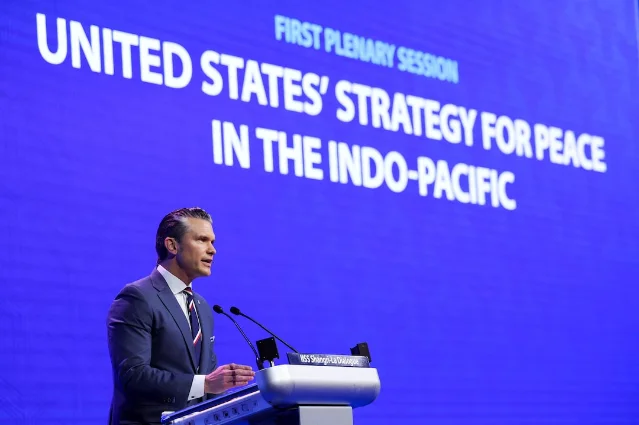
U.S. Defense Secretary Pete Hegseth addressed the Shangri-La Dialogue in Singapore on Saturday, two weeks after Trump visited Xi Jinping in Beijing. His tone was markedly softer than last year, when Beijing accused him of making "vilifying" remarks.6 This year, Hegseth did not mention Taiwan in his prepared speech, called US-China relations "better than they have been in many years," and cited more frequent military-to-military contact as a stabilising force.2
His core message: "No state, including China, can impose its hegemony" over the Indo-Pacific. He pressed allies to raise defence spending to 3.5% of GDP ("no freeloading"), praised South Korea, the Philippines, Australia, Japan, Singapore, Malaysia and Thailand, and took an implicit swipe at European allies without naming them. On Taiwan, he deferred entirely to the president: "Any decision about future Taiwan arms sales, as the president said, will rest with him" — signalling no clarity on the stalled $14 billion package.6 He also stated the US is ready to resume Iran strikes if talks fail.
Senior Tsinghua fellow and retired PLA Colonel Zhou Bo, part of China's non-ministerial delegation, said Hegseth struck "a much better tone this year" — attributing the shift to Trump's Beijing summit. U.S. Sen. Tammy Duckworth, attending on the sidelines, accused the administration of "cozying up to Beijing at the expense of Indo-Pacific commitments."6
Market / supply-chain impact. The Taiwan arms ambiguity is the critical commercial signal. Taiwan's defence-tech supply chain — semiconductors, radar, C4ISR — had anticipated the $14 billion package as a demand anchor; its delay extends procurement uncertainty for prime contractors and sub-suppliers. The absence of Taiwan from Hegseth's speech will be parsed in Taipei, Seoul and Tokyo as indicating Trump may use the package as a bargaining chip with Beijing in upcoming trade negotiations. Indo-Pacific allies' stated drive toward higher defence spending (3.5% of GDP) points to continued strong orderbooks for shipbuilders, munitions makers and drone manufacturers in Japan, South Korea and Australia.
4. Russian Drone Hits Romanian Apartment Block — First NATO-Soil Casualties
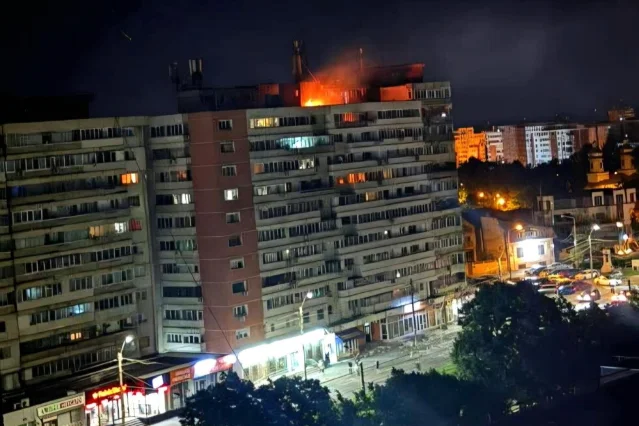
A Geran-2 drone that Russia launched in a swarm of 43 against Ukrainian targets overnight Friday veered into Romanian airspace and crashed onto the roof of a Galati apartment building, sparking a fire and injuring two people — the first time anyone has been hurt by a Russian drone on NATO member territory since the war began in February 2022.7 Romanian President Nicusor Dan identified the drone by type and trajectory: "We know the trajectory, we know where it went through Ukraine, we know where it entered Romania." Investigators said it likely carried at least 30 kg of explosives.
Romania scrambled two F-16s and a helicopter but did not intercept. Dan convened the Supreme Council of National Defence, declared the Russian consul in Constanta persona non grata, and closed the consulate, giving the consul 72 hours to leave.7 Putin, speaking in Astana, denied Russian responsibility and bizarrely requested Romania "turn the drone over to Russia." NATO Secretary-General Rutte expressed "absolute solidarity" and said NATO "stands ready to defend every inch of Allied territory." The European Commission's Ursula von der Leyen said Russia "crossed yet another line" and that a 21st EU sanctions package is being drafted.
GCHQ head separately disclosed this week that Russia has lost approximately 500,000 soldiers since February 2022, a figure that underlines why Moscow is escalating unconventional pressure.8 Zelenskyy, visiting Sweden, renewed his appeal to Trump for additional Patriot air-defence batteries.7
Market / supply-chain impact. The Galati incident — a Danube port city — is directly relevant to grain and steel traders: Ukraine's Reni-Galati corridor is a principal export route for Ukrainian grain following the Black Sea shipping disruptions. Insurance underwriters will reassess war-risk premiums on vessels transiting the Danube and the lower Black Sea. European defence contractors — Rheinmetall, KNDS, Leonardo — can expect further acceleration of air-defence procurement orders as NATO members rush to upgrade short-range counter-UAS capabilities. The EU 21st sanctions package, if passed, will likely expand on dual-use tech and maritime insurance restrictions targeting Russian energy exports.
5. Oil's Worst Week in Seven Weeks; Equities Push to Records on Deal Hopes
Brent crude settled around $91.57 on Friday, down approximately 11% on the week — the sharpest weekly decline since mid-March — driven by ceasefire-extension optimism across the US-Iran theatre.3 At the week's peak (before deal signals) Brent had traded above $110 on fresh US-Iran strike fears; Friday's close represents a ~$20 reversal from that intraweek high. WTI tracked Brent lower. A Yahoo Finance tracker put the May 29 Brent spot at $94.44, with the week's close somewhat lower.
US equities continued to add to records, led by the tech sector; Dell surged on strong AI-server earnings, helping the S&P 500 and Nasdaq to fresh highs.9 Asia's indices closed the week at records on Thursday (Nikkei +2.5% to 66,329; Kospi +3.6% to 8,476 — as covered in yesterday's brief). IMF and World Bank economists, meeting in Bali, warned that the Middle East war continues to "strain energy supplies" and that a resolution is needed to prevent second-round inflation effects in food-importing economies in Africa and South Asia.3
Market / supply-chain impact. Even under a 60-day ceasefire extension, Hormuz normalisation is not immediate. Mine-clearance, insurance reinstatement and tanker repositioning are a 4-8 week process; full shipping volume recovery likely takes a quarter. Airlines and petrochemical feedstock buyers are the most exposed to the residual Brent premium (~$8-10/bbl above pre-war baseline). Defence procurement stocks remain well-bid on the week regardless of the oil move, reflecting NATO's accelerated spending cycle. The Trump decision — expected imminently — is the single biggest short-term binary for oil, the dollar, and risk-on equities at Monday's open.
Sources: Reuters, AP, The Independent, Economic Times. All prices as of Friday 29 May 2026 close unless noted.
参考来源
- 1Reuters — Trump says he will soon decide on Iran deal
- 2Reuters — Pentagon chief urges allies to boost defence spending
- 3Economic Times — Oil prices tumble 11%
- 4Reuters — Israeli forces cross key Lebanon river
- 5Indian Express — Military talks in Washington, airstrikes in Lebanon
- 6AP — Hegseth tones down warnings about China
- 7AP
- 8The Independent — Ukraine-Russia war live
- 9AP — US stocks gain ground
围绕这条内容继续补充观点或上下文。