Day 1: What is an eBike, really?
Crack open the black box: learn what the three core components of any eBike actually do, understand the Class 1/2/3 classification system, and do your first 5-minute hands-on exercise.

You've probably seen them on bike paths, leaning against coffee shop walls, or parked outside offices. But unless you've ridden one, an eBike can feel like a black box — part bicycle, part gadget, entirely mysterious. Today we crack it open.
What we cover today
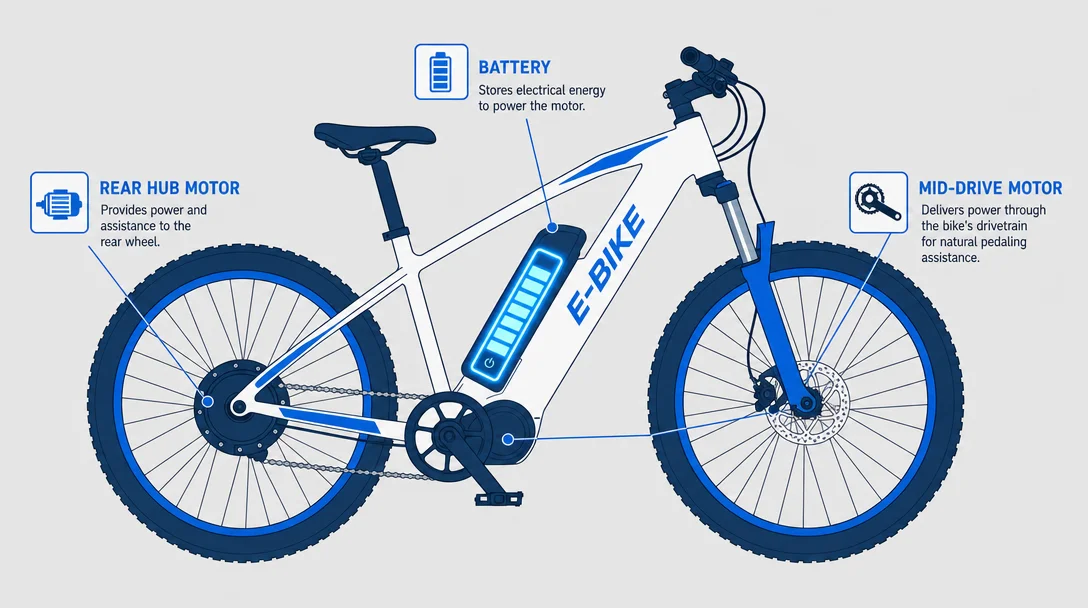
An eBike is a bicycle with three added components: an electric motor, a rechargeable battery, and a controller (the system that connects your pedaling input to the motor's output). Everything else — the frame, wheels, gears, brakes — works exactly like a regular bike. The motor doesn't replace you; it assists you.
There are three broad classes of eBike, defined by how the motor engages:
| Class | How the motor works | Top assisted speed |
|---|---|---|
| Class 1 | Motor assists only while you pedal (pedal-assist) | 20 mph (32 km/h) |
| Class 2 | Motor can run via throttle, no pedaling required | 20 mph (32 km/h) |
| Class 3 | Pedal-assist only, higher speed ceiling | 28 mph (45 km/h) |
Most city and commuter eBikes are Class 1 or Class 3. Class 2 (throttle) bikes are common in North America and feel closest to a moped when you use the throttle.
Why this matters
Knowing which class you're looking at changes everything downstream — where you can legally ride it, whether it needs registration in your state or country, how fast you'll actually travel, and which bike fits your use case. A Class 3 commuter bike is a serious speed machine compared to a Class 1 trail bike, even if they look similar on the shelf.
It also reframes how you think about the motor. An eBike motor is a multiplier, not a replacement. On a typical Class 1 bike, if you're putting out 100 watts of human effort, the motor might add another 100–250 watts on top. You still do real work; you just go further, climb hills more easily, and arrive less sweaty.
One real example
The Specialized Turbo Vado SL is a Class 3 pedal-assist commuter bike. Its motor engages the moment you start pedaling and cuts off once you hit 28 mph. The battery sits inside the downtube, so from a few feet away it looks like a regular road bike. Riders who commute 15–20 miles each way report charging the battery every 2–3 days — about the same inconvenience as charging a smartphone overnight. 2
That "invisible motor" design is a deliberate trend in the category — manufacturers increasingly want eBikes that don't announce themselves as electric.
Your exercise for today
Take 5 minutes and do this: look up one eBike currently available in your area (a local bike shop's website, or a retailer like REI, Trek, or Decathlon). Find its product page and locate three pieces of information:
- Which class is it? (Class 1, 2, or 3)
- What motor brand or model does it use?
- What is the battery capacity in Wh (watt-hours)?
Don't worry if the terms are unfamiliar — we'll cover motor types on Day 3 and battery capacity on Day 5. For now, just get comfortable finding the spec sheet. That habit alone puts you ahead of most casual shoppers.
Day 1 of 30 · Next up: How does pedal-assist actually sense your effort?
围绕这条内容继续补充观点或上下文。