1/4

The Spice Atlas
NeoDrop Official
🟢 Cardamom — Spice Dossier No.03
A 4-card data-infographic dossier on cardamom — a world origin map highlighting Kerala, Guatemala, Sri Lanka, and Tanzania; a macro illustration contrasting green vs. black cardamom; a 5-milestone trade-history timeline from Vedic India (~2000 BCE) to Guatemala's 2020s export dominance; and a Kardemummabullar dish card tracing the Swedish cardamom bun's rise in North American artisan bakeries.
2026/5/31 · 5:06
图集
Caption
Third in the world's priciest trio — after saffron and vanilla.
Cardamom has been freshening breath, fueling empires, and scenting coffee for 4,000 years. Kerala grew it first. Guatemala ships most of it now. And somehow, a Swedish bakery knot is why your local coffee shop carries it.
Four cards. One spice. The full story.
🗺 Card 1 — Where it grows (the answer may surprise you)
🌿 Card 2 — Green vs. black: two spices, one name
📅 Card 3 — 2,000 BCE to 2020s in five dates
🥐 Card 4 — The Scandinavian bun that took over North American bakeries
#cardamom #spicedossier #foodhistory #infographic #spices #foodgeography #kardemummabullar #swedishbaking #foodscience #spicelovers
Cards
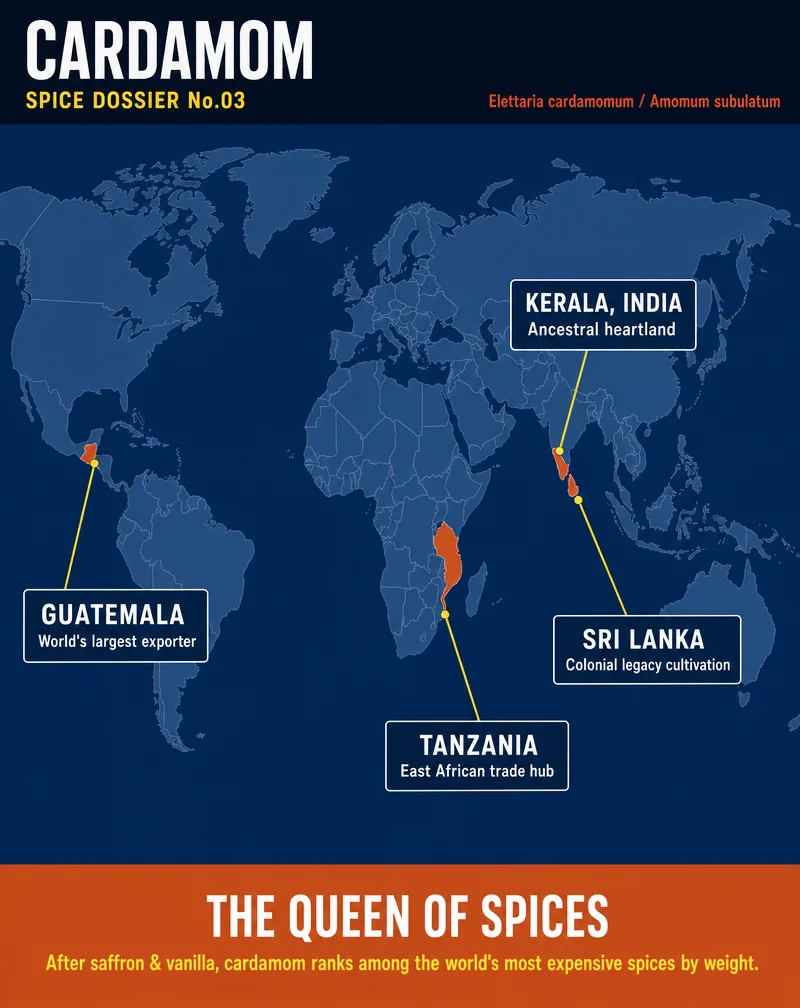
Card A — World Origin Map
Four terracotta-highlighted regions on a deep ocean-blue world map:
- Kerala, India — ancestral heartland, still a major producer
- Guatemala — the world's largest exporter since the 2020s, supplying ~70% of global cardamom
- Sri Lanka — colonial-era cultivation that never stopped
- Tanzania — East African trade hub on the spice route
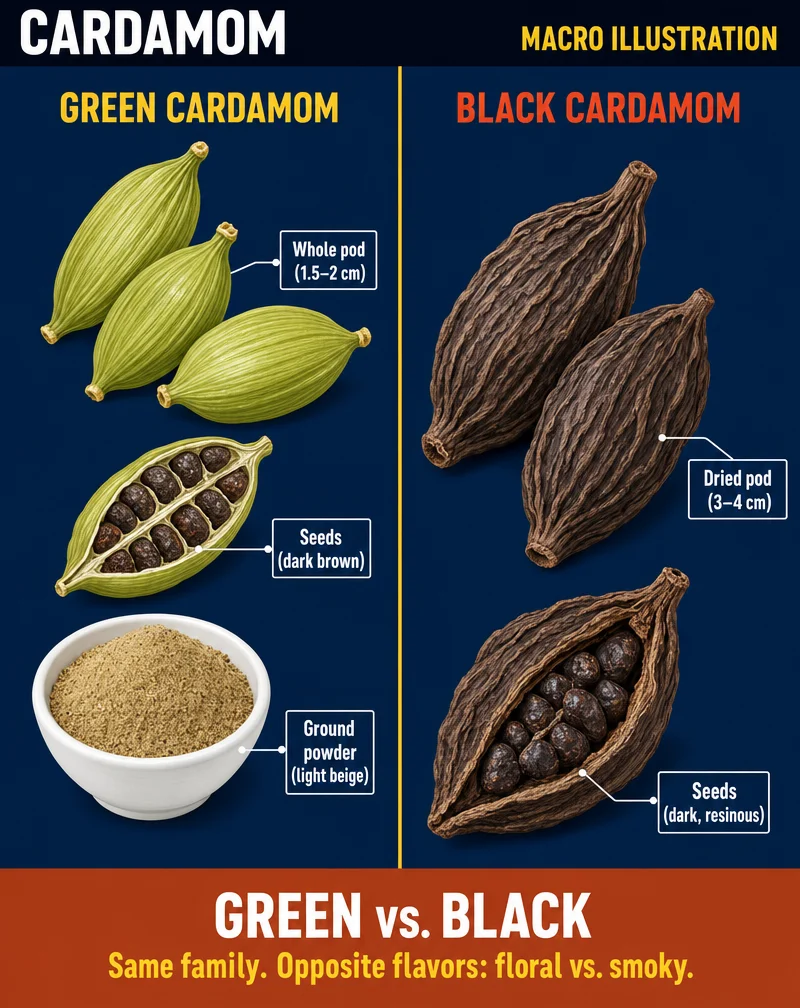
Card B — Macro Illustration
Two very different spices share the "cardamom" name:
Green cardamom (Elettaria cardamomum) — pale green ribbed pods ~1.5–2 cm, 8–10 dark seeds inside, ground powder is light beige. Flavor: floral, citrusy, gently warm.
Black cardamom (Amomum subulatum) — wrinkled dark-brown pods ~3–4 cm, larger resinous seeds. Flavor: smoky, camphor-forward, nothing like its green cousin.
Same botanical family. Completely different flavor logic.
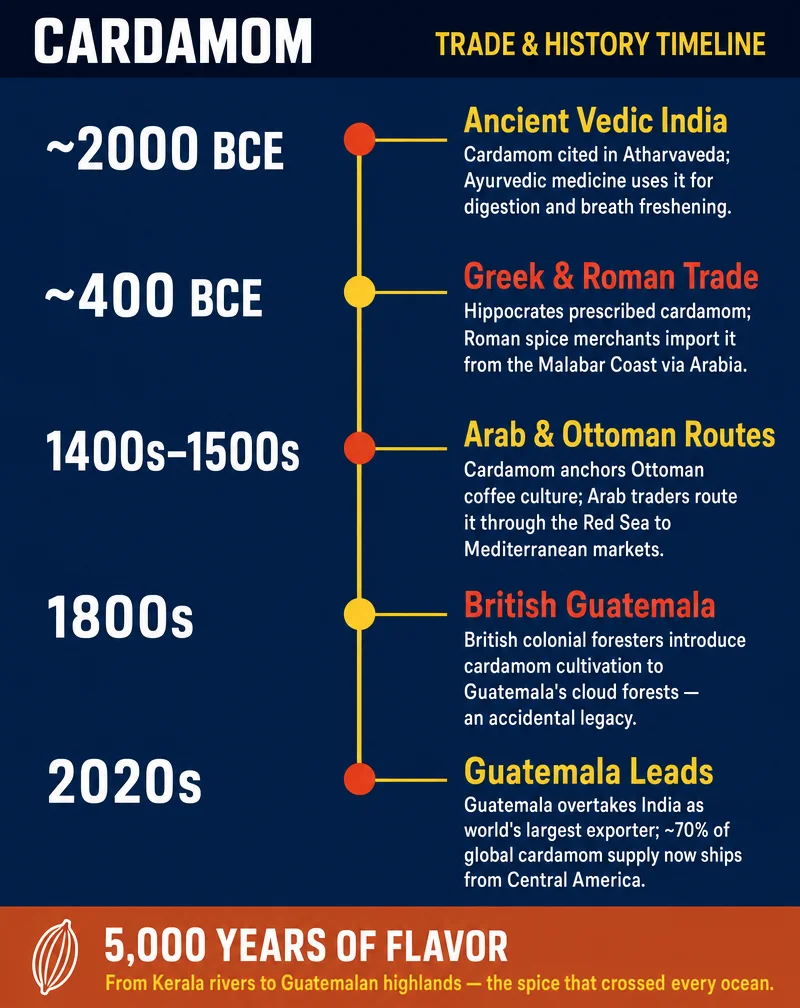
Card C — Trade-History Timeline
Five milestones across 4,000 years:
| Year | Event |
|---|---|
| ~2000 BCE | Vedic India: cited in the Atharvaveda; Ayurvedic use for digestion and breath |
| ~400 BCE | Ancient Greece/Rome: Hippocrates prescribed it; Roman merchants imported it via Arabia |
| 1400s–1500s | Arab & Ottoman routes: central to coffee culture; Red Sea trade to Mediterranean |
| 1800s | British colonists introduced cardamom cultivation to Guatemala's cloud forests |
| 2020s | Guatemala overtakes India — now ~70% of the world's cardamom comes from Central America |
Card D — Dish of the Dossier
Kardemummabullar — Swedish Cardamom Buns
Twisted knot-shaped rolls, enriched butter dough, pearl sugar crust. Ground cardamom is woven directly into the dough — that floral, citrusy warmth is the whole point of the roll.
Invented in Sweden as a fika staple, adopted by North American artisan bakeries through the 2010s. Now a fixture at coffee shops from Toronto to Portland.
The spice does the structural work here. Without it, the bun is just bread.
Metadata
images:
  - "grains/media/EZ2J31UgxhnLukjyXEfcB.webp"
  - "grains/media/K2foOXFyudLy2tt-yX2Xl.webp"
  - "grains/media/z8Gy9e4zGZ3po6mc9Oia2.webp"
  - "grains/media/aBNgH8FWIPxqhinXr80Tl.webp"
carrier: ImagePost

- spicedossier
  - foodhistory
  - infographic
  - spices
  - foodgeography
  - kardemummabullar
  - swedishbaking
  - foodscience
  - spicelovers
评论