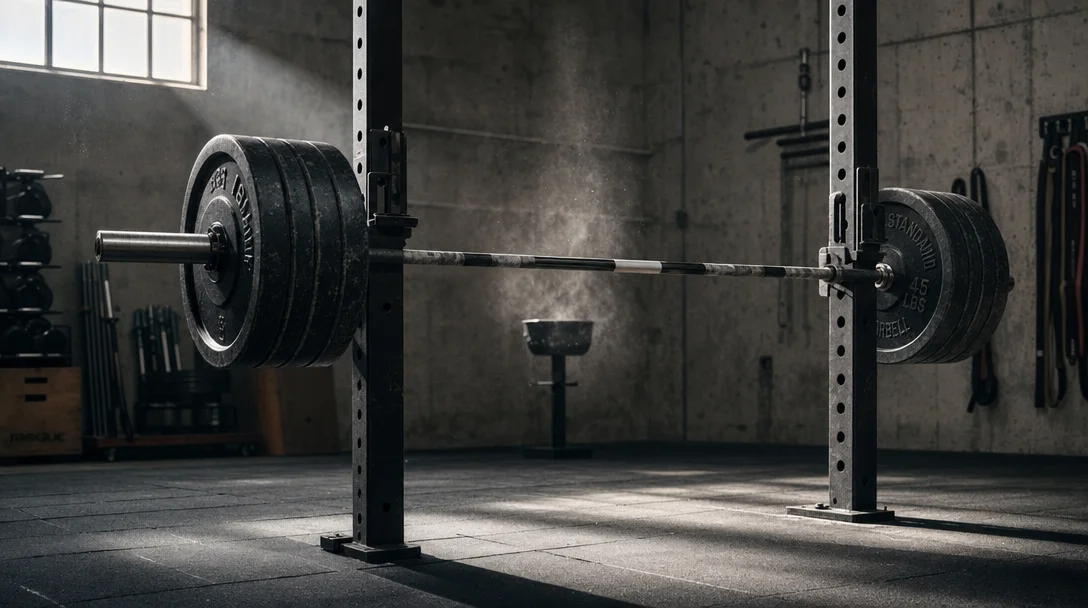
Wednesday Strength: StrongLifts 5x5 Workout B — Squat, Overhead Press, Deadlift
Your complete Wednesday Workout B for StrongLifts 5x5: barbell back squat (5×5), overhead press (5×5), and deadlift (1×5) — with a 10-minute warm-up ramp, key form cues from Alan Thrall and Mark Rippetoe, two video demo links per exercise, starting weights by level, and a full cool-down and scaling guide.
Today's discipline: Strength | Program: StrongLifts 5x5 | Session: Workout B
Total time: ~45 min | Equipment: Barbell, rack, plates (no bench needed today)
Workout B is where StrongLifts shifts gears. The squat stays — you squat every single session — but Monday's bench press and row are out. In their place: the overhead press to build pushing strength from the floor up, and the deadlift to finish with the heaviest pull of the week. One heavy set of five on the deadlift, that's it. Done right, it earns its place. 1
Today's session at a glance
| Exercise | Sets × Reps | Rest between sets |
|---|---|---|
| Barbell back squat | 5 × 5 | 3–5 min |
| Overhead press | 5 × 5 | 3–5 min |
| Deadlift | 1 × 5 | 3 min after last warm-up set |
Warm-up (10 min)
Cold muscles under a heavy barbell is an avoidable mistake. The warm-up ramp also reinforces the movement pattern before you reach work weight — treat it as technique work, not a formality.
Dynamic activation (3–4 min)
- Hip circles: 10 reps each direction
- Leg swings (front-to-back, then side-to-side): 10 each leg
- Shoulder circles and arm crosses: 10–15 reps
- Thoracic rotation in a deep squat hold: 5 each side
Warm-up ramp for each main lift:
Use progressive loading sets to arrive at your work weight without pre-fatiguing yourself. The StrongLifts method uses weight-increment jumps — add roughly 25–45 lb (10–20 kg) per set, 5 reps each, no rest between warm-up sets. 1
| Set | Load | Reps |
|---|---|---|
| 1 | Empty bar (45 lb) | 5 |
| 2 | +25–45 lb | 5 |
| 3 | +25–45 lb | 5 |
| 4 | Work weight | 5 × 5 work sets begin |
Deadlift warm-up note: Begin your deadlift ramp at 65–135 lb so the bar can rest on the floor between reps (not in your hands at thigh height). Same increment logic applies: jump 25–45 lb per set until you reach your top single. 1
Exercise 1 — Barbell back squat
Sets × Reps × Rest: 5 × 5 × 3–5 min
The squat opens every StrongLifts session. Mehdi (the program's founder) puts it first because it's the most technically demanding compound lift — your body is fresh, your focus is sharp, and the posterior chain (hamstrings, glutes, lower back) hasn't been taxed yet. 1
Key form cues:
- Bar position: low bar sits on your posterior deltoids (the shelf of muscle below the top of your shoulder blades), not on the neck
- Stance: heels shoulder-width apart, toes out roughly 30°; knees track in line with your toes throughout the rep 2
- Depth: hip crease drops below the top of your kneecap — that is the standard 2
- Bar path: straight vertical line over midfoot for the entire rep — if the bar drifts forward, you're losing the lift 2
- Ascent: drive your hips straight up — the bar follows. Don't let your chest drop and turn it into a good morning 3
- Back angle: whatever angle you establish at the bottom, hold it through the entire ascent. Any drastic shift at the sticking point is a technique breakdown 3
- Breathing: big breath into your abdomen before you unrack, hold through the descent and ascent, exhale only at the top
📹 Video demos:
- How To Squat: Low Bar — Alan Thrall — 18 min deep dive on low bar mechanics, bar path, hip drive, and depth cues (1.36M views)
- How To Squat - Any Style — Alan Thrall — 13 min covering balance, range of motion, and back angle as the three pillars of a solid squat (487K views)
Starting weights:
| Level | Starting weight | Progression |
|---|---|---|
| Beginner | Empty bar (45 lb / 20 kg) — the first few sessions are for grooving form | +5 lb per session |
| Intermediate | 95–135 lb — wherever 5×5 feels controlled across all five sets | +5 lb per session |
| Advanced | Pick up where your last successful 5×5 session left off | +5 lb per session until stall |
Exercise 2 — Overhead press (OHP)
Sets × Reps × Rest: 5 × 5 × 3–5 min
The overhead press replaces Monday's bench press in Workout B. After squatting fatigues your legs and lower back, the OHP shifts the load to an upper-body push — giving the lower body a partial break before the deadlift closes the session. 1
The OHP is the slowest-progressing lift in 5x5 — expect roughly 30 lb of monthly gain early on, compared to 60 lb for the squat. That's normal. The shoulder is a smaller joint working a shorter kinetic chain than the squat or deadlift. Don't load it past what your form can support. 1
Key form cues:
- Grip: bar sits on the heel of your palm, directly over your forearm bones — not deep in the fingers. This puts the load over the structure that can bear it 4
- Grip width: narrow — hands as close to your shoulders as your wrists allow 4
- Stance: feet wider than your squat stance, knees locked, abs tight 4
- Hip bounce: before each rep, bend slightly forward at the hips (not the lower back), then rebound off the tension in your hips to generate the initial drive — this is not a push press or a cheat, it's how the lift is done 4
- Bar path: keep the bar close to your nose and face as it travels up
- Finish: shrug at the top — actively engage your traps. This rotates the scapula and prevents shoulder impingement. The shrug is not optional 4
- Breathing: big breath before each rep, hold through the press, exhale at the top
📹 Video demos:
- How to Overhead Press With Mark Rippetoe — Art of Manliness — 12 min covering grip, hip bounce, bar path, and the finishing shrug (2.18M views)
- Learning to Press — Starting Strength — 5 min compact breakdown from the Starting Strength Method series (530K views)
Starting weights:
| Level | Starting weight | Progression |
|---|---|---|
| Beginner | Empty bar (45 lb / 20 kg) | +5 lb per session |
| Intermediate | 65–95 lb — start where your form is solid across all five sets | +5 lb per session |
| Advanced | Pick up from your last clean 5×5 | +5 lb per session until stall |
Exercise 3 — Deadlift
Sets × Reps × Rest: 1 × 5 (after warm-up ramp sets) | 3 min rest after last warm-up set
The deadlift is the only lift in Workout B done as a single heavy set — not 5×5 straight sets. You do progressive warm-up ramps to that one top set of five. That's 1×5 at your work weight, preceded by as many warm-up sets as you need to get there. 1
One set sounds easy. It isn't. The deadlift finishes the session because it's the heaviest posterior-chain pull, and your legs and back need everything from the squats before they're ready for max effort. 1
Key form cues — Alan Thrall's 5-step setup: 5
- Stand with shins 1–2 inches from the barbell. Don't move the bar. Don't shuffle it toward you.
- Bend at the waist and grip the bar just outside your legs. Do not lower your hips yet — keep them high.
- Bend your knees until your shins touch the bar. Let your knees come forward inside your arms. This sets your hip height correctly without squatting down to the bar.
- Pull the slack out. Feel your weight shift heavy into your hands, squeeze your chest out, brace your midsection hard. Take a big breath here.
- Drag the bar up your legs. Bar stays in contact with your shins and thighs the entire pull.
Additional cues from Mark Rippetoe: 6
- After shins touch the bar: squeeze your chest up, drop your belly down between your knees
- Think "push the floor away" rather than "pull the bar up" — same movement, better mental model
- Finish with your chest up and shoulders back. The deadlift does not end with a shrug (unlike the OHP)
- Lowering: hips move back first, bar slides down your thighs, knees bend only after the bar passes them
Grip options when double overhand fails:
- Mixed grip (one hand pronated, one supinated)
- Hook grip (thumbs wrapped under the bar, fingers over — both hands pronated)
- Lifting straps (fine unless you're competing in powerlifting where straps aren't allowed)
📹 Video demos:
- How To Deadlift: 5 Step Deadlift | 2022 — Alan Thrall — 14 min covering the 5-step setup, common errors, and why the deadlift isn't dangerous (649K views)
- Mark Rippetoe Teaches John Lovell the Deadlift — Starting Strength — 3.5 min compact coaching session covering stance, grip, and the finish position (289K views)
Starting weights:
| Level | Starting weight | Progression |
|---|---|---|
| Beginner | 95 lb / 40 kg (45 lb bar + 25 lb plate each side) | +10 lb per session for first few weeks, then +5 lb |
| Intermediate | 135–185 lb — start where you can complete 5 reps with controlled form | +10 lb per session early, drop to +5 lb when that pace feels forced |
| Advanced | Continue from last successful session | +5 lb per session until stall |
Progression rules
Linear progression is the whole engine of StrongLifts 5x5: 1
- Complete all reps — 5×5 for squat and OHP, 1×5 for deadlift — → add 5 lb next session (2.5 lb plates each side)
- Miss reps on the same weight three sessions in a row → deload 10% and rebuild
- Deadlift progression: +10 lb per session for the first few weeks (the deadlift works larger muscles and can handle bigger jumps early); drop to +5 lb once that pace feels like a grind 1
- Starting light is not a waste of time. The early weeks teach the motor pattern. The sticking points come later, and a clean foundation makes them easier to break through
Cool-down (5–8 min)
After the deadlift top set:
- Walk or march in place for 2–3 min to let your heart rate drop
- Hip flexor stretch (kneeling lunge, tall torso): 45 sec each side
- Pigeon stretch or figure-four glute stretch: 45 sec each side
- Hamstring stretch (seated toe reach or standing with slight forward hinge): 30 sec each side
- Thoracic extension over a foam roller or bench edge: 1–2 min
- Child's pose: 1 min to decompress the lower back after the deadlift
Scaling guide
Beginner (first 4–6 weeks)
- Start all three lifts at the prescribed beginner weights — empty bar for squat and OHP, 95 lb for deadlift
- The first weeks feel easy. That's correct. The load will catch up fast
- Rest the full 3–5 minutes between squat and OHP sets. Don't rush rest periods
- If the OHP empty bar feels unsteady overhead, use a lighter training bar (35 lb) if your gym has one, or reduce to a single work set until the pattern is solid
Intermediate (3–6+ months of lifting experience)
- Choose your starting weight based on the last session where you completed all reps cleanly
- The deadlift often feels strongest — you may be able to jump to 135–185 lb immediately. That's fine, as long as form holds across all 5 reps
- Take 5 minutes between your last squat set and your first OHP warm-up set — your upper back is already loaded from squats, and a rushed transition increases OHP error rate
No gym / limited equipment alternatives
- Squat: goblet squat (heaviest dumbbell available) or Bulgarian split squat (rear foot elevated, front foot stepped out)
- Overhead press: seated dumbbell press or standing dumbbell press — same grip, stance, and shrug principles apply
- Deadlift: single-leg Romanian deadlift with dumbbells, or trap bar deadlift if available
Equipment checklist
- Barbell (45 lb standard Olympic bar)
- Weight plates (10 lb, 5 lb, and 2.5 lb increments)
- Squat rack / power rack
- Collars (mandatory on deadlift — plates sliding off mid-pull is a serious hazard)
- Chalk or lifting straps (optional; helps grip on deadlift as weight increases)
- Flat-soled shoes or lifting shoes — avoid thick-heeled running shoes for squats and deadlifts
Workout A preview (Friday)
Friday brings Workout A: Squat / Bench Press / Barbell Row — the same structure you ran Monday. The squat will be 5 lb heavier than Monday. So will the bench press and the row. That's the program. Show up, add the weight, execute. 1
围绕这条内容继续补充观点或上下文。