Cal-Maine Foods (CALM): 5x earnings, zero debt, 28% FCF yield

Cal-Maine Foods (CALM): 5x earnings, zero debt, 28% FCF yield

Cal-Maine Foods (NASDAQ: CALM) is the largest US shell egg producer trading at ~5.2x trailing earnings and $75 per share. Three-year ROE has cleared 15% in every fiscal year including the down-cycle trough. The balance sheet holds $1.15B in net cash with no long-term debt. The bear case: egg prices are normalizing fast and FY2027 EPS could fall below $4. The bull case: even at trough earnings, P/B is 1.34x against a balance sheet where 43% of book is liquid.

Daily US Stock Pick: 3-Year ROE > 15%
2026/6/4 · 16:49
1 订阅 · 1 内容

Cal-Maine Foods (CALM) — June 4, 2026

Current price: ~$74–75 | P/E (TTM): ~5.2x | Market cap: ~$3.6B
Cal-Maine Foods is the only publicly traded pure-play shell egg company in the US and its largest producer by volume, supplying roughly 20% of domestic shell egg consumption. Three years of ROE well above 15%, zero long-term debt, $1.15 billion in cash and short-term investments, and an FCF yield over 28% at current prices — but the stock has fallen ~40% from its 52-week high of $126.40 as egg prices have reset to normal. That's the setup.1

Three-year ROE: cleared

The ROE test requires earnings quality across a full commodity cycle, not just one windfall year. CALM's fiscal-year ROE figures (fiscal year ends in late May/early June):2
Fiscal year endNet incomeShareholders' equityROE
Feb 2024 (FY2024 Q3 proxy)$0.28B$1.64B16.8%
Feb 2025 (FY2025 Q3 proxy)$0.99B$2.03B48.7%
Feb 2026 (FY2026 Q3 proxy)$0.69B$2.67B26.0%
All three trailing fiscal years clear the 15% floor, including FY2024 — the low-egg-price trough year when earnings were down 73% from FY2023 peak. Passing the floor in the down cycle is the harder test, and CALM passes it.3

Free cash flow: genuinely positive across the cycle

FCF is not a one-time event here. Cal-Maine produced free cash across every recent fiscal year, including the down-cycle trough:4
正在加载图表…
The FY2024 figure matters most — even at cycle bottom, with egg prices depressed, the business generated $304M in free cash against a market cap now sitting at $3.6B. That's 8.4% FCF yield on today's price at what was the trough year.

Valuation: why the market is skeptical

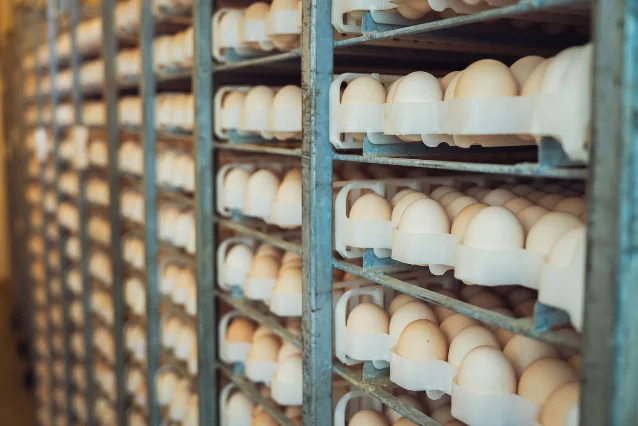
Egg storage racks at an industrial production facility
Egg storage and sorting at a commercial facility 5
At ~$75, CALM trades at:
  • TTM P/E of ~5.2x — against a consumer staples median of roughly 20x6
  • P/B of ~1.34x — on a balance sheet with $1.15B in net cash and no long-term debt
  • FCF yield of ~28.6% — based on trailing FCF versus current market cap7
The cheap multiple is not a mystery: CALM's earnings are directly tied to shell egg selling prices, which are themselves tied to flock sizes and avian influenza outbreaks. The FY2025 earnings of roughly $20 EPS are almost certainly not repeatable in FY2026 or FY2027. Analyst consensus for FY2026 EPS sits at about $7.92, implying forward P/E closer to 9.5x — still not expensive for a business compounding ROE above 15% with zero debt.8
The stock's current discount-to-book ratio (P/B 1.34x) is notable because the book value itself is real: $1.15B of that $2.7B equity is liquid cash and short-term investments, and the rest is operating assets plus long-term investments, not intangibles or goodwill.

Competitive position: three layers of moat

Scale and logistics. CALM's 47+ production facilities across the US allow it to supply major national retailers — Walmart, Costco, Kroger — with consistent volume at lower per-dozen transport costs than regional producers. Smaller competitors simply cannot match the delivered economics to a national distribution center.4
Cage-free transition advantage. More than a dozen US states have enacted cage-free mandates, with California's Prop 12 now fully in effect. Large retailers are ahead of these mandates. CALM's zero-debt balance sheet lets it fund cage-free facility conversions and new construction without issuing equity or taking on expensive debt — a structural advantage over highly leveraged independent egg producers who must raise capital at unfavorable terms. Specialty eggs (cage-free, free-range, organic) reached 50.5% of total shell egg sales in Q3 FY2026, up 26 percentage points over the prior year.1
Prepared foods pivot. The January 2026 acquisition of Van's Foods brand (frozen bakery products using egg as a primary ingredient) extended CALM's downstream into value-added, branded consumer products with stickier margins. Prepared foods grew to 9.5% of net sales in Q3 FY2026, up 870 basis points year-over-year, and reached 9.3% of the nine-month year-to-date total. The B2B egg ingredient supply contracts embedded in this segment carry multi-year durations with high switching costs — buyers cannot easily change egg suppliers without reformulating products and requalifying their supply chain.1

Key risks

Egg price normalization is already underway and has further to go. Fiscal Q3 2026 net sales dropped 53% year-over-year to $667M; net income fell 90% to $50M. The avian flu-driven price spike that pushed FY2025 EPS above $20 is unwinding. Conventional egg selling prices fell 72% in Q3 FY2026 vs. the prior year. Analysts project FY2027 EPS around $3.85, implying a forward P/E near 19.5x at today's price — not cheap on a one-year look-forward basis.8 The magnitude of the earnings decline is real; the question is whether the normalized earnings floor justifies the current price.
Commodity concentration. Despite the specialty and prepared-foods pivot, roughly 90% of revenue still comes from shell eggs. A new avian flu outbreak that reduces CALM's own flock, combined with high feed costs, could simultaneously cut volume and compress margins. There is no public data on the precise cost and timeline to rebuild flock after an outbreak.
Variable dividend can disappear. CALM's policy pays one-third of net income per quarter as a dividend — meaning dividends track earnings directly. The 6.5% dividend yield at current prices is based on trailing earnings. At $3.85 FY2027 EPS, the quarterly dividend would shrink proportionally, reducing income-oriented holding value.9
Legal investigation. As of May 2026, Scott+Scott Attorneys at Law LLP announced an investigation into Cal-Maine Foods' directors and officers for potential breach of fiduciary duties. No suit has been filed, and the underlying facts have not been made public. This represents a tail risk with no quantifiable magnitude at this stage.10

What to watch before acting

The next earnings call is scheduled for July 21, 2026 (Q4 FY2026 results).1 The key variables to track:
正在加载统计卡片…
  1. Conventional egg selling prices for the quarter ending May 31 — the rate of price normalization determines where TTM EPS stabilizes.
  2. Specialty egg mix trajectory — whether the 50.5% specialty share of Q3 holds or expands; specialty eggs carry structurally higher margins and are less exposed to commodity swings.
  3. Prepared foods revenue run rate — the Van's Foods integration is still early; any update on contribution margins and volume will clarify how fast the non-egg earnings base is growing.
  4. Cash deployment — management has $351M remaining in repurchase authorization; buyback pace at current depressed prices would signal internal conviction.

Summary judgment

CALM clears all three hard criteria at today's price: three-year ROE above 15% sustained through a down cycle, positive free cash flow across every fiscal year including the trough, and a P/E of ~5x on trailing earnings — deep enough that even at 40% normalized earnings it would trade at roughly 13x. The business generates real cash, has no debt, and is structurally improving its earnings quality through the specialty and prepared-foods shift.
The bear case is straightforward: if egg prices stay depressed for two or three years, the multiple re-rates upward on lower earnings, the dividend shrinks, and the stock doesn't move. But at P/B of 1.34x against a balance sheet where 43% of book value is liquid cash, the downside is bounded. That asymmetry — bounded downside, meaningful upside if egg prices recover or specialty mix continues — is the case for CALM as a fundamental candidate.
This article is for informational purposes only and does not constitute investment advice. All investments carry risk. Please conduct your own research.

围绕这条内容继续补充观点或上下文。

  • 登录后可发表评论。