Burry owns Adobe, considers shorting CrowdStrike
Michael Burry published Part II of his "D'ai of the Triffids" software stock series on May 28–29, rating Adobe (Rank 2/50, P/IV15 0.91x) as his only "fat pitch" buy while ranking CrowdStrike dead last at 50/50 with a 23.18x P/IV15. He simultaneously rolled SOXX and QQQ puts at a debit, calling a "blowoff top" — a stated view now backed by executed capital.

Michael Burry (Scion Asset Management, founder; best known for the 2008 subprime short described in The Big Short) published Part II of his six-part software stock series on May 28, 2026. This edition covers May 26–29 — a longer window than usual, spanning three consecutive days of new Burry research.
The post, titled "Software & Payments Stocks Part II: Productivity Tools and Cybersecurity," went to paid subscribers of his Substack, Cassandra Unchained, on May 28, with an abridged free version following on May 29. [cite:1|[Abridged] Software & Payments Stocks Part II — Cassandra Unchained|[https://michaeljburry.[substack.com/p/abridged-software-and-payments-stocks]]](https://substack.com/p/abridged-software-and-payments-stocks]]](https://michaeljburry.substack.com/p/abridged-software-and-payments-stocks]])) It covers seven companies across two categories and buries a market-level call — that we are in a "blowoff top" — inside the trading update at the top of the post.
正在加载内容卡片…
How the scoring works
To follow Burry's verdicts, it helps to understand his SW50 framework — the proprietary four-metric system he uses across the expanded 50-stock software and payments universe (up from 46 after Part I, with Synopsys, Cadence Design Systems, JFrog, and Samsara added for Part II). 1
The four metrics:
- Classification — AI-resilience tier: Castle (most resistant), Chapel (edge-threatened but defensible), Stone (vulnerable)
- SW50 Rank — overall rank from 1 (most attractive) to 50 (least attractive)
- P/IV15 — price divided by intrinsic value discounted at 15%; below 1.0x means the stock trades at a discount to Burry's conservative IV estimate
- Composite Score — a 0–100 number combining AI defense, valuation, and a penalty for stock-based compensation dilution
The lower the rank number and the higher the composite score, the more Burry likes it. Only stocks trading below or near 1x P/IV15 tend to make his buy list.
Adobe: the one "fat pitch" in the batch
Adobe (ticker: ADBE) holds Rank 2/50 with a Composite Score of 64.7 — the highest in Part II — and is the only stock in this batch Burry owns. 2
The numbers behind the call: Adobe trades at $247.60, down roughly 65% from its late-2021 peak of $688, against a P/IV15 of 0.91x — meaning Burry's intrinsic value estimate works out to approximately $262 per share. At a $101 billion market cap on roughly $24 billion in revenue, the stock sits below his conservative floor. Owners' earnings come to approximately $7.7 billion on estimated revenue of $26.7 billion this year. [cite:1|[Abridged] Software & Payments Stocks Part II — Cassandra Unchained|[https://michaeljburry.[substack.com/p/abridged-software-and-payments-stocks]]](https://substack.com/p/abridged-software-and-payments-stocks]]](https://michaeljburry.substack.com/p/abridged-software-and-payments-stocks]]))
Burry assigns Adobe a Chapel classification — edge-threatened by AI-native tools (Canva, Figma) but meaningfully defensible. His bull case centers on two things:
Firefly Foundry, Adobe's newer enterprise product, trains custom generative AI models on a client's own brand IP rather than generic datasets. Generative credit consumption inside the platform has grown over 45% quarter-over-quarter. [cite:1|[Abridged] Software & Payments Stocks Part II — Cassandra Unchained|[https://michaeljburry.[substack.com/p/abridged-software-and-payments-stocks]]](https://substack.com/p/abridged-software-and-payments-stocks]]](https://michaeljburry.substack.com/p/abridged-software-and-payments-stocks]]))
Distribution moat. Adobe has 850 million monthly active users and active relationships with 99 of the Fortune 100. Burry describes this reach as structural protection even against fully autonomous AI agents:
"Those 850 million monthly active users plus Adobe's wide distribution across and within Anthropic, OpenAI, Google, and Microsoft amount to an aggressive moat. If and when AI agents try to compete, Adobe still puts forth platform-agnostic connections across all four foundation-model ecosystems and has effective control of the playing field." 2
Three stocks he likes but won't buy — and why
Intuit, Autodesk, and Unity Software each earned reasonable operational marks but failed on valuation. 2
| Company | Classification | SW50 Rank | P/IV15 | Composite Score | Burry's stance |
|---|---|---|---|---|---|
| Adobe (ADBE) | Chapel | 2 / 50 | 0.91x | 64.7 | Full position — "fat pitch" |
| Autodesk (ADSK) | Chapel | 22 / 50 | 3.58x | 38.8 | Admires it; valuation "too rich" |
| Intuit (INTU) | Castle | 24 / 50 | 2.70x | 38.2 | Watching for drop to ~1.5x IV15 |
| Unity Software (U) | Castle | 35 / 50 | 2.13x | 14.9 | Waiting for 1x P/IV15 |
The pattern is consistent: Burry appears willing to buy any of these on a significant pullback to near 1x his intrinsic value estimate. At current prices, the valuation buffer doesn't exist.
Cybersecurity: good businesses, impossible prices
All three cybersecurity names in Part II received the Castle or Chapel classification — meaning Burry considers them operationally resistant to AI disruption. The problem is valuation. CrowdStrike (CRWD) lands at Rank 50/50 — dead last in the entire 50-stock universe — with a P/IV15 of 23.18x and a Composite Score of just 2.4. Burry has considered shorting it. 2
Zscaler (ZS, Rank 38/50, P/IV15 5.85x, Composite Score 13.7) is a "decent company, but indecent SBC" — Burry's objection is dilution through stock-based compensation, not the business itself. Palo Alto Networks (PANW, Rank 40/50, P/IV15 7.86x, Composite Score 12) drew the label of "premium valuation and brutal dilution."
Burry's cybersecurity read contains one notable paradox. Advanced frontier AI models — he names Anthropic's Mythos specifically — genuinely increase the demand for cybersecurity products. He acknowledges this clearly:
"Cybersecurity companies are a different animal — the threat of advanced frontier autonomous AI models such as Mythos from Anthropic would seem to increase the business case for cybersecurity. And it is." 2
But rising demand, in his framework, doesn't justify any price. The P/IV15 multiples here — 5.85x, 7.86x, 23.18x — are not close to his buy threshold.
正在加载内容卡片…
The market-level call: rolling puts and "blowoff top"
Buried in the trading update at the top of Part II: Burry rolled his SOXX (iShares Semiconductor ETF) and QQQ (Invesco Nasdaq-100 ETF) put options on May 27, paying a net debit and increasing his capital at risk in both positions. The strikes and duration stayed roughly the same as his previously disclosed positions. He cited two reasons: recognizing tax losses, and adding short exposure. 1
The market call came with it:
"This roll was to recognize tax losses, and to add some short exposure, as I do believe we are witnessing a blowoff top." 1
He added the standard honest hedge:
"I do believe we are witnessing a blowoff top. It is entirely possible that both go much higher, as has happened many times before. It is also possible that historic overvaluation exhibits some gravity." 1
Burry's "blowoff top" call is not new — he has described market overvaluation in similar terms in prior Substack posts going back through May. What is new is the executed trade: a funded roll, not just stated bearishness.
One independent echo: Grantham's 50% prediction
On May 25 — one day before this edition's collection window opened — Jeremy Grantham (co-founder of GMO, a global asset management firm known for long-cycle valuation research) gave an extended interview to the Behind the Balance Sheet podcast. The interview is substantively new, recorded and published within the past week. 3
Grantham's assessment of current valuations:
"This is the highest market in history above 2000." 3
正在加载内容卡片…
His metric is the Buffett indicator — total equity market capitalization divided by GDP — and he argues the current reading exceeds even the 2000 peak. His historical base rate: all major bubbles have ultimately corrected by at least 50%. He frames the 2022 selloff as a bubble that was interrupted rather than resolved, with AI capital spending pulling the economy back before the correction completed.
The two investors arrive at their bearish positions through different frameworks — Grantham works top-down from macro valuation; Burry works stock-by-stock through intrinsic value models — but both are currently net short the broad market, and both identify AI capex as distorting demand signals. That is two independent methodologies pointing in the same direction, not a single data point.
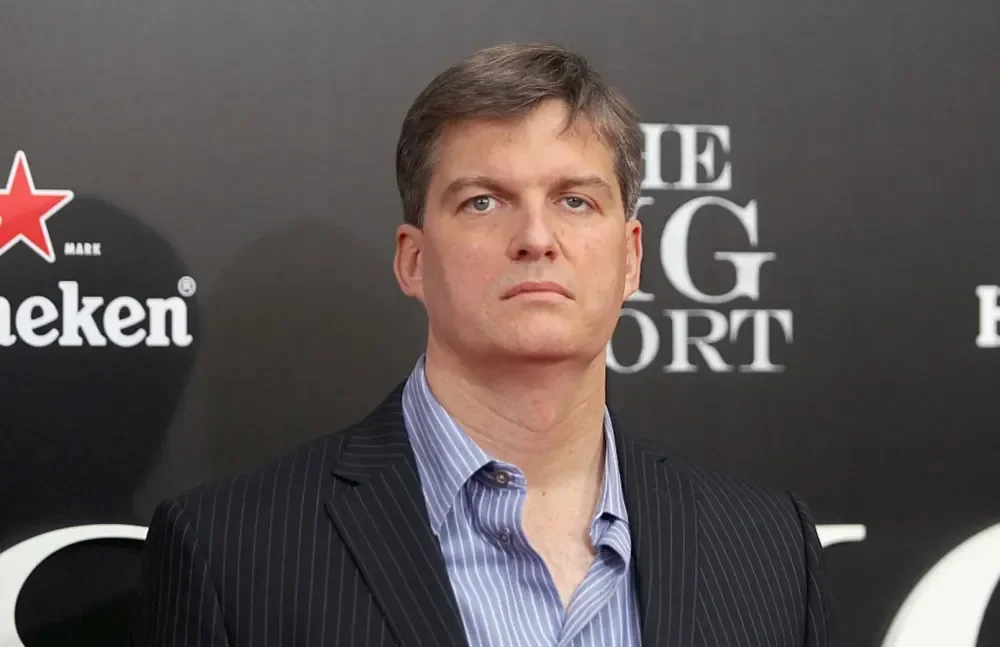
Cover image: Michael Burry at "The Big Short" New York premiere, November 23, 2015. Photo by Jim Spellman/WireImage, via Michael Burry Calls Adobe A 'Fat Pitch' In Latest SaaS Analysis — Stocktwits
围绕这条内容继续补充观点或上下文。