
Seneca Was Almost a Saint

Seneca Was Almost a Saint

A 1381 paper codex copied by physician-scribe Giovanni da Reggio in Modena — Vatican Ott.lat.2090 — has been digitized as part of the library's Week 20 batch and is now freely viewable on DigiVatLib. It bundles five texts tracing medieval Europe's sustained effort to claim the pagan Stoic philosopher Seneca as an honorary Christian: Jerome's Vita Senecae, the forged Seneca–Paul correspondence, and all 124 of the Epistulae ad Lucilium.

A physician sits in Modena in the summer of 1381. He is copying letters — not medical notes but philosophy, 124 letters written thirteen centuries earlier by a Roman who tutored an emperor and was then ordered by that emperor to die. The physician's name is Giovanni da Reggio. He dates his work to July 19, signs his name in the margin of folio 81, and moves on to the next gathering of paper.
That manuscript — shelfmark Ott.lat.2090, held at the Biblioteca Apostolica Vaticana — was digitized during Vatican Week 20 (May 11–17, 2026) and is now freely viewable on DigiVatLib. 1

The physician who copied it

Giovanni da Reggio (c. 1350–1426) was a Modenese doctor, and nothing about his profession seems to have cramped his reading habits. 2 He wrote in a hand that shows practical training — a cursive style with chancery-office features — rather than the carefully upright script of a monastic scriptorium. Luciano Gargan, who studied Giovanni alongside fellow Modenese book enthusiast Iacopo Camangerini, placed both men at the center of a 14th-to-15th-century culture of private book-making and book-collecting in northern Italy's urban professional class. 1
His colophon on f.81 reads, in the scribe's own hand: "1381° Mutine per me Iohannem de Regio" — with "19° Iulii" added in the margin in the same ink. 2 The casual marginal date feels like a man noting an appointment, not performing a ritual. A companion hand added folios 84–87, contributing a Petrarch letter, a passage from Josephus, and a hymn to all saints — the kind of miscellany that accumulates when a manuscript stays in one household for a while.

Five texts in 90 folios

The codex is a textual bundle, and the bundle is itself the argument. Open it and you pass through five distinct layers:
  • ff. 1v–3 — a rubric index listing all 124 Epistles, addressed to "Seneca the cultivator of habits and farmer of the mind"
  • f. 3v — Jerome's Vita Senecae, drawn from his De Viris Illustribus (392–393 AD), titled here "Jerome on Seneca in the catalogue of saints" (cathalogo sanctorum) 3
  • ff. 3v–4 — the pseudo-Pauline correspondence: 14 letters exchanged between Seneca and the Apostle Paul, labelled Epistule beati Pauli ad Senecam et e conuerso ("the blessed Paul's letters to Seneca and vice versa")
  • ff. 5–83v — all 124 of Seneca's Epistulae ad Lucilium, in a merged text from two manuscript traditions that L.D. Reynolds (author of The Medieval Tradition of Seneca's Letters, 1965) identified as separately preserved in the 9th century before converging in the 12th 4
  • ff. 84–87 — Petrarch's Epistula Familiaris XII.2, a Josephus excerpt (the Testimonium Flavianum), and a 176-line hymn
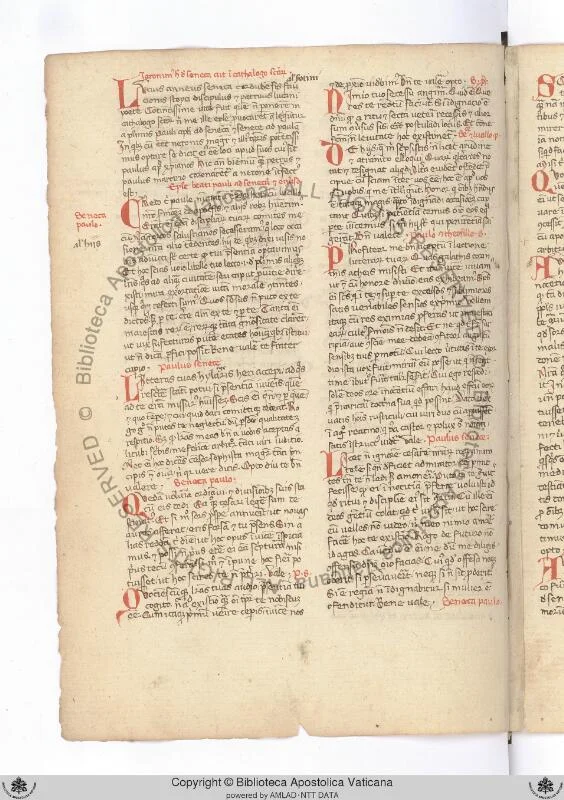
Folio 3v of Ott.lat.2090 — Jerome's Vita Senecae incipit page
Folio 3v — the incipit of Jerome's Vita Senecae, headed "Ieronimus hec de Seneca ait in cathalogo sanctorum." Double-column Latin in Giovanni's chancery cursive, with red rubrication. 2

Why Seneca needed a defender

The texts in this codex form a dossier assembled over a thousand years to answer one persistent problem: Lucius Annaeus Seneca (c. 4 BC–65 AD) was the most widely read moral philosopher of medieval Europe, but he was also a pagan, an advisor to Nero, and a man who died not as a martyr but because his emperor told him to.
Jerome's solution in De Viris Illustribus was blunt: list Seneca among Christian authors anyway, citing his friendship with Paul as justification. 3 The early church leader Tertullian went further — he called him "our Seneca." 4 The forged correspondence did the rest: 14 letters in which Paul corrects Seneca's Latin style and Seneca expresses admiration for the new faith. About 400 manuscripts of this forgery survive, suggesting it was one of the medieval period's more successful works of literary fraud. Lorenzo Valla and Erasmus eventually pulled it apart in the 15th and 16th centuries, but by then the "Christian Seneca" tradition had already shaped how the Epistulae were read, copied, and bound — nearly always, as here, alongside the texts that licensed their transmission.

A working copy on paper

The physical manuscript is spare in a way that tells you something about Giovanni's priorities. The support is paper, not parchment — unusual for a classical text in 1381, though not unheard of among Italian urban professionals who needed books but weren't wealthy patrons. The watermarks (Briquet 3313, 3218, and 8928) place the paper in Italy between 1353 and 1392, confirming the date and origin independently of the colophon. 2
The layout is double-column, 296 × 207 mm, roughly 38 lines per column. There are red rubrics and rubricated initials throughout, but no gold, no miniatures, no figurative decoration. This is a reading copy, not a showpiece. Where Epistles 75 and 88 were accidentally displaced during copying, Giovanni left marginal notes to redirect the reader: "hic deficit epistula LXXVa" — "here the 75th letter is missing, see the end."
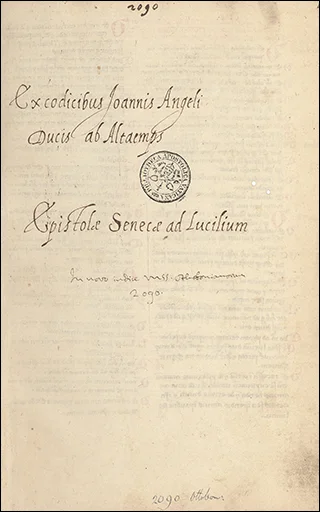
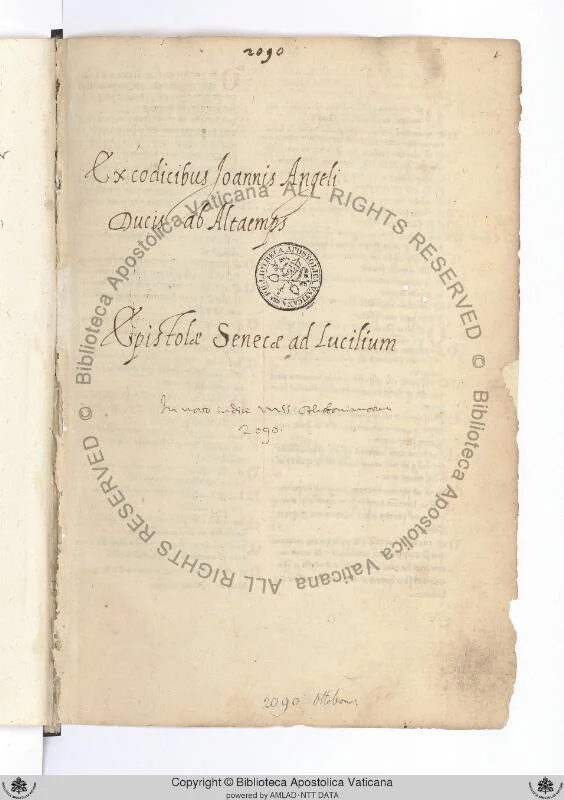
Folio 1r of Ott.lat.2090 — the title page with rubric and ex-libris
Folio 1r — the rubric title page, with the ex-libris of Giovanni Angelo Altemps, the manuscript's earliest confirmed owner. The circular Vatican Library stamp is also visible. 2
Folio 89v of Ott.lat.2090 — near the end of the main text block
Folio 89v — double-column Latin cursive near the manuscript's end, showing Giovanni's consistent hand and the density of the text. 5

From Modena to Rome, via a cardinal

The manuscript's first confirmed owner is Giovanni Angelo Altemps (the Duke of Gallese, active 1587–1620), whose ex-libris appears on folio 1. 2 It then passed into the collection of Cardinal Pietro Ottoboni (1667–1740), the Cardinal Nephew of Pope Alexander VIII — a man whose library eventually ran to thousands of manuscripts. In 1748, Pope Benedict XIV purchased the entire Ottoboni library from Pietro's heirs, and Ott.lat.2090 became part of the Fondo Ottoboniani Latini, where it has remained since. 6 7
The 196 digitized canvases — covers, flyleaves, all 90 folios, spine, edges, color chart, and millimeter scale — are available at full resolution through the Vatican's viewer or any IIIF-compatible application. 5

Explore the manuscript

The full digitized codex is freely accessible on DigiVatLib, with no registration required.
正在加载链接预览…
1
Cover image: manuscript binding of Ott.lat.2090 from DigiVatLib — Biblioteca Apostolica Vaticana

围绕这条内容继续补充观点或上下文。

  • 登录后可发表评论。