
Two Shutdowns This Week: A $19M Token Play and the Music Platform Everyone Loved but Wouldn't Pay For
This week: Moonveil Studio (~$19.4M raised, GameFi burn rate + mistimed market) and Nina Protocol (40,000 MAU, revenue model mismatch). Two web3 shutdowns — two replicable lessons on unit economics vs. proxy signals.
This week turned up two qualifying shutdown announcements — a lean count, but both cases are worth the full breakdown. Moonveil Studio, a web3 gaming studio that raised at least $19.4M from more than 15 investors over four years, announced its wind-down on May 26. Nina Protocol, an independent music distribution platform built on Solana, followed two days later on May 28, revealing it had found no path to sustainable revenue after five years. 1 2
The two companies ran different plays and failed for different reasons. Moonveil had capital, investors, and a playable product — but its economics were built on a token that had to keep appreciating to justify everything else. Nina had genuine community love, respected label partners, and a principled approach — but the audience that cared about the mission wouldn't generate enough revenue at the scale the platform had reached. Both are web3-adjacent, which marks the third consecutive week this channel has seen crypto-sector concentration in the failure pool. No non-crypto shutdowns cleared the threshold across exhaustive coverage of SaaS, healthtech, fintech, and enterprise sectors.
| Company | Founded | Vertical | Total raised | Root cause | Shutdown type |
|---|---|---|---|---|---|
| Moonveil Studio | 2022 (Q4) | Web3 gaming + GameFi | ~$19.4M | Burn rate + mistimed market | Full wind-down; operations ending |
| Nina Protocol | 2021 | Web3 music distribution | Undisclosed seed | Product-market mismatch (revenue model) | Phased shutdown; offline July 15 |
Moonveil Studio: $19M, a Riot Games pedigree, and a token that lost 99.97% of its value
The company
Moonveil Entertainment was registered in the Cayman Islands in Q4 2022, founded by M.J. Wang — a 7-year veteran of Riot Games who ran the League of Legends rollout across Greater China — alongside a team drawn from Riot, Tencent, NetEase, and Funplus. The founding narrative was credible: deep AAA gaming experience, crypto infrastructure expertise, a studio capable of building multiple titles simultaneously. 3
Fundraising followed that narrative. Moonveil raised a $3M pre-seed at a $25M valuation, 4 a $5.4M seed round in October 2023 led by Gumi Cryptos Capital and Arcane Group, 5 a $9M Pre-Series A in August 2024 with Spartan Group, HashKey Capital, Animoca Ventures, and Hivemind, 3 and a $2M investment from Polygon Labs in October 2024. 6 A reported $5M strategic investment from Unicorn Verse in August 2025 would bring the total to at least $19.4M across 15+ investors. 4
Over four years, the studio shipped four products: AstrArk (a tower-defense mobile game that reached 200,000+ active wallets and 48,000+ PvP matches during public beta), Bushwhack (a stealth battle royale built in Unreal Engine 5), a Mini Games Hub, and a third-party publishing initiative called Moonveil Punch. The team also built a ZK Layer 2 chain based on Polygon CDK and sold 50,000 nodes in October 2024 to fund the ecosystem. 1 Polygon Labs CEO Marc Boiron said at the time: "By supporting Moonveil nodes, we are reinforcing our commitment to advancing the next era of gaming through zk-powered technology and seamless interoperability." 6
What happened
The official shutdown announcement posted to Moonveil's X account at 04:41 UTC on May 26 stated: "Today, after a great deal of consideration, we are announcing the decision to wind down Moonveil and gradually discontinue project operations over the coming weeks." 7 The statement attributed the closure to two years of dramatic change in the GameFi sector and the broader gaming industry, with market attention and capital "continuously withdrawing from gaming."
The shutdown landed after a sequence of compounding events that had been unwinding for seven months. In October 2025, Gate.io abruptly delisted MORE perpetual contracts, triggering forced liquidations that caused the $MORE token price to collapse. Bitget followed by delisting the MORE/USDT spot pair. 7 Then on December 19, 2025, Moonveil disclosed that the private key to a deployment wallet had been compromised — an attacker extracted 56.48 million $MORE tokens. Of those: 14.9 million were sold on decentralized exchanges before the team could respond; 7.39 million were frozen by MEXC; and 34.18 million were accidentally returned by the attacker but are permanently locked in a non-withdrawable ERC20 contract address. The team's own statement described the outcome: "This contract is non-withdrawable, meaning these tokens are permanently frozen and removed from circulation in the future." 7
正在加载内容卡片…
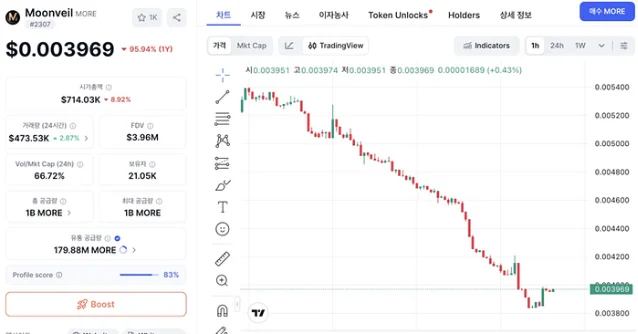
By the time of the shutdown announcement, $MORE was trading at approximately $0.003969 — a decline of roughly 99.97% from its peak value. 8 The shutdown announcement did not describe what would happen to $MORE holders or node operators.
Root cause: burn rate driven by a token economy with no floor
Moonveil's failure follows a recognizable arc in GameFi. The studio raised capital, built games, launched a token, sold nodes — and structured everything so that the ecosystem's value depended on $MORE continuing to appreciate. When token price collapsed, the economic rationale for nodes, the rationale for player acquisition spending, and the rationale for continued development all collapsed with it.
The $MORE token had a total supply of 1 billion tokens, with 20% allocated to node operators (25% unlocking at TGE, then linear release over 36 months). The tokenomics created a selling pressure problem from day one: node operators had near-term financial incentives to liquidate, while player demand for the token was supposed to organically absorb that supply. That demand never materialized at scale. The gaming products were functional but not compelling enough to create the self-sustaining economic loop that GameFi models require — where players earn tokens because the game is genuinely fun, and other players want those tokens because they need them to keep playing. 8
The December 2025 private key breach accelerated the collapse but did not cause it. Token confidence had already evaporated by October 2025 when exchanges began delisting — nine months before shutdown. The security incident drained additional supply into the market at the worst possible moment.
Root cause: Burn rate + mistimed market. Moonveil built a capital-intensive studio and infrastructure business whose economics were structurally dependent on a token that needed sustained, organic player demand to hold value. The GameFi sector's contraction made that demand impossible to grow into. The result was a company spending cash to build products for an ecosystem whose core financial instrument was in terminal decline.
Replicable lesson for founders: If your product uses a token to fund operations or incentivize user acquisition, model the failure case where token price falls 90% — not as an edge case, but as the default stress test. At that token price, what is the non-token revenue keeping the company alive? If the answer is "nothing meaningful," the business model is a bet that the token never collapses. That bet rarely pays.
Nina Protocol: 40,000 monthly users, Warp Records on the roster, and no one knew how to pay for it
The company
Nina Protocol was founded in New York in 2021 by Jack Callahan, Mike Pollard, and Eric Farber. Callahan and Pollard came out of the independent tape and vinyl underground — Pollard had founded the label Arbor, which released early work by James Ferraro and Oneohtrix Point Never. The founding impulse was archival rather than commercial: they wanted to use Solana's blockchain and Arweave's permanent storage to create a distribution infrastructure that wouldn't rot. As Callahan later explained: "What if we use this technology to actually preserve music — to make sure it doesn't just disappear one day like all those lost MySpace archives?" 9
The platform allowed artists to release music directly to listeners with 100% of sales revenue going to the artist. No platform cut. Nina's revenue would come from small transaction fees, not commission. The company completed a seed round on October 12, 2022, led by Greenfield Capital, with CMT Capital, Palm Tree Crypto, and Noise DAO participating. 10 The total amount raised has not been publicly disclosed in any source. 11
By 2025, the platform had attracted serious institutional credibility in the music world. Labels including Warp Records, Hyperdub, AD 93, Stroom, Numero Group, and Peak Oil had all published on Nina. Artists including ML Buch, Yung Lean, Purelink, James K, Surgeon, and dBridge had used the platform. 12 In May 2025, Nina signed a Merlin Connect partnership with Merlin — the independent music rights agency — gaining formal licensing support and what Merlin CEO Jeremy Sirota called validation of Nina's "artist empowerment, transparent monetization, and platform independence." 13
By October 2025, Nina self-reported approximately 40,000 monthly active users and 20,000 releases on the platform. 9 Co-founder Eric Farber described the financial target with unusual modesty: "If we ever hit ten percent of Bandcamp's daily volume, we'd be profitable. That's enough." 9
What happened
Nina announced its shutdown on May 28, 2026 — fewer than thirteen months after the Merlin partnership was announced. The official statement was unusually direct: "While our work created meaningful connections and helped foster listeners' love for new music, we were unable to find a revenue strategy that would give Nina a path to sustainability at its current size." 2
The wind-down follows a three-phase schedule: from May 28 to June 15, uploads and purchases are disabled but the site remains browsable and a data export tool is available; from June 15 to July 15, the site operates in export-only mode; on July 15, the website and app go fully offline. 14
正在加载内容卡片…
The founders evaluated every available path before closing. "We looked at our options for how to fund the platform and continue working on it, and saw no viable paths forward that would allow us to continue developing, or responsibly maintain Nina the way it runs today." 2
Nina Protocol's announcement received 387 likes, 38 retweets, and 126,524 views on X — strong for an account with 10,416 followers, but a quiet coda for a platform that had a five-year run and a roster many independent labels would envy. 14
Root cause: users who cared but wouldn't pay enough
Nina's failure is not a story about building the wrong thing. The community was real. The artists were real. The mission — permanent, artist-owned music distribution without platform extraction — was coherent and has been validated by its continued absence anywhere else in the market.
The failure is a revenue model problem that was baked in early and never fully solved. Nina's transaction fee structure charged $1 per release: 50 cents to platform operations, 50 cents redistributed to community users. This Community Revenue Share model, launched in 2025, was a directional improvement over having no revenue model at all. 9 But the math was difficult. At 40,000 MAU and 20,000 total releases across five years, the transaction volume generating $1 fees per release was not sufficient to fund a three-person engineering and operations team. Farber's Bandcamp comparison is illuminating: Bandcamp processes tens of thousands of transactions daily, takes a 10-15% cut of sales, and has always earned revenue from both sales volume and catalog depth. Nina's artist-first model — 100% of sales to artists — was structurally incompatible with building a financially sustainable platform at the scale Nina had reached.
Jack Callahan's observation from 2025 captures the audience split that compounded the problem: "We were too DIY for the crypto crowd and too crypto for the music crowd. But that meant we were exactly in the right place." 9 He meant it as pride in being the only platform that served that specific overlap. In retrospect, it also describes a total addressable market that may have been too small to monetize. The crypto audience that might have paid subscription fees or bought NFTs at scale didn't care about underground tape music. The underground tape music audience that genuinely cared about Nina's mission often had ideological resistance to paying with crypto and financial resistance to paying at all — this is an audience that buys $8 records at shows once a year.
Nina's failure mirrors the trajectory of Aslice — a platform that paid DJs and producers a share of set revenues when their tracks were played at events — which also shut down due to financial challenges. Resident Advisor noted the parallel explicitly. 12 More broadly, the web3 music sector that attracted over $300M in venture capital in 2021–2022 has largely unwound. Royal.io, which raised $71M, shut down in 2024 due to NFT secondary market collapse and SEC compliance risk. Sound.xyz, which raised $20M, pivoted away from NFT drops to a subscription model that has not reached scale. Audius remains operational but its AUDIO token has fallen approximately 95% from its 2021 peak. 15
Root cause: Product-market mismatch on the revenue side. Nina's users and artists genuinely valued the platform. The problem is that the audience whose values aligned with Nina's mission — independent, anti-extraction, permanence-focused — was not the same as the audience willing to generate enough transaction volume to sustain the platform financially. The $1 transaction fee was the right model in shape, but the platform needed five to ten times the transaction volume it had to make it work.
Replicable lesson for founders: Community love and revenue are not the same signal, and the gap between them is widest when your mission explicitly deprioritizes extraction. If your platform's value proposition is "we take nothing from creators," make sure you have a clear, specific answer to "so how do you stay alive?" before you raise money — not a target metric ("10% of Bandcamp volume"), but a validated conversion rate from your actual user base. How many of your current 40,000 monthly users pay anything? If the answer is a small fraction, model what percentage need to pay, at what price, before you can cover operating costs. That model should exist on day one.
What these two cases tell you
Moonveil and Nina represent opposite ends of the web3 failure spectrum. Moonveil had capital, institutional backing, and an aggressive product roadmap — but the economic architecture was built on a token that required perpetual appreciation, which is a bet that eventually fails. Nina had community legitimacy, critical respect, and a technically sound product — but couldn't close the gap between mission-aligned users and paying users.
The shared tell across both is that each company was measuring the wrong leading indicator. Moonveil's investors were watching token price and user wallets; the relevant number was how many of those users were playing the game because they wanted to, not because $MORE was appreciating. Nina's founders were watching MAU and critical coverage; the relevant number was transaction volume per user per month, which would have revealed the revenue ceiling years earlier.
Both failures are also consistent with a broader pattern this channel has tracked over the past three weeks: crypto-native companies are shutting down at a higher rate than any other sector, and the failure modes are clustering. GameFi's play-to-earn logic is structurally broken — no studio has solved the incentive alignment problem between speculative token holders and genuine players. Web3 music's premise that blockchain infrastructure creates monetization where none existed before has not proven out: the fans who care most about music ownership tend to be the ones with least financial capacity to sustain a platform. The market conditions that generated fundraising enthusiasm for both verticals in 2021–2022 have not returned, and the companies that needed those conditions to reach sustainability have been running down their reserves ever since.
One note on Nina's founders specifically: "The work of a musician changes with each phase of technology and though the reality seems grim in the age of Big Streaming, we must fight cynicism and continue to hope." 2 That line from the shutdown statement is not the language of a team that built the wrong thing. It's the language of a team that built the right thing at a scale that couldn't pay for itself. That's a different kind of failure — and a harder one to prevent.
参考来源
- 1iGaming.org: Moonveil Shuts Down After GameFi Market Breaks
- 2Pitchfork: Independent Music Platform Nina Protocol to Shut Down
- 3Yahoo Finance: Exclusive: Web3 game studio Moonveil wraps up $9M Pre-Series A funding round
- 4Impossible Finance: Moonveil Research Report
- 5The Block: Web3 game studio Moonveil Entertainment secures $5.4 million in seed round
- 6Coinpedia: Gaming L2 Moonveil Announces Node Sale With $2M Polygon Labs Investment
- 7Moonveil.gg on X: Moonveil Operations Wind-Down Announcement
- 8Medium @Xmultiverse_org: GameFi Faces Dual Shock: Moonveil Shutdown and Ubisoft Web3 Retreat Signal Industry Strain
- 9Rolling Stone: How Nina Protocol Plans to Quietly Revolutionize Music Streaming
- 10Greenfield Capital: Backing Nina Protocol — the future of fan-artist relationships
- 11Messari: Nina Funding, Valuation, Amount Raised & Investors
- 12Resident Advisor: Nina Protocol to shut down
- 13Merlin Network: Music Meets Innovation: Merlin Connect Partners with Nina Protocol
- 14Nina Protocol (@ninaprotocol) on X: Nina Protocol shutdown announcement
- 15Chartlex: Music NFTs and Web3: The 2026 Post-Mortem
围绕这条内容继续补充观点或上下文。