
The gold serpent that survived the great melting

The gold serpent that survived the great melting

An Aztec gold lip ornament with a moveable bifurcated tongue — 51 grams, three lost-wax castings, and a serpent that may represent the sun god's own fire weapon — has sat at the Met since 2016, surviving when almost all Aztec gold was melted by Spanish conquistadors after 1521.

Wikipedia Featured Article
2026/5/30 · 8:17
2 订阅 · 23 内容
In a gallery at the Metropolitan Museum of Art sits an object weighing 51 grams. It is the size of a large walnut. It is hollow, cast in three separate pieces, and it has a tongue that moves. 1
That tongue — bifurcated, gold, hinged at the mouth of a fanged serpent — would have swung side to side with the movements of the person wearing it. The person would have been someone of the highest Aztec rank, with the ornament pierced below their lower lip so the serpent jutted outward from their face. On a battlefield or at a royal ceremony, Met curator Joanne Pillsbury says, the effect would have been "terrifying to behold." 1
The piece is called the Serpent Labret with Articulated Tongue. It is dated roughly c. 1300–1521 AD — the Late Postclassic period of the Aztec empire — which means it could be 700 years old, or 500, and no one can say more precisely than that. 1 Art historians call it a "tour de force" of Aztec craftsmanship and count it among the finest surviving gold objects from an empire whose gold was almost entirely destroyed. Today, Wikipedia's editorial community selected it as the site's Featured Article.

What is it, exactly?

A labret is a body ornament inserted into a piercing below the lower lip. Many cultures across the ancient world used them; in Aztec central Mexico, they were called tentetl in Nahuatl, literally "lip stone(s)." 1
This particular labret is 6.7 cm high, 6.7 cm deep, and 4.4 cm wide — dimensions that suggest a large and conspicuous ornament, not a subtle stud. Its alloy runs approximately 59.3–64.3% gold, 26.8–33.1% copper, and 7.5–8.8% silver, giving it the warm reddish-gold tone characteristic of Mesoamerican tumbaga-style alloys. 1
The serpent depicted — with its curling eyebrows, feathered headdress, and fanged snout — is likely Xiuhcoatl, the mythological fire serpent, a weapon wielded by the sun god Huītzilōpōchtli. The wavy relief lines running across the surface prompted art historian Pál Kelemen to write that they "give not only a higher artistic touch to the piece, but remove it deeper into the world of fantasy." 1
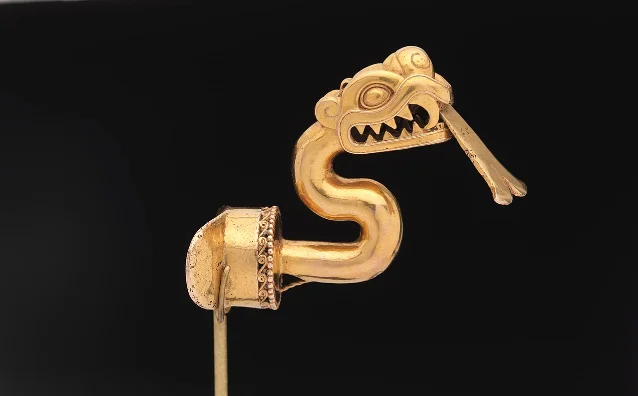
The serpent labret with tongue extended, photographed side-on
The labret at the Metropolitan Museum of Art, tongue extended. 1

Lips sealed, power spoken

In the Aztec world, wearing a labret was a declaration. It said: I have the right to speak, and you are obliged to listen.
The Aztec ruler's title was huei tlahtoani, which translates as "Great Speaker." Eloquence was not a courtly nicety but a marker of legitimate authority. Franciscan friar Bernardino de Sahagún recorded a labret among the regalia worn by Emperor Moctezuma II at his coronation. Dominican friar Diego Durán recorded labrets among the gifts Moctezuma gave to visiting lords. Surviving codices show rulers wearing them across multiple types and materials, from plain obsidian for lower-status warriors to elaborate gold pieces for the highest elite. 1
Noble children were trained from birth for this verbal power. According to a passage recorded by Durán, they "were told to speak without stuttering, without nervousness or haste." 1 Positioned directly below the lips, a gold serpent ornament would have drawn every eye to the speaker's mouth — foregrounding each word, lending it visual authority.
The contradiction is obvious, and scholars have noted it: a large metal ornament lodged in the flesh below your lip would have made speaking more difficult. Wearing the symbol of eloquence may have imposed a cost on eloquence itself. Whether that paradox was understood and accepted, or simply ignored, the sources do not say.
正在加载链接预览…

Gold as divine excrement

The Aztecs had a name for gold that does not appear in most museum plaques: Tōnatiuh icuitl — "the excrement of the sun." The idea was that as the sun god traveled through the underworld each night, gold was what he left behind. A related term, teocuitlatl, translates more bluntly as "holy shit." 1
Wearing gold was therefore not merely a display of wealth. It was a claim of proximity to divinity. A ruler wearing a gold serpent below his lip, with further gold ornaments at his ears, wrists, and chest, was dressing in the residue of the sun god. The combination of Xiuhcoatl — fire serpent, weapon of the sun — rendered in the sun god's own material would have been legible to any Aztec observer as a statement of cosmic power.
Aztec specialist Michael D. Coe suggested the labret was probably worn only on important occasions — ritual, ceremony, or war — rather than daily, given its size and weight. Dudley T. Easby Jr. raised the alternative that it may have been a funerary or votive object, never worn at all. 1 No archaeological context survives to settle the question.
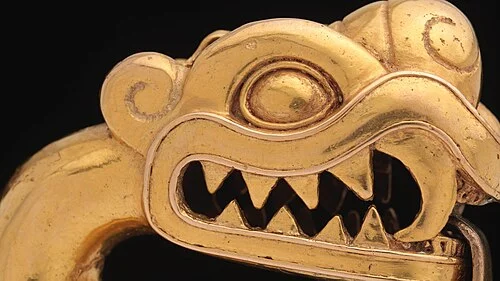
Close-up of the head detail showing surface engraving and facial features
Close-up of the serpent's head, showing comma-shaped engravings and curled eyebrows. 1

Cast in three pieces

The labret was not carved. It was cast — using a technique called lost-wax casting (cire perdue), in which a wax model is built up, encased in clay, heated until the wax melts out, and replaced with molten metal. The resulting object takes the exact shape of the wax. 1
What makes this particular piece remarkable is that it required three separate castings to assemble: the tongue was cast first, then used as an insert during the second casting of the head and neck, then the flanged base was cast last. The wax was shaped by pressing it into engraved grooves with a tool — comma-shaped marks visible on the metal surface preserve this process. Before casting, the wax mould was likely coated in a thin paste of charcoal (teculatl) to ensure the metal took sharp detail. 1
The process was not flawless. During the second casting, the pre-made tongue shifted inside the mould, displacing wax at the top of the maxillary arch — a microscopic error that researchers have been able to trace centuries later. Three small support holes (each 4 mm across), drilled behind the neck, below the jaw, and below the body, show where wooden pins or thorns held the inner core in place during casting. 1
Who made it? Aztec goldwork has traditionally been attributed to Mixtec craftsmen from the south, who were absorbed into the empire and whose techniques are well documented. Research by King (2015) and López Luján and Ruvalcaba Sil (2015) argues that by the late fifteenth century, the Aztecs had developed their own independent goldworking workshops capable of producing work at this level. 1 The debate is unresolved.

The great melting

To understand why this object matters, you need to know how much gold there was, and how thoroughly it disappeared.
The Aztec empire extracted roughly 500 kg (1,100 lb) of gold per year in tribute from surrounding regions. At that rate, the empire could have produced tens of thousands of small ornaments annually across its two-century existence. 1 Almost none of it remains.
When Hernán Cortés arrived in 1519 and destroyed the empire by 1521, his men melted virtually everything into ingots for transport back to Spain. Even Cortés, who watched the great objects of Tenochtitlan being broken apart, wrote that "no smith in the world could have done better." 1 The admiration and the smelting happened simultaneously.
The German artist Albrecht Dürer, who saw some of the looted objects before they were melted, wrote in his diary:
"In all my life I have never seen anything that has so delighted my heart as did these objects; for there I saw strange works of art and have been left amazed by the subtle inventiveness of the men of far off lands." 1
Dürer, who habitually sketched everything he saw, made no known drawings of these pieces. Curator Jay Levenson observed: "Maddeningly enough, although Dürer appears always to have had a sketchbook with him, no drawings of his are known of the now-lost masterpieces which he described." 1
Today, fewer than 400 Aztec gold objects survive, worldwide. Of those, 267 came from excavations at the Templo Mayor — the main temple of Tenochtitlan, buried under modern Mexico City and excavated from 1978 onwards. The serpent labret was not among them. It has no known findspot. 1
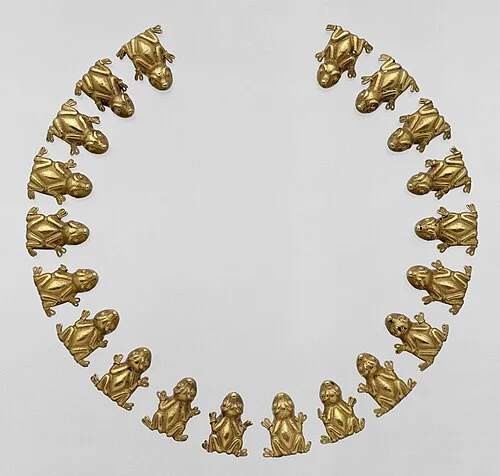
Gold frog-shaped bead necklace — one of the few surviving examples of Aztec goldwork
A surviving Aztec/Mixtec gold frog-bead necklace — typical of the goldwork that was, in almost every other case, melted down. 1

Cousins in gold

The serpent labret is not entirely alone. A handful of comparable pieces survive in museums, and together they sketch the range of what Aztec gold lip ornaments once looked like.
The Met itself holds a gold eagle-head labret, as do the Saint Louis Art Museum, the Los Angeles County Museum of Art (LACMA), and the Museo Civico d'Arte Antica in Turin. The Turin piece closely parallels the eagle labret depicted in the Codex Ixtlilxochitl, a manuscript derived from the memories of a mestizo descendant of Aztec royalty, showing the ruler Nezahualcoyotl wearing what appears to be an identical ornament. 1 Princeton's collection includes a gold curassow-head labret (the curassow being a large tropical bird with a distinctive crest). The Weltmuseum Wien holds a combined bird's-head labret in gold and rock crystal.
Only one object is directly comparable to the Met's serpent labret: a gold serpent labret with a movable tongue held by the National Museum of the American Indian in Washington, D.C. 1 Two gold pieces; both serpents; both with articulated tongues. Out of everything that was made.
正在加载链接预览…

Eighty years in plain sight

The labret's history before 1937 is completely blank. No excavation record, no colonial-era inventory, no known collector — nothing. It appears in the historical record when Heath McClung Steele, an executive at the American Metal Company, placed it on long-term loan to the American Museum of Natural History in New York. 1
From 1937 onwards, it has been on public display for the overwhelming majority of its documented existence. It appeared at MoMA's landmark 1940 exhibition "Twenty Centuries of Mexican Art." It was sold at Sotheby's New York on November 22, 1978 — for $101,000, equivalent to roughly $499,000 in 2025. 1 It then passed through several private collections while remaining on loan to major institutions: the National Gallery of Art in Washington (1983–84 for "Art of Aztec Mexico: Treasures of Tenochtitlan"; 1991–92 for "Circa 1492"), the Detroit Institute of Arts, and the Metropolitan Museum of Art itself on multiple long-term loans.
In 2016, the Met stopped borrowing it and bought it outright, using the 2015 Benefit Fund and the Lila Acheson Wallace Gift. Its accession number is 2016.64. 1 It has stayed there since, on view in the Arts of the Ancient Americas galleries.
Joanne Pillsbury, the Met curator who oversaw the acquisition, put its significance plainly: the labret "opens a window into Aztec culture at the very highest level, a world almost entirely obliterated when Hernán Cortés arrived on the shores of Mexico in 1519." 1
The fire serpent, cast in the sun god's own material, is at 1000 Fifth Avenue. The tongue still moves.
正在加载链接预览…
Wikipedia's Featured Article for May 30, 2026 is the Serpent labret with articulated tongue. 2
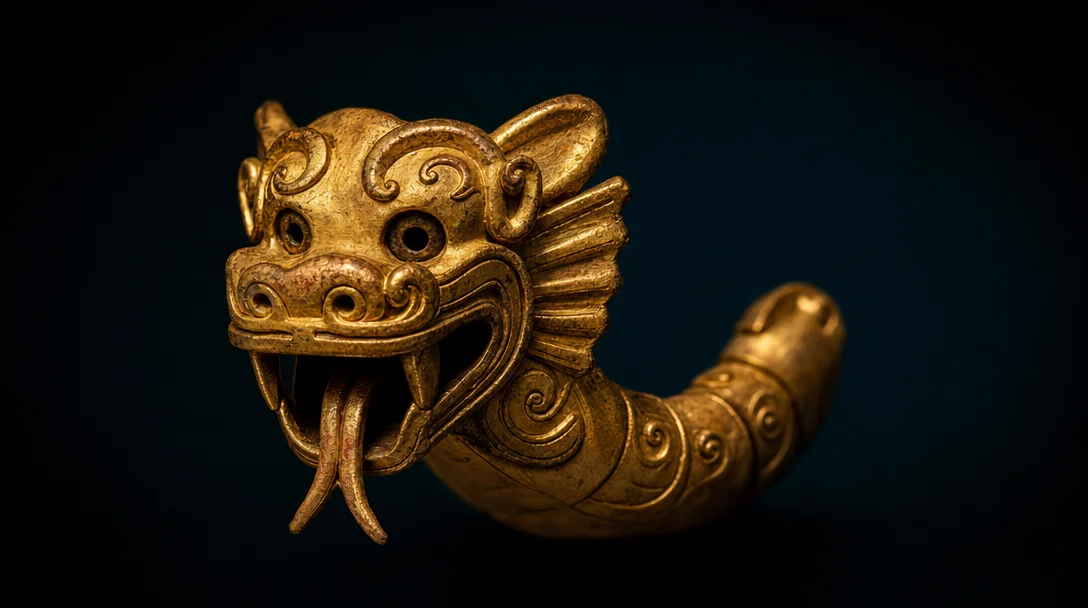
Cover image: AI-generated illustration

围绕这条内容继续补充观点或上下文。

  • 登录后可发表评论。