www.bills.com
Billshark Review May 2026 — Bills.com
Independent review covering Billshark's fee structure, the cannot-refuse clause, installment options, and which bill categories it can and cannot negotiate.
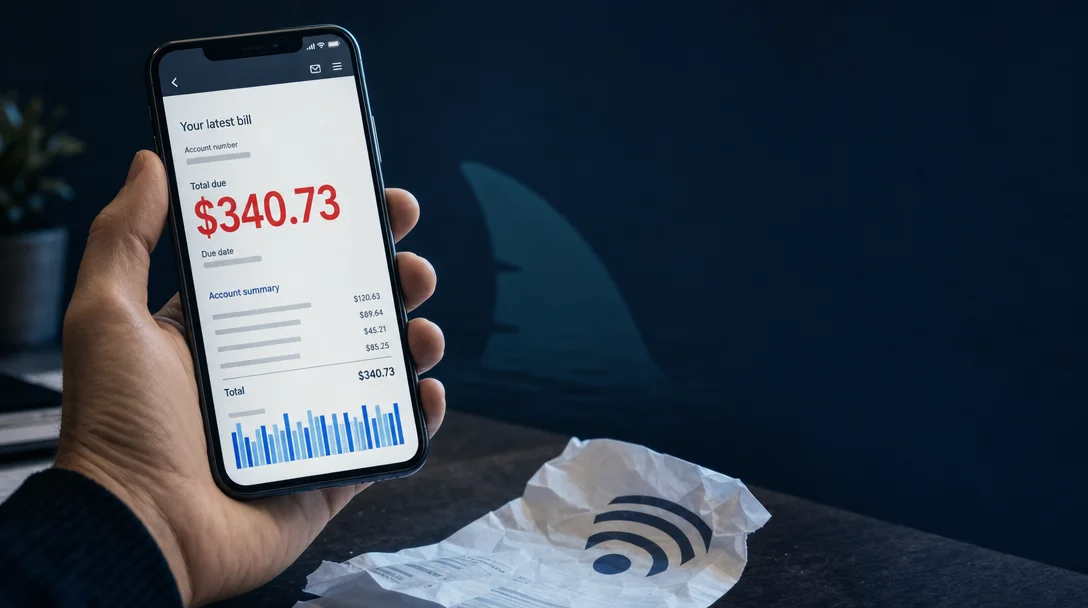
Issue 2 tests Billshark's bill-negotiation service with real user outcomes — including the $1,100+ fee invoice that arrives with no warning — and delivers a five-step mobile carrier retention script built from verified Verizon chat transcripts, a T-Mobile competitor-cite case, and AT&T routing guidance. Includes a fee-math table, anti-pattern flags, and a combined annual savings estimate of $540–$648 when stacked with the Issue 1 ISP call.

Universal opener — works on Verizon, T-Mobile, and AT&T: When you reach a phone agent or open a live chat, say exactly this: "My bill went up and I'm considering switching. Can you connect me with your loyalty or retention department?" Do not say "billing," "promotions," or "can you lower my bill?" Those keywords route you to standard customer service, where agents have almost no authority to reduce your base rate. The magic phrase on Verizon's app chat, T-Mobile's 611, and AT&T's IVR: "cancel service." 1 2
"I did read that it was a 40% but thought it meant 40% of the total per month so ~$10 seemed reasonable. Nope. Don't make the same mistake I did — it's 40% of the TOTAL savings for 2 years." 7
"There was no notice of 'Hey, this is the amount on the table — just a reminder that we charge 40%. Are you sure you want to proceed?' Nope — it was just done." 7
| Scenario | Gross savings | Billshark fee (40%) | Your net |
|---|---|---|---|
| $40/mo reduction × 24 months | $960 | $384 | $576 |
| $28/mo reduction × 24 months | $672 | $269 | $403 |
| Verizon case (Dec 2025) | $2,900 | $1,160 | $1,740 |
Four things that blow up the mobile carrier call:1. Calling billing instead of retention. Standard billing has almost no authority to reduce your base rate. The IVR keyword "cancel service" (or "cancel my account") routes you to loyalty/retention, which has a different authorization level. 12. Accepting the first offer. Verizon's app-pushed $20 offer is confirmed across dozens of community posts as the floor, not the ceiling. 16 Declining it once and asking again is the single highest-leverage action in this script.3. Accepting a 24-month lock-in for a short-term discount. If a retention agent offers to lock you into a 24-month contract in exchange for a discount, the discount almost certainly lasts only 12 months — leaving you overpaying in year two with no renegotiation leverage. Confirm discount duration before agreeing to any contract extension. 174. Using an empty cancel threat. If you tell a retention agent you're switching to a specific competitor but have no real intention of following through — and the agent knows the competitor doesn't meaningfully cover your area — your leverage is zero. This is especially relevant for T-Mobile customers attempting to cite Verizon as a competitor when Verizon's coverage advantage at your location isn't real. Community posts on r/tmobile confirm that bluffing produces worse outcomes than an honest "my bill is too high and I'd like to explore options." 18
Independent review covering Billshark's fee structure, the cannot-refuse clause, installment options, and which bill categories it can and cannot negotiate.
The August 2023 thread where u/lucifermorningstar7 documents being invoiced $355.20 on a 12-month Comcast agreement, Billshark's ToS SMS-consent response, and the community's breakdown of the fee-calculation dispute.
The January 2026 thread where u/handle77433 documents the full $340 single-line outcome after declining Verizon's app-pushed $20 offer. Community replies add $360 and $550 confirmations.
围绕这条内容继续补充观点或上下文。