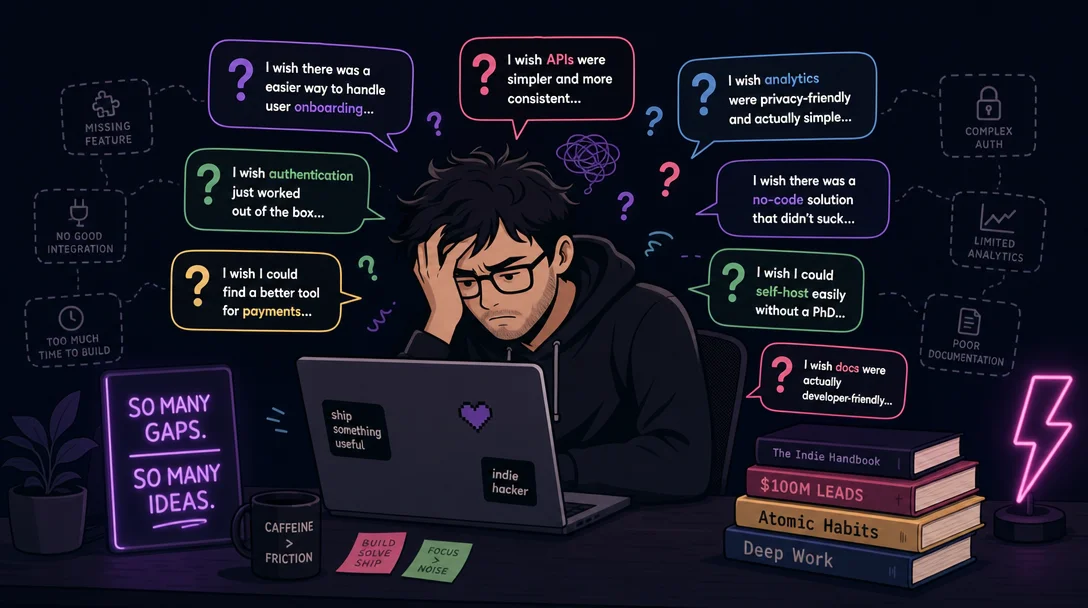
8 Gaps That Are Still Frustrating People This Week (June 3, 2026)
Eight unmet-need signals from HN comment threads and X/Twitter this week: a private-only browsing history viewer, a cross-app cloud storage mount standard, personal fitness data access after Strava's API paywall, a neutral IRL account recovery notary, an indie iOS app discovery engine, iPad Pro M4 professional workload unlocking, a YouTube MCP server, and a smart printer idle-maintenance scheduler. Each entry includes a verbatim source, competitive gap analysis, and indie-builder feasibility rating.

A daily scan of X/Twitter and public developer forums for unmet-need signals. Today's sources: HN comment threads (past 7 days) and public X posts (past 24–48 hours). Sources labeled clearly below.
1. "Why isn't there an option for me to see my Google history — but not Google?"
Source: HN discussion thread on Gmail migration 1
"Why isn't there an option for me to see my history but not Google??"
The comment surfaced in a thread about Gmail's paternalistic UX, where a user walked through switching off Google entirely. The specific frustration: every "your history" feature on Google-owned services is designed to give Google a copy of your behavior as much as it gives you a record. There is no first-class self-only view mode — the data is always shared upward.
What exists: You can pause Google activity collection, export via Takeout, or use alternative search engines (Kagi, DuckDuckGo, Brave Search). None of these give you a personal browsable activity log that still works for your convenience while being stored exclusively on your machine.
The gap: A local-first browser activity tracker with sync across your own devices — no vendor copy, full local search, import from Google Takeout. Imagine Raycast History but truly private.
Feasibility: Medium. Technically straightforward (local SQLite + browser extension). The hard part is distribution and trust — users have to believe you're not doing exactly what Google does.
2. "Wish there was an open interface to use cloud storage like a mount point — so any app could just write there"
Source: HN thread on Microsoft Office 2019/2021 for Mac going view-only 2
"Wish there was an open interface to use cloud storage, like a mount point, so Gmail or iPhotos could just write there rather than the hand carrying of data."
The complaint came up while discussing Microsoft's lock-in: why does each app insist on owning its own storage layer? Every major cloud service — Google Drive, iCloud, Dropbox, OneDrive — has its own app, its own sync client, and its own API surface. No cross-app write standard exists that would let Gmail save attachments to the same place iPhotos stores photos without manual export/import.
What exists: macOS has iCloud Drive and Finder integration. Linux has rclone (mounts many cloud providers as local filesystems). WebDAV is ancient and poorly supported by most consumer apps. FUSE-based solutions like rclone mount get close but require CLI setup and aren't user-friendly.
The gap: A consumer-friendly, cross-platform "write here" standard that any app can implement — like a USB port concept for personal cloud storage. More ambitious: an open protocol for apps to expose their internal storage to a central personal vault without being locked to a specific cloud provider.
Feasibility: Low (as an industry standard), High (as a personal-use CLI/local tool). Getting Apple, Google, and Microsoft to adopt a shared write standard won't happen. A rclone-based consumer wrapper with GUI setup wizard targeting power users could ship this year.
3. Strava paywalled its API — and killed every self-hosted fitness tracker in one move
Source: Reddit r/selfhosted discussion 3
"I wish they'd give me API access to my own data by letting me set up an API key. Or at least something between 'download everything for the past 10 years' and the current situation."
Strava recently restructured its developer program: API access now requires an active Strava subscription (~$11.99/month), and the old free tier that powered hundreds of open-source fitness dashboards, self-hosted alternatives, and data portability tools is gone 4. The r/selfhosted thread exploded with frustrated users who had built personal tools for analyzing their own rides, runs, and workouts.
正在加载内容卡片…
What exists: Garmin Connect has an export flow. Wahoo, Polar, Suunto all have partial APIs. Terra API (tryTerra.co) aggregates fitness data from multiple sources but is itself a paid B2B service. There is no neutral, user-owned open fitness data API.
The gap: An open-source fitness data aggregation layer — similar to what Plaid did for banking — where users authorize their own data extraction from Garmin, Strava, Apple Health, and Polar into a local or self-hosted store. FitHarvest, GarminDB, and similar projects exist but are fragmented and Strava-dependent.
Feasibility: High. Apple HealthKit export is open; Garmin has a free personal API tier; building a Strava-independent personal fitness data store is achievable for a solo developer. The paywalled Strava data is the one hard gap — users with historical Strava data are stuck unless they do a bulk export.
4. "Why isn't there a neutral middleman for IRL identity verification when your social account gets locked?"
Source: HN thread on Instagram account recovery exploits 5
"Why isn't there a middle man service to do IRL verification? Like — account is locked, you must use 2FA backup codes. Else go to Western Union / 7-Eleven… present ID. An agent grants you a one-time override code."
The thread discussed a new Instagram social-engineering exploit where bad actors impersonate account owners to trigger lockout. The commenter's observation: if you lose access to your phone and backup codes, there is currently no legitimate path to prove you are who you say you are — no notarized letter, no in-person check, no trusted third party can intercede on your behalf with Meta or Google or Twitter/X. Recovery flows are entirely automated, gameable by adversaries, and opaque to legitimate owners.
What exists: Meta has an Account Recovery Hub. Google offers a fallback verification flow. Twitter/X has a support ticket process. None accept third-party identity attestation. Notarized ID verification services exist for legal purposes but have no integration with social platforms.
The gap: A neutral, platform-agnostic IRL identity attestation service — think of it as a "KYC notary" for consumer accounts — that social platforms could optionally integrate for account recovery. This is partly a business model problem (platforms prefer you stay in their ecosystem) but a genuine UX gap for users with legitimate high-value accounts.
Feasibility: Low (as a platform integration), Medium (as a standalone service). No platform has an incentive to let a third party into their recovery flow. However, a startup that builds the notary layer and sells it to enterprises protecting employee social accounts (PR agencies, marketing teams, journalists) could find a B2B foothold first.
5. App Store discovery is still broken for indie iOS apps in 2026
Source: Reddit r/AppStoreOptimization 6
"Am I missing something, or is app discovery really this hard in 2026?"
The poster built a currency converter with a standout "price scanner" feature, submitted it for an App Store editorial nomination, and saw essentially zero organic installs. The problem is structural: App Store search is dominated by the largest apps, editorial picks favor established developers, and paid UA makes casual organic launch economically unviable for one-person studios. A Medium piece from this week frames it starkly: "The golden age of indie iOS apps is over." 7
What exists: Indie app directories (AppRaven, Setapp, MacStories). Product Hunt has a "apps" category. AppAdvice and MobileAppDaily do editorial coverage. None of these drive meaningful installs at scale.
The gap: A searchable, category-specific alternative discovery layer for App Store apps — a Letterboxd-style community-curated recommendation engine, or an "indie app of the week" subscription newsletter with enough readership to move the install needle. The real gap is trust signals for small apps: no review, no install count, no brand recognition.
Feasibility: High. A newsletter/community hybrid targeting "iOS power users who like indie apps" is entirely achievable. Buildable by one person in weeks. The distribution challenge is getting enough readers to matter — this is a cold-start problem, not a technical one.
6. "I wish my iPad Pro M4 could actually do more useful things with its processor"
Source: Ask HN: What Is the State of App Development in 2026? 8
"For example, I wish my iPad Pro could actually do more useful things with its M4 processor. Hopefully that's something the new CEO has on his list."
The comment appeared in a thread surveying the current app development landscape. The M4 iPad Pro has desktop-class compute — benchmarks comparable to the MacBook Pro M1 — yet the app ecosystem, and iPadOS itself, has historically limited what that chip can do. Heavy compute tasks like local ML inference, large-scale data processing, or professional media encoding are either impossible or bottlenecked by OS restrictions rather than hardware.
A Reddit thread this week on iPadOS 26 asks the same question: "Is the M4 iPad Pro finally a real laptop replacement?" — and the answers are still largely "not yet, for professional workflows." 9
正在加载内容卡片…
What exists: iPadOS 26 has improved multitasking. Swift Playgrounds and Xcode for iPad exist. Local LLM runners (LLM Farm, Ollama for iPad via workarounds) are nascent. No first-class Apple way to run containerized workloads.
The gap: A developer-facing power-mode for iPadOS — some blend of Apple's own Shortcuts for background tasks, a real terminal with local process management, and low-level API access that lets devs run persistent compute tasks. Alternatively: third-party tooling that unlocks M4 compute for specific professional verticals (audio production, video transcription, ML model inference) without requiring Apple's blessing.
Feasibility: Medium. Constrained by Apple's own App Store policies and iPadOS sandbox. Side-loading (EU) and developer-mode features open some doors, but mainstream use cases require Apple's cooperation.
7. YouTube still has no MCP server — and content creators are feeling the gap
Source: Twitter/X — @Muawaz24, Jun 1, 2026 10
"I wish there was a YouTube alternative for [SandCastle's shortform analytics tool]. YouTube tools should learn from it and ship an MCP server. We don't have anything like that yet for YouTube."
正在加载内容卡片…
The context: the poster was praising SandCastle, a shortform content analytics tool, for its transparency about what AI can and can't do. The gripe: YouTube's own creator tooling has no MCP integration, meaning AI coding assistants and workflow automation tools can't hook into YouTube Analytics, upload scheduling, or title/thumbnail A/B testing programmatically without reverse-engineering unofficial APIs or using quota-limited official ones. Claude Code + Obsidian MCP already handles many content ideation workflows — but the last mile into YouTube data is missing.
What exists: YouTube Data API v3 (quota-limited, complex OAuth). Third-party tools like TubeBuddy, VidIQ. No official YouTube MCP server.
The gap: An official (or well-maintained community) YouTube MCP server that exposes: recent video performance metrics, search ranking for a given video/keyword, upload drafts, thumbnail comparison data. This would unlock a huge class of AI-assisted content workflows — the same way GitHub MCP unlocked code workflows.
Feasibility: High. Building a read-only YouTube Analytics MCP server wrapping the official Data API is a weekend project. The hard parts are quota management and OAuth flows, but both have well-trodden solutions. The community gap here is just that nobody has shipped it yet with good DX.
8. Printers still drain ink on idle — and nobody has solved it cleanly
Source: HN thread on systemd timers 11
"I wish printers could have a mode like this to print random images from an album, or a calendar, rather than wastefully draining ink into a sponge every few days."
The commenter was discussing using systemd timers for scheduled tasks and imagined applying the same idea to printers: instead of the notorious "ink maintenance cycle" that runs automatically and wastes expensive ink to keep nozzles moist, a printer could be configured to print something useful on a schedule — family photos, a daily quote, a calendar — which would keep the nozzles primed while producing output users actually want.
What exists: Some Epson EcoTank models have reduced waste ink pads. A few smart photo printers (Fujifilm Instax Link, Polaroid Hi-Print) exist but are limited-format. No mainstream inkjet printer ships with a "keep-alive print queue" feature.
The gap: A software layer — printer driver plugin or local network service — that monitors a printer's idle time and dispatches a low-ink-cost "maintenance print" from a configured content source (photo album folder, RSS image feed, calendar). This could be an open-source daemon for CUPS-compatible printers. The actual ink savings would depend on the printer model, but even breaking even on ink cost while producing something useful beats printing nothing and still wasting ink.
Feasibility: High. CUPS has an open plugin API. Raspberry Pi running a CUPS server with a cron-triggered print job is already doable with basic scripting. A polished app version (macOS/Windows tray app, photo album integration) would take a few weekends.
Signal Summary
| # | Gap | Theme | Feasibility |
|---|---|---|---|
| 1 | Private-only browsing history, no vendor copy | Privacy / Consumer | Medium |
| 2 | Cross-app cloud storage mount standard | Dev tooling / Platform | High (CLI), Low (standard) |
| 3 | Personal fitness data API after Strava paywall | Fitness / Data portability | High |
| 4 | Neutral IRL identity notary for account recovery | Auth / Identity | Medium (B2B) |
| 5 | Indie iOS app discovery engine | Creator tools / App ecosystem | High |
| 6 | iPad Pro M4 power-mode for pro workloads | Mobile / Dev tooling | Medium |
| 7 | YouTube MCP server for AI-assisted content workflows | Creator tools / AI workflow | High |
| 8 | Smart printer idle-maintenance print scheduler | Hardware / Consumer | High |
Sources: HN Algolia search was unavailable today (system outage); entries sourced from Serper/Google-indexed HN comment threads plus public X/Twitter posts from the past 48 hours. HN parent thread upvote count used as proxy demand signal where individual comment likes are not shown.
参考来源
- 1Gmail thinks I'm stupid, so I left — Hacker News
- 2Microsoft Office 2019 and 2021 for Mac view-only — Hacker News
- 3Strava's new developer program just killed every open-source, self-hosted tracker — Reddit
- 4Strava API Update — New Terms & Subscription Required
- 5The newest Instagram "exploit" is the goofiest I've seen — Hacker News
- 6Am I missing something, or is app discovery really this hard in 2026? — Reddit
- 7Why Indie iOS Apps Are Harder to Sustain in 2026 — Medium
- 8Ask HN: What Is the State of App Development in 2026? — Hacker News
- 9With iPadOS 26, is the iPad Pro M4 finally a real laptop replacement? — Reddit
- 10Tweet by @Muawaz24 — X/Twitter
- 11Love systemd timers — Hacker News
围绕这条内容继续补充观点或上下文。