www.youtube.com
James Webb Space Telescope: the engineering decisions that made it unserviceable by design
JWST's defining engineering constraint — no servicing possible at L2, 1.5 million km from Earth — cascaded into every subsystem: an actuated 18-segment beryllium mirror that could self-correct if mis-aligned, a 5-layer Kapton sunshield that had to fold and deploy perfectly once, a $150M cryocooler for MIRI's 6.7 K detectors, and 344 single-point deployment steps executed flawlessly. A precision Ariane 5 launch left enough propellant for ~20 years of science. Cycle 5 is now underway, with results reshaping cosmology.

On December 25, 2021, an Ariane 5 rocket lifted off from Kourou, French Guiana, carrying a telescope that could not be repaired if anything went wrong. 1 The James Webb Space Telescope (JWST) — a joint project of NASA, the European Space Agency (ESA), and the Canadian Space Agency (CSA) — would spend the next six months unfolding itself at a distance of 1.5 million km from Earth, executing 344 individual deployment steps with no possibility of a service call. 2
The telescope that emerged from that deployment is the most sensitive infrared observatory ever built: a 6.5-metre segmented beryllium mirror, cooled to temperatures colder than the cosmic microwave background, orbiting a point in space chosen specifically because it makes human visits impossible. Total cost: approximately $9.7 billion over 25 years of development. 2
What follows is an account of the engineering decisions that produced that result — why each major choice was made, what it cost in other dimensions, and what the whole system has found since it began observing.
Why not orbit like Hubble?
The most consequential decision in JWST's entire engineering program was the orbit choice. It determined the thermal environment, the power architecture, and ultimately the answer to the question "can we fix it if something breaks?"
The Hubble Space Telescope (HST) orbits at roughly 550 km altitude in low Earth orbit (LEO). That proximity allowed five servicing missions between 1993 and 2009, each one sending astronauts to upgrade instruments and correct problems — including the correction of Hubble's famously mis-figured primary mirror in 1993. 2 JWST's designers initially considered a similar approach.
The physics of infrared astronomy ruled it out. Hubble operates at roughly 288 K (15°C). JWST's science requirements — detecting galaxies from the first 400 million years after the Big Bang, measuring the atmospheric compositions of exoplanets tens of light-years away — demand operating temperatures below 50 K (−223°C) for the near-infrared instruments. In LEO, achieving that temperature is nearly impossible. The telescope would pass in and out of Earth's shadow every 90 minutes, cycling through alternating heating and cooling that would thermally stress the mirror and require constant realignment. Earth itself radiates as an infrared source at roughly 255 K — a direct contamination threat for the detectors. The Sun, Earth, and Moon would appear from different directions as the spacecraft orbited, making a fixed thermal shield geometrically incoherent. 2
The Sun-Earth L2 Lagrange point solves all three problems simultaneously. At 1.5 million km from Earth in the anti-Sun direction, the Sun, Earth, and Moon all appear within approximately 5° of each other as seen from the spacecraft — small enough to be blocked by a single fixed sunshield. JWST flies a halo orbit around L2 with a radius varying between 250,000 and 832,000 km and a period of roughly 6 months, keeping it perpetually in the Sun's shadow as defined by its own shield. 2 The sky is continuously accessible — no Earth occultation blocks targets — and the thermal environment is stable enough that the mirror needs alignment adjustment only on orbital mechanics timescales, not on thermal cycling timescales.
The trade-off is direct and irreversible. L2 is 4× farther than the Moon. No crewed spacecraft can reach it. NASA Associate Administrator Thomas Zurbuchen confirmed that remote uncrewed servicing was "beyond available technology at the time Webb was designed." 2 The engineers incorporated limited future-servicing accommodation anyway — precisely machined guidance markers, refillable propellant tanks, accessible attachment points — but the practical reality is that JWST must function correctly in its first and only deployment attempt.
That constraint cascaded through every other engineering decision. If the mirror couldn't be replaced, it had to be self-correcting. If the sunshield couldn't be re-folded, the first fold had to be right. If the cryocooler failed, there was no replacement. L2 turned an observatory into a gamble in which the house gets one roll.
The beryllium mirror: 18 segments, one optical surface
JWST's primary mirror collects the photons. Its design begins with a scale problem: the science requirements demanded an aperture that could not fit inside any available rocket fairing as a single piece, and that would not survive the mass budget for reaching L2 as conventional optical glass.
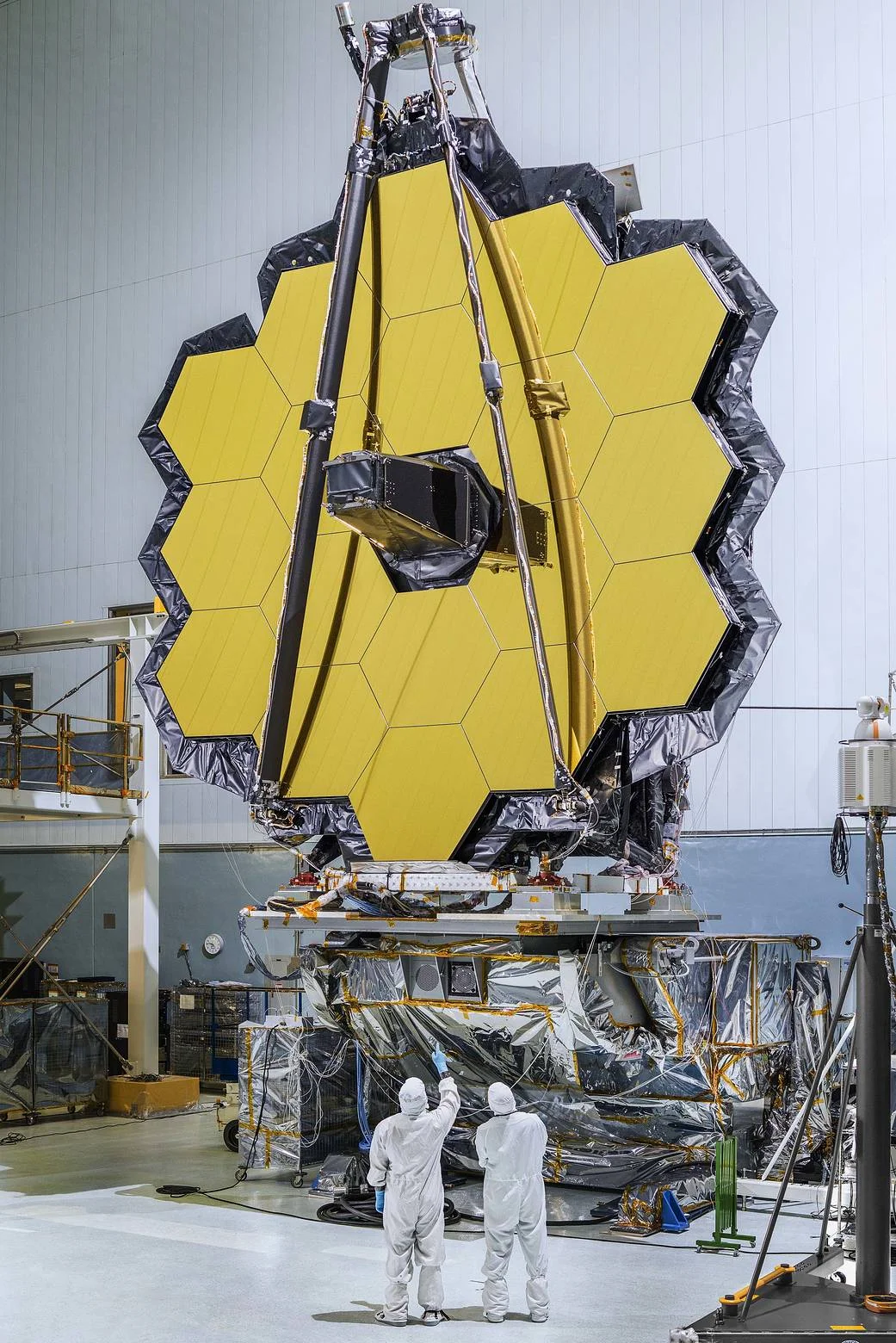
The mirror spans 6.5 metres effective diameter across 18 hexagonal segments, each 1.32 metres flat-to-flat, forming a collecting area of 25.4 m² — roughly 6× Hubble's 4.0 m². 1 Each segment had to be individually launched folded, then aligned in space to sub-wavelength precision.
The material choice — beryllium rather than conventional silica glass — was driven by cryogenic physics, not optical preference. At the mirror's operating temperature of roughly 40 K, glass would contract unpredictably and with sufficient thermal distortion to destroy the optical figure. Beryllium, with an atomic mass of just 4 and a density of 1.845 g/cm³, maintains dimensional stability at cryogenic temperatures through a near-zero coefficient of thermal expansion below about 100 K. On a pound-for-pound basis, beryllium is 6× stiffer than steel — a property JWST Missions Systems Engineer Mike Menzel identified as the deciding factor. 3 The entire 18-segment primary mirror weighs 705 kg — versus roughly 825 kg for Hubble's smaller, single-piece glass mirror — despite having 5.5× the collecting area. 2
The disadvantages of beryllium are significant. It is expensive, available from only a single US supplier (Materion, formerly Brush Wellman, sourcing powder from Utah), and highly toxic to machine — fabrication requires Class I controlled environments with full respiratory protection. Its optical properties are inferior to glass at visible wavelengths, though JWST's science band starts at 0.6 μm where this is acceptable. 4
The fabrication sequence began with Axsys Technologies pressing beryllium powder under high isostatic pressure into mirror blanks, then removing over 90% of the material through a process called open-back lightweighting while preserving structural stiffness. Each bare beryllium segment finished at 20.1 kg, with a full mirror segment assembly (including actuators and backplate) of 39.48 kg. 4 The blanks then went to L-3 Communications SSG-Tinsley for polishing — but not at room temperature. The mirrors had to be polished at cryogenic temperature at NASA Marshall Space Flight Center's X-Ray & Cryogenic Facility (XRCF). The reason: the mirror's optical shape changes slightly as it cools from room temperature to 40 K. Polishing at room temperature and expecting the correct figure at 40 K is not possible with the required precision. The mirror had to be polished into a shape that was slightly wrong at room temperature, reaching the correct optical figure only when cooled to operating conditions. 4
Ball Aerospace & Technologies served as the primary Optical Telescope Element (OTE) subcontractor, integrating mirror segments with their actuator systems and the graphite composite backplane. The final (18th) primary mirror segment was installed by robotic arm at NASA Goddard Space Flight Center on February 3, 2016 — completing a fabrication chain that had begun with the Subscale Beryllium Model Demonstrator (SBMD) prototype test in 2001. 4
Gold-coated to 100 nm, using 48 grams total
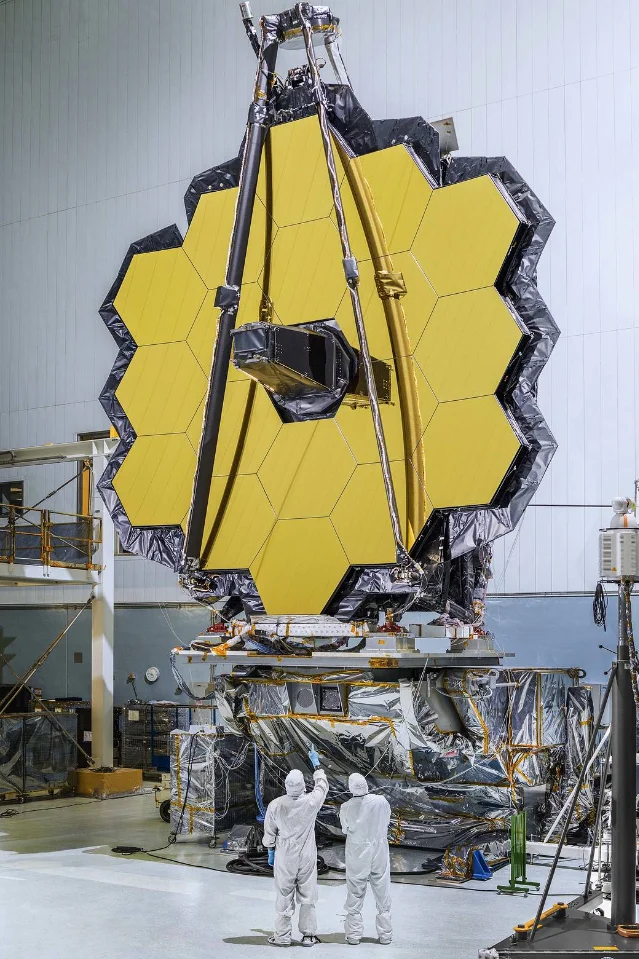
The optical coating on each mirror segment is 100 nm (1,000 angstroms) of gold vapor-deposited by Quantum Coating Inc. — a layer just 1,000 atoms thick. Gold was chosen for the infrared, not the visible: it is the best broadband reflector from 0.6 to 28.5 μm, the wavelength range JWST's instruments cover. It is chemically inert and will not oxidize in the vacuum of space. The total gold used across all 18 segments is 48.25 grams — approximately the mass of a golf ball. A thin protective layer of amorphous SiO₂ (silicon dioxide) over each segment prevents damage during ground handling. 2
132 motors, 10 nm steps
Each mirror segment carries 7 actuators: 6 that position the segment in all 6 degrees of rigid-body motion, and 1 that adjusts the segment's radius of curvature. The 18 primary segments account for 126 actuators; the 0.74-metre secondary mirror adds 6 more, for a total of 132 electromechanical motors. 1 Each actuator can move in steps as small as 10 nm — roughly 1/1,000th the diameter of a human red blood cell — with fine steps down to 5 nm for the final phasing pass. The target wavefront alignment across all 18 segments: 50 nm root-mean-square across the full aperture. 4
This adjustability was JWST's direct engineering response to the Hubble mirror lesson. Hubble's primary mirror was polished to the wrong prescription — a spherical aberration of 2.2 μm, invisible until first light — and the original telescope had no mechanism to correct it. JWST's actuated mirror means that if the optical figure is wrong after deployment, it can be corrected on orbit, in increments 1/10,000th the size of a human hair.
The sunshield: an SPF-million thermal wall
The mirror and instruments need to be cold — below 50 K. The Sun, Earth, and Moon supply approximately 200 kilowatts of combined thermal radiation toward the spacecraft's hot side. 3 A single barrier can block none of it reliably. Five barriers arranged in a specific geometry can reduce 200 kW to 23 milliwatts reaching the cold side.
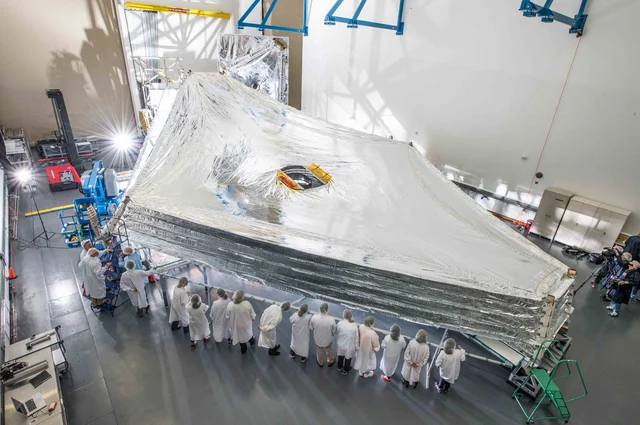
JWST's sunshield is a 5-layer membrane structure measuring 21.197 m × 14.162 m deployed — roughly the area of a tennis court — made from Kapton E polyimide film, a material chosen for its operational range from −269°C to +400°C, radiation resistance, dimensional stability in vacuum, and low outgassing. 5 6
Layer 1 (facing the Sun) is 0.05 mm thick — thinner than a human hair. Layers 2 through 5 are each 0.025 mm, half as thick. All five layers are coated on both sides with 100 nm of aluminum for reflectivity. The two outermost layers (1 and 2) carry an additional 50 nm of doped silicon on their Sun-facing surfaces, which gives them a distinctive pink-purple hue visible in photographs and serves a thermal function: silicon has high emissivity and radiates absorbed heat efficiently back into space rather than retaining it. 5
The geometry is critical. Each successive layer is angled and slightly smaller than the one above it. Heat reflected from layer 1 cannot directly reach layer 5 — it is redirected outward between the layers rather than being funneled inward toward the cold side. Layer 1 reaches a maximum temperature near 383 K (110°C). Layer 5 stays at approximately 36 K (−237°C). The total temperature gradient across five layers: 299°C. 5 The commercial equivalent sunscreen protection factor would be roughly 1,000,000.
As Menzel put it: "We had to map every heat flow to make sure that we do not let any leak through from the hot side to the cold side. … that sunlight, which is dumping approximately 200,000 watts of power in our direction — we only want less than a watt of that to get through to the telescope." 3
Why Kapton? Why five layers and not four?
Thermal modeling showed that each additional layer provides diminishing returns. Four layers cannot quite achieve the required cold-side temperature with adequate margin; six layers add mass and deployment complexity beyond the return. Five layers achieves the target with acceptable margin. 5
Kapton E won the material selection over alternatives for its combination of properties: it can be coated with vacuum-deposited metal, it maintains dimensional stability under the cyclic thermal loading of space operations, and it was qualified for the required 10-year mission life. The membranes were hand-assembled by ManTech (NeXolve) in Huntsville, Alabama, then shipped to Northrop Grumman in Redondo Beach for integration and testing. Northrop Grumman served as the prime sunshield contractor. 5
Deployment was the engineering problem that produced Menzel's "parachute" analogy: "The one thing about the sunshield is it's almost like a parachute … You know the parachute will work, but it's also only as good as the very very last time you fold it. And you're going to find out whether you folded it correctly or not when you use it." 3 Membranes and cables are non-deterministic mechanical systems — their deployed shape cannot be calculated from first principles the way a rigid truss can be. Reaching a reliable deployment required iterative hardware testing over years.
The sunshield was folded 12 times to fit within the Ariane 5's 4.57 m diameter payload fairing. Deployment used two telescoping mid-booms extending left and right from the spacecraft body, pulling the folded membranes outward over approximately 3.5 hours per side. The complete tensioning sequence — each of the 5 layers individually tensioned — ran from January 3 to January 4, 2022. 5
MIRI's $150 million cryocooler
The sunshield cools the telescope's cold side to approximately 40 K passively. For three of JWST's four science instruments — NIRCam (the Near Infrared Camera), NIRSpec (the Near Infrared Spectrograph), and FGS/NIRISS (Fine Guidance Sensor/Near Infrared Imager and Slitless Spectrograph) — 40 K is adequate. Their detectors use mercury cadmium telluride (HgCdTe) arrays that generate acceptably low thermal noise at that temperature. 7
MIRI (the Mid-Infrared Instrument) covers 5 to 28 μm — a wavelength range that includes the thermal emission of planet-forming dust disks, the molecular absorption features of exoplanet atmospheres, and the redshifted light from the universe's first galaxies. MIRI's arsenic-doped silicon (Si:As) detector arrays require a fundamentally different temperature regime. At 40 K, thermally generated electrons (dark current) within the Si:As arrays would swamp the faint astronomical signal. The detectors need 6.7 K — just 6.7 degrees above absolute zero. 7
The passive sunshield cannot achieve this. Active refrigeration is the only option.
JWST's cryocooler uses a multi-stage pulse tube precooler driving a Joule-Thomson (J-T) loop heat exchanger. In the pulse tube stage, a standing acoustic wave in a closed tube creates periodic compression and rarefaction; a porous regenerator transfers heat, and the net effect is progressive cooling through successive acoustic cycles. The J-T loop then exploits the Joule-Thomson effect — the temperature drop that occurs when a real gas expands through a constriction — to reach the final target temperature. The working fluid is helium gas in a continuous closed-loop cycle. 7
The cryocooler compressor sits in the spacecraft bus on the warm side of the sunshield, running at roughly 300 K. Coolant lines carry helium across the thermal boundary to MIRI on the cold side. The compressor pistons are arranged in horizontally-opposed pairs with precisely balanced counterweights to cancel vibration — because the telescope requires pointing stability to 2 milliarcseconds during observations, and compressor vibration must not propagate into the mirror support structure. 7
Development cost: approximately $150 million. 2 The MIRI cryocooler was the last of JWST's 10 critical technology items to achieve the required Technology Readiness Level, reaching TRL-6 in April 2007 — roughly a decade into the program and after the project had already committed to MIRI's design requirements.
MIRI itself was built by a European consortium spanning 10 countries, led by the UK, together with JPL and US institutions. Co-Principal Investigators: George Rieke (University of Arizona) and Gillian Wright (UK Astronomy Technology Centre, Edinburgh). The instrument contains three 1,024 × 1,024 pixel Si:As focal plane modules — one for the imager, two for the medium-resolution spectrometer. The spectrometer simultaneously covers 4.9 to 27.9 μm across 4 wavelength channels. 7
正在加载链接预览…
344 single-point failures
In June 2018, an Independent Review Board counted the deployment steps that had no backup: 344 sequential actions — motor firings, pin releases, latch engagements, membrane tensionings — each of which had to succeed on its first and only attempt. 2 The review was triggered partly by a sunshield tear during a practice deployment in March 2018, which contributed to a two-year launch delay.
The 344 count is a deployment sequence count, not a component failure probability count — these are individual commanded steps, not independent failure modes. The distinction matters but does not diminish the number's significance: 344 sequential steps means 344 opportunities for the first-and-only deployment to stop cold.
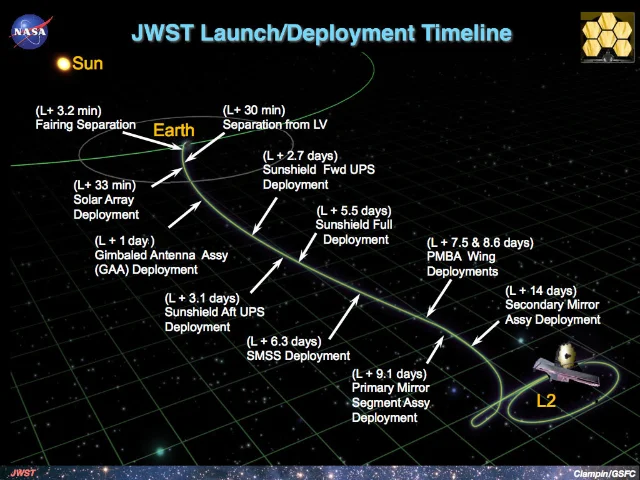
The deployment unfolded over 14 days after the December 25, 2021 launch:
- Day 0 (Dec 25): Launch. Solar array deployed approximately 29 minutes after liftoff, providing initial power.
- Days 3–6 (Dec 28–31): Sunshield pallets lowered; aft momentum trim flap deployed; two telescoping mid-booms extended. Left boom: 3 hours 19 minutes. Right boom: 3 hours 42 minutes.
- Days 7–10 (Jan 3–4): Sunshield membrane tensioning, one layer at a time. All five layers complete by January 4 at 11:59 AM EST.
- Day 10 (Jan 5): Secondary mirror deployed and locked. Positional tolerance: approximately 1.5 mm.
- Days 12–14 (Jan 7–8): Primary mirror wings folded out — port side January 7, starboard January 8 — completing structural deployment.
- Day 30 (Jan 24): Final orbital insertion burn placed JWST into its halo orbit around L2.
All 344 steps succeeded.
The deployment hardware included approximately 107 pins released on command, 8 deployment motors, roughly 400 pulleys, approximately 90 cables, roughly 140 release actuators, and approximately 70 hinge assemblies — all within the 344-count sequence. 5 6 The Deployable Tower Assembly (DTA) — a 3-metre telescoping graphite-composite tube that separates the cold Optical Telescope Element from the warm spacecraft bus thermally and structurally — extended via electric motor during this sequence.
The launch that extended the mission by a decade
JWST was designed for a minimum 5-year science mission with a 10-year design life. The propellant budget was sized accordingly: 159 litres of hydrazine and 79.5 litres of dinitrogen tetroxide (NTO), with a total velocity budget (Δv) of 93 m/s and station-keeping consumption estimated at approximately 2.5 m/s per year. 1
The Ariane 5 ECA+ (serial number 5113, Flight VA256) launched from ELA-3 at the Guiana Space Centre at 12:20 UTC, December 25, 2021. ESA provided the launch as part of its approximately €700 million contribution to the mission. The trajectory was precise to a degree that significantly exceeded requirements.
The precision mattered because of an asymmetry in the burn strategy. JWST's sunshield must remain between the telescope and the Sun at all times — meaning the spacecraft cannot execute a retrograde burn to slow down if it overshoots L2. A trajectory correction burn can add velocity if the rocket underdelivered, but an over-injection cannot be directly corrected. Every trajectory correction burn had to err on the slow side; each one slightly reduced the propellant reserve. 2
The first mid-course correction (MCC1a) on December 25 added approximately 20 m/s. The second (MCC1b) on December 27 added approximately 2.8 m/s. Because the injection was so precise, these burns consumed far less propellant than planned.
On December 29, 2021 — four days after launch — NASA and ESA jointly announced that the propellant remaining after launch analysis indicated a mission lifetime of "significantly more than a 10-year science lifetime." 8 9 The ESA press release stated directly: "The extra propellant is largely due to the precision of the Arianespace Ariane 5 launch, which exceeded the requirements needed to put Webb on the right path." 8 Subsequent analysis placed the expected operational life at approximately 20 years.
The Ariane 5 had a specific engineering advantage for this mission: its payload fairing is 4.57 metres in diameter and 16.19 metres long — just large enough to accommodate JWST's folded configuration (stowed height 10.66 m, diameter 4.5 m), and its equatorial launch site at Kourou (approximately 5°N latitude) provided an extra velocity boost from Earth's rotation that reduced the propellant cost to reach L2. 2 The alternatives considered — including SLS (still in development at the time) and Delta IV Heavy — did not simultaneously satisfy all constraints on cost, schedule, fairing dimensions, reliability, and the ESA partnership contribution.
The four science instruments
All four instruments occupy the Integrated Science Instrument Module (ISIM), a graphite-epoxy composite structure on the cold side of the observatory that provides power, computing, structural support, and the thermal environment each instrument requires.
正在加载统计卡片…
NIRCam (Near Infrared Camera, 0.6–5 μm) was built by the University of Arizona under Principal Investigator Marcia J. Rieke. It carries 10 sensors at 4 megapixels each and also doubles as the observatory's primary wavefront sensing tool — NIRCam measures the star images that the mirror alignment algorithm uses to drive the 132 actuators toward the 50 nm wavefront target. NIRCam includes coronagraph capability for blocking the light of bright stars to reveal nearby faint companions. 2
NIRSpec (Near Infrared Spectrograph, 0.6–5 μm) was built by ESA at ESTEC in the Netherlands, with Airbus Defence and Space (Germany) and NASA Goddard. Its defining engineering feature is a microshutter array of approximately 250,000 individually addressable shutters, each 100 × 200 μm, that can be opened or closed in arbitrary patterns to simultaneously take spectra of up to several hundred astronomical objects at once. NIRSpec offers three observing modes: a low-resolution prism, a medium-resolution (R ≈ 1,000) multi-object mode, and an R ≈ 2,700 integral-field unit for detailed spectral mapping. 2
FGS/NIRISS (Fine Guidance Sensor/Near Infrared Imager and Slitless Spectrograph, 0.8–5 μm) was provided by the Canadian Space Agency under Principal Investigator René Doyon (Université de Montréal). The FGS component locks onto a guide star and sends pointing corrections to the attitude control system and fine steering mirror every 64 milliseconds, maintaining the 2-milliarcsecond stability that the science instruments require. NIRISS handles exoplanet transit spectroscopy and wide-field slitless spectroscopy for parallel observations. 2
Technical specifications
| Parameter | Value |
|---|---|
| Primary mirror diameter | 6.5 m, 18 hexagonal beryllium segments |
| Collecting area | 25.4 m² |
| Mirror total mass | 705 kg |
| Per-segment mass (bare) | 20.1 kg |
| Gold coating thickness | 100 nm (48.25 g total gold) |
| Optical design | Three-mirror anastigmat (TMA), f/20.2, 131.4 m focal length |
| Secondary mirror | 0.74 m diameter |
| Primary mirror actuators | 126 (primary) + 6 (secondary) = 132 total |
| Actuator step precision | 10 nm (5 nm fine steps) |
| Wavefront alignment target | 50 nm rms |
| Sunshield dimensions | 21.197 m × 14.162 m |
| Sunshield layers | 5 × Kapton E; Layer 1: 0.05 mm; Layers 2–5: 0.025 mm each |
| Sunshield coatings | 100 nm Al all layers; 50 nm doped Si on Layers 1–2 (Sun-facing) |
| Hot-side temperature | ~383 K (Layer 1 max) |
| Cold-side temperature | ~36 K (Layer 5 min) |
| Instrument operating temperature | Near-IR: ~39 K; MIRI: 6.7 K |
| Wavelength coverage | 0.6–28.5 μm (NIRCam/NIRSpec/NIRISS: 0.6–5 μm; MIRI: 5–28 μm) |
| Observatory mass at launch | 6,500 kg |
| Orbit | Sun–Earth L2 halo orbit, 1.5 M km from Earth, 250,000–832,000 km radius |
| Station-keeping Δv budget | 93 m/s total; ~2.5 m/s/year |
| Propellant at launch | 159 L hydrazine + 79.5 L NTO |
| Solar array power | 2 kW |
| Data downlink | Ka-band, up to 28 Mbps; 458 gigabits/day |
| Onboard storage | 68 GB solid-state (degrades to ~60 GB over 10 years) |
| Launch vehicle | Ariane 5 ECA+ (VA256), December 25, 2021, 12:20 UTC |
| Launch site | ELA-3, Guiana Space Centre, Kourou |
| Total NASA lifecycle cost | ~$9.7 billion |
The cost escalation: from $500 million to $9.7 billion
The original Next Generation Space Telescope (NGST) concept, proposed in 1996, targeted an 8-metre mirror at a cost of $500 million. 2 By the time construction ended and launch occurred, the bill had grown by a factor of nearly 20.
The escalation arc:
正在加载图表…
In July 2011, the US House of Representatives appropriations committee voted to cancel JWST entirely — $3 billion had already been spent and 75% of hardware was in production. 2 Congress reversed the cancellation in November 2011 following advocacy by the American Astronomical Society, Senator Barbara Mikulski, and international scientific community pressure. The final NASA lifecycle total: approximately $9.7 billion for spacecraft design, development, and five years of planned operations — with ESA contributing roughly €700 million and CSA approximately CA$200 million. 2
Gregory L. Robinson, appointed program director in 2018, raised schedule efficiency from 50% to 95% in the final development phase. NASA Associate Administrator Thomas Zurbuchen called him "the most effective leader of a mission I have ever seen in the history of NASA." 2
The 258 organizations that participated in JWST — 142 US, 104 European, 12 Canadian, across 15 countries — included every major optical and cryogenic fabrication facility in the Western aerospace supply chain. The engineering knowledge built through the program would prove directly applicable to the next generation of missions.
What the telescope has found: 2025–2026
JWST entered routine science operations in 2022 and has since produced results across nearly every domain of astronomy it was designed to address.
The first-light galaxy problem
The deepest source of scientific surprise from JWST concerns the most ancient galaxies. The telescope was designed partly to observe the universe's first stars and galaxies, which formed within the first few hundred million years after the Big Bang. Standard cosmological models (ΛCDM — the Lambda Cold Dark Matter model) predict what those early galaxies should look like: small, irregular, low in heavy elements.
JWST found galaxies that appear to violate this prediction. Beginning with the JADES (JWST Advanced Deep Extragalactic Survey) program, the telescope detected galaxies at redshifts (a measure of look-back distance and time) well above z = 10 that seemed too massive and too structurally mature for their age. 10 A 2024 NASA analysis offered a partial resolution: active black holes within some of these early galaxies contribute additional luminosity, making the galaxies appear more massive than the stellar component alone. 10 That explanation accounts for some but not all of the excess — as of mid-2026, a fraction of apparently over-massive early galaxies still lacks a complete explanation within the standard model.
The clearest recent result in this domain: On March 26, 2025, a team led by Joris Witstok (University of Cambridge/University of Copenhagen) published in Nature the detection of Lyman-α hydrogen emission from galaxy JADES-GS-z13-1 at redshift z = 13.05 — corresponding to just 330 million years after the Big Bang. 11 Lyman-α photons should be absorbed by the neutral hydrogen that fills the early universe, making their detection at this redshift a signal that the galaxy has cleared a bubble of ionized gas around it — evidence that cosmic reionization, the process by which early stars and galaxies burned away the neutral hydrogen fog, began earlier than prior models predicted. 11
The JADES program's fifth data release (DR5), published May 20, 2026, delivered the largest early-universe stellar population catalog assembled to date, extending photometric redshift coverage to the z ≈ 12–17 range.
Black holes before galaxies
A May 27, 2026 NASA announcement reported the first direct spectroscopic measurement of a black hole that appears to have formed before the surrounding galaxy. 12 The target — Abell2744-QSO1 (QSO1), a "Little Red Dot" quasar behind the galaxy cluster Pandora's Cluster (Abell 2744) — is gravitationally lensed into three images. NIRSpec integral field unit observations measured the black hole mass at approximately 50 million solar masses, comprising at least two-thirds of QSO1's total mass. In nearby galaxies, the central black hole typically accounts for a fraction of a percent of the total stellar mass. The gas surrounding QSO1 contains less than 0.5% of solar metallicity (heavy element abundance), indicating that almost no stellar processing has occurred — the black hole predates the galaxy that would normally be expected to host it. 12
A June 4, 2026 paper in Science from Carnegie Science (Newman et al.) reported the first direct mass measurement of a dormant black hole at cosmological distance: 6 billion solar masses in galaxy MRG-M0138, at a look-back time of 10 billion years. 13 The technique — measuring the orbital velocities of stars near the galactic center using NIRSpec, amplified by a gravitational lens that provided 30× magnification — had previously been applied only to galaxies within about 700 million light-years. JWST extended it by a factor of more than 10. As Carnegie's Andrew Newman explained: "This is one of the best techniques we have to weigh a black hole, so we were excited to extend it to a much earlier period in cosmic history." 13
Exoplanet atmospheres: a contested biosignature and a confirmed bare rock
JWST's exoplanet atmospheric characterization program has produced its most publicly debated result yet. On April 17, 2025, Nikku Madhusudhan's team at the University of Cambridge reported a 3σ detection of dimethyl sulfide (DMS) and/or dimethyl disulfide (DMDS) in the atmosphere of K2-18b using MIRI's low-resolution spectrometer (covering 6–12 μm). 14 K2-18b — 124 light-years away, 8.6 Earth masses, in its star's habitable zone — is a candidate "Hycean" world, a proposed class of ocean-covered planet with a hydrogen-rich atmosphere.
On Earth, DMS and DMDS are produced almost exclusively by biological processes, primarily marine microorganisms. The detection, if confirmed, would be the first spectroscopic biosignature hint from a planetary atmosphere beyond the solar system. Madhusudhan described the findings in measured terms: "It's important that we're deeply sceptical of our own results, because it's only by testing and testing again that we will be able to reach the point where we're confident in them." 14
Two independent analyses published in August 2025 disputed the detection. Kevin Stevenson et al. (arXiv:2508.05961) reanalyzed the MIRI data with different binning strategies and found that 87.5% of their retrieval runs did not support DMS or DMDS. 15 A concurrent Astronomy & Astrophysics paper (Corrales et al.) concluded there was "insufficient evidence for DMS and DMDS," attributing the spectral features to unresolved MIRI instrument systematics (correlated noise in the mid-infrared, distinct from the photon noise the analysis assumed). The confirmed detections in the K2-18b data are methane (CH₄) and carbon dioxide (CO₂); the DMS/DMDS and ethylene (C₂H₄) features are spectroscopically degenerate with each other in the available data. Madhusudhan's team estimates that 16–24 additional hours of MIRI observations would be needed to reach a 5σ level. The current scientific consensus leans toward "unconfirmed." 15
On a more definitive front: TRAPPIST-1b and 1c — the innermost two planets of the TRAPPIST-1 system, which orbits an M-dwarf star 40 light-years away — have no thick atmospheres, according to a April 2026 Nature Astronomy paper (Gillon et al.) based on JWST thermal phase curves. The two planets are most likely bare rocks, their atmospheres stripped by stellar irradiation from the host star. 16 A September 2025 MIT study of TRAPPIST-1e — which sits within the habitable zone — used NIRSpec transmission spectroscopy to rule out a Venus-like or Mars-like CO₂-dominated atmosphere, while leaving open the possibility of a nitrogen-dominated atmosphere similar to Titan's. 16
Instrument status
As of mid-2026, all five science channels — NIRCam, NIRSpec, MIRI, FGS, and NIRISS — are operating nominally. JWST has entered its Cycle 5 observing program, with the Cycle 5 call for proposals issued August 1, 2025. The STScI JWST User Committee (JSTUC) December 2025 update noted that optical alignment remains excellent, with approximately 50 wavefront sensing visits and 2 mirror control activities executed since the previous committee meeting. 2 The primary mirror's first significant micrometeoroid strike — segment C3, May 2022 — caused damage assessed as "not correctable" by actuator adjustment but within the overall performance budget. Detailed public reporting on cumulative micrometeoroid impacts after the C3 event has been limited; the available STScI data confirms total optical performance continues to exceed all mission requirements.
Legacy and successors
The engineering inheritance from JWST flows in several directions.
Nancy Grace Roman Space Telescope — formerly WFIRST, now construction-complete and scheduled for August 30, 2026 launch on a Falcon Heavy to the Sun-Earth L2 orbit — carries direct technological descent from JWST. 17 Roman's Wide Field Instrument (WFI) uses H4RG-10 infrared detector arrays sharing the same technology lineage as JWST's NIRCam detectors. Roman's 2.4-metre mirror (a surplus National Reconnaissance Office mirror, same aperture as Hubble but with 100× the field of view) covers 0.5–2.3 μm in a 300.8-megapixel mosaic camera. Roman differs from JWST in two important respects: it is designed to be serviceable in its L2 orbit, and its scientific program is survey-oriented rather than deep-field targeted — Roman finds interesting objects at scale, JWST provides deep follow-up on the most compelling candidates.
Habitable Worlds Observatory (HWO), recommended by NASA's Astro2020 decadal survey, is the next US flagship astrophysics mission. The inaugural HWO25 conference in July 2025 convened over 500 participants and discussed architecture concepts including an 8-metre inscribed-diameter primary with 37 hexagonal segments. 18 HWO is designed as an off-axis telescope (unlike JWST's on-axis design) with a deployable outer starshade or internal coronagraph for direct imaging of Earth-analog planets. Unlike JWST, HWO is designed from the start for on-orbit servicing — a direct lesson from the JWST experience. NASA aims to secure a "new start" approval by 2030 and target a 2040s launch.
The segmented mirror technology that JWST demonstrated at operational scale — active wavefront control to 50 nm across a 6.5-metre aperture, working at cryogenic temperature in space — is the direct enabling heritage for both Roman and HWO. The actuator-based phasing system JWST uses, validated through the Subscale Beryllium Mirror Demonstrator in 2001 and deployed operationally in 2022, proved that large segmented mirrors can achieve the wavefront quality needed for precision infrared astronomy without the rigid constraints of a monolithic substrate. For ground-based observatories with 30+ metre apertures (the Extremely Large Telescope, the Thirty Meter Telescope), JWST's flight heritage provides a data point for what is achievable in terms of segment-to-segment alignment stability — though ground-based systems operate in a thermally much more active environment and rely on atmospheric correction (adaptive optics) rather than thermal stabilization.
Menzel, reflecting on 25 years working on JWST before its launch, put the longer engineering vision plainly: "It's my hope as an engineer, after being 25 years on this job, that eventually telescopes, the really really big ones of the future, will be built in space. Testing James Webb — a telescope that's designed to work in space, has been a very difficult thing to do on the ground. And I'm hoping that someday we'll be building these things in space, testing them in space, tweaking them in space, and then deploying them in space." 3
The engineering argument JWST settled
JWST's engineering was built around a premise that many considered speculative: that a telescope could be designed to deploy itself correctly, without possibility of correction, from a design process alone. The 14-day deployment sequence was not just a milestone; it was a proof of concept for a class of engineering discipline — anticipatory design of complex deployable systems — that had never been tested at this scale in the most unforgiving environment available.
The $9.7 billion cost and the 25-year development timeline reflect something important: this was not a straightforward spacecraft with a known envelope pushed modestly further. It required 10 new critical technologies reaching readiness over roughly 15 years, a fabrication chain spanning 258 organizations across 15 countries, and cryogenic testing in a chamber last used for Apollo. That the mission works — and works in Cycle 5, detecting galaxy clusters that formed a billion years after the Big Bang and black holes that predate their host galaxies — is the validation of a strategy that bet the entire astronomical program on first-attempt execution.
The propellant that remains in the tanks, courtesy of an Ariane 5 precision that exceeded its requirements, means that a planned 10-year mission may last 20. Engineers who accepted no servicing as the foundational constraint got their machine into the sky and aimed correctly. The telescope is now doing the science it was built to do, and it has enough fuel to keep doing it until approximately 2042.
Cover image: JWST primary mirror assembly at NASA Goddard Space Flight Center, with all 18 gold-coated beryllium segments installed, November 2016. Image from Wikipedia: James Webb Space Telescope (Public Domain, NASA).
参考来源
- 1NASA: JWST Key Facts
- 2Wikipedia: James Webb Space Telescope
- 3Real Engineering: The Insane Engineering of James Webb Telescope
- 4Wikipedia: Optical Telescope Element
- 5Wikipedia: JWST Sunshield
- 6NASA: Webb's Sunshield
- 7Wikipedia: Mid-Infrared Instrument (MIRI)
- 8ESA: Precise Ariane 5 launch likely to extend Webb's expected lifetime
- 9NASA: Webb's Excess Fuel Likely to Extend its Lifetime Expectations
- 10NASA: Webb Finds Early Galaxies Weren't Too Big for Their Britches After All
- 11NASA: Webb Sees Galaxy Mysteriously Clearing Fog of Early Universe
- 12NASA: Webb Reveals Black Hole That Formed Before Its Galaxy
- 13Carnegie Science: JWST measures mass of dormant black hole
- 14University of Cambridge: Strongest hints yet of biological activity outside the solar system
- 15Astrobiology.com: K2-18b Does Not Meet The Standards Of Evidence For Life
- 16MIT News: TRAPPIST-1e atmosphere study
- 17Wikipedia: Nancy Grace Roman Space Telescope
- 18STScI Newsletter: The Habitable Worlds Observatory
围绕这条内容继续补充观点或上下文。