Five papers: June 7, 2026

Five papers: June 7, 2026

Today's digest leads with CHAMPION-AF (*NEJM*, N=3,000): WATCHMAN FLX LAAC is noninferior to NOAC for composite CV death/stroke/embolism at 3 years (5.7% vs. 4.8%) and superior for non-procedure-related bleeding (HR 0.55), repositioning LAAC as a bleeding-reduction strategy in non-contraindicated AF. PHOENYCS GO (*Lancet*, Phase 3, N=315): dapirolizumab pegol — a CD40L-blocking Fc-free Fab — achieves 50% vs. 35% BICLA response at Week 48 in moderate-to-severe SLE (p=0.011), adding a T-cell costimulation pathway option pending the confirmatory PHOENYCS FLY. ACCESS (*Nature Medicine*, Phase 2b, N=230): oral aleniglipron reaches −11.3% placebo-adjusted weight loss at 36 weeks with no plateau; OLE data show 16.2% total loss at a median 56 weeks. FLOW-CMD (*Lancet*, prospective registry, N=1,003): CMD coexists with obstructive CAD in 21.5% of real-world cath lab patients and doubles 2-year MACE risk (HR 1.91). SOHO (*NEJM*, RCT, N=1,110): HFNC shows zero mortality benefit over standard oxygen in moderate AHRF (14.6% vs. 14.6%, p=0.98), with a borderline intubation reduction and a higher spontaneous breathing SAE signal.

PubMed Top Medical Papers
2026/6/7 · 22:27
2 订阅 · 20 内容

研究速览

1. CHAMPION-AF — WATCHMAN FLX noninferior to NOAC for composite MACE, superior for bleeding (NEJM, June 4)

Journal: New England Journal of Medicine — IF tier 1 (IF ~100) Study design: International, prospective, open-label RCT; 1:1 randomization; noninferiority margin 4.8 percentage points; median follow-up at data cutoff not yet reached (ongoing). Population: N = 3,000 (1,499 device, 1,501 NOAC). Mean age 71.7 ± 7.5 years; 31.9% women; mean CHA₂DS₂-VASc 3.5 ± 1.3. Non-valvular AF with suitability for anticoagulation — notably, this is the first large trial not restricting enrollment to patients with anticoagulation contraindication. Peer-review status: Published (N Engl J Med 2026;394:2087–2098). Funded by Boston Scientific. 1

Primary efficacy endpoint (3-year composite: CV death, stroke, systemic embolism)

OutcomeWATCHMAN FLXNOACDifference (95% CI)P
Composite MACE5.7%4.8%+0.9 pp (−0.8 to 2.6)<0.001 for noninferiority
Non-procedure-related bleeding10.9%19.0%HR 0.55 (0.45–0.67)<0.001 for superiority
The noninferiority verdict rests on a 4.8 pp margin; the absolute difference was 0.9 pp in favor of NOAC for the primary composite. WATCHMAN FLX's superiority on bleeding (HR 0.55) is the headline differentiator — nearly halving non-procedure-related hemorrhage. 1
Clinical implication: For AF patients who tolerate anticoagulation, CHAMPION-AF reframes LAAC as a bleeding-reduction strategy rather than an anticoagulation alternative of last resort. The trial does not establish efficacy superiority; clinicians should weigh the upfront procedural risk against long-term bleeding reduction, particularly for patients with gastrointestinal or intracranial bleeding history. Guideline panels will need to decide whether "superior bleeding + noninferior MACE" meets the bar for expansion beyond the current high-bleed-risk indication.
Lead author affiliation: Saibal Kar (first-listed investigator); overall trial leadership shared by Marc Leon (Columbia University Medical Center, New York) and Kenneth Ellenbogen (Virginia Commonwealth University School of Medicine, Richmond). Statistical coordination: Stuart Pocock (London School of Hygiene and Tropical Medicine). 1

2. PHOENYCS GO — dapirolizumab pegol meets primary BICLA endpoint in moderate-to-severe SLE (Lancet, June 6)
Journal: The Lancet — IF tier 1 (IF ~100) Study design: Phase 3, randomized (2:1), double-blind, placebo-controlled; 48 weeks; 177 centers in 25 countries. Population: N = 321 randomized (213 dapirolizumab pegol [DZP], 108 placebo); 315 analyzed (6 excluded for GCP non-compliance at one site). 293 female, 22 male. Age ≥ 16; moderate-to-severe active SLE on standard of care (SOC). Peer-review status: Published (Lancet 2026;407:2291–2304). Funded by UCB and Biogen. 2
IV infusion bag labeled &quot;Phase 3 Lupus Biologic&quot; on a clinical drip stand, with a patient in the background
PHOENYCS GO enrolled patients across 25 countries with moderate-to-severe active SLE despite standard of care. 3
Dapirolizumab pegol is a PEGylated anti-CD40L (anti-CD154) Fab fragment. Unlike earlier anti-CD40L antibodies that failed due to thromboembolic events (attributed to Fc-receptor-mediated platelet activation), DZP removes the Fc region entirely. The CD40–CD40L pathway is central to T-cell–dependent B-cell activation and autoantibody production in SLE — blocking it should reduce both B-cell-mediated and T-cell-mediated inflammation without the platelet hazard.
Primary endpoint (BICLA response, Week 48): 50% (103/208) DZP vs. 35% (37/107) placebo; difference 14.6 pp (95% CI 3.3–25.8); p = 0.011. 2
The first key secondary endpoint — BICLA at Week 24 — was not met, which by pre-specified sequential testing means subsequent secondary endpoints are not formally controlled for multiplicity. That said, observed directional trends included: reduced severe BILAG flares, improvement in SLEDAI-2K, anti-dsDNA antibody reduction, complement C3/C4 normalization, and clinically meaningful FACIT-Fatigue improvement. More DZP patients tapered glucocorticoids from >7.5 mg/day to ≤7.5 mg/day.
Safety: TEAEs in 82.6% (DZP) vs. 75.0% (placebo); serious TEAEs 10.0% vs. 14.8%. One death on DZP (gangrene-related sepsis). One MI (DZP). Hypersensitivity reactions 3% (DZP). Serious infections 4% vs. 6%. The safety profile appears acceptable given baseline disease severity, though the single death and MI warrant monitoring in the confirmatory trial. 2
Clinical implication: SLE has two approved biologics (belimumab targeting BAFF; anifrolumab targeting IFN-α/β receptor) plus voclosporin. A positive Phase 3 on a distinct T-cell costimulation pathway adds a mechanistically differentiated option — relevant for patients who fail B-cell or interferon pathway blockade. Before licensing, the confirmatory Phase 3 PHOENYCS FLY (NCT06617325, currently enrolling) must replicate the Week 48 signal. The failure to hit the Week 24 secondary creates a question mark about durability of early response.
Lead author affiliation: Megan E.B. Clowse (Duke University, Durham, NC). 2

3. ACCESS — oral aleniglipron reaches −11.3% placebo-adjusted weight loss at 36 weeks in Phase 2b (Nature Medicine, June 5)

Journal: Nature Medicine — IF tier 1 (IF ~58) Study design: Randomized, double-blind, placebo-controlled Phase 2b; 36 weeks double-blind + ongoing open-label extension (OLE); 38 US centers. Presented at ADA 2026. Population: N = 230 adults with overweight or obesity (BMI ≥ 27 kg/m² with ≥1 weight-related comorbidity; HbA1c < 6.5%; mean BMI 39.5 kg/m²; 54% women). No prior T2D diagnosis. Peer-review status: Published (Nat Med, June 5, 2026). Sponsored by Structure Therapeutics. 4
Aleniglipron (GSBR-1290) is a non-peptide, oral small-molecule GLP-1 receptor agonist. Unlike semaglutide (which requires injection) or orforglipron (a competing oral small molecule in Phase 3), aleniglipron is the first to report Phase 2b data at this weight-loss magnitude using a once-daily oral tablet without peptide backbone or formulation coatings.
Primary efficacy results (Week 36, efficacy estimand — placebo-adjusted % weight change):
DosePlacebo-adjusted weight loss95% CIP
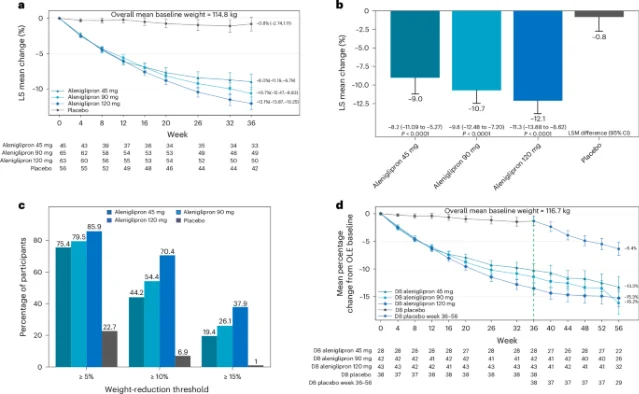
45 mg−8.2%−11.1 to −5.3<0.0001
90 mg−9.8%−12.5 to −7.2<0.0001
120 mg−11.3%−13.9 to −8.6<0.0001
At 120 mg: 86% of participants lost ≥5% body weight; 70% lost ≥10%; 38% lost ≥15%. Weight loss had not plateaued by Week 36. 4
Figure 3 from ACCESS trial: (a) LS mean weight change over 36 weeks by dose, (b) placebo-adjusted change at Week 36 with CIs, (c) categorical weight loss thresholds, (d) open-label extension interim analysis to Week 56
Fig. 3 from the ACCESS Phase 2b trial showing dose-response weight reduction curves and open-label extension data (Rosenstock et al., Nat Med, 2026). 4
OLE interim analysis (median 20 weeks additional follow-up): total weight loss from baseline reached 16.2% — the curve continues descending. No drug-induced liver injury events, no deaths. GI adverse events were mild-to-moderate and decreased in frequency after dose escalation. All-cause treatment-related discontinuation: 10.4%. Cardiometabolic secondary endpoints improved: hsCRP fell 28.8–46.4%; HbA1c fell 0.27–0.36%. 4
Clinical implication: Phase 2b cannot establish efficacy for approval, but the −11.3% placebo-adjusted loss at the highest dose — comparable to injectable semaglutide Phase 2 data at similar timepoints — positions aleniglipron as a competitive oral-GLP-1 candidate. Structure Therapeutics has announced Phase 3 initiation for Q3 2026. The absence of a weight-loss plateau and the 16.2% cumulative loss in OLE are the two signals most worth watching when Phase 3 data mature. The earlier aleniglipron data were covered in the June 6 digest; the June 5 publication date places this paper just outside the strict 24-hour window for this issue but within the prior-day clinical relevance horizon. 4
Lead author affiliation: Julio Rosenstock (lead corresponding); Structure Therapeutics, South San Francisco, CA (sponsor/affiliating institution for multiple co-authors). 4

4. FLOW-CMD Registry — CMD present in 21.5% of obstructive CAD patients; HR 1.91 for MACE at 2 years (Lancet, June 6)

Journal: The Lancet — IF tier 1 (IF ~100) Study design: Prospective, multicenter cohort study; 7 tertiary hospitals, South Korea; April 2022 – November 2024. Population: 5,764 screened; 1,003 enrolled (756 men, 247 women). Age ≥ 18; referred for clinically indicated invasive coronary angiography. All underwent systematic coronary physiological assessment (CFR + IMR measurement). Peer-review status: Published (Lancet 2026;407:2319–2328). Funded by Abbott Vascular and Boston Scientific. 5
CMD definition used: coronary flow reserve (CFR) < 2.0 and index of microcirculatory resistance (IMR) ≥ 25. Both criteria required — making this a conservative, double-threshold phenotype.
Key prevalence findings:
  • CMD in patients with obstructive CAD (FFR ≤ 0.80 or severe stenosis): 21.5% (123/573)
  • CMD in patients without obstructive CAD: 9.3% (40/430)
Primary outcome (all-cause death + MI + clinically driven revascularization + HF hospitalization): 2-year Kaplan–Meier estimate 18.8% (CMD) vs. 10.5% (no CMD); HR 1.91 (95% CI 1.22–2.99); p = 0.0047. Median follow-up: 1.9 years. 5
Clinical implication: One in five patients undergoing invasive angiography for suspected ischemic heart disease has CMD by this rigorous dual-threshold definition — and their 2-year composite event rate is nearly double that of patients without CMD. This is a real-world cath lab registry, not a selected research cohort, which strengthens external validity. The data support routine physiological assessment (CFR + IMR) during clinically indicated angiography, particularly when epicardial lesions appear borderline. No randomized trial data yet exist to show that CMD-targeted therapy reduces events, so the implication is currently prognostic and risk-stratification oriented rather than prescriptive. The ongoing TREAT-CMD and similar trials will be the next critical data points.
Lead author affiliation: Joo Myung Lee (Division of Cardiology, Samsung Medical Center, Sungkyunkwan University School of Medicine, Seoul, South Korea). 5

5. SOHO — HFNC does not reduce 28-day mortality vs. standard oxygen in moderate-to-severe AHRF (NEJM, June 4)

Journal: New England Journal of Medicine — IF tier 1 (IF ~100) Study design: Multicenter, open-label RCT; France; 556 HFNC vs. 554 standard O₂. Population: N = 1,110 analyzed. Inclusion: PaO₂/FiO₂ ≤ 200 mmHg, RR > 25 breaths/min, pulmonary infiltrate on imaging — moderate AHRF by Berlin/ARDS criteria overlap. Peer-review status: Published (N Engl J Med 2026;394:2099–2108). Funded by French Ministry of Health (PHRC-19-0305) and Fisher & Paykel Healthcare. 6
ICU patient receiving high-flow nasal cannula oxygen therapy, cardiac monitor visible in background
SOHO enrolled 1,116 patients with PaO₂/FiO₂ ≤ 200 mmHg across French ICUs; HFNC vs. standard oxygen were compared head-to-head for 28-day mortality. AI-generated illustration.
Results:
EndpointHFNCStandard O₂Difference (95% CI)P
28-day mortality (primary)14.6%14.6%−0.05 pp (−4.21 to 4.10)0.98
28-day intubation42.4%48.4%−5.93 pp (−11.78 to −0.08)Borderline
Spontaneous breathing SAEs (cardiac arrest/pneumothorax)2.3%1.1%
The primary mortality endpoint is unambiguously null. The intubation reduction is borderline significant (the confidence interval just touches zero) and was a secondary endpoint — it does not rescue the trial's clinical conclusion. The higher spontaneous breathing SAE rate (2.3% vs. 1.1%) — while a secondary safety signal requiring cautious interpretation given the trial was not powered for this — echoes prior concerns about P-SILI (patient self-inflicted lung injury) with unsupervised high-effort breathing under HFNC. 6
Clinical implication: SOHO joins FLORALI-2 and other RCTs in failing to demonstrate a mortality advantage for HFNC over conventional oxygen in AHRF. The borderline intubation signal may inform resource-constrained settings where avoiding intubation carries real operational value, but it should not be the primary justification for HFNC use in patients with moderate AHRF who are hemodynamically stable. For intensivists managing de novo hypoxemic respiratory failure: HFNC remains a reasonable comfort/effort-reduction tool, but it does not improve survival in this population. The P-SILI safety signal warrants attention in patients with high spontaneous breathing effort.
Lead author affiliation: Jean-Pierre Frat (Médecine Intensive Réanimation, CHU de Poitiers; INSERM CIC 1402, Université de Poitiers, Poitiers, France) and Arnaud Thille (CHU de Poitiers), on behalf of the SOHO Trial Group and the REVA Network. 6
Cover image: AI-generated illustration.

围绕这条内容继续补充观点或上下文。

  • 登录后可发表评论。