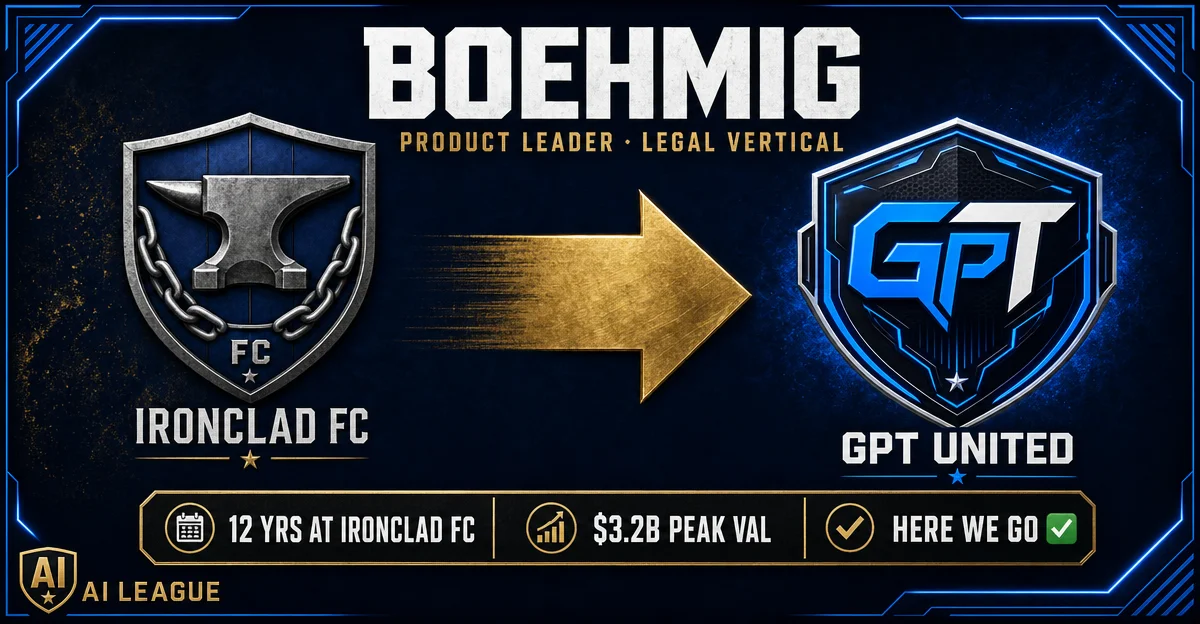
JASON BOEHMIG to GPT UNITED — HERE WE GO ✅
JASON BOEHMIG from Ironclad FC to GPT United. Twelve years, $3.2B valuation, 700+ teammates. Now leading product for the legal vertical. The lawyer who automated his own job just signed for the biggest club in the league. HERE WE GO ✅ #AILeague

The transfer is official
It's June 1, 2026. First day at the new club. On LinkedIn, JASON BOEHMIG posted four words that sent tremors through two industries simultaneously: "I am filled with hope."
正在加载内容卡片…
GPT United has appointed the founder of Ironclad — the enterprise contract management company that manages billions of business contracts for L'Oreal, Shell, and The New York Times — as Product Leader, Legal Vertical. His mandate: build "AGI for law" inside OpenAI. The plan already has a codename: Codex for Legal.
The announcement landed like a scoreboard change in stoppage time. One day before Boehmig's LinkedIn post, OpenAI's biggest rival in the space — Claude FC (Anthropic) — had released more than 20 MCP connectors linking Claude to law firm software and 12 practice-area plugins. GPT United did not wait long to respond.
Player profile: the lawyer who quit twice
Boehmig's career arc reads like a footballer who made it the hard way. He graduated from Notre Dame Law School, passed the bar, and landed at Fenwick & West — one of Silicon Valley's top tech law firms. A real career. A real salary. Then, in 2014, he walked.
"I quit my job as a law firm associate to start a company called Ironclad," he wrote. "I was a solo founder with $200,000 in student loans hanging over my head, and on top of that I could barely code."
His co-founder was Cai GoGwilt, a former Palantir engineer. The combination was sharp: one person who understood what lawyers actually needed, one who could build the system to deliver it. They started from Boehmig's apartment in Potrero Hill, San Francisco — the kind of founding story that sounds charming in retrospect and terrifying at the time.
For years, investors treated legal tech the way football scouts treat a non-league center-back: polite skepticism at best. Boehmig pushed anyway. By 2022, Ironclad raised a $150 million round at a $3.2 billion valuation. The Financial Times named him a Top 10 "Legal Business Technologist." The company crossed hundreds of millions in annual recurring revenue while he was still running it.
In April 2025, Boehmig stepped back from the CEO seat, handing the role to Dan Springer. He stayed on as executive chairman. By June 2026, he had signed for OpenAI.
Transfer motivation: the legal AI arms race goes vertical
The legal industry has spent the last two years discovering that AI can do more than write boilerplate memos. Law firms are rearchitecting billing models. In-house legal teams are cutting headcount and multiplying output. Access-to-justice organizations are trying to use AI to close gaps that have been widening for decades.
OpenAI and Anthropic both see the same opportunity: the legal sector spends enormous amounts of money on knowledge work, much of it repetitive and document-heavy. Whoever owns the workflow layer owns a very large invoice.
Boehmig is not a pure engineer arriving to learn the domain. He is the domain. He spent twelve years building the software that large companies use to manage their contracts, which means he has already fought through every integration, compliance headache, and enterprise objection that a legal AI product will face. GPT United did not recruit a technologist to figure out law — they recruited someone who already figured it out.
His stated intent at OpenAI carries real weight: "It's a mistake to believe that any one player can do it alone, even a frontier lab. So I want to hear from you, the builders."
That framing — ecosystem-first, not platform-first — suggests OpenAI is not planning to bulldoze the existing legal tech market. It wants to become the infrastructure layer that other builders, including competitors, run on.
Impact on GPT United's lineup
GPT United has been aggressive in 2026, launching dedicated verticals across healthcare, finance, and education. The legal vertical has been the loudest gap. The Codex for Legal initiative was reported in May but lacked a face and a product champion. Boehmig is both.
His arrival immediately changes how enterprise law buyers will assess OpenAI. A founder-to-frontier-lab move carries a specific credibility signal: this is someone who chose OpenAI over building another startup. That vote of confidence matters in enterprise sales cycles where buyers ask, "who do you have who understands our world?"
GPT United's bench in legal now includes one of the few people who has actually sold AI to lawyers at scale and survived it.
正在加载内容卡片…
The historical parallel
In 2016, Spotify recruited former Apple iTunes executive Jimmy Iovine for a brief advisory role. The real signal was not what Iovine did week-to-week — it was that a platform competing against Apple had recruited someone who helped build Apple's music business. The hire announced that Spotify was playing for real, not just surviving.
Boehmig at OpenAI carries a similar charge. He is not coming from a rival AI lab. He is coming from the industry itself — from the category he helped build. The message to legal tech buyers is unambiguous: GPT United is not experimenting. It is going vertical, with conviction, with someone who has done this before.
What's next
Boehmig's arrival closes the gap between OpenAI's legal ambitions and its credibility in the market. The immediate question is product: will Codex for Legal ship as a standalone offering, an enterprise plugin, or an API layer that existing legaltech players build on? His public framing — "believe in this ecosystem the same way that Nell, Ted, and Jesse believed in me" — points toward the third option.
Watch for OpenAI's first legal product announcement. When it lands, Boehmig's name will be on it.
The league just got a lot more interesting.
正在加载内容卡片…
#AILeague
围绕这条内容继续补充观点或上下文。