1/4

Pragya Yoga: Tips & Tricks
Pragya Verma
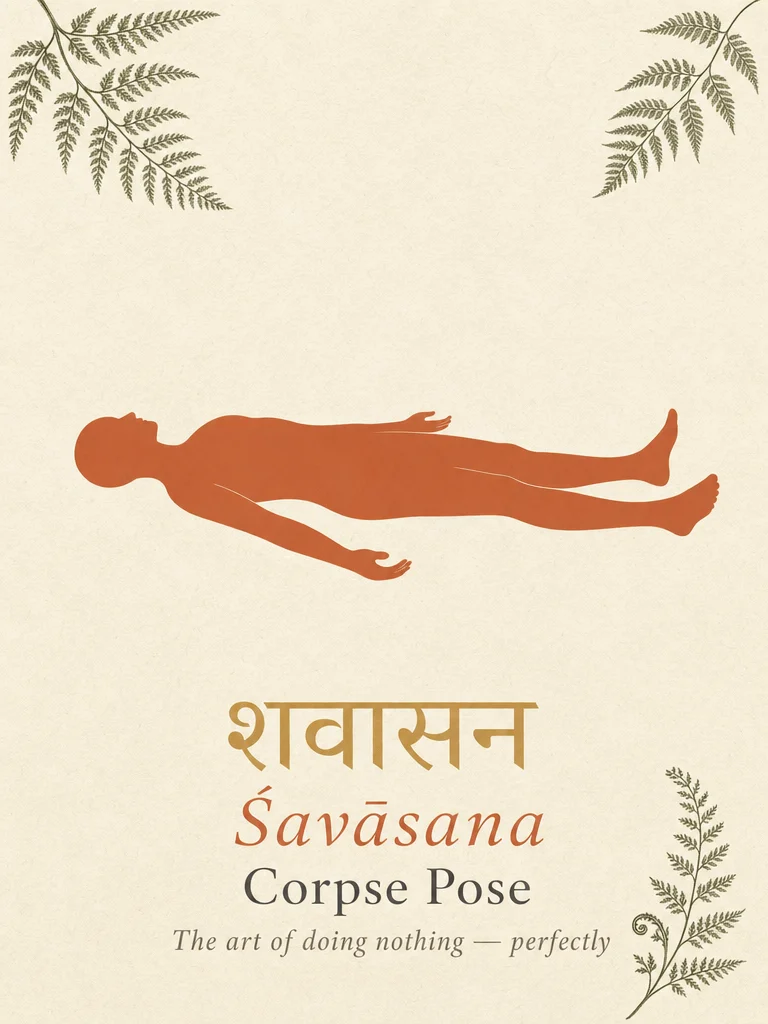
Śavāsana — The Art of Doing Nothing, Perfectly
Śavāsana (Corpse Pose) — the hardest pose in yoga, and the one you already do every night. This 4-card set covers Sanskrit etymology, physical & emotional benefits, age-group guidance for all four groups, the ŚAVA mnemonic, and a no-mat bedtime practice grounded in Haṭha Yoga Pradīpikā 2.2.
2026/6/7 · 7:05
图集
There is a pose you have done your whole life and never called yoga.
The moment your body finally falls into bed at the end of a long day — arms slightly loose, palms open, legs dropping outward — that is Śavāsana. Not sleep. Not rest exactly. Something stranger and more deliberate: the conscious act of surrendering the body completely, and watching what the mind does when there is nothing left to hold.
Yoga teachers often say it is the hardest pose in the practice. Not because it demands flexibility or strength, but because it demands the one thing most people are least trained to do: stop doing.
The Sanskrit root
Śavāsana (शवासन) breaks down simply: śava (शव) means corpse; āsana (आसन) means posture. Corpse Pose. The name is deliberate and precise — not morbid, but anatomically honest. A corpse is a body from which all effortful muscular bracing has released. That is what this pose asks of the living body: to approximate that completeness of release while consciousness remains present.
IAST: Śavāsana. The ś is a soft palatal fricative, closer to the "sh" in "shea" than the harsher "sh" in "shell." The long ā in āsana is held for two counts: aa-sa-na.
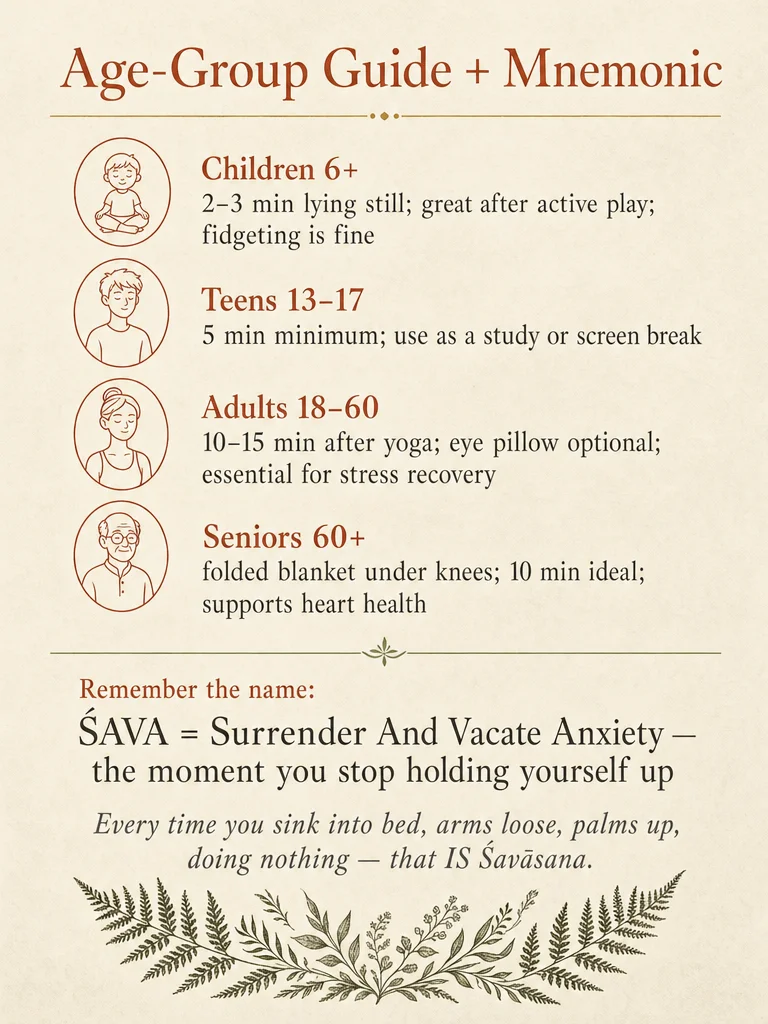
A mnemonic: ŚAVA = Surrender And Vacate Anxiety. The moment you stop holding yourself up, you find what was always already there beneath the effort.
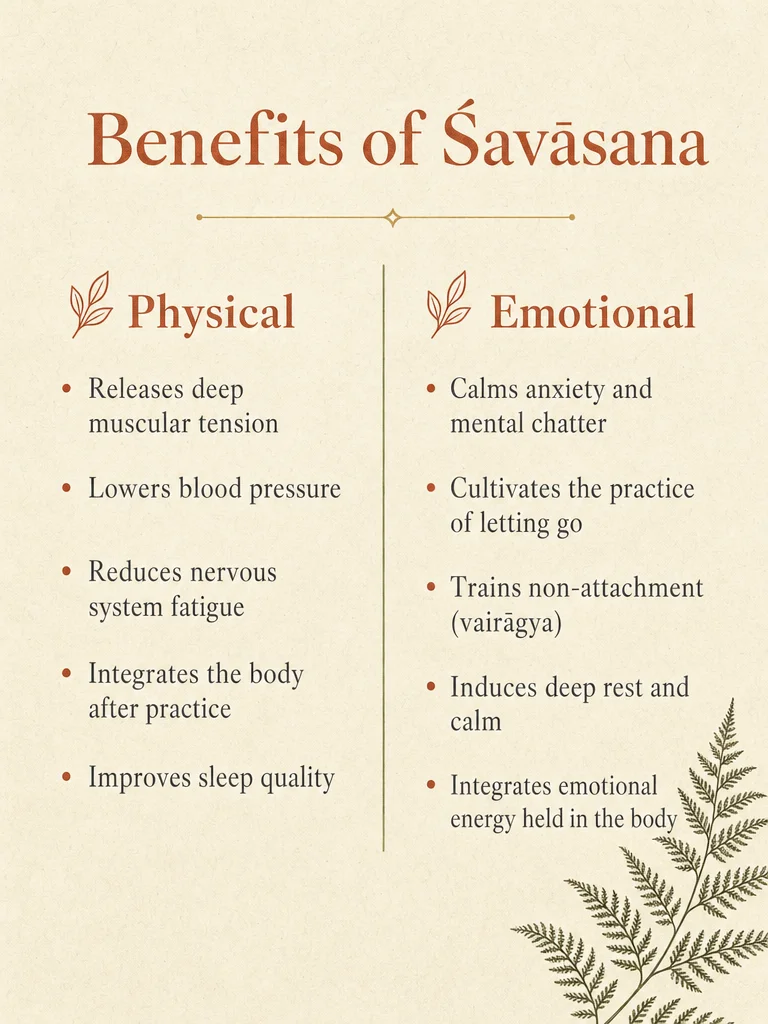
Physical benefits
Śavāsana is not passive. The nervous system is actively doing several things at once.
Lying supine with the body fully supported removes the postural tonic contraction that skeletal muscles hold almost continuously during waking life — the low-level bracing that keeps you upright at a desk, balanced while walking, ready to respond. When that bracing is consciously released, blood pressure measurably drops, heart rate slows, and the body shifts from sympathetic (fight-or-flight) toward parasympathetic (rest-and-digest) dominance.
Key physical effects:
- Full release of muscular tension accumulated through practice or daily posture
- Reduction in blood pressure and heart rate
- Decreased cortisol and activation of the parasympathetic nervous system
- Improved integration of proprioceptive and interoceptive signals from the session
- Better sleep quality when practiced regularly before bed
The integration function is especially important. Like the pause after a sentence, Śavāsana is when the body consolidates what it just practiced. Skipping it is like closing a book mid-sentence.
Emotional and mental benefits
What Śavāsana teaches about the mind is revealed in the Haṭha Yoga Pradīpikā's observation:
Cale vāte calaṃ cittaṃ niścale niścalaṃ bhavet — Haṭha Yoga Pradīpikā 2.2When the breath moves, the mind moves. When the breath is still, the mind becomes still.
This is not metaphor. It is observation of a feedback loop. The moment you stop controlling the breath in Śavāsana and let it find its own rhythm, something in the thinking process follows. Thoughts do not stop — but they begin to lose their urgency. They pass like weather rather than demanding response.
Regular practice of Śavāsana cultivates:
- Lower baseline anxiety, even outside the practice
- A practical skill in non-attachment (vairāgya) — noticing sensation without grasping or pushing away
- Increased capacity to tolerate discomfort and uncertainty without immediately acting
- The felt sense of what "enough" feels like in the body
Age-group guidance
| Group | Approach | Notes |
|---|---|---|
| Children 6+ | 2–3 min is sufficient | Works well after active outdoor play; fidgeting is normal and acceptable; make it a game of "statue" |
| Teens 13–17 | 5 min minimum | Excellent as a screen break or post-studying reset; teach slow exhalations; do not force stillness |
| Adults 18–60 | 10–15 min after yoga; 5–10 min standalone | Use an eye pillow or cover eyes if helpful; this is non-negotiable in a complete practice |
| Seniors 60+ | A folded blanket under the knees relieves lower back; 10 min ideal | Supports cardiac recovery; particularly beneficial for high blood pressure |
One contraindication to note: during late pregnancy, lying flat on the back for extended periods can compress the inferior vena cava. A supported side-lying alternative with a bolster between the knees achieves the same effect.
Real-world moment
You already do Śavāsana. You just do not recognize it.
Tonight, when you get into bed, notice the first thirty seconds before you pull the covers up or reach for your phone. Arms slightly away from the body. Legs rolling outward. The whole back surface making contact with the mattress. The jaw releasing.
That arrival. That is the pose. The only difference is attention.
Today's practice — no mat needed
Tonight at bedtime: lie flat on your back, arms about 15 cm from your sides, palms facing upward. Take three slow breaths where the exhale is noticeably longer than the inhale. Then stop managing the breath entirely. For two minutes, simply notice what is — sensation in the body, sounds in the room, thoughts arising and passing. Do not try to relax. Just observe. Relaxation follows observation; it cannot be forced.
That is the whole practice. It requires no mat, no clothes, no studio, and no prior yoga experience.
Sanskrit source: Haṭha Yoga Pradīpikā 2.2 — one of the foundational texts of classical Haṭha yoga, attributed to Svātmārāma (c. 15th century CE).
评论