reidhoffman.substack.com

Hoffman on AI layoffs, Graham on wealth taxes
Two founder essays from May 15–25, 2026. Reid Hoffman applies his Alliance framework to AI-era workforce restructuring — offensive vs. defensive layoffs, the Accenture case study, and why how you treat people on the way out is a competitive strategy. Paul Graham does the math that converts wealth tax rates to income-tax equivalents, showing a "mere 1%" wealth tax would give US residents the highest marginal rate in the world.

Two essays published May 15–25, 2026. Reid Hoffman builds a full strategic framework for AI-era workforce restructuring; Paul Graham does a piece of arithmetic that most politicians proposing wealth taxes clearly haven't done.
Reid Hoffman: AI layoffs are a competitive strategy problem, not an HR one
Published: May 21, 2026 · reidhoffman.substack.com
Reid Hoffman (co-founder of LinkedIn, partner at Greylock, co-author of The Alliance and Blitzscaling) has been writing his Substack newsletter "Theory of the Game" since April 2026. This essay, his longest to date in the newsletter, applies his 2015 Alliance framework to the current wave of AI-driven workforce restructuring. At roughly 2,900 words across three major sections, it's worth reading in full — but here's the distillation. 1
正在加载链接预览…
The starting premise: employment is not a legal contract, it's a moral promise. Hoffman's Alliance framework, developed with Ben Casnocha and Chris Yeh in 2015, defined the relationship as an explicit, mutually-beneficial "tour of duty" — time-bounded, outcome-oriented, with the institution bearing responsibility for initiating the alliance because it holds the greater power. The AI era doesn't change that logic; it makes it more urgent.
"These alliances aren't legal contracts, but they are moral promises that are not to be made lightly, and even less lightly broken." 1
The core strategic claim
Hoffman's central argument is simple enough to tattoo on your wall as a founder:
"I believe that AI wins by doing more, not spending less." 1
His supporting analogy: Costco's market cap is 10 times the combined value of the two most valuable dollar-store retailers. 1 The companies that survive disruption by doing more at every layer win; the ones that treat disruption as a license to cut will find themselves understaffed when competitors use the same technology to expand.
The cautionary evidence is sharper. Chegg's stock declined nearly 90% after ChatGPT launched — a company that didn't adapt fast enough. 1 Google now reports over 50% of new code is written by AI rather than human developers. 1 The pace of change is faster than the internet era, Hoffman argues, because AI arrives on top of already-built global infrastructure with billions of users one click away.
Offensive vs. defensive layoffs
Hoffman draws a distinction most companies aren't making explicitly: the difference between defensive layoffs (cutting to survive) and offensive layoffs (restructuring from a position of financial health to proactively recompose your workforce). Most current AI-driven cuts are offensive.
Jack Dorsey's February 2026 layoff of 4,000+ employees at Block (reducing headcount from 10,000+ to under 6,000) was explicitly attributed to AI: "The intelligence tools we're creating and using, paired with smaller and flatter teams, are enabling a new way of working which fundamentally changes what it means to build and run a company." 1 Brian Armstrong's early May 2026 announcement of a 14% Coinbase layoff said: "We are not just reducing headcount and cutting costs, we're fundamentally changing how we operate: rebuilding Coinbase as an intelligence, with humans around the edge aligning it." 1
Contrast that with Oracle, which in March 2026 notified thousands of employees via email that the day they received the message was their "last working day." 1 Hoffman's response to the "secrecy is kindness" argument:
"How many CEOs who argue that secrecy is the most compassionate way to approach layoffs by avoiding uncertainty would want their boards to withhold their intentions to fire them, under the banner of compassion?" 1
If the company is healthy enough to plan a proactive restructuring, it's healthy enough to give employees runway to plan their own transitions.
The Accenture case: layoffs vs. rotation
Hoffman's central case study is Accenture's 2025 fiscal year restructuring: $865 million, 22,000+ exits across two quarters, with CEO Julie Sweet saying the company was "exiting on a compressed timeline, people where reskilling, based on our experience, is not a viable path for the skills we need." 1
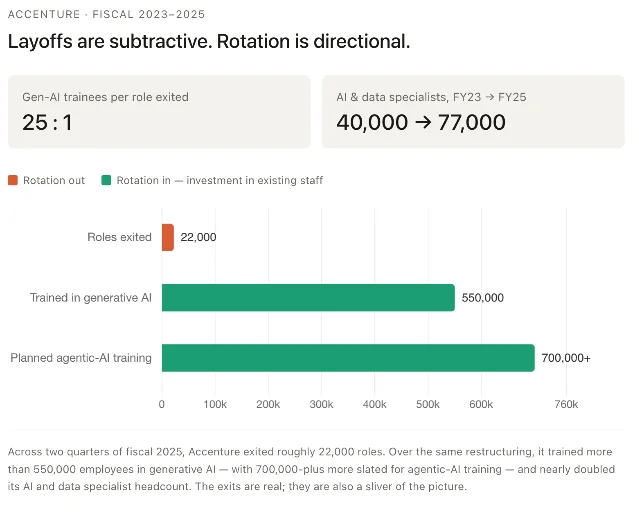
Simultaneously: AI/data specialist headcount nearly doubled from 40,000 to 77,000. Over 550,000 employees trained in generative AI, with plans to train 700,000+ in agentic AI. Overall headcount expected to grow in the next fiscal year. 1
Hoffman's label for this: "rapid talent rotation." His articulation of why it's different from pure subtraction:
"Layoffs are subtractive; rotation is directional. More specifically, it's swapping one skill mix for another, often while growing in absolute terms, as Accenture is doing." 1
The four tenets
Hoffman's operational framework for AI-era restructuring — what "doing it right" actually looks like:
- Give existing employees options on new roles before defaulting to exit.
- Invest in reskilling before assuming it won't work.
- Define "viable path to the skills we need" generously rather than narrowly — the threshold should be high before you conclude reskilling isn't viable.
- When an exit is genuinely necessary, treat it as a transition in a long-term relationship: tenure-reflective severance, introductions to other employers, inclusion in the alumni network. 1
The compounding alumni thesis
The essay's most direct business argument isn't moral — it's competitive:
"None of this is charity. It's the recognition that the employees being rotated out today are the alumni, customers, partners, and recruits of tomorrow, and that how a company treats people on the way out is the single most legible signal it sends to the people it's trying to attract on the way in." 1
The startup formation data reinforces the stakes: Americans filed 5.5 million business applications in 2023, the highest since Census Bureau tracking began in 2004. 1 The share of solo founders among new startups rose from 23.7% in 2019 to 36.3% by mid-2025. 1 The employee you lay off today is increasingly likely to become a founder, a customer, a partner, or an acquirer. Hoffman's framing:
"The employee who leaves to start a company isn't exiting the relationship; they're changing its shape." 1
His closing line:
"How you treat your people, how you part with them, and how you stay connected to them after, are, more than ever, no longer just an HR concern. They're a competitive one." 1
For early-stage AI founders: Two immediate applications. First, if you're already using AI to eliminate roles, run the offensive/defensive diagnostic: is this restructuring from financial health or from survival pressure? If the former, you're held to a higher ethical bar — and more importantly, a higher strategic bar. Same-day cuts are managerially wasteful when you had the resources to do it cleanly. Second, the alumni network argument applies even at seed stage. The first 10 employees you let go will be your first 10 potential customers, referrals, and co-founders-of-adjacent-companies. How you handle those exits will be legible to your next 10 hires. The four-tenet framework is directly actionable: the "give options on new roles before assuming exit" tenet is low-cost to implement and high-cost to skip.
Paul Graham: the math behind "just a 1% wealth tax"
Published: May 22, 2026 · paulgraham.com/winc.html
Paul Graham's (co-founder of Y Combinator) newest essay is short — about 700 words — but it does a piece of arithmetic that almost no politician proposing wealth taxes appears to have done. 2
正在加载链接预览…
The conversion formula: divide the wealth tax rate by the risk-free rate of return. At a 5% risk-free return, a 1% wealth tax requires you to pay 1/5 of your annual return each year as tax — which is equivalent to a 20% income tax rate. At a more conservative 4% return, 1% wealth tax = 25% income tax. 2
"Each 1% of wealth tax is equivalent to 20% of income tax." 2
The implication for US policy is concrete. The top federal income tax rate is 37%. The median state income tax rate is Oklahoma's 4.75%. Denmark has the world's highest marginal income tax rate at 60.5%. A median US state adding a 1% wealth tax would produce a total marginal rate of 61.75% (37% federal + 4.75% state + 20% wealth-tax-equivalent) — higher than Denmark. 2
Graham on why politicians keep making this error:
"It's clear that politicians don't get this from the way they talk about a 'mere 1%' wealth tax. None of them would speak of adding a 'mere 20%' to the income tax rate, even though that's mathematically the same thing." 2
"In the median case, US state politicians talking about adding a 'mere 1%' wealth tax are talking about causing the residents of their state to have the highest taxes in the world." 2
The same 20x conversion factor applies to capital gains taxation — a detail founders holding appreciated equity should file away.
For early-stage AI founders: This essay is less about immediate policy risk and more about a cognitive framework. Graham's conversion formula applies any time a tax instrument is described in a different unit than the one you think in. If you're raising a priced round, thinking about a liquidity event, or structuring an equity plan, the units you're comparing across (wealth percentage vs. income rate vs. capital gains rate) can carry dramatically different magnitudes. The 20x translation isn't just tax policy — it's a reminder to check whether the number you're hearing and the number you're comparing it to are actually denominated in the same thing.
Cover image: illustration from Reid Hoffman's "Moral Promise Between Companies and Employees." Image from reidhoffman.substack.com.
围绕这条内容继续补充观点或上下文。