The Temple of Dendur: a Roman emperor's sandstone proxy, sailed to New York beneath Italian cheese
Commissioned by Augustus around 23 BCE as a monument of Roman soft power in Nubia, the Temple of Dendur honors two deified drowned brothers — Pedesi and Pihor. After Coptic conversion, Nile flooding, Jackie Kennedy's personal intervention, and a competitive "Dendur Derby" won by the Met, the sandstone temple crossed the Atlantic aboard a cargo ship, packed beneath Italian cheese, to become one of New York's most iconic spaces.
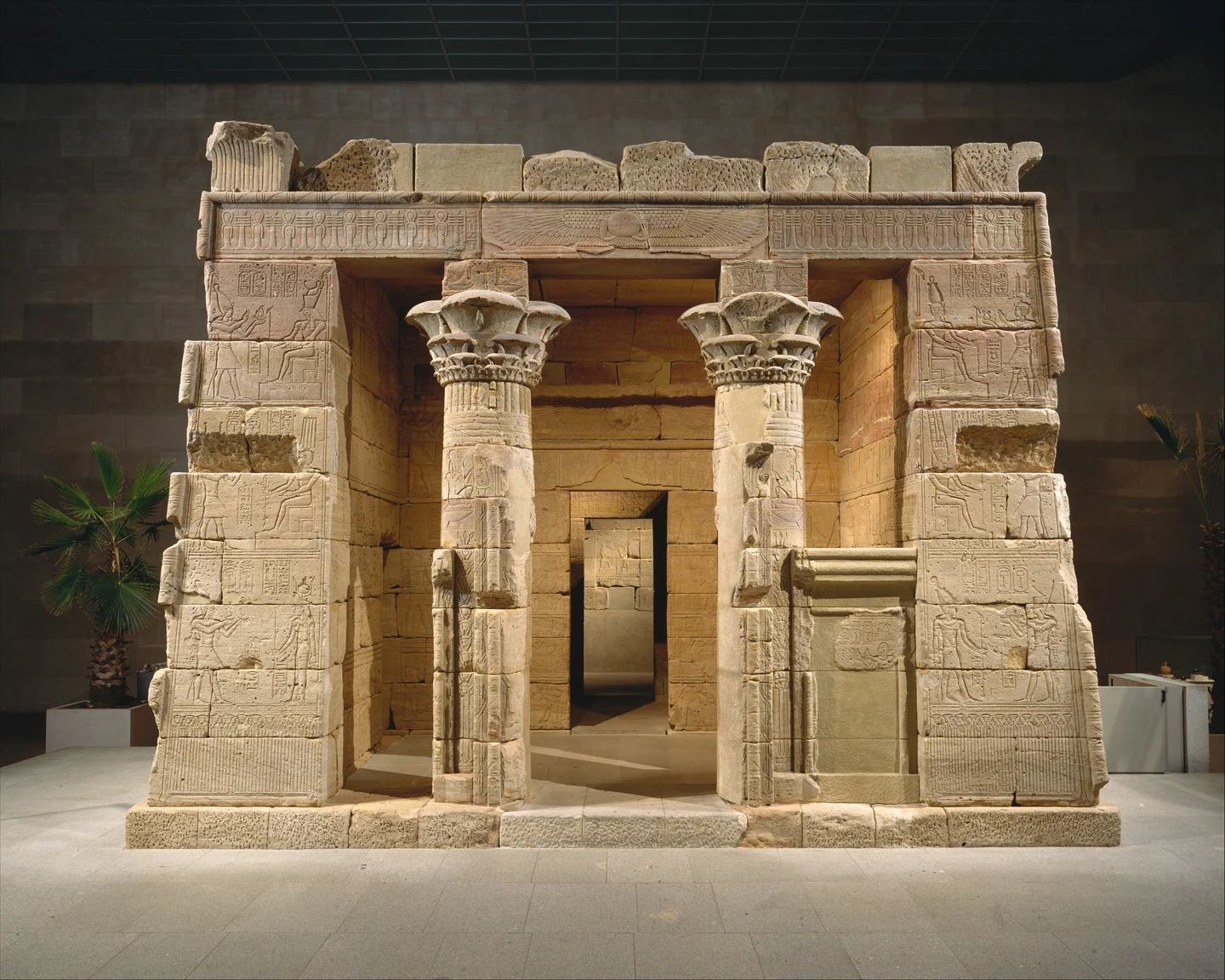
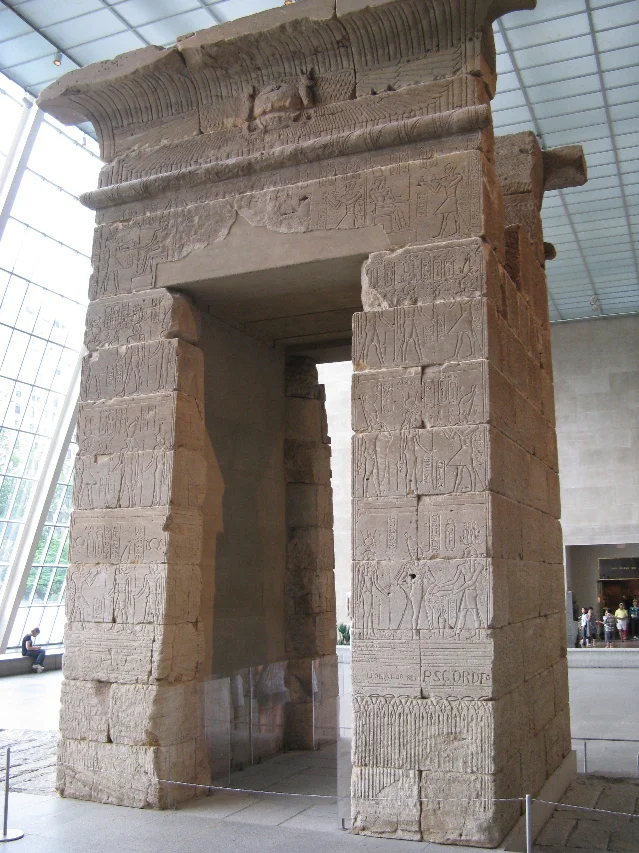
Step into Gallery 131 at the Metropolitan Museum of Art on a bright morning and you may stop without meaning to. The room is enormous — a glass-and-granite greenhouse attached to the museum's Fifth Avenue building — and at its center, raised on a low platform above a long rectangular pool, sits a small Egyptian temple. It is a pale, pinkish-gold sandstone structure not much taller than a two-story townhouse. The water below it catches the diffused light from the stippled glass ceiling above. On the back wall, a sloping granite cliff simulates the Nubian landscape that surrounded the original site. The entire composition — temple, water, cliff, sky — is a room-sized diorama of a world that has been underwater since the mid-1960s.1
The temple is about 2,000 years old. It was built in Nubia, dismantled block by block in 1963, shipped to New York aboard a freighter carrying Italian cheeses, and reassembled here over three years by Met conservators and stonemasons working from a numbering system applied to each of its 661 sandstone blocks.2 It has a hidden chamber whose purpose remains unknown. It once blazed with painted colors that thirty years of annual flooding washed away. And on its walls, carved in sunk relief, a Roman emperor performs the rituals of an Egyptian pharaoh for a goddess and two brothers who drowned in the Nile.
None of this was supposed to end up in New York. The story of how it did is strange enough to seem invented.
Augustus on the Nile, in costume
The temple dates to the reign of Augustus (r. 27 BCE–14 CE), the first Roman emperor, who absorbed Egypt into his domain after defeating Mark Antony and Cleopatra VII at the Battle of Actium in 31 BCE.2 Egypt was not treated as an ordinary Roman province; Augustus governed it as his personal estate, appointing prefects and taking extraordinary care with its religious institutions. The Nile valley was immensely productive, strategically irreplaceable, and religiously complex. Managing it required a delicate touch.
Part of that touch was commissioning temples. In the far south of Egypt, in what the Romans called the Dodecaschoenus — a 75-mile stretch of Lower Nubia running from the island of Philae (near modern Aswan) south to a site called Maharraqa — Rome had recently concluded a difficult war. Around 24 BCE, the Meroitic queen Amanirenas led a Kushite army north and sacked Aswan, Philae, and Elephantine. The Roman prefect Gaius Petronius retaliated, pushing deep into Nubian territory and sacking the Meroitic capital at Napata.3 The Treaty of Samos, signed around 20 BCE, ended the conflict and established the Dodecaschoenus as a jointly administered buffer zone — a region where both Romans and Nubians had access to the major temples.4
Into this politically sensitive landscape, Augustus commissioned a new temple at a small Nile-bank settlement called Tuzis — later Dendur — about 80 kilometers south of Aswan. Petronius oversaw its construction, using local Egyptian architects and Nubian stonemasons. The building work probably began around 23 BCE and was completed by 10 BCE.2
The temple was dedicated primarily to the goddess Isis, whose main sanctuary stood on the nearby island of Philae. Isis worship had spread throughout the eastern Mediterranean by this period — she was, in the words of Met curators Janice Kamrin and Adela Oppenheim, a universal goddess whose cult transcended borders, and Dendur "was an essential part of the Roman strategy to use religion to help mediate its complex social and political relationship with Nubia."4 The temple was also dedicated to the gods Osiris and Horus, and to two local Nubian brothers who had recently drowned.
Their names were Pedesi — "he whom Isis has given" — and Pihor — "he who belongs to Horus." They were the sons of a Nubian chieftain named Quper. Both died in the Nile.5 In Egyptian religious belief, drowning in the Nile was not an ordinary death; the sacred river was thought to lift those who died in it toward divinity, associating them with Osiris, who had himself drowned according to certain versions of the myth. A local cult formed around Pedesi and Pihor after their deaths. Rome incorporated them into the official religious program of the new temple, and they were depicted in its innermost sanctuary — the only space in the entire building where Augustus himself does not appear as the central actor.
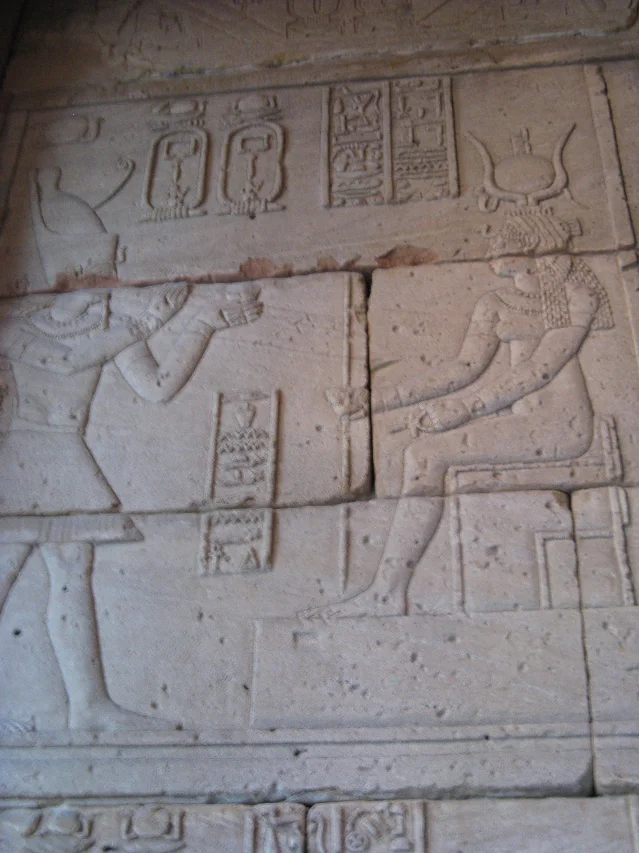
Augustus appears everywhere else. Walk around the exterior walls and you will find him carved in sunk relief — the technique that creates sharp shadows in bright sunlight — wearing a kilt with a bull's tail, a white crown, and a double crown. He carries incense burners, libation vessels, linen bags, and a cobra identified as "the cobra of truth." He makes offerings to Isis, Osiris, Horus, and the deified brothers. His cartouches — the oval-shaped hieroglyphic frames that identify Egyptian rulers — label him simultaneously as Pharaoh (pr-ˁ3, "Great House"), as Autokrator (Greek for "emperor," in one place misspelled as "Autotrator" for reasons of hieroglyphic symmetry), and as Kaisaros ("Caesar").5
He never set foot in Dendur. The temple was his stone avatar, performing the rituals of kingship at a site he would never visit. As Met Associate Curator Isabel Stünkel has noted, "Augustus is shown in Egyptian costume, as Egyptian pharaoh, and offering to Egyptian deities" — an act of deliberate religious mimicry designed to confirm his legitimacy as ruler of a region whose own traditions ran three millennia deep.5 In Egyptian theology, these depicted offerings were not merely symbolic; they were thought to magically ensure the continuation of cosmic order. The stone picture was the guarantee.
A building worth reading slowly
The temple proper measures 43 feet long, 21 feet wide, and 16 feet high — compact enough that Amelia Edwards, who visited in 1874, would call it "an exquisite toy."6 Its architecture follows a standard Egyptian sequence, moving from public to increasingly private: a monumental pylon gateway (which the Egyptians called "the Luminous Mountain Horizon") opens onto an open court; the court leads to a pronaos, or entrance porch, supported by two columns with composite capitals shaped like papyrus and lotus plants; beyond that, an antechamber used for offerings; and finally the sanctuary, the innermost room, which once held a stone repository for a sacred bark — a model boat used in religious processions — and a niche for a cult statue of Isis.2
Behind the sanctuary, accessible only by pivoting a stone block on the outer south wall, is a hidden chamber measuring roughly 9.5 feet by 6 feet by 2.25 feet. Its purpose is unknown. It may have stored cult equipment; it may have served some other function entirely. No written record explains it.2
The symbolic program of the building is layered throughout. The base of the outer walls is carved with papyrus and lotus plants rising from the Nile, personifying the god Hapi — the deity of the annual flood. Above the pylon gateway and temple entrance, a winged solar disk of Horus of Behdety extends protective wings across the threshold. The pronaos ceiling is decorated with flying vultures, an ancient Egyptian sky motif. The two columns outside the porch carry sunk-relief carvings of men bringing gifts of animals and flowers; their capitals combine papyrus (the plant of Lower Egypt) and lotus (the plant of Upper Egypt) in a single capital that was, architecturally, a statement about unified rule.5
The reliefs were originally painted in vivid reds, blues, greens, yellows, and blacks over a white gesso ground, as all Egyptian temples were. The British Egyptologist Aylward Blackman documented traces of the original polychromy in a 1906 survey.1 That paint was still partially visible in the early twentieth century. It would not remain so.
The graffiti parade
Before the dam raised the water, the temple received a long succession of visitors who left their marks — some in official ink, some carved directly into the walls.
The first Christians arrived in 577 CE, when a figure named Presbyter Abraham consecrated the temple as a Coptic church and carved an inscription to document the ceremony.1 Abraham's congregation cut a new doorway through the north wall of the pronaos, damaging the relief of Isis in the process; they then repaired her severed arm by carving it at a slightly different angle at the elbow. They covered the pagan reliefs with plaster and installed a cross on the roof. When Nubia converted to Islam in the thirteenth century, the church was abandoned. The mud-brick enclosure walls that had once surrounded the entire complex slowly vanished — taken apart by local inhabitants for building material — until only the stone pylon and temple building remained.7
The European record begins on December 30, 1737, when a Danish naval officer named Frederick Lewis Norden, traveling on behalf of King Christian VI, made the first documented Western drawings of the site.8 His plans had errors — he omitted one room, misplaced a side door, missed the gentle concave curve of the platform's front face — but he put Dendur on the map. The British traveler Richard Pococke visited the same year and left the first English-language account.
In 1819, a German architect named Franz Christian Gau, trained at the Académie des Beaux-Arts in Paris, arrived and made what Met curator Catharine Roehrig has called remarkably accurate drawings of the decoration.8 Gau was also the first to investigate the mysterious rear chamber, finding it by careful measurement and recording it in his 1822 publication Antiquités de la Nubie.
In January 1829, a French artist named Nestor L'Hôte came through as part of the expedition led by Jean-François Champollion — the man who had decoded hieroglyphics just seven years earlier. L'Hôte dined beside the temple at sunset and later described a strange acoustic effect: after supper, he wrote, "we amused ourselves with an echo which is, I think, one of the most remarkable that exists." He tested it with an Alexandrine verse — a twelve-syllable line of formal French poetry — and found that the hills across the river repeated it back, "with admirable clarity," several times, each repetition louder than the last. Gunshots, he reported, returned as "frightful claps of thunder."8
In April 1850, Maxime Du Camp arrived with his companion Gustave Flaubert. Du Camp photographed the pylon's eastern face using the salted paper process — one of the earliest photographs of the site, now in the Met's collection.8 He found the reliefs inferior and said so. A year later, the French civil engineer Félix Teynard produced the first complete photographic view of Dendur, standing at the river's edge to show the full temple elevated on its sandstone terrace.
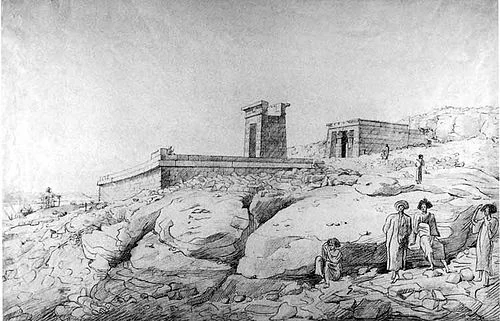
The most lyrical visitor arrived in February 1874. Amelia B. Edwards (1831–1892) was a British novelist and journalist making her first Egyptian journey; she had never planned to go to Egypt, she explained in her eventual book, but bad weather in France had altered her plans, and she had simply kept going south until she found herself on the Nile. At the temple, arriving at sunset on the way back from the Second Cataract, she stood in the rosy dusk and wrote what became the temple's most-quoted description:
"The whole thing is like an exquisite toy, so covered with sculptures, so smooth, so new-looking, so admirably built. Seeing them half by sunset, half by dusk, it matters not that these delicately-wrought bas-reliefs are of the Decadence school. The rosy half-light of an Egyptian afterglow covers a multitude of sins, and steeps the whole in an atmosphere of romance."6
Edwards called the reliefs "of the Decadence school" — a judgment that reflected the prevailing Victorian view that Roman-period Egyptian art was a late, degraded form. She was charmed anyway. Her 1877 book A Thousand Miles Up the Nile became a Victorian bestseller, and she went on to co-found the Egypt Exploration Fund (now the Egypt Exploration Society), channeling wealthy patrons into the new science of Egyptology.
The graffiti meanwhile accumulated: Royal Navy Rear Admiral Armar Lowry Corry had carved "A L Corry RN 1817" into the left side of the entrance; the Italian Egyptologist Girolamo Segato left his name; later visitors added their own.1 The oldest graffiti on the site dates to roughly 10 BCE — carved into the pronaos north wall barely five years after the temple was completed, possibly by a visitor testing the new building's acoustics in the same spirit as L'Hôte would, 1,800 years later.
Water rising
In 1933, Egypt raised the height of the Aswan Low Dam for the third and final time. The effect on the temples between Aswan and the Second Cataract — including Dendur — was catastrophic by slow increments: the complex began flooding for nine months of every year.1 For three decades, Nile water seasonally submerged the temple up to its pronaos columns, washing away whatever paint still clung to the carved surfaces. By the time the waters subsided each spring, the polychromy was a little more gone. When Egypt announced plans for a far larger structure — the Aswan High Dam, which would fill the valley with a reservoir roughly the size of Wales — the sandstone blocks at Dendur faced permanent submersion under 50 or more meters of water.9
In 1960, UNESCO launched the International Campaign to Save the Monuments of Nubia. Fifty countries contributed expertise, equipment, and money. The campaign's most dramatic achievement was the relocation of the colossal Abu Simbel temples — cut into 1,036 blocks and raised 65 meters and 200 meters inland at a cost exceeding $40 million.9 More modestly scaled temples were offered as diplomatic gifts to the countries that had contributed most substantially to the rescue effort. Temple of Debod went to Spain; Temple of Taffa to the Netherlands; Temple of Ellesiya to Italy. The Temple of Dendur was offered to the United States.
Egyptologists, photographers, and architects spent two years documenting Dendur before any physical intervention. Then, in 1963, the Egyptian Antiquities Service dismantled the complex by hand saw into 661 blocks of Aeolian sandstone, assigning each block a number recording its precise position and orientation within the structure.10 The blocks weighed approximately 640 tons in total, though Met sources give figures closer to 800 tons — a discrepancy that likely reflects whether the count includes the pylon separately and how wet weight was measured.1
In 1965, Egypt formally presented the temple to the United States in recognition of America's $16 million contribution toward saving Nubian monuments, particularly the Abu Simbel operation.10 Jacqueline Kennedy accepted the gift on behalf of the country.
Jackie's intervention
The gift would not have happened — at least not on those terms, and not with the American contribution that earned it — without Kennedy's personal involvement in the years before.
In the early 1960s, Luther Gulick, a political scientist serving on New York City's planning commissions, alerted her to the UNESCO campaign and the scale of what was at stake. She wrote to President Kennedy urging American action, and JFK lobbied Congress directly on April 7, 1961.11 In her letter to the president, her argument was architectural and moral simultaneously: "It would be like letting the Parthenon be flooded."11
Once the gift was secured in 1965, Kennedy hoped Dendur would end up in Washington. She wanted it placed on the banks of the Potomac River, where, she said, it could "remind people that feelings of the spirit are what prevent wars."11 The decision of where to place it, however, was not hers alone.
The Dendur Derby
The press called the competition the "Dendur Derby," and it had the spirit to match.1 The Smithsonian Institution proposed installing it on the Potomac riverbank — Kennedy's preferred location, and the one with the most political support. The Boston Museum of Fine Arts offered the banks of the Charles River. Cairo, Illinois, and Memphis, Tennessee, argued that their Egyptian city names made them the obvious homes. In 1966, President Lyndon Johnson received hundreds of letters from schoolchildren in Phoenix, Arizona, making their own case.12
The two outdoor proposals — Smithsonian and Boston MFA — were rejected on conservation grounds: the temple's Aeolian sandstone, already weakened by decades of Nile flooding, could not survive New York's freeze-thaw cycles, acid rain, and humidity fluctuations. The Metropolitan Museum of Art had staked its claim early — Met Director James Rorimer announced New York's interest in January 1966 — and its proposal was straightforward: house the entire structure indoors, in a climate-controlled environment that could replicate the dry heat of its original Nubian setting.
A commission appointed by the National Foundation on the Arts and the Humanities evaluated the applications. On or around April 20, 1967 — sources differ on the precise date, with some noting President Johnson's formal letter to Met Director Thomas Hoving is dated April 28 — the temple was awarded to the Metropolitan Museum of Art.112
Beneath the Italian cheeses
Six years elapsed between the temple's dismantling in 1963 and its arrival in New York. The 661 blocks had been packed into 661 wooden crates, and they were loaded aboard the Italian freighter SS Concordia Star for the transatlantic crossing. When the ship docked at Pier 10 on Hamilton Avenue in Brooklyn in August 1968, the museum writer Cyril Aldred recorded the scene:
"On board, in the lower hold, beneath Italian cheeses, canned tomatoes, and jars of maraschino cherries, was the Temple of Dendur."10
The New York Times had reported the previous month that the shipment would arrive "shy 4 blocks" — four stones unaccounted for somewhere in transit. The discrepancy was never publicly explained.
The crates were taken to the Met and stored in enormous inflatable canvas-and-vinyl structures — "bubbles," as they became known — in the museum's South Parking Lot. They remained there until 1974, when the blocks were moved to the North Parking Garage as construction of the new gallery finally began.13 The relocation and rehousing cost approximately $9.5 million in total; Lila Acheson Wallace, co-founder of Reader's Digest, provided major financial support.1
Kevin Roche's glass house for a sandstone temple
The gallery was designed by Kevin Roche (1922–2019) and his partner John Dinkeloo (1918–1981) of the Connecticut firm Roche-Dinkeloo. Roche, an Irish-born architect who had trained under Eero Saarinen and gone on to design major museums and corporate campuses across the United States, was a student of Egyptian architecture and had incorporated pyramidal forms into earlier projects.13
His solution to the problem of housing a Nubian temple on the east side of Manhattan was a long glass-and-granite room attached to the museum's north wing. Every element of the design serves an analog to the original site: the long rectangular reflecting pool in front of the temple represents the Nile; the sloping granite wall behind it evokes the sandstone cliff that once rose above the original platform; the stippled glass ceiling and north wall diffuse light to approximate the quality of Nubian sun without the intensity.2 The climate-control system maintains the temperature and humidity levels of a dry Egyptian environment. The temple faces east — as it did on the Nile bank — and the proportions of the room give visitors enough distance to see the full structure the way it was meant to be seen: from the front, across water, with light falling from above.
On July 15, 1975, Met conservators and stonemasons began the physical reconstruction of the temple, reassembling the numbered blocks like a three-dimensional jigsaw with a great deal riding on each placement.1 The gallery opened to the public on September 27, 1978 — fifteen years after the temple had been cut apart in Nubia. It was named the Sackler Wing, after Arthur M. Sackler, the art collector and philanthropist whose family later became synonymous with the opioid crisis. In 2021, the Met stripped the Sackler name. The space is now listed as Gallery 131.1
Until 1994, visitors could only observe the temple from the exterior — it was displayed, as curator Dorothea Arnold explained, "sculpturally, as an object to view and admire on a pedestal like a statue."13 That year, the Met began allowing small groups to enter the pronaos and antechamber under guard supervision. Standing inside the pronaos, between the two lotus-papyrus columns, you can see the inner south wall where Augustus burns incense for Pedesi and Pihor, and you can see, on the sanctuary's back wall, the only scene in the building where the emperor is absent: Pihor adoring Isis, and Pedesi, partly destroyed, adoring Osiris.
Bringing back the color
In 2015 and 2016, a team led by Erin Peters, then a Chester Dale Fellow at the Met, used digital projection mapping to restore, on a temporary basis, something of what the original temple looked like. The project — called "Color the Temple" — cast reconstructed colors onto the south wall of the pronaos: Augustus offering wine to Hathor and Horus, in the red, blue, green, and gold that Blackman's 1906 survey and comparisons with the Temple of Hathor at Dendera suggested was the original palette.14 The team had worked with conservator Ann Heywood to confirm that the reliefs had originally been painted in vivid colors over a white gesso ground.
The projections ran on Friday and Saturday evenings through March 2016. Ron Jenkins, a theater professor from Wesleyan University who saw the installation, described the effect simply: "You feel closer to the creators. It's not just dead stone."15
Peters and her collaborators wrote afterward: "Through rigorous research, prototyping, discussion, and iteration, we have managed to cast new light on the Temple by presenting it in a fashion much closer to its original form for the first time in many millennia."14
The phrase "cast new light" is nicely doubled: the project was literally a light projection, and it restored something that thirty years of Nile flooding had destroyed. The colors are gone again. The stone is back to its pale pink-gold, and the reliefs — Augustus in his kilt, Isis with her ankh, the lotus and papyrus growing from imaginary water — are carved into a surface that shows nothing of what it once displayed.
But Diana Craig Patch, the Lila Acheson Wallace Curator in Charge of the Met's Department of Egyptian Art, has noted that most visitors to the Met ask specifically to see the Temple of Dendur.16 What they ask to see, whether they know it or not, is a building that has survived a pagan-to-Christian conversion, four centuries of abandonment, thirty years of annual flooding, international competition for its custody, and an Atlantic crossing hidden beneath grocery cargo. It sat in a New York parking lot for a decade before a Connecticut architect designed a glass room around it that tries, with surprising success, to be the Nile.
The rock-cut chamber that likely held the tomb of Pedesi and Pihor — built into the cliff behind the original temple, left behind when the building was dismantled — was never moved. It is 50 meters beneath Lake Nasser. The brothers are still there, or their absence is. The temple that was built to memorialize them stands in Manhattan, above a reflecting pool, in diffused glass light, its offering scenes intact.
Cover image: Wide-angle photograph of the Temple of Dendur in Gallery 131 at the Metropolitan Museum of Art. Metropolitan Museum of Art, CC0, via Wikimedia Commons.
参考来源
- 1Temple of Dendur — Wikipedia
- 2The Temple of Dendur: Architecture and Ritual — The Metropolitan Museum of Art
- 3The Nubian Queen Who Fought Back Caesar's Army — HISTORY
- 4The Land of Nubia — The Metropolitan Museum of Art
- 5The Temple's Cult and Decoration — The Metropolitan Museum of Art
- 6A Thousand Miles Up the Nile — Amelia B. Edwards (University of Pennsylvania Digital Library)
- 7Tour Egypt: The Temple of Dendur
- 8Early Representations of the Temple — The Metropolitan Museum of Art
- 9The Rescue of Nubian Monuments and Sites — UNESCO World Heritage Centre
- 10I Was Here I Was I — The Metropolitan Museum of Art
- 11Abu Simbel, Dendur, and Jackie Kennedy — Alberti's Window
- 12What Is the Temple of Dendur? — Elle Decor
- 13Top 10 Secrets of the Temple of Dendur — Untapped New York
- 14Color the Temple — The Metropolitan Museum of Art
- 15Temple of Dendur's Lost Colors Brought to Life at the Met — The New York Times
- 16How the Temple of Dendur Ended up in Manhattan — Artsy
围绕这条内容继续补充观点或上下文。