Sleeping in on weekends cuts depression risk by 41% for people in their 20s. Here's the science.

Sleeping in on weekends cuts depression risk by 41% for people in their 20s. Here's the science.

A 2026 study of 1,087 young adults found that catching up on sleep over the weekend was associated with a 41% lower risk of daily depressive symptoms in people ages 16 to 24. Here's what the research actually measured, why your late-night biology isn't your fault, and what this means practically.


Gen Z Health Daily
2026/6/11 · 15:09
5 订阅 · 6 内容

Sleeping in on weekends might actually be protecting your mental health

If your alarm-free Saturday mornings come with a side of guilt, you can probably let that go. A study published in January 2026 found that people ages 16 to 24 who caught up on lost sleep over the weekend had a 41% lower risk of daily depressive symptoms compared to those who didn't. 1
That's not a small number. And the researchers weren't measuring vague "mood" — they looked at whether people reported feeling sad or depressed every day.
正在加载统计卡片…

What the study actually did

Researchers from the University of Oregon and SUNY Upstate Medical University analyzed data from 1,087 young adults ages 16 to 24 who participated in the 2021–2023 National Health and Nutrition Examination Survey (NHANES). 2
Participants reported their typical weekday and weekend bedtimes and wake-up times. Weekend catch-up sleep was calculated by comparing average sleep on weekend days versus weekdays — so if you sleep 6 hours on school nights but 9 hours on Saturday, you're getting 3 hours of catch-up sleep.
The team used causal inference techniques (specifically inverse probability weighting) to account for confounding variables including age, sex, race/ethnicity, and body mass index. Both their causal inference model and a traditional multivariate regression pointed to the same result: catching up on sleep over the weekend was associated with significantly lower odds of daily depressive symptoms. 1
For context, the study also found that getting enough sleep on weekdays at the right time each had roughly twice the protective benefit — so consistent, well-timed sleep still wins. But for the large chunk of teens and young adults who can't pull that off, weekend catch-up is a real second option.

Why your brain stays up late and it's not just your phone

A young woman studying by candlelight late at night
Late nights with deadlines, jobs, and social commitments pile up sleep debt by Friday. Pixabay
Here's the thing most sleep articles miss: your late bedtime isn't purely a willpower failure or screen addiction. There's biology involved.
During adolescence and into your early 20s, your circadian rhythm naturally shifts later — your body genuinely doesn't feel tired until late at night. "Instead of being a morning lark you're going to become more of a night owl," said Melynda Casement, a psychologist and sleep researcher at the University of Oregon who co-authored the study. "Sleep onset keeps progressively delaying in adolescence until age 18 to 20." 2
This creates a structural mismatch: your biology pushes your sleep window to roughly 11 p.m. to 8 a.m., but school and work start early. Most U.S. college students and young workers are running a chronic sleep deficit by Friday — not because they're lazy, but because the schedule doesn't fit the biology.
That sleep debt accumulates across the week, and it appears to have real consequences for mood. Depression is one of the leading causes of disability in the 16–24 age group — meaning it doesn't just feel bad, it derails daily functioning. The researchers framed weekend catch-up sleep as a meaningful and practical harm-reduction strategy in that context.
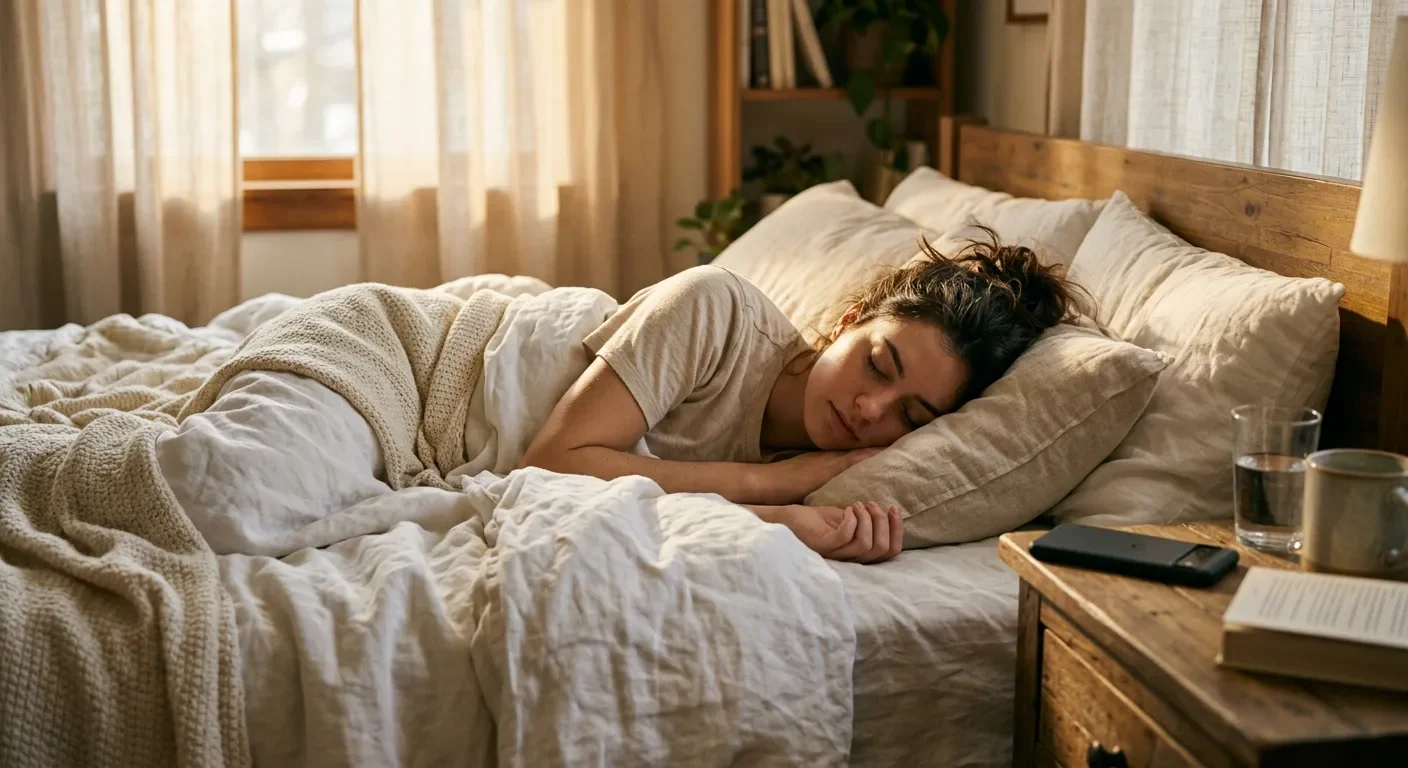
A young person sleeping in on a weekend morning, warm light, restful and calm
Catching up on sleep on weekends may help protect teens from depression, researchers found. 3

What "catch-up sleep" actually means in practice

The study didn't define a specific target number of extra hours — it simply categorized people as getting positive catch-up sleep (any amount more than their weekday average) versus not. So even getting an extra hour or two on weekends likely counts.
That said, Casement was careful not to position weekend sleep as a free pass. The findings aren't a signal to destroy your sleep schedule Monday through Friday and just bank the recovery on Sunday. The study found that consistent healthy sleep duration — 8 to 10 hours nightly — is still the gold standard and provides roughly twice the protective benefit. But the researchers explicitly acknowledge that goal is "just not practical for a lot of adolescents, or people generally."
What the data does support:
  • If you're regularly sleeping less than you need on weeknights, sleeping in on weekends appears meaningfully protective for mood
  • The protection is real even after controlling for weekday sleep duration and timing
  • It's not the same as well-timed consistent sleep, but it's a meaningful second-best
One thing not captured here: the study doesn't tell us how much extra weekend sleep is optimal, or whether there's a ceiling effect. That's a gap future research will need to fill.

What counts as a depression symptom worth paying attention to

The study used a fairly narrow definition — feeling sad or depressed every single day. That's on the more severe end. But it's worth knowing what the fuller range of depression symptoms looks like, especially since young adults often dismiss or rationalize them.
Signs that might be worth taking seriously:
  • Persistent low mood most days (not just one bad week)
  • Loss of interest in things you usually care about
  • Fatigue that doesn't improve with rest
  • Difficulty concentrating at work or school
  • Changes in appetite or sleep that aren't explained by external events
  • Feeling hopeless or like nothing matters
If several of these have been present for more than two weeks, that's worth talking to someone about — a counselor, a therapist, or your doctor. Many universities offer free or low-cost mental health services; Psychology Today's therapist finder (psychologytoday.com/us/therapists) lets you filter by insurance and sliding-scale fees if cost is a barrier.

The bottom line

Sleeping in on weekends probably isn't ruining your sleep schedule — and based on this data, it may actually be protecting your brain. The study is observational, so it can't prove catch-up sleep causes lower depression risk. But the association is strong and consistent across two different statistical methods, in a nationally representative U.S. sample, with controls for major confounders.
The researchers' recommendation is blunt: let teens and young adults sleep in on weekends if they can't get enough sleep during the week. "That's likely to be somewhat protective," Casement said. 2
If you're already getting 8 to 9 hours on weeknights, you don't need to change anything. But if you're running on six hours Monday through Friday and have been treating your 10 a.m. Saturday wakeup as something to feel bad about — the research says stop doing that.

围绕这条内容继续补充观点或上下文。

  • 登录后可发表评论。